
Google
 

Friday, November 30, 2007

Last Legs of the Sucker's Rally

The Bernanke Put and the Last Legs of the Stock Market Sucker's Rally

By Nouriel Roubini | 30 November 2007

    How sharply will the US stock market fall if the US experiences a recession? Given the recent flow of very negative macro news, the likelihood of a US hard landing has sharply increased; thus, it is important to assess the implication of such a growth slowdown, hard landing or outright recession on the stock market.

It is true that in the last two days the US stock market has recovered sharply after a significant 10% downward correction in the period from early October until Monday. But the most sensible interpretation of the upward move on Tuesday and Wednesday this week (in spite of an onslaught of lousy macro news: consumer confidence, existing home sales, Beige Book, fall in durable goods orders, regional Fed manufacturing reports, initial claims for unemployment benefits, expectations that Q4 growth will be closer to 0% after the revised 4.9% in Q3, sharply rising credit losses, falling home prices and a worsening housing recession, etc.) is that this is the last leg of a sucker rally (or dead cat bounce) driven by wishful hopes that the Fed easing will prevent a recession.

Certainly on Wednesday, the equities rally was totally driven by Fed governor Kohn signaling the obvious, i.e. that given that the liquidity and credit crunch is now worse than at its August peak the Fed will cut rates in December, January and for as long as needed. In this game of chicken between the Fed and the bond market (with the latter signaling already for a while that the Fed will keep on cutting) the Fed was obviously the one to blink: this was no surprise to anyone who had noticed the meltdown in financial markets (an ugly liquidity and credit crunch) in the last few weeks. But for some reason the stock market only discovered on Wednesday what analysts, the bond market and credit markets had known all along— that the Fed will have to keep on cutting rates as we are headed towards an ugly recession that is now inevitable regardless of how much the Fed cuts rates.

The behaviour of the stock market since last August can be best interpreted in terms of a Bernanke Put, i.e., the stock markets' hope that a Fed easing will prevent a hard landing of the economy. The August liquidity and credit shock severely tested the stock market downward; then you had a first sucker rally on August 16th when the Fed announced the switch from a tightening bias towards an easing bias. A second phase of this sucker rally occurred on September 18th when the Fed surprised the markets with a 50bps Fed Funds rate cut rather than the 25bps that the market expected. Then equities kept on rising, in spite of worsening economic and credit news, all the way until October 9th. Then, a drumbeat of weaker and weaker economic and credit news started to take a toll again on the stock market and triggered the beginning of the stock market correction (10% fall in stock prices) that continued until last Monday November 26th. A third phase of this sucker rally occured after the Fed cut rates on October 31st triggering another stock market rally that turned out to be brief as a bombardment of awful credit news and weak economic data pushed down the market again.

The current leg of the sucker rally started Wednesday— with stock prices sharply up— when Kohn effectively signaled to the markets that— in spite of all the Fed rhetoric to the contrary in the last few weeks— the Fed would ease rates in December and for as long as needed to deal with the liquidity and credit crunch and to avoid a recession. In each case in the last few months the stock market has rallied when the Fed has signaled a willingness to ease monetary policy to avoid a recession.

    Call it a Bernanke Put if you believe that the Fed is trying to avoid a financial meltdwon; call it a need to bail out the economy rather than bailing out the markets if you believe— as I do— that the Fed actions are more driven by its concerns about the economy rather than an attempt to rescue investors; call it a moral hazard play if you believe that the Fed is trying to rescue investors and risks creating still another asset bubble down the line. You can call it whatever you like, but one thing is obvious: the Fed easing is perceived by the stock market as an action aimed to prevent a recession from occurring and stock prices rally— in spite of worsening macroeconomic news that signals a recession ahead— because of the hope— that I will show is only a hope— that the Fed will be able to avoid a hard landing. Thus, what has been mostly driving up the stock market in the cycles since last summer is expectations of easing Fed policy.

    The same pattern of market delusion and serial sucker rallies occurred in 2001: the economy entered in a recession in
    March 2001 but the S&P 500 index rallied by a whopping 18% in April and May because the market and investors expected that the aggressive Fed easing— that had started in January— would prevent a 2001 recession (the famed and deluded hope of a second half of 2001 "growth rebound" that never occurred). It was only in June when it was obvious that the economy was still sinking in spite of the Fed's hold on rates [[but not until after a final coup de grâce of 50bpts! : normxxx]] that the stock market started to sharply fall again; so then and again now the onset of a recession led to a typical sucker rally fed by expectations of a Fed bailout of the economy; and the latest rally this week is occurring while the liquidity crunch and credit crunch in the markets are as bad now or worse than in August and while the news is worsening by the day.

    Indeed the 2008 recession will repeat the Fed cycle and stock market cycle of the 2000 - 2001 recession: then the Fed tightened rates all the way to 6.5% in June 2000 and kept a tightening bias in July, September, November as it was worried more about inflation than about growth (that had been as strong as 5% in Q2 of 2000 but was sharply deceleraring by H2 of 2000 as the tech boom went bust). The Fed was totally mistaken then about its assessment of the effects of the tech bust on the economy and kept on worrying about inflation while growth was plunging after Q2 of 2000; it was only at the mid December 2000 FOMC meeting, when the signals were that the holiday sales would be awful, that the Fed suddenly switched from its November FOMC tightening bias to an easing bias. And two weeks later when, after lousy holiday sales data, the NASDAQ fell 7% on its first 2001 trading day of January, the Fed started to cut the Fed Funds rate aggressively with a an initial 50bps inter-meeting cut that day. Then as now, you had a sucker rally following the Fed easings that intensified in April and May 2001 as the Fed kept cutting rates.

    Indeed, not only the Fed got it wrong on the coming recession in the 2000 - 2001 period;
    but the professional forecasters also got it wrong, as an Economist magazine poll in March 2001 (when the recession had already started) showed that
    95% of the forecasters believed that a recession would be avoided as the aggressive Fed easing would lead to a H2 growth rebound. And, as discussed above, even the stock market got it wrong as the 18% final sucker rally (or last dead cat bounce) in April and May 2001 was followed by a massive bear market starting in June 2001 as the economy spun down into a deeper recession in spite of the aggressive Fed ease.

To take a longer and more analytical perspective, notice that typically a sucker rally occurs at the beginning of an economic slowdown that leads to recession. The initial reaction of markets to a flow of bad economic news is usually a stock market rally based on the belief that a Fed pause (like the rally following the August 2006 Fed pause) and then possibly easing will rescue the economy. This rally always ends up being a sucker rally as, over time, the anticipated beneficial effects of a Fed ease meet the reality of the investors realization that a recession is coming and that the effects of such a recession on profits and earnings are first order, while the effects of the Fed easing on the economy and stock market are— in the short run of a recession— only second order.

That is why we have had several sucker rallies this fall— every time the Fed eased rates or surprised markets with greater easing than expected or signaled to markets that it would ease ahead (as on Wednesday). But, as the continued flow of poor economic news increases the general expectation of a looming recession, the equity markets will— in due course— fall sharply when the successive waves of negative news and macro developments hits an already weakened and vulnerable economy hard; then you will see a serious bear market in equities. So, equities came under great pressure in July and August when the credit market very nearly froze and the financial news turned very negative; they rallied only after the August 16th and September 18th Fed surprises; and turned into a negative 10% after October 9th when the news became awful again.

It is well known— from basic macroeconomic theory— that the equity market reaction to poor growth news is ambiguous. Lower than expected growth leads to a higher stock market value via the "lower interest rate expectation channel" and to a lower stock market value via the "lower profits/earnings expectation channel". The former effect derives from the fact that bad economic news increase the probability that the Fed will ease monetary policy and thus stimulate the economy, demand and profits. The latter channel derives from the fact that slower growth— or even worse an outright recession— will lead to lower demand, lower revenues and lower profits. Indeed, as stock prices are forward looking, and nominally equal to the discounted value of dividends where the discount rate is related to an appropriate measure of interest rates, bad growth news affects both the numerator and denominator (both are expected to decrease) of the ratio of dividends to the appropriate discount rate. Usually, the first effect (the denominator) dominates at the beginning of an economic slowdown— when the likelihood of a slowdown is high but the likelihood of a true hard landing or recession is still low and unclear: then the interest rate channel dominates the profits channel. But once the signal of a hard landing or recession become clearer and the likelihood of such hard landing sufficiently high, the profits channel (the numerator) dominates the interest rate channel.

Why is this conceptual discussion important? Now that the likelihood of a recession has increased— even in the eyes of otherwise soft landing analysts— one is starting to hear and read with increasing frequency such Goldilocks statements such as "a hard landing will be good for stocks" or "the stock market can rally during a recession" or "the Fed will most certainly rescue the markets if there is a recessionary hard landing" or "P/E ratios are low and earnings yields are much higher than bond yields, thus the stock market is now undervalued".

    [ Normxxx Here:  That last is the result of the infamous "Fed model" which, as John Hussman has pointed out, "... has nearly insane implications. For example, the model implies that stocks were not even 20% undervalued at the generational 1982 lows, when the P/E on the S&P 500 was less than 7. Stocks followed with 20% annual returns, not just for one year, not just for 10 years, but for 18 years. Interestingly, the Fed Model also identifies the market as about 20% undervalued in 1972, just before the S&P 500 fell by half. And though it's not depicted in the above chart, if you go back even further in history, you'll find that the Fed Model implies that stocks were about as “undervalued” as it says stocks are today— right before the 1929 crash."  ]

To clear the air from the spin that one is increasingly hearing, it is useful to ask a simple factual question: what is the relation between stock markets and recessions? So, for a moment, let us leave aside the issue of whether my recession call is correct or not. But let us assume, for the sake of argument, that a recession is coming and then ask the question: if we have a recession, what will happen to the stock market? So, you don't have to believe in a recessionary hard landing to consider this specific question. You just need to ask yourself— what happens to stock prices when recessions do come.

Luckily we have enough data from previous recessions and stock prices to give an answer to this question. Consider the charts below. They present the percentage change in that S&P500 index around the time of the last six U.S. recessions (i.e. starting with 1970)— in the months before the start of a recession, in the months during a recession, and in the months after it. The vertical lines in each chart represents the peak of the business cycle (the beginning of a recession) and its trough (end of a recession). On average the stock market does not change much between the peak and the trough of the business cycle: on average the fall is only 0.4% between peak and trough; in some recessions— such as the 1974 - 1975 one— the peak-to-trough fall is fairly deep (-13%), but in others— such as the 1980 one— stock prices actually rose 5.8% between peak and trough. So 0.4% is an average for all recessions, but scarcely captures the variability.

This may seem like a relatively small market change, but the peak-to-trough comparison is deceptive. It is deceptive because, usually, the stock market starts to fall apart well before a recession starts (even before the business cycle/boom peaks), then falls very sharply during the first stage of a recession, and finally starts to recover in the late stages of a recession (even before the business cycle/recession has reached its trough). Specifically, the stock market fall from the peak of a business cycle to the nadir of the business cycle averages 17.5%; and in every one of these six recessions you have the same pattern: initially stock prices fall sharply before the economy enters recession. Then, the recovery of the stock market starts before the trough of the business cycle— before the economy has begun recovering from the recession.

    [ Normxxx Here:  FWIW, this may be somewhat deceptive. Economic indicators lag almost as badly as economists— just about every economist will admit to a recession once it is well apparent that we are in one. The market is probably just much more sensitive to economic conditions than most indicators (and economists). Which is not to say it (alone) is more accurate; everyone is familiar with that old saw, "the market has predicted nine of the past six recessions!"  ]

Note again that, in most episodes, the stock market peaks a few months before the formal peak of the business cycle and starts falling before the onset the recession. Therefore, the average fall of the stock market from its business cycle peak to its business cycle low is well above 17.5%. In fact, this average fall in stock prices from its just pre-recession peak to its near end of recession bottom is actually close to 28%, an extremely severe fall.

So we can see that the peak-to-trough, almost flat, average behavior of the stock market conceals a much sharper fall over the course of a recessionary episode (starting just before the peak of the prior boom cycle), followed by an equally sharp recovery in the late stages of the recession. This pattern makes sense, as equity prices are forward looking and tend to reflect all imnmediately available information about the expected path of earnings, dividends, and interest rates. The stock market starts to fall early because the closer you get to the peak of the business cycle, the higher is the probability that a recession will occur and will thus drag down profits [[actually, I would maintain that, the closer to the peak, the more the financial/economic conditions that have contributed to that peak have (relatively) deteriorated; therefore, the market does not have to be prescient: normxxx]]. So, a 'forward looking' equity market peaks before the peak of the business cycle and starts falling before the actual recession has started. That is why stock prices tend to be a good— if imperfect— leading indicator of the business cycle end [[and explains why the market alone often fails as an indicator, since the conditions it is 'seeing' may recover short of a recession: normxxx]].

The fall in the stock market from its peak of the business cycle to its lowest level in the following recession was 21.0% in the 1970 recession, 33.88% in the 1974 - 75 recession, 10.6% in the 1980 recession, 18.2% in the 1981 - 82 recession, 14.6% in the 1990 recession, and 10.3% [[[sic] I believe it was actually 38% from peak to trough for the Dow and 46% for the S&P: normxxx]] in the 2001 recession. In 1970, the stock market peaked 9 months before the recession and fell 12% before the recession started. In 1973 - 75, the market peaked 12 months before the start of the recession and fell 23% before the recession formally started in December 1973, with a good half of this pre-recession drop right after the beginning of the Yom Kippur war that led to Arab oil embargo. One exception is 1980 when the stock market actually rose in the months just before the start of the recession in February. In 1981 - 82, the stock market peaked four months before the onset of the recession and then fell about 4% before the recession actually started. In 1990, the stock market peaked two month before the recession and fell about 2% before the start of the recession. In the 2001 episode, the S&P peaked about seven months before the start of the recession in March 2001 and then fell by 31% before the recession started. (The peak of the Nasdaq was even earlier, in March 2000 a full year before the onset of the recession.)

Of course, in the last few decades, sometimes U.S. stock prices have fallen and a recession has not materialized— stock markets are not a perfect and always correct leading indicator of a recession. But, and this is most important in the context of the question asked above, almost every time a recession did occur, the stock market fell sharply [[only one false negative! : normxxx]]. The issue is not whether the stock market has at times provided incorrect signals of the business cycle; rather, the issue is whether a hard landing and the onsets of recessions are associated with sharply falling stock prices. And the simple and unequivocal answer is that recessions lead to very bearish stock markets where from the peak in the economy to the trough in the stock market the fall is about 17.5%, whereas the peak-to-trough in the stock market (i.e. the pre-recession market peak to the near end of recession market botttom) is about 28%. So, hard landings and recessions do lead to bear stock markets, but the markets usually provide an early warning. The recent market buzz and chatter about hard landings and recessions "being good for the stock market" is counter-factual and utter nonsense based on the historical data.

The fact that the stock market begins recovery before the trough of the business cycle is reach is also logical and based on the forward looking nature of stock prices: even before a recession has ended the rate of the fall in economic activity tends to decrease markedly. (In the early stage of a recession, the first derivative of output is negative, indicating negative growth, while the second derivative shows an acceleration of the rate of economic contraction. In the late stage of a recession, the first derivative is still negative but the second derivative shows a deceleration of the rate at which the economy is contracting and signals that the trough of the business cycle may be close. Thus, it is not necessary to wait until the recession is over for stock prices to anticipate better earnings and dividends.

How about "soft landing" episodes, i.e. episode where a Fed tightening did not lead to an outright recession but rather to a significant slowdown of the economy and then an economic recovery? The only recent episode of a successful soft landing is 1994 - 95 when a 300bps tightening by the Fed in 1994 led to a relatively sharp slowdown in the economy. But even in that episode, the Fed risked overdoing it and eased the rate in 1995 only when the slowdown in the economy already appeared as excessive. Note that, in that episode, the economy was just recovering from a painful recession that, while formally ended in 1991, was still followed by job-loss and a very slow job (the famous "job-less") recovery of 1992 and 1993. Only by early 1994 was the economy showing signs of healthy growth and employment recovery.

So the monetary tightening of 1994 - 95 was bound to be a lot more tentative on the part of the Fed (and the business cycle was at a much healthier stage)— the Fed was largely bringing the Fed Funds rate back to a more 'neutral' level (if rather abruptly) after its sharp easing during the 1990 - 91 recession. In terms of the market consequences of such a "soft landing", the S&P500 fell by 5% between January and December 1994 as the Fed tightening was under way and the economy was starting to decelerate. Thus, while the S&P had started to recover briskly after the 1990 - 91 recession, and had double digit returns both in 1992 and 1993 (and subsequently from 1995 on), the "soft landing" of the economy in 1994 led to a significant fall in the stock market. The underlying trend in the market index of the double digit annual recovery in 1992, 1993, and after 1995, implied an underperformance of the stock market relative to trend was of the order of 17%, i.e., without the soft landing slowdown of 1994 the market could have grown— based on the underlying trend of the S&P— by a further 17%.

What are the potential caveats to the arguments above that a US recession would lead to a sharp drop in the stock market? Some argue that the sharp fall in equity prices during previous recessions occurred after long periods in which the market was bullish and sharply increasing; thus, close to the recession P/E ratios were already excessively high and bound to adjust; also the monetary and credit tightening in previous recessions squeezed profits severely and pushed equity prices lower.

Today, it is argued that conditions are very different from such previous growth slowdowns: equity prices zig-zagged without much of a strong trend from 2002 to 2005 and have grown only 'modestly' since, while earnings have sharply increased. Thus, the argument goes, P/E ratios are now relatively low and valuations are not inflated [[moreover, by historical standards, monetary policy is 'easy'— and preparing to ease further: normxxx]]. If anything, given the surge in earnings valuations, the ratios are relative low and bound to rise if a "soft landing" occurs, or not fall much even if a "hard landing" does occur. Specifically, unless a major credit crunch leads to a sharp fall in profits and earnings, equity valuations may not be as much at risk in a US hard landing scenario.

    [ Normxxx Here:  Two caveats to the caveats. One, P/E ratios always tend to rise during a recession as earnings fall (but rarely enough to offset the falling earnings). P/E ratios tend to be lowest at the peak of the earnings cycle and highest at the bottom of the earnings cycle— as is only logical; investors are not entirely fools and always anticipate some diminution of earnings (if not a recession) at the top and and an (eventual) recovery in earnings (some day) at the bottom. Two, the 'caveat commentators' are obviously unfamiliar with the thirty-year secular cycle in average P/E ratios. According to that cycle, average P/E ratios are scheduled to fall further until about 2010.  ]

The above arguments require a whole separate discussion of earnings and profits and their likely future trends that will be discussed in another note. For now, let us observe why these arguments are not convincing. First, in a recession, revenues fall and both profits and earnings sharply fall; so equity valuations need to take a hit; and while recessions triggered by a credit crunch or a monetary tightening have more severe effects on corporate profits, even recessions triggered by the bursting of a bubble— the tech bubble in 2000, the housing bubble today and its consequent credit crunch— can severely affect earnings and thus valuations. In a typical US recession NIPA profits fall by about 20% and corporate earnings fall by more than NIPA profits— closer to 30% plus. Such a drop in profits and earnings has devastating effect on stock prices.

Second, recent data on Q3 earnings already suggest a fall in earnings in Q3 of 8.3% relative to a year ago and a fall in earnings relative to Q2. Third, on a (business) cycle adjusted basis, P/E ratios are still very high: especially as both profits and earnings now look peaky and bound to sharply slow and/or fall in growth, P/Es are likely much too high considering the likelihood of a hard landing and the consequent sharp fall in earnings. Of course, the fact that valuations have been relative moderate for a number of years may imply that not all stocks will be hit as hard in a recession: many will gradually fall during the economic downturn but others, that have low valuations now and whose earnings would be less affected by a recession, may do relatively better or not as bad as the overall market. It may also be the case that, the stock market will fall by less than the average in a typical recession. Still, it is hard to avoid the conclusion that a recession would be really bad for the stock market. In every previous recession equities have done very poorly and it is hard to make a logical or empirical argument why in the next recession things would be meaningfully different.

Finally, notice that the equity valuations of homebuilders, financials, and discretionary consumption firms have already followed the pattern that I described above: a sharp fall in earnings followed by a sharp fall (about 20% or more in equity valuations).

The discussion above clarifies what one should expect if— as I have predicted— the current US slowdown accelerates into a recession: based on historical experience the stock market is likely fall sharply by about 28% from its peak to its trough before it starts to recover in the late stage of the recession.

    [ Normxxx Here:  That would be about 4000 points down from its peak around 14200— or about a low of 10,200.  ]

So beware of the large amount of spin that is being peddled by bulls that are only now starting to recognize that a recession is likely: they need to spin the bad news about the economy as suggesting that such bad news is actually very good news for the stock markets or that the Fed will be able to prevent such a recession. For these perma-bulls good economic news is very good for the stock market and bad economic news is also very good for the stock markets— as exemplified by the reaction ("I guess it is probably a buying opportunity") to my recession call by a recent Squawk Box anchor interview suggests. But savvy investors will not allow themselves to be fooled by such non-sequitur arguments and will cautiously adjust their portfolio to reduce the risk of being stuck in a bear market once the recession actually gets under way.

    [ Normxxx Here:  Unfortunately, this recession is likely to prove more delayed (and delayable by the powers that be) than most— and the pre-recession period could easily drag out until summer of 2008 or even as late as autumn of 2009]


Click Here, or on the image, to see a larger, undistorted image.


Click Here, or on the image, to see a larger, undistorted image.


Click Here, or on the image, to see a larger, undistorted image.


Click Here, or on the image, to see a larger, undistorted image.


Click Here, or on the image, to see a larger, undistorted image.


Click Here, or on the image, to see a larger, undistorted image.


ß§

Normxxx    
______________

The contents of any third-party letters/reports above do not necessarily reflect the opinions or viewpoint of normxxx. They are provided for informational/educational purposes only.
The content of any message or post by normxxx anywhere on this site is not to be construed as constituting market or investment advice. Such is intended for educational purposes only. Individuals should always consult with their own advisors for specific investment advice.

Wednesday, November 28, 2007

The Next Credit Scandal

The Next Credit Scandal

By Peter Eavis, senior writer | 27 November 2007

NEW YORK (Fortune)— The major banks have already reported billions in unexpected losses from complex investment vehicles known as CDOs. Now they face big risks from other corners of the debt markets— but don't expect them to warn investors anytime soon.

The failure by banks to properly inform shareholders of their potential losses is perhaps the biggest scandal so far of the credit crunch that began this summer. Earlier this year, for example, Merrill Lynch, Citigroup and Bank of America gave almost no indication that one particularly toxic debt product— CDOs, or collateralized debt obligations— could be the source of billions of dollars in losses.

Those losses came to light this fall, blindsiding shareholders and pummeling banks' stock prices. The lack of disclosure not only has unsettled investors, but also has raised the prospect that large losses are lurking in other parts of the banks' businesses.

One likely new trouble spot: Conduits, the opaque structures banks set up to provide debt funding to borrowers. Often, the debt issued by the conduits is collateralized with assets, like mortgages.

Conduits typically aren't consolidated on a bank's balance sheet. But banks are often on the hook to fund them if investors stop buying the debt they've issued. When that happens, a lot of risk can get moved onto the balance sheet [[and very quickly! : normxxx]].

In a similar way, a good chunk of Citigroup's CDO losses occurred because it had to honor prior commitments to fund a large amount of debt previously issued by CDO structures. The financial services giant was ultimately forced to bring onto its balance sheet $25 billion of short-term CDO-debt backed with risky mortgages. (CDOs explained)

Now, conduits could trigger a similar process at many big banks. Since demand for certain types of conduit debt has shrunk dramatically and bad loan numbers on subprime debt are soaring, banks could well end up absorbing large amounts of conduit debt. Citigroup had off-balance sheet conduits with assets totaling $73 billion as of Sept. 30. And Merrill bought $5 billion of assets from its conduits in the third quarter, a move that led to pre-tax losses of over $500 million in the same quarter.

Almost every major banks has significant conduit exposure. But if conduits are becoming a problem, banks are not saying much about it in their financial statements. A close look at what happened with CDOs at Citigroup and Merrill shows just how little investors are told— and should make investors very wary about how little they know about banks' exposure to conduits.

So Why Was Cdo Exposure So Secret?

Banks typically arranged and sold CDOs to investors, so the sold ones would not appear on their balance sheets. In fact, there was one place in financial statements where numbers were given on CDOs. The disclosure was inadequate, but still worth looking at now.

In quarterly financial statements, companies disclose their "variable interest entities," or VIEs. These are entities to which a company has actual or potential economic exposure. When it comes to inadequate CDO disclosures, the VIEs that matter are those that are not consolidated on a company's balance sheet.

A word search for CDO in a public financial statement may have taken an investor to the VIE tables. But once there, there would be no way of gauging just what the true exposure was to CDO losses. This is partly the fault of the accounting rule— something called FIN46-R— that governs off-balance sheet VIEs. The big problem is that it doesn't force companies to disclose realistic estimates for losses.

Under FIN46-R, companies must disclose their maximum loss exposure. That sounds like a conservative approach, but in practice it isn't. That's because banks often add comments in financial statements that effectively tell investors not to take these maximum loss numbers seriously. Take a look at Citigroup's second quarter filing, posted Aug. 3, which was well into the summer credit meltdown. In it, the bank said actual losses from its unconsolidated VIEs, which included $75 billion of CDOs, were "not expected to be material." It has since estimated losses could be between $8 billion and $11 billion (which is most definitely material).

So the question becomes: Did banks have a good idea of what off-balance-sheet CDO losses would be before they were disclosed? The answer to that is: Almost certainly. Even if FIN46-R doesn't demand that banks disclose their estimates for actual losses, if such losses are material, other accounting guidelines demand they be made public. And recent financial statements clearly indicate that banks have closely and continuously estimated the value of their financial commitments— even those to off-balance sheet entities, like CDO structures.

If a change in the estimated value of a financial commitment to an off-balance-sheet entity produces a loss, that also generates a loss on the income statement. Both Merrill and Bank of America say in recent financial statements that their income statements have already been recognizing value changes in commitments to provide funding to CDOs. For Citigroup, it was these sorts of CDO funding commitments that led the bank to take $25 billion of CDO debt onto its balance sheet.

If Citigroup were valuing that commitment in the same way as Merrill and Bank of America, then it would presumably have taken at least some losses on it before the CDO debt came on its balance sheet. And those loss estimates should have been rigorous and sophisticated. That's because FIN46-R guides companies to give probabilities to different loss scenarios for its unconsolidated entities. In other words, if FIN46-R were being followed, all the banks concerned should have been able to produce internal estimates for a range of loss scenarios— and they would have been doing so as the credit crunch started this summer.

"We are confident that our financial statements fully comply with all applicable rules and regulations," said Citigroup spokeswoman Christina Pretto. Just think how much better warned investors would have been if those actual loss estimates had been made public. And just think how useful it would be to know those loss estimates for distressed conduits the banks must deal with now.

Normxxx    
______________

The contents of any third-party letters/reports above do not necessarily reflect the opinions or viewpoint of normxxx. They are provided for informational/educational purposes only.
The content of any message or post by normxxx anywhere on this site is not to be construed as constituting market or investment advice. Such is intended for educational purposes only. Individuals should always consult with their own advisors for specific investment advice.

Credit Crisis to Credit Crunch

Credit Crisis to Credit Crunch

By John Mauldin | 9 November 2007

Just when it felt like it was safe to get back in the water, a second and potentially much meaner version of this summer's credit crisis has reappeared. This week we look at why there are more mortgage write downs coming (in a self-fulfilling prophecy) in the financial sector, how an obscure new accounting rule is shedding light on a lot of risk in the world's banking system, how this is all tied to the consumer and is part of the reason for the fall in the dollar. It's a complex world, and I am going to spend a considerable part of a beautiful Friday evening in Texas trying to make it simple for you, gentle reader. That's my job, and I love it. And since I can't think of my usual "but first" we'll jump right in.

A Confidence Credit Crunch Credit Crisis

I have written for some time that we are in a credit crisis brought on by a lack confidence which has the real possibility of devolving into a credit crunch which will make loans harder to get and has the potential to slow down the US economy, on top of a weakening consumer. Data released in the past few months, and again this week, have shown that banks and other lenders are tightening their standards for all sorts of loans. And it is not just that they are becoming more like an old-fashioned banker who actually wanted to know that he could get his money back. Their new found conservatism is being forced on them. But let's start at the beginning.

    The Financial Accounting Standards Board (FASB) is the referee for accounting practices. They recently issued a new rule which [was] implemented November 15. Essentially, Statement 157 requires a financial firm to divide its assets into three categories called simply enough, Level 1, Level 2 and Level 3.

    Under FASB terminology,
    Level 1 means assets that can be marked-to-market, where an asset's worth is based on a real price, like a stock quote. Level 2 is mark-to-model, an estimate based on observable inputs which is used when no quoted prices are [readily] available. You can go get several bids and average them, or base your assumption on what similar assets sold for.

    Level 3 values are based on "unobservable" inputs reflecting companies' "own assumptions" about the way assets would be priced. That would be market talk for best guess, or in some cases SWAG (as in Scientific Wild-A**ed Guess, or, a WAG with numbers.)

    Financial companies have never had to break out this information. As you might expect, there is particular interest in how much and what kind of
    Level 3 assets a bank or brokerage firm might have. It turns out, that there may be more problems lurking in those assets than we realize.

Nouriel Roubini gave us some numbers earlier this week. It seems that some companies have far more Level 3 assets than they have capital. Take a look at these six banks which have already posted their Level 3 assets ahead of the deadline:

Citigroup Equity base: $128 billion
Level 3 assets: $134.8 billion
Level 3 to equity ratio: 105%

Morgan Stanley Equity base: $35 billion
Level 3 assets: $88 billion
Level 3 to equity ratio: 251%

Lehman Brothers Equity base: $22 billion
Level 3 assets: $35 billion
Level 3 to equity ratio: 159%

Goldman Sachs Equity base: $39 billion
Level 3 assets: $72 billion
Level 3 to equity ratio: 185%

Bear Stearns Equity base: $13 billion
Level 3 assets: $20 billion
Level 3 to equity ratio: 154%

Merrill Lynch Equity base: $42 billion
Level 3 assets: $35 billion
Level 3 to equity ratio: 38%

Now just because something is illiquid does not mean that it has no value. Real estate may be considered illiquid and have no "observable" price, but there is [obviously some] value. The same can be said for private equity holdings. There are often very good business reasons to hold such assets.

But as the Financial Times noted this week, valuing these assets is not easy.

    "As the technology bubble imploded, fund managers stopped pretending to know what ethernet routers did and started asking what life would look like if all tech stocks halved in value. The structured credit market has yet to reach this moment of clarity. As is typical when the sky falls in, many specialists, obsessed with complexity, point to the impossibility of generalizing about the weather.

    "It is true that in terms of the vintage and profile of the underlying collateral, and the priority of claims on it (subordination), a dazzling range of permutations exist for collateralized debt obligations. And the subprime
    "write-offs" so far from the three banks worst hit suggest intellectual chaos [[and is perfectly laughable: normxxx]]: relative to their remaining exposure to "super-senior" CDOs, UBS wrote down 8 per cent, Merrill Lynch 41 per cent, while Citigroup's guidance is 19 per cent."

    [ Normxxx Here:  And, we won't even consider Goldman Sachs, who would have us believe that they escaped unscathed.  ]

So we really do not know much more than what we have above. There is no break out (that I could find) that details what is in Level 3. Where are the mortgage CDOs and 'conduits'? Are they Level 2 or Level 3? There is going to be a demand for yet more transparency as this information yields a lot of questions. Among other things, how much do Level 3 assets contribute to your net capital position? And that is important because your net capitalization (net cap from here on) determines how much you can lend.

How Much is That Dog in Your Net Capitalization?

First off, there were some analysts who are writing that the sky is falling and that banks are going to have to write-down massive amounts of capital destroying their capital structure. Not true. Let me give you a simple analysis. Stay with me as this will be important later.

    I own what may be the world's least complex broker-dealer (member FINRA) and a futures firm (member NFA). As 99% of my business is basically referral, I simply get a few checks each month, and pay expenses.

    But even though I directly handle no client assets, I still have to have a certain minimum capitalization in the business, as is required by FINRA and the NFA. So, I simply keep my required capitalization in a CD (certificate of deposit) in a bank. But it is not that simple. I have to make sure (or Tiffani does) that at the end of the month we deduct all the liabilities against that CD (notice I did not say cash).

    If for some reason revenues are less than projected and expenses (like legal bills) were more that anticipated, I would have to find capital to put into the company in order to keep my net capitalization ("net cap") above my required amount.

    Now, in figuring the net cap, all assets are not equal. That CD, for example, is only worth 99.5 cents on the dollar toward my capital, because FINRA assumes that there could be a penalty for early withdrawal. That 1/2% deduction is called a haircut.

    Different types of assets get different haircuts. Some haircuts on volatile or illiquid assets can be very steep. And I can guarantee you the regulators pay very close attention to your net capital reports. So, the
    Level 3 assets which are just now being reported have already been given an appropriate haircut. The fact that financial firms are disclosing the difference in the quality of assets has very little (or should have very little) to do with how those assets contributed to their net cap prior to the disclosures.

However, that does not mean that certain assets and specifically anything related to mortgages are not going to come under continued pressure [[e.g., if RE mortgage default rates were to rise materially from here— if we have a recession any time in the next several years! : normxxx]]. Estimates of $200-$250 billion in losses from subprime exposure are common [[based on current conditions: normxxx]]. Royal Bank of Scotland Group chief credit strategist Bob Janjuah put out a report Wednesday estimating that the credit crunch will cause $250 billion to $500 billion of losses at banks and brokers around the world.

    "This credit crisis, when all is out, will see $250 billion to $500 billion of losses," said Janjuah, who's based in London. "The heat is on and it is inevitable that more players will have to revalue at least a decent portion of assets they currently value using 'mark-to-make-believe.'"

(I should note that the majority of these assets are not in banks but in pension funds, insurance portfolios, hedge funds, etc. Those losses have not yet been accounted for.)

Below is a table from http://www.markit.com. It is a list of various mortgage asset backed indexes based on securities that were created in 2006 and 2007. The indexes are composed of 20 different asset backed securities from major investment houses. These securities are in turn comprised of loans that were made in 2005-2007. For instance, the top index is the ABX-HE-AAA 07-2, which means this is an Asset Backed Security, Home Equity and all the securities in the index are AAA rated tranches and the securities were put together in the second half of 2007. The securities have a potential life of 30 years, by which [time] all the loans would have been paid.

The first five indexes listed are the various tranches of the same 20 securities. The next five listed are for another series of indexes created from 20 different asset backed securities put together in the first part of 2007. The next five are from 2006. The bottom five are from a group put together in early 2006 comprised of loans from 2005.

Once again. Each of these represents an index comprised of 20 different asset backed securities with the same rating from various ratings agencies. These indexes are created so that investors can hedge their portfolios if they want to, and traders can speculate either long or short. You can view more details and the actual securities if you are morbidly curious at the website.

Now notice something interesting. The AAA tranche from the top index, the one created just a few months ago, has lost over 30% of its value. Yet the AAA tranche from the first index series (in 2006) is only down 5.87%. The same relationship holds with whatever rating you want. The older it is, the less the losses. Further, an A-tranche from 2007 is not worth what a BBB-tranche is from just two years ago!

Clearly the market is saying that loans that were made in 2007 are not worth nearly as much as loans that were made in 2005. And guess which mortgages are more likely to be on investment bank books?


Click Here, or on the image, to see a larger, undistorted image.


Now, for those of us who are visual, let's look at what that AAA tranche has done since its inception just five months ago. This index was trading at $.96 just a little over one month ago, and is now down to $.69!!! The drop in value has been in one month.


Click Here, or on the image, to see a larger, undistorted image.


Many analysts are wondering why Merrill and Citigroup first stated losses to be one amount and then came back a few weeks later with another much larger amount. Looking at the above graph makes it at least partially clear. While the above chart is the steepest in terms of a drop in the last month, all the other indexes showed similar volatility in October.

Quite simply, assets that had one value at the beginning of the month had another value at the end. Further, many of those assets have fallen further in the last week. This suggests that further write downs are around the corner. There is still pain in the days and weeks to come for many of the best known financial names.

Remember that net cap issue we discussed earlier? Now we come to the relevance of what would normally be an arcane and uninteresting subject. When you submit your net cap reports, you have to justify the value you place on the assets.

It used to be (and not so long ago) you could play some games, like taking the bid price on an asset one quarter and the ask price the next, depending on whether you wanted to increase your earnings or "bank" some earnings for the future. It allowed for some gaming of the numbers. Now you have to show a consistent methodology. Further, the accounting firms are far more rigorous in a Sarbanes-Oxley world. They are far more insistent that clients show realistic numbers.

You cannot go to a regulator and say, "We think the market is crazy and we are not going to mark this asset down." As my Dad used to say, "That dog won't hunt."

The ABX indexes create a price comparison that cannot be ignored when you are putting together your accounting for your net cap reports. If the index is dropping, you are going to have to mark your assets down if you have similar assets on your books. Period, end of story. You can lose a great deal if you don't. It is not worth it.

Let's take a side trip for a moment and look at a 2002 vintage AAA mortgage backed asset. It is probably still capable of being rated AAA. Why? Because the bad lending practices were not prevalent, any mortgages still in existence have been paid on for almost six years, and the underlying homes may have appreciated anywhere from 50-100%. It would take a disaster of biblical proportions for that AAA tranche to lose money. By that I mean that 60% of the loans would have to lose 50% of their 2002 value (or 75% of their 2007 value) for the investor to lose money. Not very likely.

So, to the extent that banks and investors have "seasoned" senior mortgage backed securities, they are just fine. Where they are losing money is on the recent vintage mortgages that they could not get off their books and into the hands of their clients in time as the asset backed market simply has ceased to function.

Looking at the graph suggests that because of the significant drop since the end of October there are further potentially large markdowns coming unless these indexes reverse themselves and go back up. Put another way, if the banks had to mark to market today, the losses they announced last week would be even higher. And potentially a lot higher.

Banks which have write downs and losses have to raise capital to meet net cap requirements. One of the ways you can do that is by making fewer loans. Thus, banks are tightening up their lending standards.

But there is another reason that lending standards are higher. Many banks no longer function as what we think of as banks in the "old days" of 20 years ago. Today a bank uses its capital to make a number of loans and then packages them up and sells them as a security to another investor. Banks are now originators of loans rather than long term lenders.

But the institutions which are the ultimate market are demanding higher quality loans, and thus originators are responding to the market demand. So far, there is little new CDO issuance, and no subprime securities to speak of. But standards are going to get tighter for all sorts of paper. Capital One informed us today that credit card delinquencies are up over a full percentage point from this time last year to 4.75%. Do you think that investors will buy credit card paper at the same terms as last year? The market for credit card asset backed securities is almost $700 billion. Rates are going to go up, and credit will be harder to get for those with less than pristine credit.

There is a distinct lack of confidence in the ratings of asset backed securities of all types. We do not have a liquidity crisis. We have a confidence crisis. As we see capital implode and confidence erode, we are facing the real possibility of a full blown credit crunch.

(By the way, this is not just a US problem. You can bet similar problems are going to crop up in institutions all over Europe.)

King Dollar Faces the Guillotine

But there is yet another problem facing the credit markets and that is the erosion of the value of the US dollar. Some argue that a falling dollar is good for the US because it makes our exports cheaper, and indeed exports are rising. But there is more to the falling dollar than improving our exports.

Look at this chart provided me by South African partner Prieur du Plessis's Investment Postcards blog. It is what a European investor would have lost if they had invested in a ten year US treasury note, down an ugly 7% in a government bond after today's bond sell-off.


Click Here, or on the image, to see a larger, undistorted image.


If you own the Dow, you are down [even] after today in terms of the euro. And that is pretty much the case for most currencies. It is why [several] prominent Chinese official suggested that China should start to put more of its assets in stronger currencies, touching off a very quick drop in the dollar. The euro and the pound are [around] 5% higher than they were at the beginning of September when I was in Europe.

If you are a foreign investor, why would you want to invest in dollar denominated assets in which you are not totally confident? Sure, you can hedge your currency risk, but hedging is not without cost, and that cost will be born by the borrower which is to say American businesses and consumers.

Think about this for a moment. If you are China, you could reduce your energy bill by 20% just by letting your currency rise. Not to mention the cost of copper, steel, nickel and other commodities. And did I mention all the massive food imports China requires? Yes, keeping your currency low has helped you to get a competitive advantage in manufacturing all sorts of products. But at some point it will make more sense to have a stronger currency.

The Euro-Yen Cross

Two quick notes before we close: Greg Weldon noted in Weldon's Money Monitor that came out tonight the very tight correlation between the US stock markets and what is known as the Euro-Yen cross, or the Euro as denominated in yen.


Click Here, or on the image, to see a larger, undistorted image.


This cross is a proxy for the yen carry trade. It is a clear example of the appetite in the world for risk. That appetite went away in August but came back in September and October. It is once again heading down, which does not bode well for the stock market if it continues.

The Consumer is Getting Tired

Consumer sentiment is at a 15 year low, taking out the temporary spike down after Katrina. And it is showing up in consumer spending. Let's close with this note from friend Bill King (remove sharp objects from your vicinity).

    "October US retail sales are at or near recession levels. Food inflation boosted warehouse sales. Wal-Mart sales increased 0.4% on heavy discounting; +1.1% was expected. WMT's sales are flat ex— Sam's Club (+4.2%, which is mostly from increased food sales) and are down 0.3% ex-gasoline. Nordstrom reports a decline of 2.4%; +1.3% was expected. Macy's sales declined 1.5%;— 0.6% was expected. Gap same-store sales declined 8%;— 4.7% was expected. Limited Brands (Victoria's Secret) reports same-store sales declined 6%;— 1.5% was expected. Chico's sales declined 10.6%;— 5.9% was expected. Abercrombie & Fitch same-store sales declined 2%;— 0.6% was expected. Ann Taylor sales declined 4.2%; +1.2% was expected. Target same-store sales increased 4.1% (+2.4% exp). Costco same-store US sales jumped 7% (food).

    "
    The National Retail Federation and TNS Retail both forecast the smallest holiday sales growth in five years. The NRF includes purchases in November and December in its forecast. TNS uses sales during October, November and December. The Int'l Council of Shopping Centers said October sales increased 1.6%, the worst October in 12 years.

    "Bloomberg's Same-store Sales Index increased 1% in Oct; year-to-date sales are +1.5%. The only reason for being positive is the warehouse clubs index increased 5.3%. It's the food inflation, stupid!"

Jim Cramer used the "R" word on his show [the other] night: recession. I think it is more likely than not. The Fed is going to cut and cut again. The dollar is going down some more. It is dangerous out there for relative return investing.

Normxxx    
______________

The contents of any third-party letters/reports above do not necessarily reflect the opinions or viewpoint of normxxx. They are provided for informational/educational purposes only.

The content of any message or post by normxxx anywhere on this site is not to be construed as constituting market or investment advice. Such is intended for educational purposes only. Individuals should always consult with their own advisors for specific investment advice.

Market Bounce Coming

Market Bounce Coming

By Brian Bloom | 27 November 2007

The Dow Jones Industrial Index is now badly oversold from a technical perspective, and it looks more likely that the markets will bounce up than "collapse". Having said this, the most important chart in the array of charts seems to be the Dow Jones Industrial Index below.


Click Here, or on the image, to see a larger, undistorted image.

(Charts Courtesy Bigcharts.com)

If we focus on the On Balance Volume chart we see that, since October, there have been a series of falling bottoms— and about a week ago, the OBV fell to a new low. This constituted a "sell" signal. Since then it looks like it wants to rise because the there has been a series of three rising lows in the last week.

To give you some context, the chart below is the same chart, but it shows a 12 month period.


Click Here, or on the image, to see a larger, undistorted image.


Since around May this year, the OBV has been hovering around the 5-7.5 billion share mark, and the OBV is now closer to the 5 billion mark.

If you now look at the next chart— which is the same chart dating back to 1998, you see that the OBV started rising strongly in mid 2003— following what is known as a "non confirmation" by the MACD. In late 2001, the MACD fell to a low when price fell to a low, but in 2002, when the price fell to a lower low, the MACD low showed rising lows


Click Here, or on the image, to see a larger, undistorted image.


Now let's focus on the MACDs in the three charts. Note how the MACD fell to a lower low in November than in August (in the first chart) Note the series of three descending lows in the MACD in the second chart Note, in the last chart, that the MACD at -500 is far higher than the 2001 low of -1,000. There is a formation on the 10 year chart above— known as a "megaphone" formation— which has been slowly emerging in 2007.

Since about June, there have been three successive rising tops and also three successive falling bottoms in the price chart. This is a sign of confusion. The bulls have been increasingly bullish and the bears have been increasingly bearish.

That's why the On Balance Volume Chart is so important. It tells you who is winning the war.

The first chart above shows that, during the period when the megaphone was being formed, on balance, sellers prevailed. There was less volume changing hands when the three new highs manifested that there was when the three new lows manifested. Net, Net, selling pressure has prevailed. Having said this, selling pressure has been subtle. It does not reflect urgency so much as opportunism.

My interpretation of all of the above is that, with the market very badly oversold, it should bounce upwards in the very short term— but this will be a sucker rally. I don't think the market will rise to new highs [[probably just another chance for the "smart money" to leave— before next summer. But, it would seem, that the "positive" season has begun (or is about to).: normxxx]].

So far, the above does not show signs of any coming "Panic". More likely we will see a series of hopeful rallies followed by a series of agonising falls— with a bias to the downside. The 11,000 level seems like it will offer significant technical support, and the 13,000 level now represents resistance.

The days of easy money "day trading" profits are behind us.

Now let's focus on gold. Does this represent a "safe haven"?

The biggest single issue relating to gold is that it has highly emotive connotations. This is not an accident of history. There are significant practical reasons for this, which have nothing to do with "money". These reasons are too involved to be explained here, and so we need to cut through all the "theory" and look at the charts.

The first chart below shows gold relative to the $CCI commodity index on a weekly basis: (Courtesy stockcharts.com)


Click Here, or on the image, to see a larger, undistorted image.


This is not an easy chart to interpret. From a bullish perspective, one could argue that— since April— there has been the emergence of a "saucer" formation. If it breaks through the 1.9 level it might scream upwards relative to commodities.

From a bearish perspective, the MACD looks overbought as does the RSI.

Now, if we look at the daily charts, this is even more confusing:


Click Here, or on the image, to see a larger, undistorted image.


Here the MACD looks like it is turning up, as is the RSI. Also, the price chart peaked and has been "neatly" consolidating as it pulled back to the 40 day Moving Average line— from which it is now bouncing up.

The saucer and the double top are clearly seen from the P&F chart below, and the three green Xs seem to show a healthy sign that the ratio will at very least consolidate around this level.


Click Here, or on the image, to see a larger, undistorted image.


If we take a step back and look at the P&F chart, sensitised for a 3% X 3 box reversal, we see that a break to new highs will likely be very bullish. We could see the ratio rising to around 202


Click Here, or on the image, to see a larger, undistorted image.


The question is whether this will arise from an "explosion" in the gold price, or a fall in the prices of commodities in general.

The chart below is a 2% X 3 box reversal chart of the $CCI commodities index


Click Here, or on the image, to see a larger, undistorted image.


This is hardly a bearish chart at present, but it might pull back to (say) the 430 level.

It would be easy to argue that "therefore, the market is expecting inflation, and all commodities should rise, with gold rising faster than everything else."

This argument is, in my view, too easy. The reason is that if the market was expecting inflation, long term interest rates should be rising.

    [ Normxxx Here:  but what if it's stagflation that's expected?  ]

The following chart shows that, contrary to expectations, long dated yields are falling.


Click Here, or on the image, to see a larger, undistorted image.


So, with all the above in mind, where does the argument lead?

Overall Conclusion

It looks like "negativity" is the dominant emotion in the market, but right now this fear is manifesting more as caution than fear. Investors are moving to protect themselves.

Some are moving to put their money into hard assets, whilst others are moving to put theirs into government bonds. If hard assets become the "flavour of the month" then gold will likely outperform all the others.

Will there be a market crash? It is possible but, based on the current technical situation (which might change) I doubt it. Technically, the information above is biased slightly to the negative. It is not (yet) showing signs of panic. Fundamentally, if the market were to collapse at this point, it would be a collapse from which there would be no recovery.


Normxxx    
______________

The contents of any third-party letters/reports above do not necessarily reflect the opinions or viewpoint of normxxx. They are provided for informational/educational purposes only.

The content of any message or post by normxxx anywhere on this site is not to be construed as constituting market or investment advice. Such is intended for educational purposes only. Individuals should always consult with their own advisors for specific investment advice.

Tuesday, November 27, 2007

Nightmare Economic Scenario

New Wave of Mortgage Failures Could Create a Nightmare Economic Scenario

By Joe Bel Bruno, AP Business Writer | 26 November 2007

NEW YORK (AP)—
    When Domenico Colombo saw that his monthly mortgage payment was about to balloon by 30 percent, he had a clear picture of how bad it could get. His payment was scheduled to surge by an extra $1,500 in December. With his daughter headed to college next fall and tuition to be paid, he feared ending up like so many neighbors in Ft. Lauderdale, Fla., who defaulted on their mortgages and whose homes are now in foreclosure and sporting "For Sale" signs.

    Colombo did manage to renegotiate a new fixed interest rate loan with his bank, and now believes he'll be OK— but the future is less certain for the rest of us.

In the months ahead, millions of other adjustable-rate mortgages like Colombo's will reset, giving them a higher interest rate as required by the loan agreements and leaving many homeowners unable to make their payments. Soaring mortgage default rates this year already have shaken major financial institutions and the fallout from more of them, some experts say, could spread from those already battered banks into the general economy.

    The worst-case scenario is anyone's guess, but some believe it could become very bad.

    "We haven't faced a downturn like this since the Depression," said Bill Gross, chief investment officer of PIMCO, the world's biggest bond fund. He's not suggesting anything like those terrible times— but, as an expert on the global credit crisis, he speaks with authority.

    "Its effect on consumption, its effect on future lending attitudes, could bring us close to the zero line in terms of economic growth," he said. "It does keep me up at night."

Some 2 million homeowners hold $600 billion of subprime adjustable-rate mortgage loans, known as ARMs, that are due to reset at higher amounts during the next eight months. Subprime loans are those made to people with poor credit. Not all these mortgages are in trouble, but homeowners who default or fall behind on payments could cause an economic shock of a type never seen before.

    Some of the nation's leading economic minds lay out a scenario that is frightening. Not only would the next wave of the mortgage crisis force people out of their homes, it might also spiral throughout the economy.

    The already severe housing slump would be exacerbated by even more empty homes on the market, causing prices to plunge by up to 40 percent in once-hot real estate spots such as California, Nevada and Florida.
    Builders like Chicago's Neumann Homes, which filed for bankruptcy protection this month, could go under. The top 10 global banks, which repackage loans into exotic securities such as collateralized debt obligations, or CDOs, would suffer far greater write-offs than the $75 billion already taken this year.

    Massive job losses would curtail consumer spending that makes up two-thirds of the economy. The Labor Department estimates almost 100,000 financial services jobs related to credit and lending in the U.S. have already been lost, from local bank loan officers to traders dealing in mortgage-backed securities.
    Thousands of Americans who work in the housing industry could find themselves on the dole. And there's no telling how that would affect car dealers, retailers and others dependent on consumer paychecks.

    Based on historical models, zero growth in the U.S. gross domestic product would take the current unemployment rate to 6.4 percent.
    That would wipe out about 3 million jobs from the economy, according to the Washington-based Economic Policy Institute.

    By comparison,
    in the last big downturn between 2001-03 some 2 million jobs were lost, according to the Labor Department. The dot-com bust early this decade decimated the technology sector, while the Sept. 11, 2001, terror attacks hurt the transportation and allied industries. Economists said the country was officially in recession from March to November of 2001, but the aftermath stretched to 2003.

There is increasing evidence that another downturn has begun.

Borrowers who took out loans in the first six months of this year are already falling behind on their payments faster than those who took out loans in 2006, according to a report from Arlington, Va.-based investment bank Friedman, Billings Ramsey. That's making it even harder for would-be buyers to get new mortgages— a frightening prospect for home builders with projects going begging on the market, and for homeowners desperate to unload property to avoid defaulting on their loans.

Meanwhile, the number of U.S. homes in foreclosure is expected to keep soaring after more than doubling during the third quarter from a year earlier, to 446,726 homes nationwide, according to Irvine, Calif.-based RealtyTrac Inc. That's one foreclosure filing for every 196 households in the nation, a 34 percent jump from just three months earlier.

    Such data suggests more Americans could lose their homes than ever before, and those in peril are people who never thought they'd welsh on a mortgage payment. They come from a broad swath— teachers, pharmacists, and civil servants who were lured by enticing mortgage terms.

Some homebuyers gambled on interest-only loans. The mortgages, which allowed buyers to pay just interest at a low rate for two years, were too good to pass up. But with that initial term now expiring, many homeowners find they can't make the payments. The hopes that went along with those mortgages— that they'd be able to refinance because the equity in their homes would appreciate— have been dashed as home prices skidded across the country.

"It's been said a lot of people have been using their homes as ATM machines," said Thomas Lawler, a former official at mortgage lender Fannie Mae who is now a private housing and finance consultant. "The risk has a lot of tentacles."

This example illustrates the distress many homeowners are in or will find themselves in: A subprime adjustable-rate mortgage on a $400,000 home could have payments of about $2,200 a month, with borrowers paying 6.5 percent, interest only. When the teaser period expires, that payment becomes $4,000, with the homeowner paying 12 percent and now having to come up with principal as well as interest.

Minneapolis resident Chad Raskovich found himself in a such a situation. He hoped— it turned out, in vain— to gain more equity in his home and that a strong record of payments would enable him to secure a better loan later on.

"It's not just me, it's a lot of people I know. The housing market in the Twin Cities has dramatically changed for the worse in the years since I purchased my home. Now we're just looking for a solution," he said.

Colombo, who lives in the planned community of Weston just outside Ft. Lauderdale, said the reset on his home would have "destroyed" his financial situation. He went to Mortgage Repair Center, one of hundreds of debt counselors trying to bail out desperate homeowners, to work with his lender.

"But many people in my neighborhood didn't get help, and some have literally just walked away from their homes," said Colombo. "There are over 133,000 homes on the market in Broward-Miami-Dade counties, and some of them were actually abandoned. People in this situation don't like to talk about it, and end up getting badly hurt because they don't."

Many Americans are unaware that a borrower defaulting on a loan can have an impact on everyone else's well-being and that of the nation. After all, the amount of mortgages due to reset is just a fraction of the United States' $14 trillion economy.

But the series of plunges that Wall Street has suffered in past months prove that no one is immune when mortgages turn sour. Today's financial system is interconnected: Mortgages are sold to investment firms, which then slice them up and package them as securities based on risk. Then hedge and pension funds buy up such investments.

When home prices kept rising, these were lucrative assets to own. But the ongoing collapse in housing prices has set off a chain reaction: Lenders are tightening their standards, borrowers are having a harder time refinancing loans and the securities that underpin them are in jeopardy.

This has resulted in more than $500 billion of potentially worthless paper on the balance sheets of the biggest global banks— losses that could spill into the huge pension and mutual funds that also invest in these securities and that the average worker or investor expects to depend on.

There's more pain left for Wall Street: "We're nowhere close to the end of the collapse," said Mark Patterson, chairman and co-founder of MatlinPatterson Global Advisors, a hedge fund that specializes in distressed funds.

"I just assumed banks could stomach these kind of losses," said Wendy Talbot, an advertising executive when asked about the subprime crisis outside of a Charles Schwab branch in New York. "I guess you don't really pay attention to things until you're forced to. ... You put out of your mind the worst things that can happen."

    The subprime wreckage could dwarf the nation's last big banking crisis— the failure of more than 1,000 savings and loans in the 1980s. The biggest difference is that problems with S&Ls were largely contained, and the government was able to rescue them through a $125 billion bailout. But this situation is far more widespread, which some experts say makes it more difficult to rein in.

"What really makes this a doomsday scenario is where would you even start with a bailout?" housing consultant Lawler asked.

Sen. Charles Schumer, D-N.Y., a key member of Senate finance and banking committees, said borrowers are the ones who need relief. The playbook to bail out the economy would not be applied to the banks and mortgage originators, but money could be funneled through non-profit organizations to homeowners that need help, he said in an interview with The Associated Press.

"There is a worst-case scenario because housing is the linchpin of our economy, and more foreclosures make prices go down, that creates more foreclosures, and creates a vicious cycle," Schumer said. "You add that to the other weakness in the economy— on one end is the home sector and the other is the financial sector— and it could create a real problem."

He also believes Federal Reserve Chairman Ben Bernanke should do more to help the economy. Bernanke said in recent comments he has no direct plans to bail out the mortgage industry, but to instead offer relief through cheap interest rates and further liquidity injections into the banking system.

There's also been talk of letting government-backed lenders like Fannie Mae and Freddie Mac buy mortgages of as much as $1 million from lenders, pay the government a fee for guaranteeing them and then turn them into securities to be sold to investors. This would extend the government's support, and its exposure, to the mortgage market to help alleviate stress.

    [ Normxxx Here:  This overlooks the fact that both Fannie and Freddie are reporting losses and have long since run out of the capital to do any such thing!  ]

Either way, the impact of a fresh round of subprime losses remains of paramount concern to economists— especially since there's little certainty about how it would ripple through the U.S. economy.

"We all know that more hits from these subprime loans are coming, but are having a devil of a time figuring out how it will happen or how to stop it," said Lawler, who was once chief economist for Fannie Mae.

"We've never been in this situation before."

Normxxx    
______________

The contents of any third-party letters/reports above do not necessarily reflect the opinions or viewpoint of normxxx. They are provided for informational/educational purposes only.
The content of any message or post by normxxx anywhere on this site is not to be construed as constituting market or investment advice. Such is intended for educational purposes only. Individuals should always consult with their own advisors for specific investment advice.

Monday, November 26, 2007

Financial Markets Anticipate Recessions

Financial Markets Anticipate Recessions Before They are Obvious
Click here for a link to complete article:

By John P. Hussman, Ph.D. | 26 November 2007
All rights reserved and actively enforced.


    “This month, market action produced a recession warning. Our investment position does not rely on a recession, so we hope that this signal is incorrect. It is quite true that consensus economic forecasts remain relatively upbeat here. Unfortunately, most economists have never fully internalized the “rational expectations” view that market prices convey information. Of course, accepting this view does not require one to believe that prices convey information perfectly (which is what the “efficient markets hypothesis assumes). But where finance economists take this information concept too far, economic forecasters don't take it far enough. As a result, economic forecasts are generally based on coincident indicators such as GDP growth and industrial production, or pathetically lagging indicators. This tendency to gauge economic prospects by looking backward is why economists failed to foresee the Great Depression and every recession since.
    — Hussman Investment Research & Insight, October 3, 2000.

A year later, the NBER business cycle dating committee (the body that officially dates— not forecasts— recessions) confirmed that the U.S. was in recession. By then, the S&P 500 had already lost over 35% of its value. Indeed, by March 2001, which the NBER identified as the official recession start-date, the S&P 500 was already down more than 25% from the high it had set just a few months earlier. A large portion of bear market losses occur while investors are still denying the probability of a recession. By the time that a recession is well-recognized, significant damage has already been inflicted.

Two weeks ago, for the first time since the 2001-2002 downturn, our measures again signaled an oncoming U.S. recession. This signal is based on four general conditions. They are all well-known to be related to economic weakness (not the result of spurious data-mining), but they do not have great usefulness individually. They become powerful when they are unanimous— these conditions have ALWAYS OCCURRED TOGETHER during or just prior to recessions, and they have ONLY OCCURRED TOGETHER during or just prior to recessions. Apart from the survey measures in the fourth condition (the ISM Purchasing Managers Index and U.S. employment), the most reliable evidence for an oncoming recession is based on financial market indicators. It is the forward-looking aspect of market action that produces a timely risk signal. I've added specific criteria and levels that produce a perfect classifier, but less specific cutoffs can be used as well, at the cost of adding a few outlier signals (still in the vicinity of economic downturns). These measures are:

    1: Widening credit spreads: An increase over the past 6 months in either the spread between commercial paper and 3-month Treasury yields, or between the Dow Corporate Bond Index yield and 10-year Treasury yields.

    2: Moderate or flat yield curve: 10-year Treasury yield no more than 2.5% above 3-month Treasury yields (this doesn't create a strong risk of recession in and of itself).

    3: Falling stock prices: S&P 500 below its level of 6 months earlier. Again, this is not terribly unusual by itself, which is why people say that market declines have called 11 of the past 6 recessions, but falling stock prices are very important as part of the broader syndrome.

    4: Moderating ISM and employment growth: PMI in the low 50's or worse (below 54), coupled with sluggish employment— either total nonfarm employment growth below 1.3% over the preceding year, or an unemployment rate up 0.4% or more from its 12-month low.

For ease of reference, I've reproduced the chart I presented two weeks ago. The recession signals based on the foregoing criteria are depicted in blue in the chart below. Actual recessions are depicted in red.


Click Here, or on the image, to see a larger, undistorted image.


Allow For "Clearing Rallies" Without Speculating On Them

It is crucial to recognize that the market downturns associated with recessions are never one-way movements. The basic feature of bear markets is that they maintain the hope of investors all the way down. The stock market often "rides the Bollinger band" lower, becoming more and more oversold, but will then unpredictably clear those oversold conditions by producing explosive advances that are "fast, furious, and prone-to-failure." The 2000-2002 bear market, which took the S&P 500 down by half and the Nasdaq down by more than three-quarters, included three separate 20% trough-to-peak advances in the S&P 500, and many more 5-7% rallies. We did capture a portion of those, but "clearing rallies" are always prone to failure, so we could remove only a fraction of our hedges. Unless we observe a very broad improvement in market action, that sort of trade would require more modest valuations than we see at present. Generally speaking, when valuations are stretched (on normalized earnings) and both market action and economic measures have turned negative (as they have now), you can expect that "buying-the-dip" will result in a brief feeling of genius and success followed by profound regret.

The other factor to remember is that is extremely difficult to make up large losses in the stock market. Despite a 5-year bull market in stocks, the S&P 500 is currently 5% below its 2000 high. Including dividends, the average annual total return of the S&P 500 over the past 7 years has been just 1%. Risk taken when valuations are rich and market action is poor can produce losses that entirely cancel the successful investment actions of other periods. Though periods of unfavorable valuation and market action can occasionally produce positive returns as well, they don't produce positive returns reliably enough to justify the risk.

As of Friday, the S&P 500 has lagged Treasury bills year-to-date. Longer-term, the S&P 500 has lagged Treasury bills for what is now nine full years. The recent bull market that started at the turn of 2002-2003 was unusual, in that it started at the highest valuation of any bull market in history. While 2003 presented reasonable conditions in which to accept risk, rich valuations also returned rather quickly. The predictable consequence of this is that even a minimal 20% bear market decline from the bull market high would leave the total return on the S&P 500 since the end of 2003 at less than 5%. As I've noted before, I expect that by the time that the current market cycle is completed, 2003 will be the only bull market year for which the market's returns (in excess of Treasury bills) will have been retained.

For us, the only good reason to accept risk is to achieve gains (in excess of risk-free Treasury bill yields) that we can reasonably expect to retain. This is a much different perspective than the one held by many speculators, who seem to believe that it is unacceptable to miss any rally. The problem is that it's futile to chase a rally unless you also have a reliable exit strategy. It's likely that most investors who "caught" the rally in the stock market earlier this year never got out, because the features that would have prompted them to reduce risk (overvaluation, overbought conditions, overbullish sentiment) were the same conditions that would have prevented them from taking risk in the first place. As often happens when the market is strenuously overbought, trend-following signals were not helpful in retaining the gains either. Many of the better trend-following measures (particularly Richard Russell's Primary Trend Index and Dow Theory) are only now turning negative.

Although the market will almost certainly enjoy powerful "clearing rallies" from time to time, the expected return of the current Market Climate (unfavorable valuations and unfavorable market action) is negative. Over the complete market cycle, there are typically many excellent opportunities to accept risk on the expectation of strong returns, so there is no need to speculate on short-term, high-risk rallies during unfavorable Climates. I strongly expect opportunities to accept substantial market exposure in the years ahead, despite presently unfavorable conditions.

Market Climate

As of last week, the Market Climate for stocks remained characterized by unfavorable valuations and unfavorable market action, holding the Strategic Growth Fund to a fully-hedged investment stance. Short-term conditions remain oversold, and it tends to be the case that the market often rallies up to "prior support" following a significant break. That leads us to allow for the possibility of a larger "clearing rally" than we saw on Friday, but is not sufficiently strong a likelihood to warrant speculation. Suffice it to say that despite the likelihood of an oncoming recession, and a clearly unfavorable Market Climate, investors should never expect the market to move in only one direction.

I should emphasize again that most of the returns in the Strategic Growth Fund over time have come from the gradual accrual of a performance difference between the stocks we hold and the indices we use to hedge. The Fund does not establish "net short" positions. If our investment discipline is performing well, you will not observe it simply by looking for the Fund to gain on days when the market loses. Rather, you'll observe it by the tendency for the Fund to pick up a few cents more here and there than it gives back— sometimes during advances, sometimes during declines, without any well-defined pattern. During the 2000-2002 bear market, the Fund achieved strong returns, but those returns were not well-correlated with market declines. On average, the Fund gained less than a penny a day, and would often lose a bit of value on both advancing days and declining days before recovering to a fresh high.

Given our current position, the Fund will tend to be somewhat stronger on days when technology, energy, health care and consumer stocks are strong while financials are weak, and to pull back when the opposite is true. If the Fund has a particularly strong or weak day, the first place to look is for dispersion in the market that day (e.g. between financials and technology, between large cap and small cap, etc). When there is a great deal of dispersion in the market, there will naturally be a wider amount of dispersion between the stocks we hold long and the indices we use to hedge.

In bonds, the Market Climate remains characterized by unfavorable yield levels and favorable yield trends. With 10-year Treasury yields close to 4% while corporate yields move higher, credit spreads have spiked in recent weeks (as they typically do prior to recessions). It's clear that the bond market is caught in a flight to safety, but the combination of low long-term yields and a relatively flat yield curve invites yield spikes that can erase several weeks of declining yields in a matter of days. I don't expect any sustained upward pressure on bond yields here, but I do view some of the recent decline in bond yields as having a speculative component (even allowing for the likelihood of an oncoming recession). As usual, we'll tend to increase our durations on short-term increases in yield, and to clip our durations a bit when yields become unusually depressed. In precious metals, the Market Climate continues to be generally favorable. Accordingly, the Strategic Total Return Fund holds about 12% of assets in precious metals shares.

  M O R E. . .

Normxxx    
______________

The contents of any third-party letters/reports above do not necessarily reflect the opinions or viewpoint of normxxx. They are provided for informational/educational purposes only.
The content of any message or post by normxxx anywhere on this site is not to be construed as constituting market or investment advice. Such is intended for educational purposes only. Individuals should always consult with their own advisors for specific investment advice.
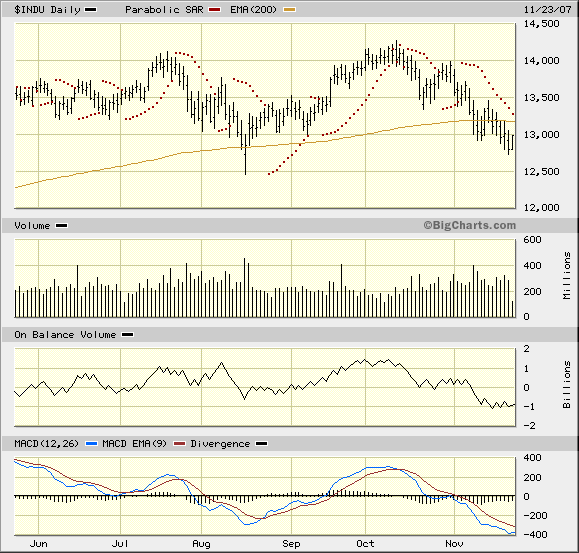
Bulls, bears, and ...

“Bulls, bears, and retests”

By Jeffrey Saut | 26 November 2007

    “People don't understand the significance of the ‘bear market signal’ of November 21. I stated on Wednesday's site (Nov. 21) that the breakdown of the Industrials signaled THE EXISTENCE of a primary bear market. It didn't signal the beginning of a bear market: Wednesday's action gave us the final word via Dow Theory that a primary bear market was already in force.

    ... A precept of Dow Theory is that neither the duration nor the extent of a bull or a bear market can be predicted in advance. It is far easier to IDENTIFY the end of a bull or bear market than it is to predict their end.
    Bull markets tend to build extended and often deceptive tops while bear markets tend to build more definite and identifiable and faster bottoms. Therefore, it's usually easier to identify the bottom of a bear market than it is to identify a bull market top.

    ... I expect a lot of wild and confusing movements from the stock market in the days ahead. But I remind subscribers that a rally here, even a powerful rally, will not mean that the bull market has suddenly been reborn.
    This bear market will not end in four months. But any rally here will allow subscribers to ‘trim their sails’."

    ... Richard Russell, Dow Theory Letters

So wrote Richard Russell on Friday (11/23/07) opining on last Wednesday’s Dow Theory "Sell Signal" when the DJIA finally confirmed the D-J Transportation Average (DJTA) by closing below its August reaction low of 12845.78. We have read Richard’s missives since the early 1970s. We remember his bull market "call" of December 1974. Likewise, we remember his bear market "call" in the fourth quarter of 1999. As one of the few remaining interpreters of Dow Theory, when Richard makes such a "call," we pay attention; especially if it "foots" with our sense of the markets.

Recall that we have been cautious on the equity markets since mid-September, often remarking, "The time to be aggressively bullish was in mid-August (we were), not following a 1,500-point Dow Wow!" We further noted that bottoms tend to be a function of time and price; and, that while we had hopefully satisfied the "price" requirement, the "time" factor was still lacking. Subsequently, we suggested a downside retest of the August lows was in order. Unfortunately last week’s downside retest, while looking successful (read: bullish), rendered a classic Dow Theory "Sell Signal."

However, we have seen many decent rallies develop following a Dow Theory "Sell Signal" since such signals tend to come after a fairly significant decline. In this case, according to Dow Theory, the bull market ended on July 19, 2007, which was the last time the DJIA and the DJTA both recorded higher closing prices. Therefore, the bear market is already four months old. While only time will tell how events play out, we are cautious and would remind participants that since 1935 the average P/E ratio for the S&P 500 is 16x; and, that the current P/E ratio is 18.3x, making stocks somewhat of a neutral value in the aggregate [[actually, rather negative; the average P/E of 16x goes with average trailing earnings; the 'cuurrent' 18.3x P/E is for one to two deviations above future (2008) earnings: normxxx]]. Also of note is that on a trailing 12-month basis, earnings momentum has turned negative, implying forward P/E ratio estimates are questionable. That said, we still own a lot of stocks, but will continue to rebalance those positions like we have been doing with our beloved "stuff stocks" over the past number of weeks.

Clearly, the various markets are currently grappling with how events play out in the coming year. As the always insightful GaveKal organization recently noted, there are four possible outcomes:

    "Scenario 1: The Fed sticks to its assertion that the risks for inflation and growth are now in balance, does not cut rates any further, and the U.S. economy grows past its credit crunch. If this happens, it would be massively bullish for the U.S.$, massively bearish for gold and potentially bearish for Hong Kong and Chinese equities (which are now anticipating more rate cuts). It would also be very bearish for U.S. Treasuries and government bonds around the world. Additionally, we would also most likely see a rotation within the stock markets away from commodity producers and deep cyclicals (which have been leading the market higher for years) toward the more traditional “growth" sectors, such as technology, healthcare, consumer goods, and maybe even Japanese equities.

    Scenario 2: The Fed sticks to its guns, does not cut rates, and the U.S. economy really tanks under the weight of the credit crunch. In essence, the U.S. would move into a Japanese-style "deflationary bust." In this scenario, equities around the world, commodities, and the U.S.$ would collapse, while government bonds would go through the roof.

    Scenario 3: The Fed ultimately cut rates, but this fails to rejuvenate the system and get growth going again. This would likely mean stagflation. As such, gold and other commodities would do well, while stocks and the U.S.$ would struggle. Excluding bonds, this is increasingly what the market is pricing in today.

    Scenario 4: The Fed ultimately cuts rates, and succeeds in reigniting the economy. This would be good news for equity markets, commodity markets, and the U.S.$ (as world trade and foreign buying of U.S. assets would again expand, increasing the need for U.S.$s). Of course, this scenario would be terrible news for bonds.

GaveKal concludes by opining that the market is betting on Scenario 3 and thus one has to be concerned that the Fed’s hand could be forced by the market to cut rates. Cut rates indeed, yet history shows while the first rate cut is impactful, the second and third tend to be less so. This is demonstrated once again by the fact that the S&P 500 is already below where it was when the Fed cut interest rates for the third time on October 31st. Meanwhile, Treasuries have been rallying sharply and junk-bond spreads over Treasuries have expanded materially. This is not an unimportant point for the stock market’s outsized "winners" (energy, materials, commodities, industrials, anti-U.S. dollar bets, emerging markets, etc.) bottomed in 2001 concurrent with the narrowing of such credit spreads. Now that these spreads are widening, it could spell trouble for the overcrowded "long stuff stock, short U.S. dollar" trade that has made us so much money over the last six years (see the attendant chart from the invaluable service "thechartstore.com"). This is one of the reasons why we have been rebalancing our stuff-stock positions (read: selling partial positions and holding the balance in cash) and reducing our anti-dollar "bets."

Another reason we have tilted our strategy is a growing sense that what we may be dealing with is more of a solvency rather than a liquidity issue. Recently, many articles have dealt with certain financial institutions’ "Equity Base" being smaller than their exposure to "Level 3 Assets". Plainly, all these folks’ Level 3 Assets are not going to go bad, but the new FASB #157 accounting rule forces financial institutions to divide assets into three categories called Level 1, Level 2, and Level 3. Under FASB’s terminology, Level 1 assets can be marked-to-market (valued on real prices). Level 2 assets are marked-to-model (an estimate based on observable inputs). Level 3 assets, however, have been marked-to-myth until now. With FASB 157’s implementation it appears these assets will be much more stringently valued on the balance sheet, potentially raising "solvency" questions. Because the central banks are much less effective at dealing with "solvency issues" than they are with "liquidity issues" this too makes us cautious.

The call for this week: Due to the aforementioned observations, we find ourselves asking the question, "Has the leadership baton been passed to the 4Q07 leaders of utilities, techs, consumer staples, and healthcare?" If so, the daily list of "new lows" might be a fertile universe for ideas now that we are entering the "teeth" of tax selling season. While only time will tell, the recent decline "feels" different than the one we anticipated, and bought at the lows, of last summer. Moreover, when interest rates cuts are met by sinking stocks, and a Dow Theory "Sell Signal," it always makes us nervous! Nevertheless, "they" are going to try and talk-up last week’s action as a successful "retest" of the August lows and may just be able to get things going on the upside, which is why we are trading some "long" indexes like the S&P 500 Geared Fund (GRE/17.04) with a close trading stop-loss point in keeping with the George Soros quote, "Economic history is a never-ending series of episodes based on falsehoods and lies, not truths. It represents the path to big money. The object is to recognize the trend whose premise is false, ride that trend, and step off before it is discredited."


Click Here, or on the image, to see a larger, undistorted image.


“I’m flat and I’m nervous."
November 19, 2007
. . . A European portfolio manager

"I’m flat and I’m nervous," is what one portfolio manager (PM) said to us as we wound our way through 11 European cities over the past 19 days. The reference was clearly to illustrate that while he was "delta neutral" on stocks, he was still nervous. And that, ladies and gentlemen, was our observation of the investment position du jour of roughly 300 PMs we interfaced with over nearly three weeks. Other observations included: why are there NO American cars in Europe?; why don’t Europeans wear sunglasses?; where are the joggers?; why are the airport bathrooms so clean in Europe?; and the list goes on. The other near ubiquitous observations were that every taxi driver was listening to American/British music, a unanimous opinion that the U.S. dollar is going lower, a reluctance to invest in U.S. stocks, and despisement of the Bush Administration and the situation in Iraq. Even the British are disgusted with Iraq, but it is not America and Americans that are despised. Indeed, a party was given for us in Paris with roughly 30 Parisians that we knew when they were living in America. To a one, they would move back to the U.S. tomorrow!

While I should probably not comment on the Iraq situation, I would suggest that thanks to the internet, and TV, the under 30 crowd has become extremely savvy as to what’s going on in the world. Manifestly, the younger generation is quite aware of the "popular culture" and they want to be part of it. The only thing standing in their way (in certain countries) is their governments. Consequently, anything that stifles their radical leaders, and allows the young people to gain political traction, should (over time) permit the "Iraqs of the world" to modernize and subsequently join the world’s society. We can already see hints of this dynamic in the underreported riots of Iranian twenty year olds against President Ahmadinejad.

Speaking to the U.S. dollar, we have been bearish on the dollar versus most of the world’s currencies since 2001. That was the view we carried to Europe six years ago along with the recognition that China was joining the World Trade Organization (WTO), which was likely to "kick off" a secular bull market in "stuff" (energy, timber, cement, agriculture, water, electricity, infrastructure, base/precious metals, etc.). We had remained steadfastly bearish on the dollar, and bullish on "stuff," until a few weeks ago. Indeed, 'short the dollar, long "stuff,"' has gained such popularity that it has become an "overcrowded trade." And, that’s why we told accounts we were reducing our anti-U.S. dollar "bets" and rebalancing most of our stuff-stock positions (read: selling partial positions and holding those funds in cash for the moment). Most of the European accounts were shocked about this reversal of opinion, just as shocked as they were when we first voiced the aforementioned anti-dollar strategy six years ago.

Nevertheless, we stood our ground when asked for a fundamental reason for turning bullish on the dollar, and while we don’t really have a fundamental reason, save the improvement in the trade balance, our mantra was, "It’s just too crowded a trade to be short the dollar right here. I don’t know if I will be bullish on the greenback for three months, or three years, but I do know I no longer want to be short." Concurrently, we have been bullish on the Japanese Yen since the low 80s (FXY/90.11), and while I didn’t make any money on this trade, many of our accounts did. Interestingly, year-to-date there is an amazing 93% correlation between the ups and downs in the world’s stock markets and the spread between yen and the euro. To wit, when the euro rallies against the yen, the world’s stock markets rally. The quid pro quo is that when the yen rallies versus the euro, stocks decline. In past missives we have written extensively about this tendency driven by the famed yen "carry trade," but that is a discussion for another time.

Other talking points from our European presentation included the U.S. consumer, the housing debacle, the subprime contagion, and the political situation; all of which should become much clearer over the next few months. Regarding the consumer, for decades our mantra has been, "never underestimate the American consumer’s ability to spend money even if they don’t have it." Said mantra has served us well. However, recently there have been some "tells" that the under-saved, overspent American consumer may finally be sated with debt. If the U.S. consumer has become unwilling to take on any more debt, it spells trouble for the Federal Reserve and suggests the Fed may be "pushing on a string."

As for housing, our real estate research team made a great "call" a few years ago by stating that the housing cycle was peaking and that before the downturn was over the homebuilding stocks would be trading at 80% of their book value. Before I left for Europe I had a discussion with that team’s leader (Paul Puryear), who told me with the homebuilders now trading at 80% of book value he would like to become more constructive on the group, but the numbers keep getting worse. Hereto, we think the next few months will provide more clarity as we enter the spring selling season and the mortgage resets expand at higher interest rates.

"The subprime situation is contained," is what we heard earlier this year when the word "subprime" crept into America’s lexicon. At the time we were skeptical and suggested the fallout from the subprime contagion was unknowable and it would likely take more time than most believed to sort things out. We still feel this way and would note that even the prowess of Citigroup (C/$34.00) can’t seem to ascertain the extent of the contagion, or value the opaque assets (CDOs, RMBS, etc.) in its own portfolio. What we find ironic is that all of this is occurring as the new FASB #157 accounting rules are being implemented (more stringent marking to the market of assets), while it looks to us as if the Structure Investment Vehicles (SIVs and SPIVs) are going to be moved from "off" balance sheet items to "on" the balance sheet items for many financial institutions. Even more ironic is that the more stringent Basel II banking standards are slated to "kick in" this January as things continue to get curiouser and curiouser.

On politics, Mark Twain remarked, "The political and commercial morals of the United States are not merely food for laughter, they are an entire banquet," . . . except in this case we are not laughing. To be sure, one of the things that continues to bother us is the movement by politicians toward protectionism, intervention, and regulation. This political rhetoric is going to torque-up as we enter the New Year. What you are going to hear regards increasing taxes on the rich. History suggests that when you hear this the middle class had best grab their wallets. Further, there is going to be more talk about raising the capital gains tax and eliminating the favorable tax treatment on dividends. How this plays out longer term is anyone’s guess, but we think it is a headwind.

As stated, we think there will be more clarity on the aforementioned points over the next few months, which is why we have been opining since mid/late-September, "the time to be aggressively bullish was in mid-August (we were), not following a 1500-point Dow Wow!" As written in our strategy report dated 9/17/07 ("Heads I win, tails you lose!"):

    "Consistent with these thoughts, we are on ‘hold’ in the trading account, as well as the investment account, on a short-term basis. While bullish since the August lows, we have always maintained that bottoms tend to be a process involving both price and time. Potentially we have met the ‘price’ requirement given the 20-session, 10% correction, ‘selling stampede’ that culminated on August 16th. That is why we are treating the August lows as an ‘internal low’ until proven wrong. It is now the ‘time’ component that we are contemplating. As previously noted, the 1990 and 1998 correction-sequences saw prices peaking in July, declining into August, and then rallying sharply before retesting those August lows in the September/October timeframe. Whether it plays that way this time remains to be seen, but we are cautious following the initial throwback rally we have experienced into this week’s FOMC meeting."

The call for this week: Well we’re back. And we find it interesting that despite three interest rate reductions, the major averages are below where they were on the last rate cut of 10/31/07 (this is almost unheard of). Also of interest is the fact that crude oil has declined, yet the D-J Transportation Average has also declined and actually broken below its August 16, 2007 closing low, rendering either one-half of a potential Dow Theory "sell signal," or a huge downside non-confirmation. Plainly, since the October "peak" things have gotten pretty confusing, leaving the four strongest sectors since that point: utilities, consumer staples, energy, and healthcare. Meanwhile, the over-crowded negative dollar "bet" has changed the export-import equation, making America just plain "cheap!" The effects can be seen along the Canadian border, in New City retail stores (read: foreigners), cruise lines, Disneyworld, etc., and the result has made us reduce our anti-dollar "bets" of the past six years.


Normxxx    
______________

The contents of any third-party letters/reports above do not necessarily reflect the opinions or viewpoint of normxxx. They are provided for informational/educational purposes only.
The content of any message or post by normxxx anywhere on this site is not to be construed as constituting market or investment advice. Such is intended for educational purposes only. Individuals should always consult with their own advisors for specific investment advice.
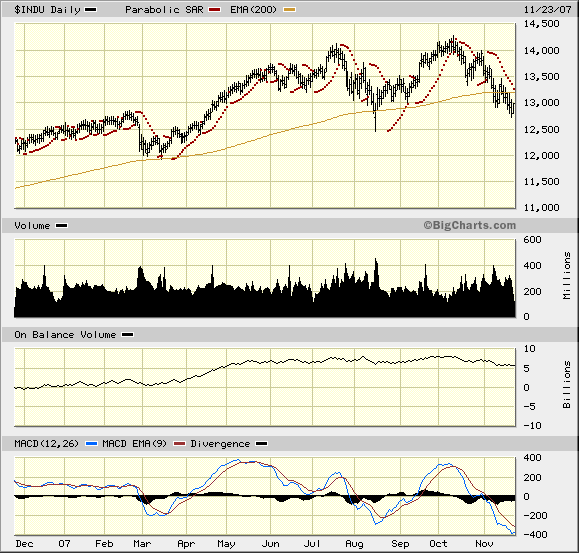
MELTDOWN?

Worsening Credit Crisis Leading to Meltdown of Financial System and Severe US Recession

By Mike_Whitney | 26 November 2007

    Take a Look at Professor Roubini's Crystal Ball— Reality has finally caught up to the stock market. The American consumer is underwater, the banks are buried in dept, and the housing market is in terminal distress. The Dow is now below its 200-Day Moving Average— the first big "sell" signal. Anything below 12,500 could trigger program-trading and crash the market. The increased volatility suggests that we are watching a "real time" meltdown.

International Business editor for the UK Telegraph, Ambrose Evans Pritchard, summed up yesterday's action in the Asian markets:

    "The global credit crisis has hit Asia with a vengeance for the first time, triggering a massive flight to safety as investors across the region pull out of risky assets. Yields on three-month deposits in China and Korea have plummeted to near 1% in a spectacular fall over recent days, caused by panic withdrawals from money market funds and credit derivatives.

    "“'This' is a severe warning sign,” said Hans Redeker, currency chief at BNP Paribas. “Asia ignored the credit crunch in August but now we're seeing the poison beginning to paralyze the whole global economy.”" (
    Credit 'Heart attack' engulfs China and Korea, Ambrose Evans Pritchard,UK Telegraph)

The credit storm that began in the United States with subprime mortgages has spread to markets across the globe. In fact, the train has already crashed. What we're seeing now are the boxcars piling up on top of each other.

On Tuesday Chinese government officials ordered a complete halt to bank lending to slow the speculative frenzy that has created an enormous equity bubble in the stock market. According to the Wall Street Journal:

    "Chinese authorities are slamming the brakes on bank lending, in their latest attempt to curb the runaway investment threatening to overheat what is soon to be the world's third-largest economy. In recent weeks, regulators have quietly ordered China's commercial banks to freeze lending through the end of the year, according to bankers in several cities. The bankers say that to comply, they are canceling loans and credit lines with businesses and individuals." ("China freezes lending to Curb Investing Frenzy" Wall Street Journal)

The move illustrates how concerned the Chinese are that a slowdown in US consumer spending will trigger a crash on the Shanghai stock market. It also shows that the Chinese are having difficulty dealing with the inflation generated by the hundreds of billions of US dollars absorbed via the trade imbalance with the US. China is awash in USDs and that surplus is causing a steady rise in food and energy costs. This could be mitigated by allowing their currency to "float" freely. But a sudden, steep increase in the Chinese yuan's value could also send the world headlong into a global recession. For now, the lending freeze and price fixing appear to be the way out.

Another sign that the markets have reached a "tipping point" appeared in a Reuters article on Wednesday; "Interbank Covered Bond Trading Halted on Volatility":

    "Renewed credit turmoil and volatility led the European Covered Bond Council (ECBC) on Wednesday to suspend inter-bank market-making in covered bonds until Monday, Nov. 26.

    The move is a sign of the stress in the covered bond market, which is dominated by German institutions that have almost a trillion euros of covered bonds outstanding.

    Covered bonds— backed by pools of assets that remain on the borrower's balance sheet— are usually highly liquid and typically rated triple-A by ratings agencies.
    The ECBC's recommendation is aimed at relieving the pressure on market makers who are forced to quote prices at a fixed bid-offer spread.

    "In light of the current market situation and in order to avoid undue over-acceleration in the widening of spreads, the 8-to-8 Market-Makers & Issuers Committee recommends that inter-bank market-making be suspended,"
    the ECBC said in a release."

Note: This isn't mortgage-backed junk that's being sold, but highly liquid bonds that are usually easy to cash in [[virtually the equivalent of cash: normxxx]]. The ECBC's action is a sign of pure desperation and indicates that credit paralysis has infected the entire euro banking system.

Reuters: "Due to general market conditions and the specific mechanics of the inter-dealer market making it even seems possible that inter-dealer market making will not be resumed this year."

That's bad. The whole mechanism for converting covered bonds [[and what other securities?: normxxx]] into cash has broken down.

The dollar took another pasting on Wednesday, sliding to $1.49 on the euro; another new record [[it closed below $75, today, at $74.82: normxxx]]. Gold shot up to $814 per ounce. Oil continues to flirt with the $100 per barrel mark, and the yen rose to 107 per dollar forcing a further sell-off of hedge fund assets levered through the carry trade [[which puts further pressure on the dollar: normxxx]].

Jon Basile, economist at Credit Suisse, summed it up like this: "There's a heck of a lot of bad news out there." Indeed.

In California Governor Arnold Schwarzenegger has joined with four mortgage lenders to freeze adjustable interest rates (ARMs) for some of the state's highest-risk borrowers; another unprecedented move. The Governor hopes to avoid a collapse of the California real estate market which has gone into a tailspin. Home sales have plummeted more than 40 per cent for the last two months. Prices have dropped sharply— roughly 12 per cent statewide. New construction has slowed to a crawl. Layoffs are steadily rising. Jumbo loans (mortgages over $417,000) have been put on the "Endangered Species" list. Even qualified borrowers can't get mortgages. Nothing is selling. California housing is "off the cliff".

Schwarzenegger's plan to keep over-extended subprime mortgage-holders in their homes faces an uncertain future. What incentive is there for homeowners to continue paying exorbitant monthly rates when their payments are not applied to the principle? The homeowners would be better off bailing out, accepting foreclosure, and starting over with a clean slate.

    It's unrealistic to think that Schwarzenegger can stop the tidal wave of foreclosures that are sweeping across the state. An estimated 3 million homeowners will lose their homes nationwide.

    If you want to blame someone; blame Alan Greenspan. He's the one who created this mess.

According to the economist Mike Shedlock:

    "The Fed caused the credit crunch by slashing interest rates to 1 per cent to bail out its banking buddies in the wake of a dotcom bubble collapse. All the Fed did was create a bigger bubble. This bubble is so big in fact that it cannot even be bailed out. It's the end of the line for a serially bubble blowing Fed.

    "So not only was this the biggest credit bubble in history,
    this was also the biggest transfer of wealth from the poor and middle class to the already enormously wealthy. That is the real travesty of justice regardless of whether or not the price tag is $1 trillion, $2 trillion, or $10 trillion." (Mike Shedlock, "Mish's Global Economic Trend Analysis")

The problem has gotten so serious that even Secretary of the Treasury, Henry Paulson, is putting up red flags. Last week, Paulson ignited a sell-off on Wall Street when he made this statement:

    "The nature of the problem will be significantly bigger next year because 2006 [mortgages] had lower underwriting standards, no amortization, and no down payments....We're never going to be able to process the number of workouts and modifications (to mortgages) that are going to be necessary doing it just sort of one-off. I've talked to enough people now to know that there's no way that's going to work."

The desperation is palpable. Like Schwarzenegger, Paulson is trying to get mortgage-lenders to provide a safety net for struggling borrowers who are defaulting on their loans.

    [ Normxxx Here:  Ah, but most of those "mortgage-lenders" are European, Chinese, Japanese, and other Asiatic and ME funds and banks! Good luck on getting them to bail-out "those American crooks!"  ]

Paulson is calling for emergency legislation that will allow the Federal Housing Administration to play a greater role in the relief effort. The FHA has already expanded its traditional role by taking on hundreds of billions in extra debt just to keep a few "private" mortgage lenders and banks from going bankrupt. Of course, when Paulson's plan goes kaput and the debts pile up; it'll be the taxpayer that foots the bill.

    "Paulson also called the Senate's failure to pass legislation overhauling mortgage giants Fannie Mae and Freddie Mac frustrating," saying that the two government-sponsored entities need to be playing a bigger role in the housing market.

    "If we ever need them it's during times like today, and they're most valuable when there is distress in the mortgage market,"
    he said. "I'd like to see them playing an even bigger role."(Wall Street Journal)

Fannie and Freddie, have already posted enormous quarterly losses and don't have the capital reserves to add millions of subprime mortgage-holders under their "government-sponsored" umbrella. Paulson is just grasping at straws.

Similar troubles are brewing in the broader market where late-payments and defaults have spread to credit card debt and new car loans. Every area of "securitized" debt has suddenly veered off the road and into the ditch. Last week the Fed injected more credit into the teetering banking system than anytime since 9-11.

No one has predicted the downward-spiral in the market more accurately than Nouriel Roubini. Roubini is a Professor at the Stern School of Business at New York University. His analysis appears regularly on his blogsite, Global EconoMonitor. Last week's prediction was particularly dire and is worth reprinting here:

    "It is increasingly clear by now that a severe U.S. recession is inevitable in next few months...I now see the risk of a severe and worsening liquidity and credit crunch leading to a generalized meltdown of the financial system of a severity and magnitude such as we have never observed before. In this extreme scenario whose likelihood is increasing we could see a generalized run on some banks; and runs on several of the weaker (non-bank) broker dealers, that may go bankrupt, with severe and systemic ripple effects on a mass of highly [integrated and interdependent] leveraged derivative instruments that will lead to a seizure of the derivatives markets... massive losses on money market funds with a run on both those sponsored by banks and those not sponsored by banks; ..ever growing defaults and losses ($500 billion plus) in subprime, near prime and prime mortgages with severe knock-on effect on the RMBS and CDOs market; massive losses in consumer credit (auto loans, credit cards); severe problems and losses in commercial real estate...; the drying up of liquidity and credit in a variety of asset backed securities, putting the entire model of securitization at risk; runs on hedge funds and other financial institutions that do not have access to the Fed's lender of last resort support; a sharp increase in corporate defaults and credit spreads; and a massive process of re-intermediation into the banking system of activities that were until now altogether securitized." (Nouriel Roubini's Global EconoMonitor)

"A generalized meltdown of the financial system".

Looks like Chicken Little might have gotten it right this time; "The sky IS falling."


Normxxx    
______________

The contents of any third-party letters/reports above do not necessarily reflect the opinions or viewpoint of normxxx. They are provided for informational/educational purposes only.

The content of any message or post by normxxx anywhere on this site is not to be construed as constituting market or investment advice. Such is intended for educational purposes only. Individuals should always consult with their own advisors for specific investment advice.
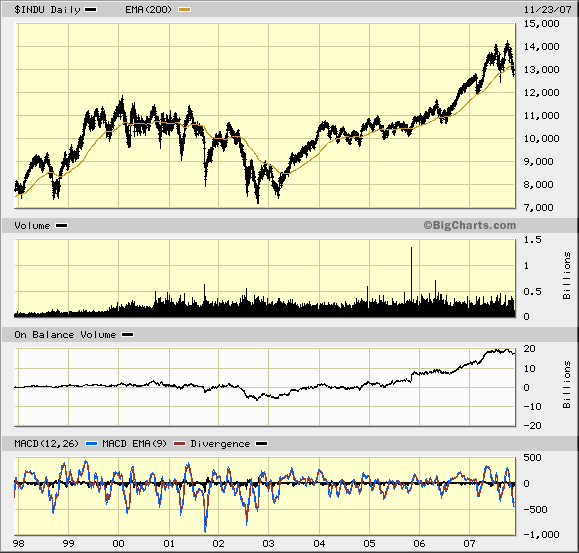
Knowing The Known Unknowns

Knowing The Known Unknowns Of A Possible Market Disaster

By Brian Milner | 26 November 2007

Saturday, November 24, 2007

    Satyajit Das is not the sort of person you want to meet after a really bad day in the markets. The renowned derivatives expert has such a gloomy outlook on the state of the world's financial system that you might have to be kept away from sharp objects after he leaves the room.

"I think this crisis has a long way to run," the globetrotting Mr. Das said yesterday from London. "It is an extra-innings baseball game and the national anthem still hasn't finished playing. So we really don't know what the worst is."

    Unlike some permabears who see a dark lining to every silver cloud and who have waited vainly for years for what they are convinced will be the mother of all market crashes, Mr. Das backs up his concerns with an impressive track record as a banker, trader, corporate treasurer and risk consultant.

    No one is better at explaining the opaque world of what he calls
    "supersized" leverage stemming from the slicing and dicing of risk and the vast expansion of credit derivatives, which now total $516-trillion (U.S.), accounting for an amazing 75 per cent of the world's liquidity.

    His technical reference work on the subject runs four volumes and more than 4,200 pages.

    Mr. Das warns that we are in the midst of a tectonic shift of the sort that occurs only two or three times a century and that all signposts point to extreme caution ahead.

"What I'm saying is we now have a shift in the market which is significant in terms of its long-term impact. I just don't think the future is going to be anything like the past."

Last year, when his latest, most accessible book, Traders Guns & Money, hit the shelves, he gave a series of speeches on the coming credit crash. "People decided that either I had lost my marbles finally or I'd been smoking something awful," he laughed.

    Then the subprime market crumbled and people began taking notice of this risk assessor's convictions that the credit bubble was never sustainable.

"A diet of cheap and excessive debt has created a bloated financial system," he wrote in a new report commissioned by Jory Capital, a small Winnipeg investment firm that has scored something of a coup by signing him on as an adviser. The firm has even persuaded him to trek to Winnipeg in February to expound on his views.

In a normal world, a bank keeps $1 of real capital on its balance sheet to support $12.50 worth of loans it has underwritten. That's conservative banking. But today, the credit markets use $1 in real capital to support $30 worth of loans through all sorts of exotic structures.

The resolution of the current credit crisis will take years, not months, and will require "regulatory will and an imposition of market disciplines on errant investors and banks," he writes. "Crash diets rarely work."

It's a story replete with villains and victims, including the investment banks that created and pedalled incredibly complex, poorly understood credit instruments for enormous profit; the central banks that have been their enablers; and the institutional investors that snapped up the stuff in their quest for ever higher yields at seemingly minimal risk.

His report is largely a recap of long-held views of the global risk posed by massive leverage, reinforced by recent market developments, financial sector writedowns and central bank interventions to prop up ailing institutions.

    But it comes out at a time when many investors, egged on by cheerleaders in the analytical community, are looking at financial stocks and some classes of debt as veritable bargains, because they have been so beaten up.

Mr. Das is noted for leavening the gloom with humour. In the report, he echoes a now famous description of the Iraq mess by then U.S. defence secretary Donald Rumsfeld. When it comes to the state of the financial system, he says, the "known known" is that there are losses stemming from subprime mortgages and anything related to them.

The "known unknown is that everybody knows that they do not know the full extent of the problem." And the "unknown unknown" is that other problems yet to be identified could be lurking out there.

A market crash might be the sexy Hollywood-style sudden ending that people are waiting for. But not Mr. Das. He forecasts a grindingly slow unravelling of the sort that occurred in the 1970s, when inflation effectively halved portfolio values over a period of five to seven years.

If he's right, investors need to adjust for higher inflation, which means focusing on real assets. This helps explain why commodities remain strong and why blue-chip equities have held up remarkably well.

This is the time to look for companies with real cash flows and good businesses that will be sustainable, Mr. Das said.

"Owning debt of a bank or sovereign debt like U.S. Treasuries— in other words, assets with fixed returns— may not be very bright."

The Worst Is Yet To Come

The Worst Is Yet To Come, Say Subprime Experts
At the end of August, about $46 billion in subprime loans had defaulted; that number is expected to triple in 2009


By Lisa Kassenaar, Bloomberg News | 26 November 2007

    They dubbed it "The Survivors’ Conference." In early November, 2,000 people who handle asset-backed securities for a living crowded into a ballroom at the JW Marriott hotel in Orlando, Fla., just 3 miles from Disney World, to hear speaker after speaker explain why 2008 may be their worst year ever.

    The subprime crisis, which has claimed the jobs of three chief executive officers and prompted more than
    $45 billion in writedowns at the world’s biggest banks, may end up spilling into 2009.

"These events tend to become deeper and play out longer than most people initially expect," says Michael Mayo, an analyst who covers securities firms at Deutsche Bank AG in New York. "This is one of the slowest-moving train wrecks we’ve seen."

    The tumbling U.S. housing market will continue to inflict the damage. Mortgage-backed securities and collateralized debt obligations containing those securities are falling in price and won’t find their footing anytime soon. That’s because most of the subprime mortgages, which provide collateral for $800 billion in securities, have yet to go bad, says Christopher Whalen of Hawthorne, Calif.-based Institutional Risk Analytics.

"The collateral is not yet problematic," Whalen says. "That’s the next big shoe to drop."

    Whalen says defaults will soar as the rates of low-interest "teaser" mortgages held by borrowers with poor credit move up. At the end of August, about $46 billion in subprime loans, representing 225,000 homes, had defaulted, according to Credit Suisse Group. The number will more than triple to $143 billion by the middle of 2009, the bank forecasts. Total subprime loan defaults will top out at about $270 billion, or 1.52 million homes, in 2010 or later.

    Home builders are also facing headwinds. U.S. housing starts rose in October as an increase in condominium projects offset the weakest construction of single-family homes in 16 years. Builders broke ground on 1.229 million homes at an annual rate last month, up 3 percent from September, the Commerce Department said in Washington on Tuesday. Building permits, a gauge of future construction, fell 6.6 percent to a 1.178 pace, the lowest since 1993.

    Companies can’t trim their inventories because sales of single-family homes are declining as fast as construction, suggesting the real-estate recession will linger into 2008.

"Until housing prices bottom out, the writedowns won’t stop," says Peter Kovalski, who helps manage more than $12 billion at Purchase, N.Y.-based Alpine Woods Investments. "The Street wants things right away, but it doesn’t work that way."

Banks’ writedowns include assets that they classify as level 3, an accounting category which indicates the holdings are so illiquid that they can only be priced using the firm’s own valuation models.

Goldman Sachs Group Inc.’s level 3 assets rose by 33 percent in the third quarter of 2007 from the prior period because it was stuck with loans when the leveraged buyout market froze [[what!?! The supply of suckers dried up?: normxxx]]. Level 3 assets accounted for 6.9 percent of the firm’s $1.05 trillion total at the end of August, according to a government filing. Citigroup Inc. classified 5.7 percent of its assets as level 3 on Sept. 30.

The total global loss from the subprime mess, Deutsche Bank’s Mayo said Nov. 12, may reach $400 billion [[Or, a couple of $trillion...: normxxx]].

Rating companies, under fire from investors for applying their highest ratings to CDOs that included securities backed by subprime loans, are downgrading the debt [[as fast as they can— without making it obvious that they goofed monumentally in the first place.: normxxx]]. Late last month, Moody’s Investors Service cut ratings on CDOs tied to $33 billion of subprime mortgage securities.

The ratings firm also threatened to downgrade structured investment vehicles with CDOs managed by Citigroup and HSBC Holdings Plc after two SIVs defaulted in October. Moody’s says it assumes the SIVs are unwinding their assets, selling at distressed prices, to refinance their maturing commercial paper. The so-called Super SIV, a fund set up by banks at the urging of the U.S. Treasury to buy the highest-rated securities, will seek to prevent a meltdown of the 30 SIVs globally holding $320 billion as of Oct. 5 [[if they can hold out that long: normxxx]].

Wall Street profits are also plunging in the fourth quarter. Citigroup, the second-largest CDO issuer in the first half of 2007, may post a loss in the final period, according to the average estimate of 23 analysts compiled by Bloomberg News. That’s after the bank reported a writedown of as much as $11 billion, which cost CEO Charles Prince his job. Merrill Lynch & Co., which replaced CEO Stan O’Neal with New York Stock Exchange head John Thain on Nov. 14, may report that profit fell 49 percent in the fourth quarter. Bear Stearns Cos. also may have a loss.

At the five biggest securities firms— Lehman Brothers Holdings Inc., Morgan Stanley, Bear Stearns, Goldman Sachs and Merrill Lynch— earnings are expected to fall 8.3 percent in 2007 from a record $30.6 billion in ’06, according to analyst estimates.

Lower profits mean more firings. Bank of America Corp., JPMorgan Chase & Co., Bear Stearns, Citigroup, Lehman Brothers and Morgan Stanley announced more than 24,000 job cuts in the first 10 months of 2007. Gustavo Dolfino, president of New York— based executive search firm Whiterock Group LLC, says he expects the firms to fire another 5,000-10,000 people in the remaining months of ’07.

The subprime debacle may echo through the economy the way the popping of the Internet bubble did— hurting consumers and growth years later. The 39 percent drop in the Nasdaq Composite Index in 2000 eventually led people to yank money from their mutual funds, Mayo says. The U.S. economy fell into recession in March ’01.

At the conference in Orlando, investors concerned about another recession were in no mood for the usual festivities. The party thrown by Bear Stearns— the first Wall Street bank to have a subprime blowup— was almost empty at 9 p.m., with 10 people commiserating over beer and calypso music.

Bose George, an analyst at Keefe, Bruyette & Woods Inc. attending the conference for the first time, has an equally glum outlook on the already slowing U.S. economy. He says a decline in home equity loans will curtail consumer spending.

    [ Normxxx Here:  They've been saying that since 2005. I suspect we may still see a good 2007 (including Christmas)— and even a reasonable 2008— then the economy falls off a cliff (starting with Christmas 2008?) and stays there for years— just in time for the baby boomer retirements to peak (average life savings of $50,000 plus SS, for what that will be worth with a drastically reduced dollar and with a government COLA running 'under 2%!')! Who's going to apply the drastic medicine— like Paul Volcker and Ronald Reagan— or what's going to spur the economy and wealth building like the run-away housing boom? Feeble replays on Wall Street won't do it. There will be NO boom in 'services!' There is a limit to how much we can take in each other's wash. Besides, we're even outsourcing services as fast as we can!  ]

"Credit is a huge driver of growth, and it’s hard to see how this isn’t going to have an impact on the economy," George says. "Things are going to get worse."

There’s one bright spot for George: He’ll have more time for research. Six of the 15 companies he used to cover, including American Home Mortgage Investment Corp. and New Century Financial Corp., have gone out of business.

Normxxx    
______________

The contents of any third-party letters/reports above do not necessarily reflect the opinions or viewpoint of normxxx. They are provided for informational/educational purposes only.
The content of any message or post by normxxx anywhere on this site is not to be construed as constituting market or investment advice. Such is intended for educational purposes only. Individuals should always consult with their own advisors for specific investment advice.
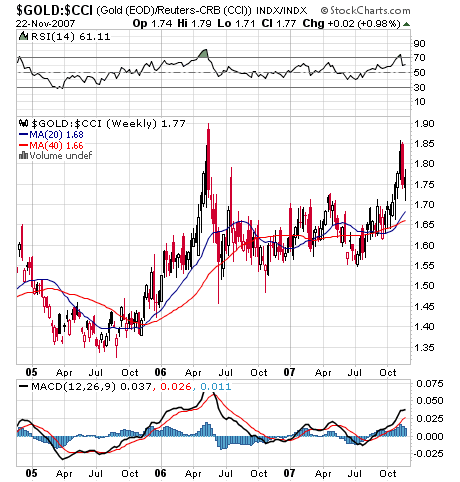
Sunday, November 25, 2007

What to Ask Mr. Market

What to Ask Mr. Market

By Michael Santoli, Barron's | 25 November 2007

Thanksgiving is not the sacred holiday at which four essential questions are asked across the celebratory table. Yet given the recent market environment, suggestive of high emotion and low margin for error, questions seem more appropriate than mock-confident assertions.

In fact, this market— having dropped 10% for the second time in four months toward its August lows, before Friday's who-didn't-see-that-coming holiday bounce— has shown enough probable cause to warrant a firm yet open-minded interrogation.

The most pressing question is whether we've entered a bear market, whether this commotion we're hearing is a bear pounding on the door or merely the same old bull falling down the stairs again. Thing is, markets don't respond to such blunt interrogations. The answers to subtler, more oblique questions nudge us toward the truth.

• First, how much damage has been done? Plenty— maybe almost enough to reflect the economic pessimist's favored scenario. The average price of the stocks in the broad S&P 1500 index was off nearly 14% at Wednesday's close from its June 4 high, notes Wayne Kaufman, technical analyst at Friedman Schnaier & Associates.

Nearly a third of the stocks were down at least 20% from their high. Fewer than 30% were above their 200-day moving average. Yet Kaufman notes that certain barometers of investor distress are still short of the levels seen in mid-August. It's enough, at least, to expect a bounce.

Put it this way: If this is still a bull market, it soon should rise significantly. Kaufman, whose trading approach features that admirable blend of discipline and flexibility, is poised for such a bounce, but is keeping the market on a short leash.

• Second, what about all the Dow Theory chatter? Several scriveners have dipped pens into inkwells and written that the Dow industrials' breakdown has triggered a formal Dow Theory sell signal, confirming the washout in the Dow transportation average. This sounds scary, but mostly amounts to another way of saying "lots of stocks are weak, especially economically sensitive ones." As a shrewd trader friend observes, "The market trades on technicals when no one knows what the hell's going on." Note that the late 1990s Dow Theory sell signal came several months and many percentage points ahead of the ultimate top.

Dissent has arisen from several quarters. UBS strategists put forward the Baltic Dry index (a measure of spot cargo demand) as the 21st century transport average. It remains strong. Jason Trennert of Strategas Research points to his firm's index of the S&P 500 stocks with the tightest historical links to GDP trends. It's flashing slowdown messages, but is well above 2001 recession levels.

• Third, are investors depressed enough to elicit a bottom? By bull-market standards, yes, or just about. Ned Davis Research— as good a beacon of sanity as can be found in tough markets— was cited here near the August lows calling for a bounce but saying no "fat pitch" on sentiment was implying an important bottom. Good call.

The firm last week was about at the same place, saying that individual-investor and newsletter-writer sentiment is negative enough to invite a year-end rally. But, adds NDR, maybe nothing more powerful than that, given the lousy tape action that hints at "bear-market conditions."

One side note: Last week, the ratio of corporate insider selling to buying was down to four, deep in buy signal territory and at a level last seen the week of Aug. 23.

• Fourth, and what about that supposedly strong fourth-quarter seasonal effect, anyway? Seasonality is climate, not weather. It offers general tendencies, not daily or weekly advice on what to wear or how to trade. This suggests that the swift 10% drop during a supposedly strong seasonal period has bruised traders' confidence enough to allow calm and perhaps higher prices to mark December. Let's just say the grand jury has yet to hand up an indictment on this market. But it's deliberating strenuously.

You know the story will be written sometime in the next year, the one about the deep-pocketed, steel-gutted opportunists who surveyed the carnage in the housing and mortgage markets and made a killing buying dollars for pennies.

For the small-time speculator, here's a way to bet on panic ebbing in this sector. Home builder Pulte Homes (ticker: PHM) has an exchange-listed senior note (ticker: PHA) that yields almost 11% and is near the top of the company's capital structure. It trades at 16.81, or 67% of its $25 face value. Pulte is among the more financially stable builders and has an unchallenging debt-payback schedule for the next few years. One caveat: The securities are thinly traded, allowing in small-timers only.

Normxxx    
______________

The contents of any third-party letters/reports above do not necessarily reflect the opinions or viewpoint of normxxx. They are provided for informational/educational purposes only.
The content of any message or post by normxxx anywhere on this site is not to be construed as constituting market or investment advice. Such is intended for educational purposes only. Individuals should always consult with their own advisors for specific investment advice.
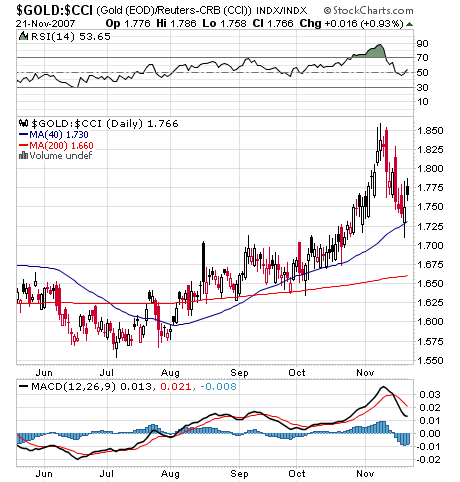
Comeback for the Greenback

A Comeback for the Greenback

By Jonathan R. Laing, Barron's | 25 November 2007

The news has been nothing but grim for the U.S. dollar as of late. For the year, the buck is down against all 16 major trading currencies save the Mexican peso. But perhaps most disconcerting, last Friday the greenback fell to an all-time low against the 13-nation euro, which has been in existence only since 1999. The European currency now fetches nearly $1.50, compared with less than 83 cents as recently as 2000.

And to hear dollar bears talk, the buck will soon lose its privileged status as the preeminent global reserve currency and major medium of exchange to the euro and, perhaps even later in the century, to the Chinese renminbi. Indeed, last week, several Persian Gulf oil powers threatened to unpeg their currencies from the dollar because the expense of buying goods and services from Europe was boosting price inflation in their domestic economies.

    Of course, the case against the greenback is invariably couched in apocalyptic terms. America's continuing budget deficit, for example, is said to betoken U.S. decadence, fueled by fiscal irresponsibility and imperial over-reach. The trade and current-account deficits? They are symptoms of a society that consumes more than it produces, spends more than it saves and relies on poorer nations to finance its profligacy.

    Nor, at this point, can a strong case be made for foreign investment in U.S. assets in order to sop up the dollar surpluses in foreign coffers. U.S. gross— domestic-product growth is slowing. Treasury rates seem headed lower. Interest differentials favor higher-yielding government paper like the German bund. U.S. residential and commercial real-estate prices seem headed further south.

    Then, too, the U.S. financial system is currently a mess with the subprime, structured-products crisis having seemingly spread to the entire international credit market— with particular emphasis on all forms of U.S. credit products. Moreover, U.S. capital gains and dividend taxes are likely to jump once the Democrats allow the Bush tax cuts to expire in 2010. And, finally,
    sovereign funds and other foreign investors worry that nativist uproars could obtrude again, in the way that kept China from acquiring Unocal and Dubai from completing its U.S. seaports deal.

Despite the budget deficit, the trade deficit and the credit mess, the buck looks ready to climb out of its hole.

Thus, it comes as something of a surprise that GaveKal, an international investment-research boutique with offices in the U.S., Hong Kong, Paris and Abu Dhabi, recently penned a report lauding the dollar's prospects against the euro. In fact, in a telephone interview from Paris, firm founder Charles Gave terms the euro "grotesquely overvalued" at its current level. In the next couple of years, he maintains, the euro should fall to its "parity" value of $1.05 to $1.10.

Gave, whose firm's good track record has won it a large institutional following in the U.S. and Europe, points to several secular factors that bode well for the greenback versus the euro. For example, rapidly aging populations in euroland figure to decimate working populations there and increase the governmental financial burden at a pace far faster than in the U.S. European countries such as France have far higher debt-to-GDP burdens than the U.S., especially when estimates of their unfunded pension liabilities for government employees are figured in.

Adding to this European fiscal burden is a trend that Gave, out of political correctness, hesitates even to verbalize— Islamization. Higher birth rates of Muslim populations that have been only imperfectly integrated into European economic and cultural life could pose big problems in the Old World over the next several decades. For one thing, the trend could boost unemployment.

Likewise, he sees the U.S. maintaining its lead over the euro zone in such prerequisites of wealth generation as productivity growth, research, product innovation and strong institutions of higher education. "Ultimately, currency values are determined by relative rates of return on capital, and here the U.S. has a decided advantage," he contends.

Finally, according to GAVE, the euro is of such recent vintage that it is untested during a serious global recession. In tough times, the nations comprising the union have such different social and economic traditions that some might opt out of the euro in favor of traditional currencies to stimulate their economies rather than accept a zone-wide tough-love solution.

According to research by GaveKal, the dollar's current woes against the euro owe to temporary factors that are likely to ameliorate. If one accepts the premise, which GaveKal doesn't fully, that chronic trade deficits weaken a nation's currency, good news seems to lie ahead for the buck. The GaveKal report points out that the weaker dollar has caused U.S. exports to rise three times as fast as imports. In fact, Gave thinks that Uncle Sam will achieve a trade balance, excluding the impact of energy, within three years or so.

A major problem for the U.S. on the trade front has been that China and some of our other major Asian trading partners have loosely pegged their currencies to the buck, to generate trade surpluses from systematically undervaluing their currencies. This policy of competitive devaluation, when followed in the 1930s economic contraction, was known as Beggar Thy Neighbor.

Yet, according to GaveKal, Asian central bankers are starting to realize the downside to such currency manipulation, beyond the complaints of trading partners. Pegged currencies also can create unhealthy booms in local stock and real-estate prices and push inflation above desired levels.

Signs of policy changes are afoot. Recently, South Korea has been allowing the won to creep higher. This spring, India allowed the rupee to rise from 44 to 39 against the dollar. The Monetary Authority of Singapore announced last month that in order to regain control of its monetary aggregates, the Singapore dollar would likely by permitted to rise over the next year.

In addition, Chinese authorities probably will increase the pace at which the renminbi is allowed to appreciate versus the greenback. If not, GaveKal argues, China is likely to face increases in gasoline and food prices that could tear at the very fabric of its society since so much of the huge nation's needs are filled from abroad.

Obviously, rising oil prices also help push up the euro-dollar exchange rate as much as U.S. trade deficits with Asia. Both phenomena create surplus dollars that, at least in part, are invested in the unified European currency for the sake of diversification. In fact, GaveKal and others have noted the tight correlation that has developed in recent years between moves in oil prices and shifts in the euro-dollar exchange rate.

There's little mystery why the dollar weakens as petro prices go higher. Many of the nations on the other side of this oil-revenue transfer, like Iran, Venezuela and Russia, share an intense dislike for the U.S. and probably dump the dollars they receive as soon as they get them. But, Gave, at least, thinks that the oil-price hikes since summer have been irrational and soon will reverse. This certainly would help the dollar.

The Bottom Line: The euro now fetches nearly $1.50, compared with less than 83 cents as recently as 2000. But a top research firm argues that it will return to $1.05-$1.10 within two years.

And, finally, the GaveKal report rejects the notion that the euro has been strong because the Federal Reserve Bank has been engaging in loose monetary policies intended to debase America's currency.

In fact, the research house points out, since 1995 the growth rate in euroland of narrow monetary aggregates has been consistently stronger than that of the U.S. That's also true when one looks at broader monetary aggregates. The U.S. is, if anything, less promiscuous and more virtuous with its monetary policy than Europe.

Of course, little is more daunting than calling turns in currency markets. Even the great Warren Buffett badly mistimed his 2005 bet against the dollar. That said, so much negativity is swirling around the greenback that bucking the trend might not be a bad businessman's bet here.

Normxxx    
______________

The contents of any third-party letters/reports above do not necessarily reflect the opinions or viewpoint of normxxx. They are provided for informational/educational purposes only.

The content of any message or post by normxxx anywhere on this site is not to be construed as constituting market or investment advice. Such is intended for educational purposes only. Individuals should always consult with their own advisors for specific investment advice.
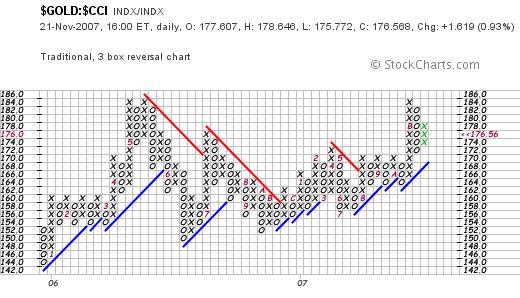
In the Long-Term...

In the Long-Term...
The economic trends that will survive this current instability.


By Irwin M. Stelzer | 25 November 2007

You've probably spent the past weeks sorting through the hourly fluctuations in share prices and interest rates, expert guesses on what the Federal Reserve Board's monetary policy committee would do to short-term interest rates, who's in and who's out at Merrill Lynch, Citigroup, and other troubled banks and brokerages, the ups and downs— well, mostly downs— of the dollar, and the other stuff of the daily financial press. So just for a change, let's look at the trends that will be more enduring, and will affect the world's economies long after the current ups and downs are forgotten.

Perhaps most important is the massive shift in the world's wealth to the developing economies of Asia and the Middle East. China and India have finally integrated their massive work forces into the globalized economy, and have become export engines— the new workshops of the world. Meanwhile, Russia and the Middle Eastern nations that float on a sea of oil are parlaying $90 per barrel prices into massive accumulations of wealth.

These funds are under the control of governments, which have created state-controlled, "sovereign" entities to invest them in pursuit not only of profits, but influence. Which profoundly changes the nature of the world trading economy. The very underpinning of the argument in favor of free trade— that it directs resources to their most efficient use— is undermined when non-economic, non-market considerations dictate the international flow of capital. And make no mistake: these funds will be invested with what Merrill Lynch calls "national strategic interests" as well as profits in mind.

Moreover, the balance of power between Western capitalists and government investment vehicles that hold huge piles of dollars and other currencies has been altered, witness the hat-in-hand trek of Wall Street deal makers to China and the Middle East in search not of silks, spices or oil, but capital.

We are not talking about a minor reallocation of the world's wealth. Some experts are predicting that the so-called Sovereign Wealth Funds— the government investment vehicles— will have $10 trillion in assets in a decade. At that size, "they are the global financial system," says Ken Rogoff, former chief economist of the International Monetary Fund. That will be grist for the mill of protectionists, already flexing their muscles. For proof look no further than Hillary Clinton's attacks on the NAFTA trade pact, considered by her husband one of the major accomplishments of his presidency.

That is only one way in which the world of business is changing. Another is the consequence of the current problems in the credit and mortgage markets, a consequence that will endure long after things have settled down in the housing market. Banks have in the past traditionally demonstrated an inability to learn from their mistakes. But in this crunch the consequences are up close and personal: bank CEOs are getting fired. That is a lesson their successors are likely to remember for some time. The result will be more expensive mortgages, and a continued decline in home ownership.

In 1994 some 64 percent of American families owned their homes; that rose to 69 percent in 2004. But the home ownership rate has since declined to 68 percent, and is headed down. The Federal Reserve Bank of Atlanta estimates that somewhere between 56 percent and 70 percent of the increase in the home ownership rate in the 1990s was due to the new, exotic mortgages that are now in disrepute, and therefore unlikely to be resurrected. So renting is likely to rise and home ownership to fall for a good long while. That means that many Americans will have to find a new vehicle with which to accumulate wealth. My guess is that the rate of saving from current income will begin to inch up, and that the political pressure to put the social security system on a sound basis will become irresistible.

Adding to that pressure will be the increase in longevity, in turn a result of a new emphasis on what is called "wellness." There can be no denying the propensity of the smoking and food police to extend their reach. That process will accelerate when a Democratically-controlled White House and congress— almost a certainty— make government an increasingly important player in health care markets. When an obese person has to pay for his own gluttony, there is little moral case for denying him the sustenance he feels he needs. When the cost of his care is borne by taxpayers— which would be the case under most of the Democratic plans— society has a good case for developing programs that will induce him to replace his burgers with salads. So look for a long-term trend toward less satisfying, healthier eating, the sale of more gym equipment, and good years for sneaker manufacturers.

Then there is the green revolution, which has been with us for some time, to little effect. But now the nation's— indeed the world's— politicians have decided that global warming is enough of a threat, or at least has captured the imagination of a sufficient number of voters, to warrant their attention and very vigorous action affecting many aspects of life. So, too, corporate chieftains, who no longer see green only as in but as "greenback,"in greener operating policies demanded by customers, investors, their work force, and regulators. In short, this green will not likely fade as quickly as have past environmental fads.

Which is both good and bad news. Good because the hunt for more efficient, cost-effective ways to use energy is accelerating; bad because hare-brained schemes such as ethanol-from-corn are leading to deforestation and higher food prices, with no appreciable net reduction of carbon emissions.

So we may be on the way to a world in which non-democratic governments dominate capital markets, protectionists interfere with the free flow of capital and goods, the dream of home ownership becomes more difficult to realize, bureaucrats decide what is permissible to eat, and the greening of the world shoehorns us into smaller cars and dimly lit rooms. Unless, of course, America decides to rely on less government intervention, and more on economic growth to propel its living standard ever upward. We'll know the answer when the next election rolls around.

Normxxx    
______________

The contents of any third-party letters/reports above do not necessarily reflect the opinions or viewpoint of normxxx. They are provided for informational/educational purposes only.

The content of any message or post by normxxx anywhere on this site is not to be construed as constituting market or investment advice. Such is intended for educational purposes only. Individuals should always consult with their own advisors for specific investment advice.
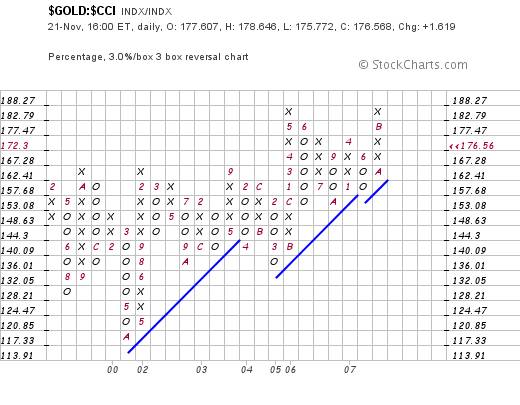
Saturday, November 24, 2007

Subprime Mortgages, Subprime Currency

Subprime Mortgages, Subprime Currency

By John Lee | 25 November 2007

Last week, US Federal Reserve chairman Ben Bernanke told the US Congress he would support raising the limit on the size of the individual loans eligible for securitization by the government-sponsored mortgage finance entities from US$417,000 to $1 million, on a temporary basis. He suggested that Fannie Mae and Freddie Mac could pay insurance premiums on these loans to the federal government, which would "act as guarantor" by taking on some of the credit risk.

Charles Schumer, the Democratic chairman of the Joint Economic Committee, enthusiastically welcomed the idea and said he would try to insert it into legislation already before Congress.

It came as Bernanke told Congress that estimates that set the total losses from subprime mortgages at about $150 billion were probably "in the ballpark". Given that the Fed and European Central Bank have already injected well over $150 billion since August, Bernanke obviously lied about his ballpark figure. But just how big is this subprime mess?

To measure subprime losses, we have to first find out the size of the subprime market. Fed data pegs the total US residential value at $20 trillion and the US residential mortgage market at $10 trillion. This number is substantial, as it eclipses the US treasury market of $9 trillion.

Of the $10 trillion mortgage market, government sponsored enterprises (GSEs) like Fannie and Freddie hold about $1.5 trillion, leaving $8.5 trillion in private hands. Within this $8.5 trillion, we have various grades and categories, with grades ranging from AAA, AA, Alt-A, BBB, and categories such as the traditional 30-year fixed, and non-traditional ARM, ARM with teaser rate, interest only, and negative-amortization.

The exact definition of subprime is not clear, with various sources estimating that the total subprime portfolio is between $1.5 trillion to $3 trillion. To precisely break down US$8.5 trillion by categories proves to be difficult. Nonetheless below is our estimate. We have valued the subprime market at $2 trillion. This is in line with an estimate by MSNBC reporter and research firm, First American Loan Performance.

So just how much of the $2 trillion subprime position is lost? Various sources including First American Loan Performance estimated a default rate of 15%; this would translate to $300 billion of non-collectable principal and interest.

That in itself is not a big deal, as every year the United States spends well over $100 billion in Iraq and $400 billion on the military outside Iraq. The real concern is how such defaults are affecting the current value of the total existing outstanding subprime portfolio. In other words, would you eat beef knowing that one in 10 cows is a mad cow?

We follow the ABX index published by Markit.com, which is the basket of derivatives linked to subprime securities. As financial tools go, this index is far from perfect, since it is barely two years old, and tends to be thinly traded. But right now it has the unfortunate distinction of being the only tool easily available to measure sentiment in the opaque subprime securities world. And in the past couple of weeks, the message emerging from this measure has started to look utterly dire, as it shows subprime mortgages are changing hands at 25 cents on the dollar.

As we have shown in the pie chart above, this 80% haircut applies to potentially $2 trillion worth of mortgages if investors of those mortgages were to exit today. The loss is not $150 billion, but more like $1.6 trillion.

What's more, the ABX shows that since September 2007, the value of AAA mortgages has begun to crater, and now trades at a stunning 70 cents on the dollar. This means if all AAA and Alt-A mortgage portfolios were to be marked to market, the loss would amount to another $2 trillion.

Despite the fact that Bernanke and the Fed moved to a neutral balance of risks assessment last week, the market now sees a roughly 55% chance that the central bank will cut rates by another 50 basis points by the close of its January policy meeting, and an additional 15% chance that it will cut by 25 points by then.

And now you understand why Bernanke was so frantic to lower interest rates and to propose the drastic policy measure of more than doubling the GSE limit to $1 million. In essence Bernanke is trying to increase the share of GSE in the pie, slowing the mortgage credit crunch perceptably, and hoping the problem will go away over time.

The curious mind asks, who holds those trillions of dollars worth of mortgages? Thanks to the genius of the American banking and marketing machine, just about every sizable institution underneath the sun with a fixed income portfolio now contains some of that 'toxic waste'. From Europeans to Asians, from banks to brokerages, from hedge funds to pension funds, institution to retail, trusts to endowments. And, it will be a cold day in hell before any of them trust their savings ever again to "those American crooks!"

Allow me to quote an FT.com article of November 1:
    [T]he experience of living through the Enron scandals earlier this decade means that the audit industry is now terrified that it could face lawsuits if it is perceived to be too lax towards its clients. So some now appear to be demanding that their banking clients reprice their mortgage assets according to the only visible market tool— namely the ABX. It is thus little wonder that some banks have suddenly been forced to increase their writedowns in recent weeks. Indeed, I would wager that the pernicious combination of ABX and the “Enron factor” is a key reason for the recent shocks emanating from Merrill Lynch.

    However, the rub is that while auditors at some Wall Street banks are becoming quasi-evangelical about the need to reprice subprime assets,
    there are still other, vast swathes of the financial system which have not yet been touched by the full blast of transparency. Moreover, many financiers outside the world of Wall Street banks remain very wary of rewriting their mortgage assets to current ABX price levels, due to a lingering hope that the recent ABX slump will prove temporary.

Most of those aforementioned outfits are in a state of shock and have been reluctant to mark their $1 trillion-plus subprime portfolio to market. Every other day there is new revelation of substantial subprime loss. First it was New Century in March, then American Mortgage and Countrywide in September, then it got worse as Wells Fargo, Bank of America, Credit Suisse First Boston, Citibank (albeit with a new CEO now) came out of the woodwork. Last Friday it was Wachovia (US's 4th largest), and on Tuesday it was Etrade. Not one major bank dealing with mortgages was immune. If there is such thing as systemic risk, we are sure looking at it, and therefore expect a lot more skeletons to come out of the closet in the months to come.

How about raising interest rates paid on the debt? Hiking interest rates on US debts is like giving a discount on mad-cow tainted beef: it’s not going to make a difference or help it sell.

At this juncture, the Fed has no choice but to redeem any and all mortgages at near face value directly, through GSEs or offshore vehicles. The more the Fed redeems, the more dollars they print. When you print $1 trillion (10%) a year, people can reasonably swallow the extra money supply, but when you print $1 trillion in a hurry and in a conspicuous way, you are directly challenging money managers’ intelligence and you will see a squeeze in gold. It’s that simple.

No sane foreign institution is now going to finance American home owners, and why should they when they can finance the Brazilians, Canadians, Thais, Russians, Chinese, Indians, all with an appreciating currency? The dollar's reserve status is now shattered. Mind you, it’s not that we are against the dollar in particular, we just don’t think any fiat currency deserves to be the world’s reserve currency.

To those who say gold is due for a prolonged correction at $800, you are missing the big picture. To us gold’s run has just started, with the emperor now naked for all to see.

Normxxx    
______________

The contents of any third-party letters/reports above do not necessarily reflect the opinions or viewpoint of normxxx. They are provided for informational/educational purposes only.

The content of any message or post by normxxx anywhere on this site is not to be construed as constituting market or investment advice. Such is intended for educational purposes only. Individuals should always consult with their own advisors for specific investment advice.
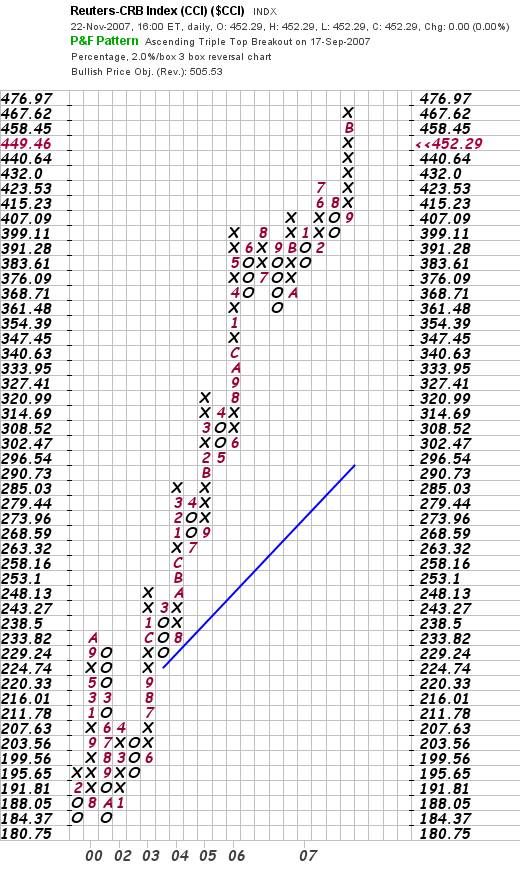
Can You Spare $1,000 Trillion?

Hey Buddy, Can You Spare $1,000 Trillion?

By sharon kayser | 23 November 2007

    I write each editorial under the impression that a major event is going to prevent me from drafting the next one. My fear almost came true. This one was scheduled to be released early October— then delayed due to an avalanche of scary news unseen before in my lifetime. The threat of 'monetary terrorism' by the world financial community has only one remedy called 'financial detoxification'. However, thanks for taking the time to read this column, which could easily have been much longer. As you will read, nobody can stop this freight train.

The story of the upcoming world crash is hidden in plain sight. Even mayor Bloomberg has jumped on the gloom and doom bandwagon: a global economic downturn was looming, triggered by the "lunacy" of public debt, he declared last month. Meanwhile denial continues. Although nearly 70% of Americans fear a recession, the possibility of a major crisis is not considered. A crisis? Not in my backyard, most of them think. It all boils down to faith. To be fair, the 'empire mentality' was born with history. Eventually, people wake up to the harsh reality that the 'empire' lied to them. The only successful government programs are wars and economic crises. When two or three decades of prosperity end with a crash and geopolitical crisis, what does this mean— frankly? Once again, the numbers tell a very different story than that we are being told. Yes dear Readers, you're not hallucinating. There is currently at least a $1,000 trillion dollar black hole in the world economy. To get the full picture, please keep on reading.

We have 600 trillion in world liabilities plus more than a 400 trillion-derivatives neutron bomb, all of which will go off when the Westerners (from EU and US) will no longer be able to borrow. The credit crisis could be just beginning according to, the Calcutta-born Australian Satyajit Das, a derivatives specialist who speaks of nearly $500tn in just derivatives. Das doesn't mince his words: "... Defaulting middle-class U.S. homeowners are blamed, but they are merely a pawn in the game," he says. "Those loans were invented so that hedge funds would have high-yield debt to buy..."

In America, the clock is dangerously ticking for consumers: the party's over, they are are truly tapped out. While it is difficult to make sense of mega-digits such as 1,000 trillion, this amount doesn't even include consumers' debts. Although it is kind of tricky to say when the credit soufflé will flatten, those grasping the dangers of a negative savings rate are already taking action. Well, anyways, the smartest— they are a strict minority at this stage. Some among the most 'cash-strapped' Americans are raiding their 401(k)s. Not knowing what is really going on, many might be prompted to turn to the $2 trillion in credit, pre-approved when times were booming, in the form of credit cards. To give you an idea of the dire situation, last May and June saw spikes in the amount of revolving debt, 12.2% and 8.4% respectively. The consumer credit 'is' the next bubble to blow without a doubt. There are a growing number of debt-laden homeowners preferring to save by using plastic first.

Delusions, survival and credit. People would rather keep accessing credit when they cannot make it financially, instead of cutting spending drastically or doing whatever it takes to stay solvent, e.g., finding an extra job. Talking of jobs, did you know that real wages peaked in 1972? Today, wages are nearly one-fifth lower— inflation adjusted!

Beyond The Climax

Now even an infusion of cash doesn't move the market anymore. The Dow Jones behaves irrationally. The economies as a whole have been rather stagnant in the West. Major European economies are on life support. They cannot overcome their costly social programs and the flood of (clandestine) immigration which is as bad as that in the U.S. [[not to mention the soaring value of the euro and the concomitant decline of European exports.: normxxx]] In a Forbes article we read that France has been in chronic deficit for 15 years. In 2005, Standard & Poor's said it may downgrade the credit ratings of Germany and Italy, two of Europe's largest economies, unless their governments reins in spending and cuts debt. In 2007, German unemployment remains stuck at 16.5% and in 2006 Berlin was reported as bankrupt. Italy was described as the 'real sick man' of Europe by The Economist in 2005. The credit crunch has also taken hold in Australia, where personal debt is worse than during Great Depression. The situation is equally dire in Britain, where house prices are even more overvalued than in the US. A financial crash cannot be ruled out, the IMF warned last month.

It Is Going To Get Worse Before It Gets Better

The latest report by Goldman Sachs makes it crystal clear: the global economy has hit a 'crunch'. The IMF predicts that the impact will be worse in 2008. The IMF and Goldman were seconded by the US Treasury Secretary acknowledging that we must prepare for a prolonged turmoil. Debt deflation is a nasty beast.

Forget about the Dow 14,000 and ask yourself frankly if you feel better off today than last year— or two years ago. That consumers must now resort to their credit cards just to pay their monthly bills while banks are tightening their standards is a bad omen. As to why they have preapproved $two trillion dollars in credit in the first place? On the one hand they try to appear wary about further credit deterioration and on the other hand they continue their reckless marketing. Their latest targets are minority homeowners on the brink of foreclosures, and college students whom they recruit as credit-card pushers to circumvent the restrictions banning credit card solicitations on campuses. Meanwhile the sin of usury continues to bankroll Congress. The US Senate okayed the debt increase to $850 billion, ignoring the remark of 'Bubble Man Greenspan' himself, when he said that the U.S. debt demand may be at the 'limit' of world resources. Cynicism knows no boundaries: the same man who just warned Congress has denied that regulators could have anticipated the problems which has caused the global credit crunch. This didn't preventing him from applauding the performance of the housing market-bubble as it was occurring! But, by early October 2007, he warned that the fate of the world economy lay with US housing.

As foreclosures skyrocket across the US and threaten to bring down real estate prices by 50% in some cities according to Yale University professor Robert Shiller, more and more we read about the unfolding world credit-liquidity crisis. Truth to be told, central banks face a liquidity trap. Only a few anchors and sound economists see the bad 'Omens' ahead as Goldman announced this very week that leveraged lenders might cut back their lending by as much as $2 trillion. We are so debt-inflated that such an outcome is going to strangle the economy.

Whether we'll be witnessing bank runs in America such as the British just witnessed (with their third largest bank— Northern Rock) remains to be seen. In the Financial Times of 2 September 2007, the following could be read:

    The Ongoing Credit Turmoil Has The Hallmarks Of A Bank Run

    The current turmoil in the financial markets has all the characteristics of a classic banking crisis, but one that is taking place outside the traditional banking sector, Axel Weber, president of the Bundesbank, said at the weekend... Some Federal Reserve policymakers also privately admit that comparisons between the current distress in credit markets and the bank runs of the 19th century, in which savers lost confidence in banks and demanded their money back, creating a spiraling liquidity crisis for institutions that had invested this money in longer-term assets, are valid... Weber's comments came as Frederic Mishkin, a Fed governor, argued for a rapid and aggressive monetary policy response to any [continued] fall in house prices. His diagnosis of the financial crisis was echoed by other experts... Paul McCulley, managing director of Pimco, said there was a
    “run on the shadow banking system”. He said the shadow banking system held $1,300bn of [defective] assets that now had to be put back onto the balance sheets of the banks...

Weren't we told the Federal Reserve was created in order to avoid precisely this type of financial hazard? Where is the point to finding out that we're now in worse shape than before the inception of the bank in 1913? Yes, back then panics were a common occurrence, although the common man was probably unaware that they were linked to the periodic overreach by bankers' reckless speculation [[and the periodic 'adjustment' of money velocity and a (relatively) fixed currency under the gold standard, resulting in the inevitable deflation of any preceding inflation: normxxx]]. Much the same behaviors occur today on Wall Street. Blaming the 'gold standard' was a myth invented for the ignorant masses, which embraced the Fed like a savior [[not true: normxxx]]. What should have been implemented is putting Congress in charge of regulating the money supply, just as stipulated by the US Constitution. Inflate or die[!?!] There is no other choice, my friends.

Irrationality plagues debt-based economies since they are backed by consumers' confidence. The willingness to take on debt goes hand in hand with the optimism that one will be able to repay in some distant future. This explains why the moral hazards linked to paper money are enormous. Most of the people [[politicians?: normxxx]] think that printing more money is the solution to all problems (e.g., Allan Greenspan), as are are 'bailouts.' But what can a 'bailout' achieve when the interbank lending business itself has broken down almost completely? In the Financial Times of 9/04/09, we read the scary headline:

    Sense of growing Crisis over interbanks deals.

    Unicredit analysts say: 'The interbank lending business has broken down almost completely.... it is a global phenomenon and not restricted to just the euro and the dollar markets... if this situation continues, it could potentially have very serious implications...

Do those at the head of our monetary institutions have a plan? Considering the current state of global finance, which is pretty well documented on http://www.moneyfiles.org, it is indeed a difficulty to make sense out of the credit market's near shutdown. Here is a NYTimes excerpt, from 9/04/09:

    ... Banks to test debt market this week: All summer, bankers have sweated on Wall Street. Instead of spending time at the golf course or at their summer houses, many found themselves in the office trying to make sense of the credit market shutdown that had left their companies responsible for the billions of dollars used to finance leveraged buyouts, yet facing uncertain prospects of getting investors to take some of the debt off their hands...

Flash back. In his 9/05/07 article, Stephen King, an HSBC banker and regular columnist at the http://www.independent.co.uk/, notes several ugly truths when admitting that in order to save the innocent, we may need to bail out the guilty. Reward for failure is a typical elite thing. It is how the powers-that-be and their cheerleaders have always colluded to save their own hides. However, this sums it up pretty well. The bailout logic is borrowed from a collectivist concept that the government is the ultimate wealth creator [[socialism for the rich; 'sink or swim,' laissez-faire capitalism for the masses! : normxxx]]. Though there is something faulty in this particular case: why can't the government just make sure that its citizens are provided with an adequate financial education instead, so the guilty can be rightfully prosecuted? On http://www.Bloomberg.com, the columnist Mark Gilbert takes a radical stance by arguing in favor of easing the money-market crisis by letting banks go bust [[unfortunately, attractive as such a course might seem, it falls under the heading of "cutting off one's nose to spite one's face!": normxxx]]. Bailouts though, merely postpone outcomes [[in the usually vain hope that something will turn up or things will get better, in the meantime: normxxx]] while frequently making them worse. 'Helicopter Ben' and the boys, by concentrating on the immediate panic as usual, seem to have chosen a course likely to completely implode the world economy. Meanwhile, the boys at Treasury are promoting a super-duper bad-loan bailout scam, as Bill Fleckenstein concludes. The truth is that Citigroup Inc. and JPMorgan Chase & Co., are just 'Enrons' waiting for their day of reckoning. And the game goes on and on. As the monetary engineers try to improve on their old tricks to save themselves from disgrace (and worse) by raising more than $60 billion, some already wonder if the 'Banks’ Stabilization Fund' will work:

    ... “It is quickly being realized that it doesn’t really solve the problems,” Joshua Rosner, a managing director at the research firm Graham Fisher & Company who had been skeptical of the proposal, told The Times. “The path they have taken of skimming off the cream from the top doesn’t resolve the fact there is poison at the bottom....”

    [ Normxxx Here:  But it just may save a few 'top' too-big-to-fail banks.  ]

Doomed Profits

What has happened over the last decades is that the world financial institutions have learned how to 'shift risks' far better than they ever have before— they think. The result of this untested assumption is that our financial security systems have remained dormant, allowing the 'easy money binge' [[of nearly unlimited credit: normxxx]] to perpetuate the illusion of wealth.

Even Chinese investors are betting all they have on a dead cat bounce. They are so infatuated with their shares that they don't hear their own lawmakers sounding the alarm:

    ..."Although listed companies achieved rapid growth, investors should still beware of hidden bubbles behind the profit surge and invest in a prudent and rational manner," said the report released on Sunday. According to the report, the interim profit figures relied too much on yield of investment in the securities market and the prospects of a continued profit increase is doubtful...

This insane credit expansion fuelled by unethical speculation will cost China dearly. Damages are already showing: rivers are so polluted that they are described as on the verge of collapse. In turn, heavy pollution is blamed for soaring birth defects and other diseases ravaging the countryside. This only on a human level. The economic fallout will be unprecedented.

It is all a matter of psychology and the perception of endless good times. Yet nothing can prevent the world economy from eventually falling off a cliff. Hard data always wins in the end. One does not wipe out $1,000 trillion in world liabilities just like that, even if it is only electronic or 'virtual' debt. Strangely, it is rare to see 'super bulls' and 'perma-bears' converge: the bulls by calling for bailouts and the bears by nodding in pessimistic agreement. The profits of doom will be soon causing the next shocks to the broad market.

    Those who are forecasting Armageddon in the hope that the Fed will come to the rescue are, for the most part, stock market perma-bulls. But, strangely, their views are shared by their opposites, the so-called perma-bears. Perma-bears have long argued that the American economy in general (and the housing market in particular) represents an unsustainable bubble, inflated by cheap credit and a dramatic mispricing of risk. Convinced that the downturn they have forecast is finally here, they write off as fantasy any signs that the rest of the economy might weather the housing and financial-market storms.

Both groups now envision the perfect storm coming our way.

Now comes the nasty 1,000 trillion dollar question: what will credit granting institutions say after the crash, when increasing scrutiny will quickly focus on them as the culprits chiefly responsible for all of the wanton speculation?

Lethal Collusion Exposed

In the FTimes last month again, one could read that credit rating agencies were being investigated for their symbiotic relationship with investment banks in the EU.

    Axel Weber, President of the Bundesbank, said:
    “What we are seeing is basically what we see underlying all banking crises.” In America the response has been less sharp but critical nonetheless, the same FTimes columnist reports. Of course the rating agencies deny any wrongdoing. This shouldn't come as a surprise. They have always done so. The sleeze just became more blatant during the subprime debacle. Now that the damage is done, the S.E.C is probing the ratings agencies' subprime role. According to CBS, last September, the federal agency still hasn't come to any conclusions about the rating agencies' explanations for 'unexpected losses' on those [AAA rated] assets. Remember Enron? How many people are currently jailed? And they will be repeating the charade once again when the consumer credit bubble pops. How is it possible that they turned a blind eye to the build-up of a $1,000 trillion
    black hole, do you think?

Ellen Brown has probed a 300 year-old scheme maintained in place (despite the boom-bust cycles) with the complicity of the man in the street who views the government and central bankers as 'wealth' managers. The cliques at the top, which have long profited from the ignorance of the masses, are now themselves faced with boomerang effects. For them too, chickens have come back home to roost.

Do you believe me now when I speak of a 'financial detox' whose consequences may be as severe as the great depression? We didn't get here because of a plethora of regulations, but rather through a lack of regulation and enforcement which allowed 'exotic' financial products, instruments, and institutions (credit derivatives, mortgage backed commercial paper, CDOs, CDSs, SIVs, hedge funds, etc) to flourish. A way to recycle debts, good or bad [[mix a little of the 'toxic' stuff with everything else, and who will notice? Except that they did! : normxxx]]. I don't know how most of these instruments work, but in the Asia Times, James Cumes, describes this financial addiction quite well:

    When everyone in the house is crazy, only the sane seem like fools. So it was when the financial addiction spread everywhere. Then everyone who was not taking his daily dose of heroin or cocaine became the fringe-dweller, the oddball, the brake on progress, the party-pooper at the greatest no-cash-down, how-to-spend-it shindig that our planet has ever known. Debt piled on debt everywhere: in households, corporations, public finances and international deficits, in magnitudes that had never been even glimpsed in the most creative imaginations before.

Back To The Basics

Optimism doesn't encourage one to worry much about piling on debt, and until the loan is spent, generally a feeling of invincibility may be experienced. But credit happiness is short-lived. Just as with drugs, there is a withdrawal.

Although consumer borrowing is a very important part of the equation, debt monetization (or recycling) between banks might be even more so. Currently lending between banks has virtually ground to a halt. In the EU, we're talking of $100bn that should have been dealt with last August. In the UK it was a matter of 70bn over the next 10 days (in a article written in August). More alarmingly, ECB made 269-billion euro refi offer as market tensions persisted as of 09/12/07. Not only have banks created a monster in the first place; now they want us to believe that just printing money to pay debt is the safest bet on earth. The Bank of England Governor must be sweating heavily though. He recently declared that markets are 20% overvalued and poised for severe fall.

On September 9, another HSBC executive endorsed 'the credit squeeze' on CBSMW but with a much gloomier tone. The worst is not over. According to him it is all about damaged confidence among the market players that needs to be restored. Confidence is broken and the outcome will be 'the crash of the millennium' that Dr. Ravi Batra described:

    ... we are now more overvalued than Japan was in 1990. So certainly most American financiers know we are in a bubble economy, but they hate to admit it because they think that they are one way or another responsible for it.... That could lead to a political/social revolution, but I do not believe it will lead to a dictatorship. I think we will see the rule of money end and that we (the majority of Americans and citizens around the world) will benefit by a tremendous revolution... Well, first there will be a lot of destruction of money.

Investors and non-investors alike will learn the hard way that seduction is the root of all evils. Indeed, how seductive is it to entice people to save via 401ks and IRAs in order to avoid taxation. Or, encouraging the use of credit cards to buy most anything and making plastic a way of life. Or, the use of super 'performance' bonuses which entice CEOs into cooking their books. All forms of short-term financial gambling that promotes the 'pump and dump' mentality. (It is interesting to note that while the average CEO's salary was about 25 times more than the average worker in the 70's, by 2005 it had shot up to 465 times more! But this was largely due to the fact that in the modern corporation the CEO largely controls his own salary!) The worst form of seduction is without a doubt the cheap interest rates set by the central banks which provide everyone with nearly cost free credit (or actually free, sometimes, when the inflation rate is subtracted to arrive at real costs— indeed from time to time the BOJ was actually paying banks to borrow money!) Credit which spends just like real money (until there is a 'crunch'). Moreover, like any form of 'easy' money, cheap interest rates tends to promote corruption and predatory financial practices.

In short, providing everyone with 'free' or 'nearly free' money (credit) promotes a speculative frenzy in which morality tends to be lost (there ceases to be any virtue in frugality or the efficient use of money/credit). And this looks very sordid when the story behind a boom is finally revealed during the next bust. Such trends may go away the day the average investor will understand that becoming a 'fat cat' in a short period of time is generally the result of good luck and an easy virtue— often at the expense of the gullible being lured into various kinds of schemes. And, asking the government for more 'protective' regulations, does not address the fundamental problems.

Something Fishy

Every year, worldwide, thousands of college students in economics are recognized by their peers. A distinction they welcome proudly as the door to brilliant career opportunities open. If they have the right connections or graduate from the right universities, all the better: many will end up working for big financial firms or at top government posts or centrals banks. Although it surely is amazing that our fate lies in the hands of these 'prominent' people, one does not need a PhD in economics to understand why the obsession with economic growth dominates all political debates, and why lawmakers (whose jobs depend on the 'well being' of the voters) make employment a high priority of theirs. To grasp the rhetoric behind the numbers, however, one has to look closely to see why 'growth and GDP' are in fact a tale concealing one of the most blatant fallacies ever.

Although this is a constant in the so-called rich countries, let's use the example of the USA. How does it come about that the twin deficits are ever increasing, and the national debt just went past 9 trillion dollars? Finding items 'made in America' has become a veritable treasure hunt— despite the boom in the US! The problem is that the word 'economy' is an abstraction. The American 'economy' is something sustained by Americans, and is largely the result of the American state of mind.

Basing the GDP largely on an ever increasing level of consumption is likely to prove fatal since it is impossible to live beyond one's means forever. If you want to find an explanation to the business cycles, here it is.

The End Of Conventional Wisdom

The GDP fairy tale has been conventional wisdom for decades. Anyone having a good sense of logic can see the hoax of a model based on unlimited debt expansion and unlimited consumerism. Spend or die is economic cannibalism in the end as we increasingly consume/spend our resources for useless doo-dads. One does not need to be a rocket scientist to ponder the origins of our $1,000 trillion liability. To be fair, there are other ingredients contributing to the mess we find ourselves in today, but since economics is the principal way to gauge our current Western society, for the sake of our survival we must reject the theory of unlimited, exponential growth. Dr. Ravi Batra may not be a dreamer after all.

Normxxx    
______________

The contents of any third-party letters/reports above do not necessarily reflect the opinions or viewpoint of normxxx. They are provided for informational/educational purposes only.

The content of any message or post by normxxx anywhere on this site is not to be construed as constituting market or investment advice. Such is intended for educational purposes only. Individuals should always consult with their own advisors for specific investment advice.
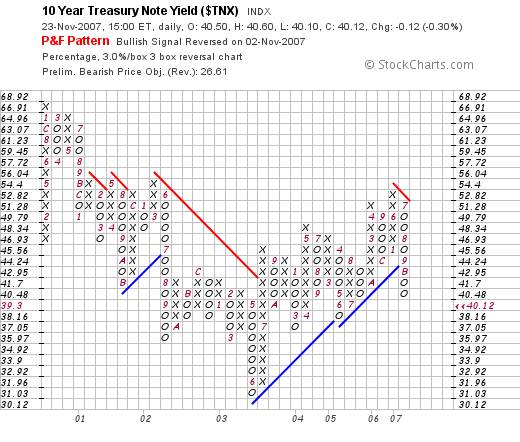
Friday, November 23, 2007

A Primary Bear Market

A Primary Bear Market

By Richard Russell, (snippet) Dow Theory Letters | 23 November 2007

Extracted from the Nov 21, 2007 edition of Richard's Remarks

    It was a noble battle, it was a battle that seemed almost endless. But today the great battle ended. Today [Wednesday] the D-J Industrial Average closed below its August 16 low of 12845.78, thereby confirming the prior violation of the Transportation Average. In so doing, the stock market and the Dow Theory have spoken— they have confirmed the existence of a primary bear market.

One of the precepts of the Dow Theory is that neither the duration nor the extent of the primary trend can be predicted in advance. I have absolutely no idea whether this is fated to be a mild bear market or a severe one.

Well, there is one hope and one hint. The most authoritative bull or bear signal comes when both Averages, Industrials and Transports, break through critical levels simultaneously. That is not what happened in the current instance.

The Transports broke under their August 16 low of 4672.35 back on November 7. Today the Industrials finally confirmed, so the bear signal was not given simultaneously. If there is even a hint that this bear market will be "kind," this is the hint, but I'll admit that this line of reasoning may be far-fetched. The fact that we must operate on is that the primary trend of the stock market is now definitely bearish. The great primary trend of the market is pointing down.

I've done my best to prepare my subscribers for this possibility. True, I did continue to "hope" that the Dow could stave off a break below 12845.78. The Dow did resist that situation for week after week. Alas, the support gave way, and the Dow succumbed.

What to do now? I don't have any magic formula. Prudence dictates that we be light, very light, in our holdings of common stocks. Those subscribers who are holding top-grade dividend-paying equities may decide to sit tight. Those subscribers in the "compounding business" with large reserve funds may decide to weather the storm, collect the dividends, and continue to compound, buying additional shares at whatever price the market may offer at the time.

Those with large stock holdings may simply decide to cut back. After all, a lot can be said for the luxury of a good night's sleep. Personally, I've chosen what I call the "way of the sleeper." I'm very low on common stocks, in fact the only common stocks I now hold is a limited position in GDX, the exchange traded fund for precious metal shares.

Thought— the market was oversold or actually severely oversold as of yesterday's close. [The] big break today renders the stock market oversold to the extreme. This could lead to a rally very shortly [[it did, today, Friday: normxxx]], and such rallies often take the Averages back to test their initial breakdown levels. If we do get such a rally, it would provide subscribers with a second chance to lighten up.

Note that the S&P and the Wilshire have NOT confirmed the Dow. In one of the strangest situations I've ever dealt with, neither the S&P 500 or the Wilshire 5000 have confirmed the Dow in that neither the S&P nor the Wilshire have violated their August 16 lows. What is the meaning of this absolutely weird situation? I don't know— honestly I really don't know. But it is certainly something to think about.

Does the superior action of the S&P and the Wilshire cast doubt on the Dow Theory bear signal? I don't know. I've never in fifty years of watching market action seen this type of situation.


There isn't a lot more that I can say that is worth saying. The market has told its story. The scene has changed. I've lived through these changes before, and so have my subscribers. A few of my subscribers have been with me for almost 50 years. We've survived and done pretty well over those 50 years. We will continue to survive, regardless of the mildness or ferocity of this bear market.


Click Here, or on the image, to see a larger, undistorted image.


Click Here, or on the image, to see a larger, undistorted image.

charts courtesy of stockcharts.com

This is an adage that I dreamed up many years ago, but I'm afraid that it's just as true today—
"In a bear market, everyone loses, and the winner is the one who loses the least."

Normxxx    
______________

The contents of any third-party letters/reports above do not necessarily reflect the opinions or viewpoint of normxxx. They are provided for informational/educational purposes only.

The content of any message or post by normxxx anywhere on this site is not to be construed as constituting market or investment advice. Such is intended for educational purposes only. Individuals should always consult with their own advisors for specific investment advice.

Waiting For The Positive Season

(Impatiently) Waiting For The Beginning Of The Positive Season

    I've been watching for signs that the worst was in, in order to become more aggressive with the idea that initiating or adding to long positions made sense.

In particular, I was looking for a reversal, that put us once more into decisively positive territory, of the prior large gap down, or an explosion in the number of new 52-week lows on the NYSE to 800 or more, or a move in the S&P 500 cash index down to 1400 - 1410.

It was touch-and-go during various parts of Wednesday and today for all three of those conditions, but by the close none of them were actually met. As hard as this kind of constant intraday disappointment is to see, it's getting us that much closer to what appears to be a high-probability opportunity.

I'm basing that on everything that's happened over the past one to two weeks, along with some new developments. As of today, the spread between smart money confidence and dumb money confidence has moved to an extreme reading. This is not something that occurs often, and it usually pays to take notice.

Over the past decade, there have been 68 days that showed a spread this large. One month after those days, the S&P 500 was positive 63 times (93%) by an average of +5.7%.

Going back even further, the one-month return has been positive about three-quarters of the time, with an average return of +2.5%. The three-month return averaged +6.7% with 93% of the days showing gains. There are a number of other indicators flashing strongly green; excellent times to be thinking about the long side.

This November has been wicked, the worst since 2000. Over the history of the S&P 500, the current month is showing one of the very worst intra-month November drawdowns— the fifth-worst, in fact. I then checked for any other time that November showed an intra-month drawdown of at least -5%— and how the following December tended to fare.

Out of the 10 occurrences, December showed a positive return 8 times, or 80%. (although one of the two fails was barely a miss, with a -0.2% return). The overall average return for those ten Decembers was +3.1%, nearly a random December. The average intra-month drawdown was -3.1% (worse than random Decembers), but the average intra-month gain of +4.7% was quite a bit above random Decembers. Based on this type of analysis, it seems as though while December may have a chance at being more volatile than normal, we should have a better-than-average chance at seeing bigger gains.

Not much though; the market is normally up about 70% of the time.

From an entry point of view, it would be nice to see that final big whoosh day that gives us the true panic readings that we've seen a number of times at important market lows— things like that 800+ number in the NYSE new low figure I mentioned earlier. The longer we get this dragged-out drip drip action (one day up, one day down), the more it wears on early buyers and the more likely it will ultimately result in one of those "puke" sessions. Better to get it out of the way sooner rather than later.

It would have been highly unusual to see something like that today, which is shortened by the holiday and enlivened by the actions of the bit players— with everyone else having left on holiday. But maybe we'll see it on Monday with weak Black Friday reports or some other excuse. Whatever happens, we currently have a multitude of reliable metrics screaming for some kind of relief, and which consistently precede very favorable intermediate-term conditions. I'm still concerned about the technical condition of the broad indices like the S&P 500, which appear very tenuous for the near term, but other than that it seems as though this weakness should be more than made up when taking an intermediate-term view of one to three months.

So far then, if you also believe the portents of the Dow, the near term is equivocal to weak, the intermediate term is chomping at the bit to try for a new high, and the long term is BEARISH.

Normxxx    
______________

The contents of any third-party letters/reports above do not necessarily reflect the opinions or viewpoint of normxxx. They are provided for informational/educational purposes only.

The content of any message or post by normxxx anywhere on this site is not to be construed as constituting market or investment advice. Such is intended for educational purposes only. Individuals should always consult with their own advisors for specific investment advice.

Thursday, November 22, 2007

Dow Theory Says SELL

Dow Theory Says SELL

By Mark Hulbert, MarketWatch | 22 November 2007

ANNANDALE, Va. (MarketWatch)—
    With the Dow Jones Industrial Average's finish on Wednesday below its August lows, the three Dow Theory newsletters I track are solidly in the bearish camp. The Dow Theory, for those not familiar with it, traces to a series of editorials that appeared over the first three decades of the last century in The Wall Street Journal. Those editorials were written by William Peter Hamilton, then the editor of that newspaper, on the basis of conversations he had with Charles Dow, the founder of Dow Jones & Co., the newspaper's publisher. (Dow Jones is the owner of MarketWatch, the publisher of this column.) Hamilton's editorials leave lots of room for followers to argue over the more esoteric points of the theory.

But the general outlines are clear enough of what is required to trigger a Dow Theory sell signal:

  1. Both the Dow Jones Industrials Average ($INDU) and the Dow Jones Transportation Average ($TRAN) must undergo a significant correction from joint new highs.

  2. In their subsequent rally attempt following that correction, either one or both of the averages fail to rise above their precorrection highs.

  3. Both averages must then drop below their respective correction lows.


Step No. 1 began this past July, by the correction that began from that month's highs. Step No. 2 was satisfied during the rally that began from the market's mid-August lows, in which the Dow Jones Transportation Average failed to surpass its precorrection high.

With the DJIA's close on Wednesday below its August lows, Step No. 3 is now satisfied too, since the DJTA earlier this month had already closed below its August lows.

Why should you care about the Dow Theory?

One reason is that many investors pay close attention to it. I suspect that was one of the reasons that the DJIA seesawed all day Wednesday above and below its August closing low of 12,846. In fact, it wasn't until the final few minutes of trading that it became clear that it would close below that level, and thereby trigger a Dow Theory sell signal.

    The Dow Theory's popularity should trigger additional selling when investors currently on vacation return from their Thanksgiving holidays, either on Friday, or more likely this coming Monday.

Another reason to pay attention to the Dow Theory: Its long-term track record is good. Confirmation comes from none other than the Ivory Tower, which traditionally has pooh-poohed the notion that the stock market could be timed.

Consider a study conducted in the mid-1990s by three finance professors— Stephen J. Brown of New York University, William Goetzmann of Yale University and Alok Kumar of the University of Texas at Austin. They fed Hamilton's market-timing editorials from the early decades of the last century into neural networks, a type of artificial intelligence software that can be "trained" to detect patterns.

Upon testing this now "trained" neural network version of the Dow Theory over the nearly 70-year period from 1930 to the end of 1997, they found that it beat a buy-and-hold by an annual average of 4.4 percentage points per year [[That's a HUGE amount! Over 40 years, it would have outperformed buy-and-hold by 560%.: normxxx]]. Their study appeared in the August 1998 Journal of Finance

Normxxx    
______________

The contents of any third-party letters/reports above do not necessarily reflect the opinions or viewpoint of normxxx. They are provided for informational/educational purposes only.

The content of any message or post by normxxx anywhere on this site is not to be construed as constituting market or investment advice. Such is intended for educational purposes only. Individuals should always consult with their own advisors for specific investment advice.

Wednesday, November 21, 2007

SIVs Hit Norway Towns

Citibank SIVs Hit Norway Townships
Several Norway townships are caught up in the international credit crisis.


    [ Normxxx Here:  Why it will be a cold day in hell before the U.S. sees much in the way of any new euros.  ]

By Mike Shedlock | 21 November 2007

Several small townships in northern Norway went along with a securities firm's advice and invested as much as NOK 4 billion in complicated American commercial paper sold by Citibank. They now risk losing it all.

The township politicians are both embarrassed and angry at the financial advisers who they now claim led them astray. "They think we're a bunch of small-town fools," one local mayor told newspaper Dagens Næringsliv.

Officials in four northern Norwegian townships (Narvik, Rana, Hemnes and Hattfjelldal) went along with an alleged recommendation by Terra Securities to invest a total of NOK 451 million in what they're now calling "high-risk structured products" offered by Citibank and sold for Citibank by Terra.

To boost returns, the Norwegian townships also borrowed NOK 3.5 billion to invest in Citibank's products, which later lost as much as 50 percent of their value because of the US credit crunch.

By now it should be clear that Asset Backed Commercial Paper ABCP problems are likely to turn up anywhere and everywhere.

Here is a small sampling:

  • Two Bear Stearns (BSC) Hedge Funds went to Zero

  • Two Hedge Funds in Australia liquidated

  • Money has been frozen in Canada including the Yukon

  • US and Canadian pension plans are affected

  • Two banks in Germany were bailed out by the ECB

  • Norway Townships borrowed money to invest in this mess

  • Citigroup (C) and Merrill Lynch (MER) both lost their CEOs over this mess

  • Hundreds of $billions in potential losses are still circulating

The latest news in the US is that SIV debts are hiding in scores of public school funds and close to a $billion in defaults losses had not even been disclosed as late as a week ago even though this mess has been brewing for six months. See SIV Debts A Disaster For Public School Funds for more on this story.

Some Very Expensive Lessons

  • Don't chase yield

  • Don't buy something you do not understand

  • There is no free lunch

  • Rating agencies opinions are essentially worthless because they are never timely enough and because their business model creates enormous credibility as well as conflict of interest issues

  • Don't trust Citigroup, Bear Stearns, Merrill Lynch or anyone else hawking debt

That last point is critical. Lack of trust will impact Citigroup, Bear Stearns, and Merrill Lynch's credibility, as well as their ability to raise capital for years to come. Trust once lost, is not easily restored.

Normxxx    
______________

The contents of any third-party letters/reports above do not necessarily reflect the opinions or viewpoint of normxxx. They are provided for informational/educational purposes only.

The content of any message or post by normxxx anywhere on this site is not to be construed as constituting market or investment advice. Such is intended for educational purposes only. Individuals should always consult with their own advisors for specific investment advice.

Fed: Slowdown to Deepen

Fed Expects Slowdown to Deepen

By Edmund L. Andrews, NYT | 21 November 2007

WASHINGTON, Nov. 20—
    The Federal Reserve expects economic growth to slow sharply next year, and policy makers there are worried that even this forecast may prove too optimistic, according to an assessment that the central bank released on Tuesday. In a new effort to be more open, the Fed released a detailed forecast that summarized the predictions of the Fed governors and regional bank presidents.

It also reported their disagreements, which almost all centered on how much the broad economy is likely to be damaged by the surge in oil prices and the tight credit markets brought on by the recent severe problems in housing and mortgage lending. At the same time, Fed officials expect unemployment to rise only slightly and inflation to edge down. In a shift from three weeks ago, the officials said they agreed that recent evidence of slowing inflation was more than a temporary blip and would "likely be sustained."

Neither the forecast nor newly released minutes from the Fed’s last meeting on Oct. 31 mentioned the chances of a recession. But the new predictions are low enough that, if borne out, the economic situation might well feel like a recession to many people. The forecast, which was much anticipated, did nothing to end the battle of wills between Fed officials and Wall Street over the need to reduce interest rates for a third time this year when the rate-setting Federal Open Market Committee meets next, on Dec. 11.

Investors did not seem to know how to react to the information. Share prices initially dropped after the report was released, possibly in reaction to the reluctance that the policy makers had expressed toward cutting rates last month. But prices bounced back and ended the day modestly higher, possibly in response to the Fed’s reduced alarms about inflation. The Dow Jones industrial average rose 51.70 points, or 0.40 percent, to 13,010.14, after making 100-point swings in both directions. That followed Monday’s drop of more than 200 points. Many Nasdaq or small stocks were flat or lower.

Fed officials have signaled in recent speeches that they do not want to cut rates anytime soon, saying their cuts in September and October would be enough to keep the economy out of recession. Indeed, many of them were already uneasy about their last cut in the benchmark federal funds rate on Oct. 31, to 4.5 percent from 4.75 percent. According to the minutes of that meeting, Fed bankers saw that decision as a "close call."

But many investors continue to bet heavily on a rate cut in December, and some economists and Wall Street analysts argue that the economy will come much closer to stalling than the Fed now assumes. "I think what we’re really debating here is the timing," said Stuart Hoffman, an economist at PNC Financial in Pittsburgh. "Whether or not it happens on Dec. 11, my guess is that by the March meeting, the Fed funds rate will be 4 percent."

The new forecasts for growth next year in the gross domestic product range from 1.6 percent to 2.6 percent. That is both lower and more uncertain than in June, when the forecasts ranged from 2.5 percent to 3 percent. "Most participants viewed the risks to their G.D.P. projections as weighted to the downside," the central bank said in its summary of the last policy meeting.

The new assessment shows that policy makers still see only limited evidence that the problems in housing and subprime mortgages have damaged the broad economy. The "central tendency" of policy makers’ individual forecasts calls for economic growth in 2008 of 1.8 percent to 2.5 percent. Growth in 2007 is expected to be 2.4 percent to 2.5 percent.

As a group, the Fed policy makers expect "subpar economic growth" over the next year. They also predict that unemployment will edge up to as much as 5 percent next year, compared with about 4.7 percent today. But the new report shows that they are much more worried that the downturn in housing and the problems in mortgage markets could cut deeper into the overall economy.

They also appear to have reduced their estimates about the nation’s long-term potential rate of growth without inflation, often described as the economy’s speed limit. The potential growth rate is based on estimates of future productivity growth and increases in the population. Until recently, most economists estimated a potential growth rate of 3 percent a year. But Fed officials appear to have reduced that to about 2.5 percent, with an assumption that productivity will climb about 1.5 percent a year. That would be much slower than in the 1990s.

The new forecasts represented the Federal Reserve’s latest step from secrecy toward openness, an evolution that has been under way for two decades. The Fed is now releasing its economic forecast four times a year, rather than twice, and the new forecast looks ahead three years instead of two. Because the outlook stretches further into the future, and assumes that the economy will be shaped by "appropriate" monetary policy, the new outlook implies what Fed officials think is both possible and desirable.

The new forecasts predict that inflation will range from 1.5 to 2 percent in 2008 and 2009. That is slightly higher than the range of 1 to 2 percent that the Fed chairman, Ben S. Bernanke, has mentioned in the past. But it is roughly consistent with what analysts have long considered the Fed’s unofficial target for inflation. Analysts cautioned that the forecast was muddier than it might appear. That is because it is an amalgam of individual forecasts from each of the Fed’s 12 regional banks and from each of 7 Fed governors. As a result, the consolidated predictions for growth, employment and inflation can seem at odds with one another.

One incongruity, for example, is that the Fed forecasts significantly slower growth over the next year but only a modest increase in unemployment to 5 percent— still a low level judged by long-term perspectives. Ian Shepherdson, chief United States economist at High Frequency Economics, said he would take the Fed forecasts with a grain of salt.

"The Fed is just as beholden to the short-term, high-frequency data as it ever was," he wrote in a note to clients. "We do not propose in the future to devote much time to the Fed’s now-quarterly forecasting exercise."

Normxxx    
______________

The contents of any third-party letters/reports above do not necessarily reflect the opinions or viewpoint of normxxx. They are provided for informational/educational purposes only.

The content of any message or post by normxxx anywhere on this site is not to be construed as constituting market or investment advice. Such is intended for educational purposes only. Individuals should always consult with their own advisors for specific investment advice.

Critical Point

Critical Point
Click here for a link to complete article:

By John P. Hussman, Ph.D. | 21 November 2007
All rights reserved and actively enforced.


    “The crisis takes a much longer time coming than you think, and then it happens much faster than you would have thought.”
    — Rudiger Dornbusch, MIT Economist

Financial and economic conditions are becoming increasingly strained. The litany of concerns include:

Rich valuations, particularly on normalized earnings— if profit margins were anywhere near the highs of prior economic cycles, the S&P 500 P/E ratio would still be above 20 (the 1929, 1972 and 1987 peaks occurred at similar multiples, while other historical bear market declines began at lower multiples, often with interest rates no higher than at present)

Emerging pressure on profit margins, with wage pressures, materials prices, rising import costs, loan losses, and unit labor costs all threatening to normalize the record profit margins of recent years

Enormous current account deficits, and the likelihood that improvement in the current account will be matched by deterioration in gross domestic investment (as has historically been the case)

Mountains of dodgy debt securitized into "investment-grade tranches" representing the claims on the initial set of payments, and lower tranches representing claims on more distant payments, all of which are increasingly being downgraded to junk status. As economist Jan Hatzius of Goldman Sachs recently noted, if a large part of this loss (he estimates a likely $400 billion) is borne by leveraged institutions, the loss to capital will lead to a reduction in lending. "There's a great deal of academic research that indicates that financial institutions tend to resist declines in their capital ratios in a difficult environment. It's going to mean another restraint on economic activity." The Problem with Financials details my views on this.

Rising delinquency and foreclosure rates, which are very predictably in the early stages because the spike in mortgage resets only started in October of this year, suggesting that the real surge of delinquencies won't be seen until the first quarter of 2008, with foreclosures surging even later.

Despite hopes that the Fed can reverse these pressures, the fact is that the entire amount of "liquidity" added to the banking system by the Fed in the past four months amounts to about $15 billion (in a banking system with a thousand times that in loans and assets). On Thursday, several news stories reported that the Fed "pumped $47.25 billion of liquidity into the banking system," the highest total since September 2001— but you'll find once again that $40.5 billion of that was pure rollovers of existing repos (which Thomson Financial noted in a news story the day before as my ballpark expectation). The rest is pre-holiday liquidity to accommodate demand for cash. Investors are deluding themselves when they count each rollover of a 3-day, 7-day or 14-day repo as new money. It's the same stuff, rolled over to retire the maturing stuff. The amount of outstanding repos is currently only about $15 billion more than its lowest 30-day average over the past year.

As Jim Stack of Investech recently noted, a market drop of even the recent -7.1% following a third discount rate cut has happened only 3 times in the past 80 years: February 1930, July 1982, and March 2001. In each case, the economy was already in recession (or worse). "Those are not the kind of odds that make one feel comfortable in today's uncharted waters." I should add that while the 1982 instance was different than the others (in that it was followed by very strong market returns), this is because the S&P 500 price/peak earnings multiple in July 1982 was already less than 7. These periods are also interesting for another reason: if you look at what happened to S&P 500 earnings over the following year, you'll find that earnings plunged in each instance. 1930:— 39.4%, 1982:— 15.9%, 2001:— 49.8%.

The level of my concern should (and is intended to) strike long-time readers of these comments as unusually high. Over the years, I've consistently emphasized that my discussion of the market's return/risk profile generally does not imply any "forecast." Historically, every Market Climate we identify includes both positive and negative returns— it's just that the mean and variance (the average return and risk) are different enough to justify varying exposures to market fluctuations. When we adhere to those various exposures over the complete market cycle, our expectation is that we will achieve higher overall returns and smaller periodic drawdowns than a passive buy-and-hold approach. Since we focus on the average return and risk associated with each Market Climate, individual short-term forecasts aren't required, so I usually avoid them.

Still, there are occasionally situations where the set of conditions becomes so extreme that we observe them only before significant shocks. In the past few months, I've emphasized two such "Aunt Minnies;" one related to stock market risk, and one related to recession risk. Accordingly, I've used the term "warning" in recent weeks, which I don't take lightly.

A Who's Who of Awful Times to Invest:
Click Here

Expecting A Recession:
Click Here

In short, the financial markets are at a critical point. It's possible that investors will somehow adopt a fresh willingness to speculate, but my impression is that in the weeks ahead, investors will be forced to recognize that recession risk has tipped. That's not to say that this realization will produce one-way market movements. Seasonal factors tend to buoy the market a few trading days before holidays and a few days around the turn of each month, and as I noted last week, oversold conditions lend themselves to "periodic short squeezes and spectacular but short-lived rebounds" (which we observed on Wednesday before quickly eroding). So we will almost certainly observe advances driven by investors frantic to "buy the dip" and "catch the rebound." Overall, however, the return/risk profile on both stocks and the economy as a whole appear increasingly lopsided toward bad outcomes.

As I emphasized last week, my intent here is not to encourage investors to depart from carefully considered investment strategies. The real issue is that investors tend to overestimate their ability to stick with large (often inappropriate) exposures to equities during significant market downturns. I hope to encourage investors to carefully consider their ability to withstand a standard, run-of-the-mill 30% bear market loss (which has historically occurred once every 5 years or so) without deviating from their investment plan. Investors who can't believe that that sort of decline is, in fact, standard and run-of-the-mill are probably already in trouble because they haven't bothered to look at the data. None of this requires that we forecast or necessarily expect such a decline. But investors emphatically should not rule out such a decline in considering their investment exposure.

As even Jack Bogle concurred in a Friday CNBC interview "I think the probability of a recession is about 75%." When asked how investors should respond, he answered "I would say do nothing— ride it out, if your asset allocation is right. The bonds in your portfolio and the long-term growth of businesses will bail you out. Unfortunately 80% of the market is speculators now, not investors. What would I say to the speculator? I would say I'm nervous and I might even say get out."

As for our own investment strategy, we may observe opportunities to cover some short call options or vary our investment exposure modestly, depending on the behavior of market action, but we are likely to remain predominantly hedged until we observe a clear improvement in market internals or valuations.

Meanwhile, shareholders can trust that I don't play in minefields with shareholder assets. We don't remove a significant portion of our hedges in overvalued markets with poor market action in an attempt to "play" purely technical bounces of unpredictable size and duration. The intent of the Strategic Growth Fund is to outperform the S&P 500 over the complete market cycle, with smaller drawdowns than a buy-and-hold approach. The Fund is intended for no other shorter-term objective.

I should also note that our various holdings in technology and small-cap are largely hedged with non-S&P 500 indices such as the Russell 2000 and Nasdaq 100. So while the difference in performance between our stocks and our hedges will continue to be our primary source of expected return, as well as day-to-day risk, I believe that our hedges are appropriately matched to our stock holdings.

Market Climate

As of last week, the Market Climate in stocks was characterized by unfavorable valuations and unfavorable market action. Internals continue to deteriorate, and with default spreads (corporate yields minus straight Treasury yields) widening to fresh highs and our own measures already anticipating a recession, this is not an environment in which we are likely to "buy the dip" except perhaps by covering a modest number of short call options, leaving put option defenses in place. As I've noted before, one of the best indicators of oncoming recession is a spike in the spread between 6-month commercial paper and 6-month Treasury bill yields. Now that we observe this and a broad mix of other warnings, whatever effectiveness "buy the dip" has had in prior instances is not likely to persist in the present case.

In bonds, the Market Climate remained characterized by unfavorable yield levels and favorable yield trends. Bond prices have extended their strenuously overbought run, which is a testament to increasing risk aversion, but presents risks of its own. It's difficult to believe that investors in say, 10-year Treasury bonds are really willing to accept annual total returns of just 4.15% for the next decade, and to the extent that they will probably demand somewhat higher returns over time, it implies that some part of the recent Treasury market rally is inherently speculative. To some extent, I think the speculation over the short-term will be correct, but we're much more comfortable with TIPS than straight Treasuries, and even there we've clipped our exposure a bit on the recent price strength.

Historically, the yield curve has tended to steepen during recessions, meaning that long-term rates either fall slower than short-term rates, or increase (which they have done, on average). While I don't place much faith in Fed actions (other than for psychological effect), Fed officials have attempted to discourage expectations for further cuts in the Fed Funds rate, most likely because of the weakness in the dollar, combined with the 4% year-over-year headline inflation rate that is virtually baked-in-the-cake for the November CPI. That may cause some re-adjustment in short-term rates, and in turn, a quick spike in long-term rates (not that I expect it would develop into a sustained uptrend). In any event, we'll continue to respond to such yield spikes, if they occur, to modestly boost our exposure in TIPS.

In precious metals, the Market Climate remains positive, and the recent pullback in precious metals shares gave us a good opportunity to slightly boost our exposure, to just over 12% of assets in the Strategic Total Return Fund.

  M O R E. . .

Normxxx    
______________

The contents of any third-party letters/reports above do not necessarily reflect the opinions or viewpoint of normxxx. They are provided for informational/educational purposes only.

The content of any message or post by normxxx anywhere on this site is not to be construed as constituting market or investment advice. Such is intended for educational purposes only. Individuals should always consult with their own advisors for specific investment advice.

The Panic of 1907

The Panic of 1907 (Book Excerpt)
Click here for a link to complete article:

By TheBigPicture | 21 November 2007


The Panic of 1907: Lessons Learned from the Market's Perfect Storm"
by Robert F. Bruner (Author), Sean D. Carr (Author)

I previously mentioned The Panic of 1907: Lessons Learned from the Market's Perfect Storm by Robert F. Bruner and Sean D. Carr, in a linkfest a few months ago.

I found the book, published exactly a century after the original event, to have some rather interesting parallels to today.

The significance of the 1907 Panic as an economic event went far beyond the mere crash and recovery. It eventually led to the creation of the U.S. Federal Reserve.

There is a video excerpt from the book here.

The authors point out the following Déjà vu— 100 years later: "War was fresh in mind. Immigration was fueling dramatic changes in society. New technologies were changing people’s everyday lives. Wall Street was wheeling and dealing . . ."

They also name 7 factors are required to develop a financial panic: Buoyant Growth, Systemic Architecture, Inadequate Safety Buffers, Adverse Leadership, Real Economic Shock, Fear and Greed, Failure of Collective Action.

Time for some book excerpts:

  M O R E. . .

Normxxx    
______________

The contents of any third-party letters/reports above do not necessarily reflect the opinions or viewpoint of normxxx. They are provided for informational/educational purposes only.

The content of any message or post by normxxx anywhere on this site is not to be construed as constituting market or investment advice. Such is intended for educational purposes only. Individuals should always consult with their own advisors for specific investment advice.

Tuesday, November 20, 2007

US Consumption Slowdown

The Coming US Consumption Slowdown that Will Trigger an Economy-Wide Hard Landing

By Nouriel Roubini | 11 November 2007

    Any recession call for the U.S. is clearly dependent on US consumption faltering. Since residential investment (only 5% of even a worsening housing recession) cannot— by itself— trigger an economy-wide recession. Rather, since private consumption is over 70% of aggregate demand, a sharp and persistent slowdown in consumption growth— below 1% or even negative— is necessary to trigger a full blown recession.

In this regard, evidence is mounting that debt-burdened and savings-less US consumers— that until recently used their homes as an ATM and borrowed against their housing wealth— is now on the ropes and at their tipping point. Let us consider first the factors that will lead to a consumption slowdown, and then the evidence that a slowdown has already started.

First, there is the wealth effect on consumption of changing home values. Estimates of such a wealth effect range between 5% and 7% of the change in wealth (see my survey— with Menegatti— of this literature). Recent work by Mark Zandi (Moody’s Economy.com) suggests figures closer to 7%. The total wealth effect of housing on consumption also depends on how far home values will fall. Current estimates range between a consensus of at least a 10% price fall, with some suggesting as much as a 15% fall, and some— like myself— arguing that home prices will fall as far as 20% or more. According to Fed data, the market value of the US residential housing stock was $21.0 trillion at the end of the second quarter of 2007. Thus, the fall in housing wealth could be in the $2 trillion (for a 10% drop in home prices) to $4 trillion range (for a 20% drop in prices). At $2 trillion and with a 5% effect one gets a fall in real consumption of $100 billion; with $4 trillion and with a 7% effect you get a fall in consumption of $280 billion. Even the lower figure implies a significant, sharp reduction in consumption, let alone the larger one.

Second, there is the effect of home equity withdrawal (HEW) on consumption. There is some debate in the literature on whether the effect of HEW is a proxy for the wealth effect or an additional and separate effect. Again the literature has a variety of estimates ranging from 50% of HEW being consumed according to Greenspan-Kennedy to 25% of it being consumed according to other studies. The appropriate measure of HEW is also important: gross or net, overall or active. HEW peaked at $700 billion annualized in 2005 and has dropped to about $150 billion by Q2 of 2007. So, the fall in consumption— assuming unrealistically no further fall in HEW from now on— would be $275 billion based on the Greenspan-Kennedy estimates or about $140 billion according to the more conservative estimates. Evidence suggests that this effect of HEW on consumption occurs with lags; that is why we have not yet seen its full effects on consumption as late as Q3. Rather, we will see its effects in the next few quarters. Another interpretation— according to Zandi— is that HEW (measured in a different way) has started to fall only in the recent quarters; so again the effect of falling HEW on consumption will be observed mostly in 2008.

Third, there is the effect of the ongoing and worsening credit crunch on the ability and willingness of consumers to borrow. The subprime mortgage market is now effectively dead while the 'near prime' Alt-A market is also comatose. Strains are even showing in the prime mortgage market, as rates on jumbo loans are sharply up. But this credit crunch will soon spread to other components of consumer credit (especially credit cards and auto loans) as the default rates on these other forms of consumer debt are also rising. For consumers that are affected, e.g., with little or no savings and on average with savings rates close to zero (or already below), diminished borrowing will directly restrain consumption growth. The use of credit will diminish because its price will rise, the maximum amounts made available to the consumer will be lower, the qualifications for getting a loan will be higher, and the difficulty of finding a willing lender will be greater. The slowdown in consumer borrowing will be due both to demand and supply factors: the supply of credit will be reduced; but even in the presence of available credit, many households will decide to reduce their demand for credit in order to replenish their savings. And, indeed, the savings rate of households has started to pick-up, if very slowly.

Fourth, with about $1 trillion of ARMs resetting in the next 18 months— about 450,000 households facing ARMs resets every quarter from now until the end of 2008— we will see nearly immediate effects on consumption of this surge in mortgage servicing costs. The direct average aggregate effect on disposable income may seem small: with the average ARM resetting at 300bps above the initial rate you get a fall in disposable income of about $30 billion. But the aggregate average effects hide important compositional effects: for the households whose ARMs are resetting, the fall in disposable income will be disproportionately larger than for the average household who does not have an ARM. Also, many households— who will not be able to refinance their resetting ARMs at a reasonable rate— will be forced into distressed sales (or repossession) that will lead to a further increase in the supply of homes, further declines in home prices, and in everyone's home wealth. So the compositional effects are more important and lead to a greater impact than the aggregate effects would seem to suggest.

Fifth, with oil (and energy) prices rising higher and higher (oil is now close to $100 a barrel) the reduction in household disposable income will be significant. The sharp reduction in consumption growth in Q2 (to 1.4% SAAR) was certainly due in part to the sharp increase in oil price during that period. A similar shock to disposable income is now underway. And with no evidence that oil and energy prices will fall in the months ahead (as global supply is tight and global demand is still strong) this reduction in disposable income will be persistent.

Sixth, consumer confidence is now sharply down based on both the Michigan and Conference Board measure. The early November Michigan measure of consumer confidence fell to 75.0 from 80.9 in October, its lowest level since 1995 (with the exception of the temporary drop after the Katrina hurricane) While it has become fashionable among some observers to dismiss the effects of consumer confidence on consumption, evidence suggests that, in periods of economic slowdown and strain, effects of confidence on consumption are indeed significant. And with polls now suggesting that 60% of Americans are expecting a recession in the next 12 months, it is clear that consumer confidence is headed south and will have a negative effect on consumption.

Seventh, income generation and job creation have significantly slowed down in the last year. Growth of employment has dropped by half— from 2% to about 1%. The employment rate and job growth have also fallen significantly. The household survey showed almost no job creation in 2007 and falling employment in the last month. And even the establishment survey data are not as good as the headline: the birth/death model used by the BLS creates statistical jobs that do not exist [at upper turning points in the economy]; and the employment fall in construction is undoubtedly larger than reported, as many workers are undocumented aliens.

Based on the latest figures, real disposable income growth is slowing down and close to a mediocre 1% (y-o-y) in real terms; so income generation is clearly weakening. The slowdown in job growth will accelerate in the next few months as the economic slowdown, the home building carnage, the losses in the financial sector, the weakness of manufacturing, and the job losses in the retail sector all persist and accelerate.

Eighth, the net worth of the household sector is now falling for a variety of reasons. Note that the Fed figures on household wealth are distorted by the Fed use of the OFHEO index for home prices. This measure— compared to the more precise indicators coming from the S&P/Case-Shiller— overestimates the earlier increase in home prices and underestimates its recent fall.

Three factors are leading to falling net worth for households. First, the fall in home prices and in home values. Second, the sharp increase in the last few years in consumer debt: the ratio of households’ debt to income is now above 130%— sharply up from a ratio closer to 70% in the 1990s and 100% in the early part of this decade. The debt to income ratio is at an historical high; and with interest rates, credit spreads, and the average rates of resetting mortgages going higher, debt servicing ratios are now going higher.

Third, there is now the beginning of a correction of the stock markets that will further reduce households’ wealth. The wealth effect on consumption of financial wealth is smaller than that of housing wealth (about 5% as opposed to 7%); and since the distribution of equity wealth is more unequal than that of housing wealth, the effect of a falling stock market on consumption are smaller than those of falling housing equity. But in the next few months the fall in equity prices is likely to accelerate. The equity indices are still higher than their beginning of 2007 levels but— since their peaks earlier this summer (or earlier in October)— they are now significantly down as the financial market turmoil, slowing earnings, slowing economy and higher risk aversion are now taking a toll on the stock market.

It is highly likely that— in spite of the effective "Bernanke put"— equity valuations will head further south as the massive credit problems and losses in the financial sector are recognized and as the economy slows further. Thus, a stock market below its earlier peaks and further falling stock prices ahead will impart additional negative effects on net worth and additional negative wealth effects on consumption.

Finally, note that typically heard statements that households’ net worth is "at an all time high" are meaningless as: a) such net worth is now falling; b) what matters is the ratio of such net worth to the GDP (but which is also falling, albeit more slowly); c) the change in the net worth— now negative— is much more important for consumption than its level, as at the start of any US recession in the past such net worth was "at an all time high", i.e., falling net worth ratios are much more relevant for consumption than their absolute level.

The above are the main factors which will influence a slowdown in consumption in Q4 and over the next few quarters. While even the consensus agrees that Q4 growth will be particularly weak, such consensus believes that consumption growth will recover in 2008 [[the inevitable positive 'spin': normxxx]]. But the basis for such consumption recovery forecast is unclear: the bearish factors described above will increase their momentum in the next few quarters; so there is little basis for believing that consumption growth will recover.

And there is now clear evidence that the slowdown in consumption growth has started in earnest. Let us look at the evidence.

First, note that while private consumption grew at 3% SAAR (or a 1% actual for the quarter) most of the growth in consumption occurred in July and August. Real consumption spending grew 0.3% in July, 0.6% in August and 0.1% in September adding up to 1% for the quarter and 3% annualized. So, in September the slowdown in real consumption was already clear at a mediocre and close to stalling rate of 0.1%.

Second, evidence suggests that October was weaker than September as far as retail sales go. Very weak data from the major retailers and weekly data on same store chain store sales— from both Redbook Johnson Research and from the UBS/ICSC surveys— show a sharp slowdown of retail sales in October on a y-o-y basis and an actual fall in October relative to September in nominal terms that implies an even larger fall in real terms. Indeed, sales at chain stores increased 1.6 percent from the same month last year, the worst October since 1995, according to UBS/ICSC. Based on a Bloomberg survey overall retail sales (data due on November 14th) are expected to have increased only 0.2% in nominal terms in October after increasing 0.6% in September [[it did: normxxx]]. So, Q4 started on a weaker note than September for retail sales and September was already a very weak month with nearly stalled real private consumption. Note also that the 3 month average of nominal core retail sales growth that was as high as 8.5% at its peak in the middle of 2006 is now down to about 4% (that in real terms translates in a mediocre 1%).

Third, all the factors above and especially the housing factors, rising gasoline prices and falling confidence are now leading to the weakest retail holiday since the recession of 2001. November and December sales and consumption are expected to be very weak this year. Major retailers are now revising down their forecasts for sales during the holiday season almost monthly. Both the National Retail Federation (NRF) and the RNS Retail are forecasting the weakest holiday sales growth since 2002. The NRF forecast is based on November and December expected purchases, while the RNS also includes October.

Fourth, retailers stock prices are now down sharply from their peaks earlier this year and they have fallen more than stocks in the financial sector. And the fall in earnings of the "consumer discretionary" sector in Q3 relative to the same period in 2005 is now 21%, even larger than the 17% for the financial sector. Thus, earnings and the stock markets are signaling that the retail and consumption sectors are weakening.

Fifth, there is evidence that durable goods consumption— the part of consumption that is most sensitive to expectations about the business cycle— is also weakening. Of course, most of this consumption is closely related to housing— building materials, furniture, home appliances— but the whole consumption segment is now falling thanks to the effects of the still worsening housing slump. Other components of durable goods consumption— especially autos/motor vehicles— are now under pressure. Auto sales were boosted in August by fire sales aimed at getting rid of the excess inventory of 2007 models before the launch of the 2008 models. Vehicle sales per capita have now fallen for all of 2007 and much more sharply this year in the states where the housing recession is most severe (e.g., California, Nevada, Arizona, Florida).

Finally, you don’t need consumption to actually fall (negative growth rate) to get a recession. With residential investment still in free fall, commercial real estate now showing some signs of strain, and capex spending by the corporate sectors remaining sluggish, it is enough for consumption to slow to 1% SAAR to trigger an economy wide recession. The evidence that real private consumption has not fallen since 1991 is irrelevant for two reasons: first, we can get an economy-wide recession if consumption slows down for a few quarters to 1% or below; second, the headwinds hitting the US consumer are the most severe since the early 1990s. A sharp slowdown in consumption growth will likely be the last straw. Expect Q4 growth to be 1% or below and this growth further to accelerate into negative territory by H1 of 2008.

Normxxx    
______________

The contents of any third-party letters/reports above do not necessarily reflect the opinions or viewpoint of normxxx. They are provided for informational/educational purposes only.

The content of any message or post by normxxx anywhere on this site is not to be construed as constituting market or investment advice. Such is intended for educational purposes only. Individuals should always consult with their own advisors for specific investment advice.

Sunday, November 18, 2007

Credit Crisis Meltdown

Credit Crisis Meltdown Is a Prelude to Global Economic Depression

By Christopher_Laird | 18 November 2007

Present contraction of credit

    The West (US,EU, Canada) is in the midst of a gigantic and spreading credit crisis that may well to lead it into a depression, if it is not fixed soon. So far, Central bank infusions (Over $1 trillion worth in a few months since July!) have been the only thing that has stopped a massive bank liquidity crisis from [totally] shutting down commerce. But the damage to credit markets thus far is so huge, and worsening so rapidly, that a very bad outcome seems assured. Gregory Peters of Morgan Stanley said there is a better than 50% chance of a systemic banking crisis that will hammer credit markets at this time.


So far, equity markets have barely reflected this turmoil to the degree it should. That is going to rapidly change. Central banks have been doing backflips to stem the crisis, and I think, things are rapidly spinning out of control. They have barely been able to stem a collapse in interbank lending, which would [immediately] halt credit markets. The damage a paralyzed credit system will do to our credit dependent economies is going to be staggering. It would appear that much of the crisis is hidden from view, but the way it will inevitably reveal itself will be in falling corporate earnings, and collapsing consumer and business spending. In a few short months, we will see if I am right. So far, stock markets have not priced in falling earnings that we expect to appear in coming months, as contracting credit markets constrain all manner of spending and investment.

Genesis of collapsing credit

As late as July of this year, a crashing housing market appeared to be something that could be weathered by other growing sectors of the US/Western economies. Then, the inevitable credit dominoes started to fall, after the first one— the mortgage delinquencies— fell. Next we entered a scary August and September world credit crisis, as huge forms of liquidity, formerly seeming of endless supply, rapidly dropped to nothing. That was the securitized credit [mostly subprime mortgage backed bonds/securities, quickly spreading to all MBBs and MBSs] markets.

Rapidly, the emerging losses in securitized credit, from CDOs, MBSs and such (packages of loans such as mortgages sold off as securities and derivatives) caused a cascade of falling confidence in elements of the banking sectors (in particular, the SIVs, which are stuffed with MBSs abd CDOs). The credit crisis spread from the mortgage derivatives markets to the commercial paper markets almost instantaneously (mostly no one wanted to buy the commercial paper offered by the SIVs), after BNP Paribas, France's largest bank, had to freeze redemptions on two hedge funds that had losses in mortgage derivatives. In about a week from that announcement, the entire European commercial paper market froze, as banks were afraid to roll over each other's commercial paper, not knowing who else had $billions worth of exposure to the huge mortgage derivatives market. This was in August.

The credit market damage is so severe that the largest banks in the US are at risk of losing much of their capital. Citibank alone said it needs to raise $30 billion in capital. If the 5 largest banks in the US are already in crisis mode, and other major banks in the EU too, and don't forget Canada, England and so on, things look incredibly negative. And the losses have only just begun to pile up. There [is much] more to come, as we will partly discuss. Bernanke stated that 450,000 mortgages will reset each quarter in the US in the coming year. But this is not all about just mortgage resets and the housing market. This is about the spreading damage to other key sectors of the credit markets.

Since July, the West's commercial paper markets (CP) have contracted by hundreds of $billions worth, as banks and investors refused to roll over CP of 270 days or less maturity. The ECB (European Central Bank), the US Fed, and other western central banks had to step in and offer short term money to cover the shortfalls, or else a massive world banking liquidity crisis would have resulted.

As it is, interbank lending is quite bad, and Central banks have not been able to stop either the continued shrinking of the CP markets, nor the ever increasing losses stemming from a collapse of the securitized debt markets. Central banks have had to step in as lenders of last resort to keep the banking and financial system from imploding, and there is little relief on this front to date. The $75 billion SIV bailouts 'arranged' by the US Treasury department is on again and off again. The key banks involved may not be able or wish to complete it. Citi, for example has to raise $30 billion in capital to cover the mess that has emerged since July.

Next big credit domino

Now, other huge credit markets are about to fall in turn. Next, is the credit insurance market. Credit insurance is an essential part of any credit market. Lenders use credit insurance to help cover the risk of loss when they make loans or buy bonds. Credit insurance is a key component that rating agencies use to assess credit risk of bonds and such; assuming that if any covered bonds default, the credit insurers will pay off.

But, the amount of securitized credit loss is so huge at this time, with losses on CDOs, MBS, and other securitized credit vehicles, that the viability of credit insurers is now in question. Credit insurers will have to start paying off in the next several months. They will be reporting big losses. Their solvency risk will affect the credit ratings of every security they insure.

This means that all the securities these credit insurers insure will be downgraded by rating agencies— if the credit insurer becomes insolvent, or even has solvency problems.

This crisis has spread to Money Market funds. First, many money market funds have a large part of their capital invested in short term commercial paper that provided a slight yield bonus. Since much CP is not rolling over, MMFs are having trouble rolling forward those maturities. Also, some MMFs have invested in securitized debt (mortgage derivatives like MBS and CDOs) or SIV commercial paper, all of which are in some degree of trouble.

I have had readers email me stories of being put off from redemptions from many money market funds since August. These are from major name institutions. I have been told of games like telling people to fill out forms and not executing what people wanted to do in their fund. Those stories still come in as I write this. It is very important that you read the disclosures about your MMFs, and know that these are generally not FDIC insured. The same goes for other nations MMFs and their deposit insurance.

How this crisis develops

First, US mortgages default, Jan to June 07. Second, the credit securities back of them collapse in value July 07 to present. Third, the banks and others holding these have to take huge losses/writedowns. Fourth, those institutions have to raise more capital. Fifth, credit insurers have to pay off (coming in the next several months). Sixth, as they go bankrupt (or near bankrupt), all of the rated securities they insure will be downgraded. Seventh, a new cycle of losses results as the values of the newly downgraded credit securities are marked down.

Finally… here is the rub— banks and such have to slow or stop lending for lack of funds, and you get a system wide contraction or freeze of new credit. We are right in the middle of this part. HSBC, for example, has stated they are going to pull back lending in the US, as they have been badly hit in the mortgage markets. Consider this, and you may anticipate credit contraction in the US increasing across all lenders. As I said, Citi alone stated they need to raise $30 billion of capital to cover losses.

Main source of credit now totally dead

What's more, the cornucopia of credit in the last 5 years, securitized credit, is fast vanishing. As that entire sector becomes discredited, the source of most of the money coming into the world's bubble economies, securitized debt, is drying up.

As banks are forced to raise capital and slow lending, consumers find new credit hard to get or not available at all. The same goes for businesses, so eventually there is a collapse in economic growth. And if no recovery is made quickly, you get a depression. Not a recession, a depression, due to the spiralling collapse of economic demand.

Gold in a real world stock collapse

So far this year, we have had about four world stock sell offs. Gold has sold off in these, but rapidly recovered later. It is not clear how gold will react if we saw a real world stock crash however, on the order of 50%.

Gold showed two types of behavior this year in stock sell offs. The first was a drop as institutions had to cover margins and sold gold to raise cash during stock drops. But, also, at one point in the August-Sept credit crisis, flight to safety caused gold to rise, even in the midst of the stock declines.

So, we know that in this kind of environment, gold has shown resiliency.

That would not likely be the case with other commodities however. In spite of the new paradigm Asia growth model, I don't think Asia will escape major economic contraction should the West have a severe economic recession. Since China is the largest consumer of many commodities, any significant contraction by them will cause commodity prices to plummet. Gold should be less affected because it is seen as a form of money, unlike other commodities.

New Chinese Foreign investment restrictions

Just consider that many Chinese economic sectors have huge overinvestment, and that China just instituted economic restrictions on new foreign investment in many sectors they consider over invested. That being the case, they would not do well if a large part of their export markets contracted, should the west (EU,US, etc) have a severe economic contraction.

Gold right now is in a very speculative phase with a lot of volatility. Japanese speculators are all over it, and it is said that when Japanese speculators get into gold, it is late in that particular bull run.

We at Prudent Squirrel are long term gold bullish, as Western central banks will likely attempt to flood money to keep markets afloat, and are lenders of last resort to the credit/banking system. The US fiscal prospects are terrible in coming years, and we expect gold to be well over $1000 in coming years. The rest of the West, EU, Japan, are not much better off.

However, in the intervening time, if financial markets finally recognize the damage to the credit markets, and consumer spending and corporate earnings finally reflect economic contraction, stocks will fall precipitously. Gold likely would sell off quite a bit initially in that. But longer term, we believe gold is still the best place to have part of your liquidity.

Stocks at this time are presently recovering somewhat, but we feel that the potential for a systemic banking crisis and the contracting credit will soon be reflected in stock markets. So far they have not reflected the severity of the credit situation as much as they should.

The Prudent Squirrel newsletter is our financial and gold commentary. Subscribers get email market alerts mid week as needed. We put out an alert Oct 30 that a general market selloff was imminent. Stocks sold off hard soon after worldwide. So far, we have predicted four major world stock sell offs by up to two days in advance this year. We also predicted the USD was about to bounce in Sunday's newsletter, which it did Monday. The USD is still shaky though.


Normxxx    
______________

The contents of any third-party letters/reports above do not necessarily reflect the opinions or viewpoint of normxxx. They are provided for informational/educational purposes only.

The content of any message or post by normxxx anywhere on this site is not to be construed as constituting market or investment advice. Such is intended for educational purposes only. Individuals should always consult with their own advisors for specific investment advice.

Dollar Collapse?

Saudi Minister Warns Of Dollar Collapse

By TheBusiness,UK | 18 November 2007

    The dollar could collapse if OPEC officially admits considering changing the pricing of oil into alternative currencies such as the euro, the Saudi Arabian foreign minister has warned. Prince Saud Al-Faisal was overheard ruling out a proposal from Iran and Venezuela to discuss pricing crude in a private meeting at the oil cartel's conference.

    In an embarrassing blunder at the meeting in Riyadh, ministers' microphones were not cut off during a key closed meeting, and Prince Al-Faisal was heard saying: "My feeling is that the mere mention that the OPEC countries are studying the issue of the dollar is itself going to have an impact that endangers the interests of the countries. There will be journalists who will seize on this point and we don't want the dollar to collapse instead of doing something good for OPEC."

After around 40 minutes press officials cut off the feed, which had been accidentally broadcast to the press room.

    Prince Al-Faisal added: "This is not new. We have done this in the past: decide to study something without putting down on paper that we are going to study it so that we avoid any implication that will bring adverse effects on our countries' finances."

    Iran and Venezuela have argued that the meeting's final communique should voice concern about the level of the dollar, which has recently fallen to new record lows against the euro. They are pushing for oil to be denominated against a basket of currencies.

The greenback also weakened slightly against the pound, although sterling's own recent weakness has pushed it down from $2.10 to $2.0457 during the week.

Nigerian finance minister Shamsuddeen Usman said that OPEC could declare in the communique that: "While underlining our concern for the continued depreciation of the dollar and its adverse impact on our revenues, we instruct our finance ministers to study the issue exhaustively and advise us on ways to safeguard the purchasing power of our revenues, of our members' revenues."

Chancellor Alistair Darling will today urge his fellow finance ministers at a major G20 summit to increase investment in oil production and refinement.


The Dollar's Decline: From Symbol Of Hegemony To Shunned Currency

By Andy McSmith, TheIndependent,UK | 18 November 2007

    The decline of the dollar, symbol of US global hegemony for the best part of a century, may have become so entrenched that some experts now fear it is irreversible.

After months of huge and sustained turmoil on the money markets, lack of confidence in the world's totemic currency has become so widespread that an increasing number of international traders are transferring their wealth to stronger currencies such as the euro, which recently hit its highest level against the dollar.

    "An American businessman over here who is given the choice would take anything but the dollar," David Buik of Cantor Index said yesterday. "I would want to be paid in yen, and if not yen then the euro or sterling."

    Matthew Osborne, of Armstrong International, added: "The majority would say sterling. There are a few dealers in the City who may take the view that they'll take dollars now, while they're cheap, and hold on to them for 12 months.

    "But the problem is so serious that there are people who in July or August might have been thinking, 'I'm paid in dollars, how annoying' for whom it's now a question of, 'Do you have a job; do you have a bonus?'"

The collapse of the sub-prime mortgage market in the US, which is fuelling the dollar unrest, has already brought down one British bank, Northern Rock, and has forced others to declare vast losses. Yesterday, just as it appeared that the dollar might have finally reached its floor, there was another warning that the sub-prime crisis is going to get worse. The US Treasury Secretary Henry Paulson, warned an international business summit in South Africa: "The sub-prime market, parts of it will get worse before it gets better." Huge numbers of US homeowners are still cushioned by introductory interest rates set when they took out loans in 2005 or 2006, he said. When these introductory offers run out, their interest payments will increase, setting off another wave of defaulting and repossessions. And the dollar is enduring its rockiest spell in recent memory.

Kenneth Froot, a Harvard university professor and former consultant to the US Federal Reserve, warned yesterday: "Part of the depreciation [of the dollar] is permanent. There is no doubt that the dollar must sink against periphery currencies to reflect their increase in competitiveness and productivity."

Professor Riordan Roett, of Johns Hopkins University in Baltimore, told Bloomberg News: "There is a loss of confidence in the dollar and the US. It may only reflect the widespread dismay with the Bush administration, but it is obvious that the next administration, of either party, will have a steep uphill struggle." As well as reaching its lowest level against the euro, which has been trading at more than $1.47, the dollar has also fallen to its lowest level against the Canadian dollar since 1950, sterling since 1981, and the Swiss franc since 1995.

Its plight was made still worse by a jarring signal from China that it was switching to other currencies. Cheng Siwei, vice-chairman of the Standing Committee of the National People's Congress, told a conference in Beijing: "We will favour stronger currencies over weaker ones, and will readjust accordingly."

The warning was reinforced by a Chinese central bank vice-director, Xu Jian, who said the dollar was "losing its status as the world currency".

China has stockpiled £700bn worth of foreign currency [[about $1.4 trillion: normxxx]], and has only to decide to slow its accumulation of dollars to weaken the currency further. Last month, in a humiliating turn of events, the central bank in Iraq, four years after the United States invaded, stated that it wished to diversify reserves from a reliance on dollars.

Korea's central bank has urged shipbuilders to issue invoices in the 'local' currency and take precautions against the weakened dollar, and three of the world's big oil exporters, Iran, Venezuela, and Russia, are demanding payment in euros rather than dollars. Iran insisted that Japan should make all its payments for oil in yen, rather than dollars.

Warren Buffet, who is reputedly the richest man in the world [[hardly! : normxxx]], was asked on the US network CNBC last month what he thought was the best currency in the world to own now. He answered: "Not the US dollar."

The Wall Street Journal ran an online poll asking people which currency, they would prefer to be paid in. The euro came top, ahead of sterling, with others such as the Canadian dollar, yen and Swiss franc trailing far behind. One respondent wrote: "Being an expat in Europe with a European employment contract, I am paid in euros, and happy to get paid in euros, and shop in the US, just as long as the cycle lasts through my retirement, so I can pick up pension in Europe and retire in the US."

The Federal Reserve has cut interest rates twice since September to revive the US economy, but the cuts— combined with the possibility that more were on the way— made the dollar even less attractive to investors. Yesterday, it recovered slightly when one Federal Reserve banker, Randall Kroszner, dampened speculation about further interest rate cuts, saying that rates were low enough to get the economy through a "rough patch".

Problems with the greenback, combined with cheap air fares, have encouraged more Britons to go shopping across the Atlantic. British tourists spent £785m in New York last year, the city's marketing and tourism organisation said yesterday. There were 1,169,000 visitors to New York from the UK in 2006, with 54 per cent going for four to seven nights and 31 per cent staying for two to three nights. They spent an average of £112 a day. The average age of the UK visitor is 40.

    Christopher Heywood, director of tourism PR for NYC & Company, said he expected the dollar crisis to attract yet more British shoppers. "The savvy traveller who's coming here for the shopping can really get a bargain. They're coming with one suitcase and leaving with two or three," he said.

    "We have people coming over here even for weekend trips to shop for the famous brand names. People are coming for the department stores that everyone around the world knows, but also for the boutique stores out of the centre of Manhattan, anything from Madison Avenue and Fifth Avenue to Bleecker Street in the West Village and SoHo."

Normxxx    
______________

The contents of any third-party letters/reports above do not necessarily reflect the opinions or viewpoint of normxxx. They are provided for informational/educational purposes only.

The content of any message or post by normxxx anywhere on this site is not to be construed as constituting market or investment advice. Such is intended for educational purposes only. Individuals should always consult with their own advisors for specific investment advice.

UK: Economy On Brink Of Snapping

An Economy On The Brink Of Snapping

By Tom Stevenson | 18 November 2007

Talk of 'soft landings' or a 'happy handover' of growth from America typifies end-of-bull-market wishful thinking.

    It has been said that the road to every recession is signposted "soft landing". The end of this economic cycle looks like being no exception, even if the terminology is slightly different. This year's wishful thinking is dressed up as Goldman Sachs's "happy handover" or the ubiquitous "decoupling".

    They are new tags, but the principle is the same. America's economy may be going to hell in a handcart— manufacturing slipped into recession again, new data showed on Friday— but the rest of the world will muddle through.

Global growth is slowing, but five years into the expansion it still looks robust— Tony Dolphin, a strategist at Henderson Global Investors, predicts 4.5 per cent next year for the world as a whole. That's down from last year's 5.6 per cent and 5.2 per cent in 2007 but still safely higher than the long-run trend.

The high-octane growth of China and India, however, disguises a gloomier outlook elsewhere. Henderson expects the US, Japan and Britain all to record growth rates of less than 2 per cent in 2008. In Europe too, the stranglehold of an overpriced currency will peg output growth to just 2 per cent.

    Even these predictions may be too relaxed. Morgan Stanley said last week that there was a 40 per cent chance of recession in America. "The real risk is that the current credit crunch and financial turmoil will lead to a US recession, which in turn drags down the rest of the world; and that the weak dollar and high oil price are too much for the European cycle," said Teun Draaisma, a strategist at the bank.

    He is in good company. Alan Greenspan, the former Fed chairman, recently put the chance of economic contraction in the US at "30" per cent, while Bill Emmott, a former editor of the Economist, told a gathering of investors at Nomura last week that there was a "60" per cent chance of recession.

After a week of relentlessly depressing economic news, the doom-mongers' hand-wringing is understandable. An older adage is reappearing: it says that when America sneezes the rest of the world catches a cold.

The sub-prime debris is already washing up on Britain's shores. Last week Barclays tried to draw a line under its exposure to the toxic waste of US mortgage derivatives. Putting a figure of £1.3bn on the damage scotched the wilder rumours, which suggested that the bank might be sitting on £10bn of losses. But question marks remain over how much more there might be to come or whether Barclays' assumptions were conservative enough.

A spike in Libor, the rate at which [international] banks are prepared to lend to each other, showed that wholesale money markets remain almost as gummed up as they were at the height of the summer's credit crunch. Philip Shaw, the chief economist at Investec, warned that "things are likely to get tighter still in the run-up to Christmas".

    At the heart of the now inevitable slowdown in Britain is the housing market, which has faced a barrage of bad news. On Friday Nationwide warned that house prices will stagnate next year.

    "As we move into 2008, economic tailwinds are increasingly being replaced by headwinds," says Fionnuala Earley, Nationwide's chief economist. "A slowing economy, tighter credit conditions, stretched affordability for first-time buyers and lower house price expectations appear likely to reduce the level of activity."

    Earlier, the Royal Institution of Chartered Surveyors' housing survey showed sharp falls in price expectations and the numbers of new buyers and completed sales. Kelvin Davidson, Capital Economics' property economist, says the figures "clearly point to a housing market that is feeling the strain from past interest rate rises". He adds: "Our central expectation is that annual house price growth will turn negative next year."

Michael Saunders, an economist at Citigroup, points to a strong historical link between slowing housing demand and retail sales. He believes that the recent 0.1 per cent drop in retail sales volumes, the first since last November, is the start of a trend.

"We expect a further marked slowdown in the trend of retail sales growth in the coming months," he says. "Retail sales volumes fell month on month in six of the 12 months ended August 2005, after the last housing slowdown."

The government retail sales figures chimed with data from the British Retail Consortium, which showed a sharp fall in the annual growth rate of like-for-like sales values from 3 per cent to 1 per cent in October. Unexpectedly strong consumer spending over the summer has hit the buffers spectacularly.

Other recent data show that the slowdown is not restricted to housing and the high street. There was a 0.6 per cent fall in manufacturing output in September, while a 0.4 per cent slide in industrial production meant there was no growth at all in the third quarter. Meanwhile, Britain's trade deficit hit a record in September as imports rose by 2.4 per cent but exports fell by 1 per cent.

Against such a gloomy backdrop it is little wonder that the Bank of England's quarterly Inflation Report last Wednesday should have struck such a downbeat tone. The Bank forecast that economic growth would slow from 2.6 per cent to 2.4 per cent, but even that weak performance assumed interest rates coming down by 0.75 percentage points by the beginning of 2009.

At the time of the last Inflation Report, the Bank was more worried about inflation than growth and the market concluded that interest rates would rise to 6 per cent from the current 5.75 per cent. Now, rates of 5 per cent seem baked into the Bank's forecasts, a huge swing in sentiment in just three months.

Yet despite the change of emphasis, the fear of rising prices refuses to lie down. With oil flirting with the psychologically important level of $100 a barrel and food prices rising steadily higher, the spectre of stagflation has returned to haunt the British economy 30 years after it last stalked the country.

Producer output prices rose by 3.8 per cent in October, a 12-year high, pushed up by sharply higher energy and food costs. There was an 8.5 per cent year-on-year rise in input costs, putting pressure on manufacturers to pass on higher prices to consumers.

It all adds up to a headache for policymakers and a dilemma for investors, who have seen share prices shake off the credit market turmoil with unexpected panache. Morgan Stanley's Draaisma thinks there is "a growing risk that this decade's bull market is ending", although he doubts that it will end like the 1990s bubble with a blow-up and subsequent bear market.

"The end of this cycle may well be more like the one before. There are many similarities between the end of the 1980s and now, including a junk bond crisis and overvalued real estate" he concludes.

Between 1989 and 1993 stock markets in Europe simply moved sideways. A whimper rather than a bang— or is that just another piece of wishful thinking?


Is An Economic Slowdown Coming?

By James Hall | 18 November 2007

We'll soon start to feel the pinch as economic woes come home to roost.

    For months the phrases "sub-prime" and "credit crunch" have been abstract concepts for British consumers, detached from the economic realities of their everyday lives. However there are growing signs that the effects of the credit crisis are trickling down to the average British household.

    Last week, the Office of National Statistics said that retail sales unexpectedly fell for the first time in nine months in October as shoppers bought less food and clothing, a sign that higher borrowing costs are squeezing consumer spending. The figures add weight to Bank of England Governor Mervyn King's concerns that the economy may slow
    "sharply" in the next year.

Andy Bond, the chief executive of Asda, the UK's second biggest supermarket, says that there is concrete evidence that shoppers have less money to spend than they did earlier in the year. New research for the supermarket by the Centre for Economics and Business Research, the consultancy, shows that households who shop at Asda have an average disposable income of just £120 a week once essential bills— such as utilities, mortgage payments and basic food— are paid. Given that Asda has 16m shoppers every week, this figure is a reasonable proxy for the UK as a whole.

"It is worth understanding just how little money people have right now," says Bond, who points out that commodity price rises of up to 50 per cent have put the cost up of a weekly shop. A litre of unleaded petrol at an Asda forecourt cost 79p last year [[$6.12 per gallon: normxxx]]. Today it costs 97p [[$7.52 per gallon: normxxx]].

The rising prices plus falling disposable incomes means tough times are ahead. Retailers such as WH Smith and French Connection last week said they are "cautious" about the consumer environment. The upcoming Christmas trading period is likely to be very nasty for some retail chains.

However Bond warns that the UK is in danger of "talking itself" into a recession if it overplays these dangers. "I fully recognise that it is a tough time for consumers but you equally make yourself a hostage to fortune by talking the country into a recession," he says.

Life is about to get yet more expensive for up to one million families.
Low-cost fixed-rate mortgages taken out at the end of 2005 and the start of 2006 expire around now and are being replaced by today's more expensive deals, adding hundreds of pounds to mortgage bills.

At the same time the UK housing market is slowing. Chris Wood, a director at PDQ, a Cornwall-based estate agency, says we could be heading for a "mini-recession". The sub-prime crisis and the introduction of controversial Home Improvement Packs (Hips) have led to a 20 per cent drop in the number of houses on the market in England and Wales compared to last year, he says.

"Sub-prime has psychologically made a big dent in the market," says Wood, who is also senior vice president of the National Association of Estate Agents.

    Wood's medium-term outlook is bleak. "We are going to see asking prices drop a bit, but there will be some sellers and letting agents who panic and drop their prices more than they need to. There will be an initial dip of 4-5 per cent in prices over a four-month period, then a levelling off," he says.

    So, not a major crash but a market correction. However Wood agrees with Asda's Bond that consumers are in danger of scaring themselves into a recession. "Once it gets to a certain level it becomes self-fulfilling," he says.

Economists say that the "real" economy is definitely being hit after slowdowns in the retail, manufacturing and services sectors in recent weeks. "There are growing signs the real economy is being hit. The data released over the last few weeks has been consistently softer," says Howard Archer, chief UK and European economist at Global Insight.

Archer expects the UK economy to grow by 1.9 per cent next year, down from 3.1 per cent this year. This would represent the second weakest annual growth since 1992.

In a sure-fire signal that a slowdown is on its way, consumer goods companies are starting to get jittery.

According to the chief executive of an advertising agency, a sign in adland that times are getting tough is when the number of companies putting their marketing accounts out to tender increases. This is happening now.

"The same thing happens when you are going into a recession as when you are riding a boom: there is an outbreak of pitching as clients put their accounts up for tender. It happens in a boom because companies think that the economy's got momentum and they want to review their options, and it happens going into a recession because they want to get value for money," says the chief executive.

"The latter is happening now. This sounds counter-intuitive but the ad market feels like it's hotting up, which means that the economy could be slowing down," he says.

Normxxx    
______________

The contents of any third-party letters/reports above do not necessarily reflect the opinions or viewpoint of normxxx. They are provided for informational/educational purposes only.

The content of any message or post by normxxx anywhere on this site is not to be construed as constituting market or investment advice. Such is intended for educational purposes only. Individuals should always consult with their own advisors for specific investment advice.

Money Markets Become a Concern

Investor Safe Haven Becomes a Concern

By Eric Dash | 14 November 2007

Correction Appended

In another sign of turmoil in the credit markets, large investment firms, having sought out the high yields for their money market funds, are being forced to protect the funds from losses brought on by investments that no longer seem safe.

The moves have cost the firms hundreds of millions of dollars, a price that could climb if credit market problems worsen.

The bailouts reflect the fact that while the managers of money market funds have no legal obligation to assure the funds do not lose money, they fear that losses might lead investors to flee the fund and perhaps take money out of other funds managed by the company. Such losses could also damage a firm’s reputation.

Bank of America said yesterday that it would provide as much as $600 million to prop up several Columbia Management funds, which bought large amounts of debt issued by structured investment vehicles, or SIVs, that is now worth less than it paid.

Credit Suisse said it had booked about $125 million in unrealized losses after it bought notes issued by collateralized debt obligations and SIVs in its money market fund. The Wachovia Corporation said it had made a similar pre-emptive strike, recording a $40 million loss to buy distressed notes from its Evergreen money market fund. Legg Mason, SEI Investments and Sun Trust Banks have each secured letters of credit suggesting that they might be willing to lose money before investors in their cash funds do.

If the credit markets worsen, others may need to take similar actions. "We can count six or seven of them now," said Peter Crane, the president of Crane Data, which tracks the money fund industry. "You could see this even rivals 1994, when roughly 50 money funds required bailouts." In that year, rapidly rising interest rates damaged funds that had effectively bet such increases would not occur.

The funds invested in short-term securities, like asset-backed commercial paper (ABCP), that were highly rated by bond rating agencies but offered greater yields than other assets. Now some issuers have defaulted, and there are enough worries about others that their securities cannot be resold for full value.

    "It is a no-brainer to spend a few million dollars on troubled securities or lose their entire mutual fund franchise that is making them billions of dollars," Mr. Crane said. "Anyone who is running a big mutual fund has more than their money fund— they have their reputation on the line."

The actions also suggest the severity and scope of the tight credit market, which first surfaced in mortgage-related securities but now threatens the retirement accounts of ordinary investors. Money market funds, which have taken in over $3 trillion, have long been considered a safe place for investors.

Commercial paper is normally issued by companies whose credit is viewed as excellent. But in recent years the market grew for asset-backed commercial paper, which was issued by borrowers who might be less credit-worthy on their own but who pledged 'high-quality' assets to support their borrowings.

Some of the paper was issued by SIVs, which owned mortgage-backed securities. One such SIV has stopped making payments on its securities, and others are unsure if they can sell commercial paper to replace maturing issues.

The country’s three biggest banks have agreed to collaborate on an $80 billion fund to scoop up assets from troubled SIVs.

While stabilizing the markets was the primary concern, preventing money funds from "breaking the buck"and the fallout— were benefits raised early in the discussions, according to several people involved with the plan. "Breaking the buck" means allowing the net asset value of a money market fund to fall below $1 a share.

So far, analysts say that most SIV securities are trading at 97 to 98 cents on the dollar. But if more SIVs are forced to unwind, the resulting fire sale would put pressure on prices.

Bank of America appeared to be trying to calm nerves yesterday, though its disclosure was somewhat vague. At a Merrill Lynch conference, the bank’s chief financial officer, Joe Price, said that it would provide $300 million in support to an institutional cash fund and anticipated providing a comparable amount to a group of Columbia Management retail funds.

That support, according to its quarterly report, "may take the form of a commitment to provide capital to the funds or to purchase certain assets from the funds." Scott Silvestri, a Bank of America spokesman, said he was unable to say which path the bank was taking.

    Wachovia said it booked a $40 million loss on the securities it bought from its Evergreen cash fund so that its investors would have limited exposure.

    "We saw about a billion dollars of commercial paper that was backed by what we considered to be pretty high quality underlying collateral," the chief financial officer, Thomas J. Wurtz, said last month. "About half of it has been resolved or paid back and there’s some more coming down the line where the ultimate loss will be zero.

    “We’ll probably take a hit in the neighborhood of
    $4 million, $5 million, $6 million perhaps if we were to sell the assets, and if we were to hold onto them, perhaps nothing," he added.

    [ Normxxx Here:  But, if they hold on to them, it could really put a crimp in its lending ability.  ]

Credit Suisse said in a recent conference call that it booked unrealized "value reductions" totaling $125 million after purchasing securities from its American money funds, including asset-backed commercial paper, and notes issued by collateralized debt obligations and SIVs. A Credit Suisse spokesman declined to comment.

Legg Mason said it had recently secured letters of credit worth $238 million for two of its money funds, and will likely incur a $4.7 million loss in the fourth quarter. In October, it invested $100 million in another money fund to "provide additional liquidity support" but did not purchase SIV— related commercial paper.

This week, SEI Investments, a money manager near Philadelphia, said that it planned to shield two funds from losses from debt issued by Cheyne Financial, a SIV that was forced to liquidate.

The company said it would step in to assure that one fund’s net asset value did not fall below 99.5 cents a share, the minimum price that can be rounded to $1. That indicated it might allow the fund to take some losses, which would show up as a lower yield, rather than as a decline in the price of the fund’s shares.

    Correction: November 16, 2007

    An article in Business Day on Wednesday about big investment firms that propped up their money market mutual funds misstated the exposure of one such fund to debt issued by complex securities called structured investment vehicles. While Wachovia booked a
    $40 million loss on securities it bought from its Evergreen fund, which greatly reduced investor exposure, it has not eliminated all risk to SIV debt.


Normxxx    
______________

The contents of any third-party letters/reports above do not necessarily reflect the opinions or viewpoint of normxxx. They are provided for informational/educational purposes only.

The content of any message or post by normxxx anywhere on this site is not to be construed as constituting market or investment advice. Such is intended for educational purposes only. Individuals should always consult with their own advisors for specific investment advice.

Saturday, November 17, 2007

Fabric Of The Universe?

Is This The Fabric Of The Universe?

By Roger Highfield | 17 November 2007

A Heroic Mathematical Enterprise That Could Lay Bare The Fundamentals Of The Cosmos, And Lead To The Theory Of Everything.

Mathematicians have successfully scaled their equivalent of Mount Everest. Today they unveil the answer to a problem that, if written out in tiny print, would cover an area the size of Manhattan.


A two dimensional representation of E8, courtesy of Peter McMullen and John Stembridge.     CLICK to enlarge.

At the most basic level, the calculation is an arcane investigation of symmetry— in this case of an object that is 57 dimensional, rather than the usual three dimensional ones that we are familiar with. Although this object was first discovered in the 19th century. there is evidence that it could contain the structure of the cosmos.

A 19th-century Norwegian mathematician, Sophus Lie (rhymes with tree), wrote down what are now known as Lie groups, sets of continuous transformations— meaning changes that could be a little or a lot— that leave an object unchanged in appearance.

For example, rotate a sphere any distance around any axis, and the sphere looks exactly the same.

Later mathematicians found five exceptions to the four classes of Lie groups that Lie knew about. The most complicated of the "exceptional simple Lie groups" is E8. It describes the symmetries of a 57-dimensional object that can in essence be rotated in 248 ways without changing its appearance.

To understand using E8 in all its possibilities requires calculation of 200 billion numbers. That is what Dr. Adams’s team did, a rare collaboration for mathematicians who usually work alone or in small groups and rarely turn to supercomputers.

    Robert L. Bryant, a mathematician at Duke who was not involved in the project, gave a biological analogy. Scientists can learn a lot about an animal from its DNA, but to understand it fully "you have to grow the organism and then study it," Dr. Bryant said. "In a certain sense, that is what the E8 team did. They used massive computation to fully develop the group E8 and its representations so that they could list its important features."

Mathematicians are known for their solitary style of working, but the combined assault on what is described as "one of the largest and most complicated structures in mathematics" required the effort of 18 mathematicians from America and Europe for an intensive four-year collaboration.

The feat may baffle most people but could have unforeseen implications in mathematics and physics, which won’t be evident for years to come, said the American Institute of Mathematics.

    "The group of symmetries of this strange geometry called E8 is one of the most intriguing structures that Nature has left for the mathematician to play with," commented Prof Marcus du Sautoy of Oxford University, currently in Auckland. "Most of the time mathematical objects fit into nice patterns that we can order and classify. But this one just sits there like a huge Everest.

    "What makes this group of symmetries so exciting is that Nature also seems to have embedded it at the heart of many bits of physics. One interpretation of why we have such a quirky list of fundamental particles is because they all result from different facets of the strange symmetries of E8. I find it rather extraordinary that of all the symmetries that mathematician’s have discovered, it is this exotic exceptional object that Nature has used to build the fabric of the universe. The symmetries are so intricate and complex that today’s announcement of the complete mapping of E8 is a significant moment in our exploration of symmetry."

For the feat, the team used a mix of theoretical mathematics and intricate computer programming to successfully map E8, (pronounced "E eight") which is an example of a Lie (pronounced "Lee") group. Lie groups were invented by the 19th century Norwegian mathematician Sophus Lie to study symmetry. E8 has rank 8 (the maximum number of mutually commutative degrees of freedom), and dimension 248 (as a manifold).

Underlying any symmetrical object, such as a sphere, is a Lie group. Balls, cylinders or cones are familiar examples of symmetric three-dimensional objects. Today’s feat rests on the drive by mathematicians to study symmetries in higher dimensions.

    "E8 was discovered over a century ago, in 1887, and until now, no one thought the structure could ever be understood," said Prof Jeffrey Adams, Project Leader, at the University of Maryland. "This groundbreaking achievement is significant both as an advance in basic knowledge, as well as a major advance in the use of large scale computing to solve complicated mathematical problems."

    "This is an exciting breakthrough,"
    said Prof Peter Sarnak at Princeton University. "Understanding and classifying the representations of E8 and Lie groups has been critical to understanding phenomena in many different areas of mathematics and science including algebra, geometry, number theory, physics and chemistry. This project will be invaluable for future mathematicians and scientists."

The ways that E8 manifests itself as a symmetry group are called representations. The goal is to describe all the possible representations of E8. These representations are extremely complicated, but mathematicians describe them in terms of basic building blocks. The new result is a complete list of these building blocks for the representations of E8, and a precise description of the relations between them, all encoded in a matrix, or grid, with 453,060 rows and columns. There are 205,263,363,600 entries in all, each a mathematical expression called a polynomial. If each entry was written in a one inch square, then the entire matrix would measure more than seven miles on each side.

The result of the E8 calculation, which contains all the information about E8 and its representations, is 60 gigabytes in size. This is enough to store 45 days of continuous music in MP3-format. If written out on paper, the answer would cover an area the size of Manhattan. The computation required sophisticated new mathematical techniques and computing power not available even a few years ago.

    "This is an impressive achievement," said Hermann Nicolai, Director of the Albert Einstein Institute in Potsdam, Germany. "While mathematicians have known for a long time about the beauty and the uniqueness of E8, we physicists have come to appreciate its exceptional role only more recently— yet, in our attempts to unify gravity with the other fundamental forces into a consistent theory of quantum gravity, we now encounter it at almost every corner," he said, referring to efforts to combine the theory of the very big (general relativity) with the very small (quantum mechanics). "Thus, understanding the inner workings of E8 is not only a great advance for pure mathematics, but may also help physicists in their quest for a unified theory."


Garrett Lisi, 39, completed his doctorate in theoretical physics in 1999 at the University of California, San Diego, but has no university affiliation. He spends most of the year surfing in Hawaii, where he has also been a hiking guide and bridge builder (when he slept in a jungle yurt).

Now Lisi says "I think our universe is this beautiful shape."

Lisi's breakthrough came when he noticed that some of the equations describing E8's structure matched his own. "My brain exploded with the implications and the beauty of the thing," he tells New Scientist. "I thought: 'Holy crap, that's it!'"

Lisi's inspiration lies in the most elegant and intricate shape known to mathematics, called E8— a complex, eight-dimensional mathematical pattern with 248 points first found in 1887, but only fully understood by mathematicians this year after workings, that, if written out in tiny print, would cover an area the size of Manhattan.

What Lisi had realised was that he could find a way to place the various elementary particles and forces on E8's 248 points. What remained was 20 gaps which he filled with notional particles, for example those that some physicists predict to be associated with gravity.

Physicists have long puzzled over why elementary particles appear to belong to families, but this arises naturally from the geometry of E8, he says. So far, all the interactions predicted by the complex geometrical relationships inside E8 match with observations in the real world. "How cool is that?" he says. His proposal is all the more remarkable because, by the arcane standards of particle physics, it does not require highly complex mathematics.

Even better, it does not require more than one dimension of time and three of space, when some rival theories need ten or even more spatial dimensions and other bizarre concepts. And it may even be possible to test his theory, which predicts a host of new particles, perhaps even using the new Large Hadron Collider atom smasher that will go into action near Geneva next year.

    The crucial test of Lisi's work will come only when he has made testable predictions. Lisi is now calculating the masses that the 20 new particles should have, in the hope that they may be spotted when the Large Hadron Collider starts up.

    "The theory is very young, and still in development," he told the Telegraph. "Right now, I'd assign a low (but not tiny) likelyhood to this prediction.

    "For comparison, I think the chances are higher that LHC will see some of these particles than that the LHC will see superparticles, extra dimensions, or micro black holes as predicted by string theory. I hope to get more (and different) predictions, with more confidence, out of this E8 Theory over the next year, before the LHC comes online."

Although the work of Garrett Lisi still has a way to go to convince the establishment, let alone match the achievements of Albert Einstein, the two do have one thing in common: Einstein also began his great adventure in theoretical physics while outside the mainstream scientific establishment. Working as a patent officer in 1905, he formulated the Special, and later (1916) the General, Theories of Relativity, the standard physical models of the macrocosm to this day. However, in later years he sought but failed to achieve the Holy Grail: an overarching explanation to unite all the particles and forces of the cosmos.

Now Lisi, currently in Nevada, has come up with a proposal to do this. Lee Smolin at the Perimeter Institute for Theoretical Physics in Waterloo, Ontario, Canada, describes Lisi's work as "Fabulous; it is one of the most compelling unification models I've seen in many, many years," he says.

    "Although he cultivates a bit of a surfer-guy image its clear he has put enormous effort and time into working the complexities of this structure out over several years," Prof Smolin tells The Telegraph.

    "Some incredibly beautiful stuff falls out of Lisi's theory,"
    adds David Ritz Finkelstein at the Georgia Institute of Technology, Atlanta. "This must be more than coincidence and he really is touching on something profound."

    The new theory is reported in the New Scientist and has been laid out in an online paper entitled "An Exceptionally Simple Theory of Everything" by Lisi.

    He has high hopes that his new theory could provide what he says is a "radical new explanation" for the three decade old Standard Model, which weaves together three of the four fundamental forces of nature: the electromagnetic force; the strong force, which binds quarks together in atomic nuclei; and the weak force, which controls radioactive decay.

    The reason for the excitement is that Lisi's model also takes account of gravity, a force that has only successfully been included by a rival and highly fashionable idea called string theory, one that proposes particles are made up of minute strings, which is highly complex and elegant but has lacked predictions by which to do experiments to see if it works.

    But some are taking a cooler view. Prof Marcus du Sautoy, of Oxford University and author of Finding Moonshine, told the Telegraph: "The proposal in this paper looks a long shot and there seem to be a lot things still to fill in."

    And a colleague Eric Weinstein in America added: "Lisi seems like a hell of a guy. I'd love to meet him. But my friend Lee Smolin is betting on a very very long shot."

E8 is also the Lie group underlying some superstring theories that physicists are pursuing in an effort to tie gravity and the other fundamental forces of the universe into one theory.

Normxxx    
______________

The contents of any third-party letters/reports above do not necessarily reflect the opinions or viewpoint of normxxx. They are provided for informational/educational purposes only.

The content of any message or post by normxxx anywhere on this site is not to be construed as constituting market or investment advice. Such is intended for educational purposes only. Individuals should always consult with their own advisors for specific investment advice.

U.S. Inflation…Or Deflation?


U.S. Inflation …. Or Deflation?

16 November 2007

Although inflation concerns are proving to be stubborn, the latest reading for U.S. core CPI once again highlighted that the odds of a deflation scare are climbing.

Core CPI is just over 2% on an annual basis, and is set to decelerate. Earlier upward pressure from the shelter component of CPI is easing [[I very much doubt it, considering the curious way in which this component was/is calculated: normxxx]], while goods prices are already firmly in deflationary territory. Service sector inflation (outside of housing) failed to gain a head of steam during the economic boom, and is likely to drift lower with the economy growing at a sub-par pace. Retailers are back in aggressive price discounting mode. Inflation is not going to be a constraint on the Fed, and we expect further rate cuts ahead, especially with the credit crunch continuing to roll on.

Normxxx    
______________

The contents of any third-party letters/reports above do not necessarily reflect the opinions or viewpoint of normxxx. They are provided for informational/educational purposes only.

The content of any message or post by normxxx anywhere on this site is not to be construed as constituting market or investment advice. Such is intended for educational purposes only. Individuals should always consult with their own advisors for specific investment advice.

Shadow Dancing

Investment Outlook: Shadow Dancing

By Bill Gross | 17 November 2007

When the music’s over, turn out the lights.
— Jim Morrison, The Doors 1967

Citigroup’s Chuck Prince was a dancer. Not by profession mind you, or even as an amateur Foxtrotter with the Stars on ABC. Prince danced with subprime mortgages and the financial conduits that contained them. "As long as the music is playing," he foreswore in early July, "you’ve got to get up and dance. We’re still dancing." Prince’s observation may not top that of Irving Fisher in 1929 who proclaimed a permanently higher plateau for the stock market, but it will suffice for a generation of modern day investors and their iconic leaders who should have known when to exit the floor. He— they— dance no more with their subprime partners. Still, someone had to be the last to know that the music was over and to be caught when Jim Morrison’s proverbial lights were dimming, if not flickering out. And, to be fair, there were millions of dancing investors still on that floor when the unraveling of Bear Stearns’ hedge funds gave the party its first hint that this was going to be the last dance.

A critic should also admit that the music had been playing for a long, long time— almost before Prince graduated from Cotillion. Subprimes were actually the last stanza in a song that described the financialization of the U.S. economy beginning way back in the 1970s. The delinking of the dollar from gold and the deregulation of banking and interest rates via the abolition of Regulation Q were necessary conditions in unleashing the potential for the hedge funds of the 21st millennium. What really provided the impetus however, were other expansive trends: global deregulation of capital [[and the no holds barred competition to keep the New York bankers and Wall Street foremost in the New World of Debt: normxxx]], computer technology, and the birth of potentially speculative instruments that could accommodate leverage and create credit outside the banking system [[and seperate risk from their assets: normxxx]]. Financial futures geared towards currencies, stocks, and bonds were followed by options, swaps, credit default securities and a host of anachronistic three-letter conduits that we now know as CDOs, SIVs, and— well, make up your own combination— it’s probably been marketed already.

Some would vehemently argue, although probably not the current Fed Chairman, that the pace of financialization was not matched by the steadying arm of regulation. The sorry state of mortgage origination with its "no docs" and "liar loans" is perhaps the most recent testament to that. In combination, the loose regulation and financial innovation of the past 35 years have spawned what PIMCO’s Paul McCulley has labeled a "shadow banking system" where credit is composed on a keyboard as opposed to a printing press. Economic historians marvel at the ability of the Weimar Republic in the late 1920s to have printed paper money so fast that workers would lower their afternoon wages in a basket to waiting wives in order to front run rampaging six-digit inflation. Surely they could not have imagined shadow investment bankers and their minions spawning financial derivatives in the hundreds of trillions, far beyond the reach of central bankers and Treasury officials alike. If old-fashioned banking’s pace could be described as a waltz, then their thoroughly modern shadow counterparts would resemble funk, hip-hop, grinding, and then some.

It is certainly true that the shadow system with its derivatives circling the globe have democratized credit. Subprimes are just another way to characterize mortgages assumed by less than blue-blooded homeowners. As benefits of cheaper credit became available to the many as opposed to the few, placating and calming waves of higher productivity and widespread diversification led to accelerating economic growth, incomes, and corporate profits. But trend reversal or momentum interruptus in the shadow as opposed to the regular banking system can offset many of the benefits. Since derivative creation and credit extension are dependent upon the animal spirits of capitalists as opposed to the interest rate metronome of central bankers, the ability to restart a stagnating or even recessionary economy is more problematic. Ask yourself how quickly individual investors will be willing to invest new money in hedge funds heralding the tarnished magic of subprime mortgages. Contemplate the future of asset-backed commercial paper. If these credit conduits contract, then a Federal Reserve seeking to resurrect a faltering economy with 25 basis point cuts in interest rates may confront the same unmanageable response from the private sector during an easing cycle, as it did during the past several years of steadily higher Fed funds.

Traditionalists would point out that the regular banking system has its hands full without throwing in the complications of the modern day shadow. That is undeniable. Mortgage write-offs, credit card losses, and increasing defaults on small business loans will squeeze bank balance sheets and income statements for the next several years. That pressure in turn will result in more conservative lending practices, which will induce not a contraction in credit growth, but a noticeable slowdown. Regulators, the press, and politicians will do their part as well, characteristically closing the barn door after the subprime mortgage horse has escaped from the barn. There’s nothing like the strong arm of new laws and/or newspaper headlines to straighten the spine of a lender faster than you can pronounce "Barney Frank," or "Gretchen Morgenson." Ask Countrywide’s Angelo Mozilo how many marginal loans his company will be making now that he’s being publicly pilloried for personal stock sales that allegedly got him out before public shareholders. And too, observe the Chancellor of the Exchequer Alistair Darling’s plea for the private market to "return to old-fashioned banking." Better late than never I suppose, but the return journey will exact a cost in the form of more restrictive credit, inducing a danger of further asset deflation in housing and other markets.

So both old-fashioned banks and their derivative, conduit-fed shadow counterparts will be growing their balance sheets a lot more slowly in future months and quarters. That rather immediately translates into a slower economy and the need for government assistance in the form of lower interest rates or liquidity pushes like Treasury Secretary Paulson’s "Super SIV." Whether Paulson’s "Committee to Save the World— Part II" will succeed like Bob Rubin’s original during the Long Term Capital crisis is debatable. The idea, first of all, is counterproductive because it continues to hide subprime asset prices in the "shadows." Secondly, Rubin confronted no regulatory headwinds back in 1998, nor did he have to deal with today’s behemoth shadow banking system in the process of losing its brave face. Rubin in fact, along with his all-star committee featuring Alan Greenspan and Larry Summers, had a near hurricane force tailwind with 24 months more of dotcom IPOs yet to come. No wonder that Chairman Greenspan needed to cut short rates by only 75 basis points before stabilizing the economy nearly a decade ago.

Normxxx    
______________

The contents of any third-party letters/reports above do not necessarily reflect the opinions or viewpoint of normxxx. They are provided for informational/educational purposes only.

The content of any message or post by normxxx anywhere on this site is not to be construed as constituting market or investment advice. Such is intended for educational purposes only. Individuals should always consult with their own advisors for specific investment advice.

A Minsky Journey

Global Central Bank Focus: Comments Before the Money Marketeers Club
Minsky and Neutral, Forward, and in Reverse


By Paul McCulley | 17 November 2007

    It is a great pleasure to be invited to speak before this group for the third time. It’s wonderful being among friends, many going back over 25 years. It is also humbling to be forced to go back and read what I said the last two times, in April 20041 and February 20062. I rarely write speeches, preferring to speak extemporaneously, but for this august group, I put fingers to keyboard, because you deserve carefully thought out analysis, as well as a speaker who must own his words.

    In preparing for tonight, re-reading my words was both instructive and humbling—
    good normative logic about policy, I re-learned, does not necessarily lead to good forecasts! Indeed, the older I get the more I regretfully conclude that too much thinking is probably counterproductive to good forecasting, particularly in the short run. The same holds for good portfolio management, my day job since leaving the Street back in 1999.

Financial objects in motion tend to stay in motion a lot longer than fundamental analysis suggests they should. Unless, of course, the fundamental analyst is a student, not just a student of Graham and Dodd, but also of the late great Hyman Minsky, who famously taught us— borrowing from the great John Maynard Keynes— that stability is ultimately destabilizing. More about that in a few minutes.

But first, let me review what I said here in 2004 and 2006, chronicling what I got right and what I got wrong, which will provide us a good basis, I think, for considering where we are right now and where we’re going. Not to hold you in suspense, the conclusion is that we’re in the midst of a Minsky Moment and have embarked on a Reverse Minsky Journey, as I wrote in my monthly essay posted on the PIMCO web site last month.3 And such a journey implies a parallel journey downward for the “neutral” real Fed funds rate— a long, long journey down!

Neutral is as Neutral Does (or Doesn’t)

    Back in April 2004, right before the Fed began its long, 17-step, 25-basis-points a step journey from 1% Fed funds to 5 ¼% Fed funds by June 2006, my axe to grind was that the “neutral” real Fed funds rate was a lot lower than most pundits— and policymakers— were touting. I argued:

    “As I have been writing ever since last fall4, I believe that
    the near universal assumption, as per Taylor’s Rule, that the ‘neutral’ real Fed funds rate is 2% is wrong. Put differently, I believe the notion that the real short rate should be just a touch below potential real GDP growth (assumed to be 2½% when Taylor came up with his Rule) is wrong.
    I believe ‘neutral’ is about one-half of one-percent.

    Essentially, my thesis is that
    overnight money, carrying zero price risk, zero credit risk and zero liquidity risk should not yield a real, after-tax return. A 50-basis-point real rate in the context of a 2% inflation rate— my definition of ‘effective price stability’— would translate to a zero real rate on money: a 2½% nominal rate, with 50 basis points going to Uncle Sam for taxes (assuming an average marginal tax rate of about 20% in this country) and 200 basis points making the holder of money whole for inflation.

    In contrast to my axe to grind with Taylor (and everybody else, it seems!) about the
    ‘neutral’ real short rate, I have zero problem with using potential GDP growth as a rough cap for the ‘equilibrium’ real long-term rate for high-grade private sector obligations. Common sense, the most powerful tool in portfolio management, as Bill Gross has pounded into me, says that over the long run, the return on financing GDP cannot be above the internal rate of return of GDP.

    Thus, I think that the long-term private rate is now probably about 3½%, my rough guess as to potential GDP growth. Subtract a long-term swap rate, and that implies a real long-term Treasury rate in a range of 3% - 3½%.

    The contrast between my assessment of the real short-term rate and the real long-term rate implies a market segmentation view of the yield curve, of course.
    It also implies a very, very steep real yield curve.
    And I have no problem with that:real returns should be connected to the longevity of risk that an investor is underwriting.

    A market-segmentation view of the yield curve is, I acknowledge, in conflict with an expectations-driven view of the yield curve, which states that the yield curve is a forward curve on the Fed-controlled Fed funds rate, plus a risk premium for uncertainty about the forward Fed funds rate. Yes, my market-segmentation view implies a structural reward for levering up into the carry trade. And, indeed, that was definitionally the case during the era of Regulation Q, when banking was about borrowing short at 3%, lending long at 6%, and hitting the golf course at 3 pm. 3-6-3 banking it was called.

    Thus, if the Fed were to enforce my view of the real short rate, the Fed and other financial regulators would need to also enforce quantitative rules on growth in levered players’ balance sheets, so as to prevent unbridled growth in credit creation via the carry trade.
    And indeed, that’s precisely what is on the table for the maestros of the carry trade, the housing finance agencies. Thus, in a world of effective price stability, in which there is no justification for the Fed to richly reward the holders of money with a hefty return for taking no risk, I anticipate that regulatory tools, rather than the interest rate tool, will become the dominant governor against excess credit creation.”

In retrospect, the Fed did not give a hoot about my estimate of the "neutral" short rate, driving the nominal Fed funds rate to 5¼%, which translated to about 3% in real terms (before taxes), depending upon your preferred inflation measure. And the reason, besides conventional wisdom? The housing and mortgage markets proved remarkably inelastic to a rising real Fed funds rate with both inflating into bubbles!

The Shadow Grows: IS-LM Implications

I fully recognized this risk back in 2004, but downplayed it because I explicitly thought that the Fed and other financial regulators would "enforce quantitative rules on growth in levered players’ balance sheets, to prevent unbridled growth in credit creation via the carry trade." How could I have been more wrong?

Financial regulators, with the Fed’s full support, did, to be sure, restrain the growth of Fannie and Freddie’s balance sheets. [[just barely! : normxxx]] But the Fed went the exact opposite direction away from those institutions, cheerleading an explosion of growth in the levered balance sheets of what I’ve dubbed the shadow banking system— the whole alphabet soup of levered non-bank intermediates. They funded themselves not with insured deposits, but asset-backed commercial paper and reverse repo, with no access to the Fed’s discount window in the event of a drying up of such funding (also known as a run), only access to (less-than-complete) back-up lines of credit with conventional banks.

Former Fed Chairman Greenspan would, no doubt, argue that he was not a cheerleader for the explosive growth of the shadow banking system, merely a cheerleader for Adam Smith’s invisible hand of markets, which birthed and nurtured non-bank levered intermediaries. I could counter that he doth protest a bit too loudly, but it would be a useless exchange; Alan believes what he believes, just as I do, and I respect him for that.

Where there can be no room for argument, however, is that if the marginal creditor of credit— the shadow banking system— is systematically relaxing loan underwriting standards (with the blessing of the credit rating agencies, critical to the shadow’s ability to float asset-backed commercial paper on comparable terms to conventional banks), then it is tautologically the case that both the demand and supply of credit will become less elastic to changes in the Fed funds rate.

Or, for those of you, like me, who are still fond of the old IS-LM model of our college youth, wanton and rakish degradation in loan underwriting standards by loan originators, supported by shadow bank buyers of such originations in securitized form, both shifts the IS curve to the right and makes it steeper. Put more simply for those who hated playing with the IS-LM model, such a journey to the credit cesspool both increases the volume of credit creation while also making it less sensitive to changes in the Fed funds rate.

A Loan or Calls and Puts?

Indeed, I’ve taken to calling the 2004 - 2006 vintages of limited or no document, no down payment, negative amortization (pay-option) subprime ARM loans as not loans at all, but rather free, at-the-money call and put options on property prices. Not exactly free, to be sure, as the putative borrower was obligated to pay something in cash interest, even if not the full amount, with the unpaid amount being added to the principal.

But as a practical matter, the options were essentially free. If home prices went up [[as they certainly did in the early years: normxxx]], the putative "borrower" would stay current, as the "call" went into the money, refinancing before the ARM reset, essentially re-striking the option exercise price higher. Simply stated, the borrower wouldn’t default, as logical people do not walk away from in-the-money call options.

And they didn’t, until about a year ago. As a consequence, default rates on pools of such subprime loans came in amazingly low, soothing rating agencies’ nerves and re-enforcing the shadow banking system’s appetite for securitized pools of them.

But if house prices didn’t rise, the call option would fall out of the money, and the put option— the right to default on the full principal value of the loan— would go into the money. Indeed, house prices didn’t have to fall, but simply not rise for this outcome to unfold, given negative amortization. In which case, the putative borrower would no longer have any incentive to stay current: Why throw good money after bad for an at-the-money call option that you got for free, which has gone out of the money?

    And so it came to pass about a year ago, when early-payment defaults became a new phrase in our collective lexicon. The home price bubble popped, the at-the-money call options went out of the money, the at-the-money put options went into the money, and the holders of them remembered the wisdom of Paul Simon’s 1975 treatise on 50 ways to leave a bad situation:

    You just slip out the back, Jack
    Make a new plan, Stan
    You don’t need to be coy, Roy
    Just get yourself free
    Hop on the bus, Gus
    You don’t need to discuss much
    Just drop off the key, Lee
    And get yourself free

And with Jack, Stan, Roy, Gus and Lee setting themselves free, the shadow banking system was revealed to be caught between the longing for love and the struggle for the legal tender, living life as Jackson Browne’s Pretender, ships bearing their dreams sailing out of sight, with the junkman pounding their fenders. To wit, a run on the asset backed commercial paper market!

My 2004 forecast of a cyclical peak for Fed funds of 2½% was spectacularly wrong. I own that. I also own the very rational reason why: the Fed chose not to use its regulatory powers to police the mortgage loan originator sharks feeding the levered yield appetites of the shadow banking system. I thought they both should and would, and I was wrong.

Too Much Success is Unsuccessful

Which brings me to my February 2006 address before this group. Having had my head handed to me with my April 2004 forecast, my axe to grind 21 months ago was that the Fed’s implicit 1% - 2% target for the core PCE deflator was too low, even as I applauded new Chairman Bernanke’s push to move toward an explicit inflation objective, which he had earlier dubbed the Optimal Long-term Inflation Rate, or OLIR.

I actually grounded my thesis with a flashback to Chairman Greenspan’s valedictory address at Jackson Hole the prior August, and follow-up remarks he made a month later. Specifically, at Jackson Hole, Alan said:

    "The lower risk premiums— the apparent consequence of a long period of economic stability— coupled with greater productivity have propelled asset prices higher."

He went on to say:

    "Any onset of increased investor caution elevates risk premiums and, as a consequence, lowers asset values and promotes the liquidation of the debt that supported higher asset prices. This is the reason that history has not dealt kindly with the aftermath of protracted periods of low risk premiums."

And then a few weeks later, on September 27, Mr. Greenspan upped his Jackson Hole ante on himself and declared:

    "In perhaps what must be the greatest irony of economic policymaking, success at stabilization carries its own risks. Monetary policy— in fact, all economic policy— to the extent that it is successful over a prolonged period, will reduce economic variability and, hence, perceived credit risk and interest rate term premiums.

    A decline in perceived risk is often self-reinforcing in that it encourages presumptions of prolonged stability and thus a willingness to reach over an ever-more-extended time period. But, because people are inherently risk averse,
    risk premiums cannot decline indefinitely.

    Whatever the reason for narrowing credit spreads, and they differ from episode to episode,
    history cautions that extended periods of low concern about credit risk have invariably been followed by reversal, with an attendant fall in the prices of risky assets. Such developments apparently reflect not only market dynamics but also the all-too-evident alternating and infectious bouts of human euphoria and distress and the instability they engender."

Irony, indeed, I proclaimed: "The Fed can be too successful in cyclically fine-tuning inflation, if such success breeds irrationally thin risk premiums, the aftermath of which history has not dealt kindly!"

Thus, I argued, the Fed faced a dilemma (not a conundrum): if it set the inflation target too low and achieved it, asset bubbles would be the inevitable consequence, the eventual bursting of which would create fat-tailed deflation risk. Thus, ironically, the best prospects for achieving secular price stability would involve, I theorized, more, not less cyclical volatility in inflation, in a wider and higher band than 1% - 2%. I suggested 1½% to 3%.

But that was just a suggestion. My key point, which I had made public in September 20055, was the irony of too much success for too long in maintaining very low and very stable goods and services prices; it was a prescription for asset price bubbles followed by a debt-deflation fat tail.

Bottom Line

Which brings us to the here and now: we are living in a debt-deflation fat tail, also known as a Minsky Moment. Well actually, as I wrote last month, the Moment has passed and we are now embarked on a Reverse Minsky Journey where "instability will, in the fullness of time, restore stability, as Ponzi Debt Units are destroyed, Speculative Debt Units are severely disciplined, and Hedge Debt Units make a serious comeback (remember, in Minsky terms, Hedge Units are the good guys!)."

The shadow banking system is being turned into a shrunken shadow of itself, as my partner Bill Gross articulately explained just a few weeks ago in his monthly essay, "Shadow Dancing6." Most important, from an investment perspective, a Reverse Minsky Journey will have the precise opposite, probably more violent, effect on the ‘neutral’ real Fed funds as the Forward Minsky Journey of 2004 – 2006. A Reverse Minsky Journey will lower it dramatically, as the implosion of the double bubbles of housing prices and the shadow banking system renders the demand for credit very interest rate inelastic to Fed easing.

Might we get back to a 2½% Fed funds rate, as I forecast would be the peak, way back in 2004? I honestly don’t know. What I do know, or at least think I know, is that the slower the Fed is in lowering the Fed funds rate, the greater will be the cumulative decline in the Fed funds rate. Debt deflation is a nasty beast and will not be tamed with a gentle monetary policy response.

Or, in the famous words of John Maynard Keynes:

    "For whilst the weakening of credit is sufficient to bring about a collapse, its strengthening, though a necessary condition of recovery, is not a sufficient condition."

The sufficient condition will be a combination of house price deflation and lower interest rates that re-ignites animal spirits towards housing as an asset class. Which means not fair, but cheap. So cheap, perhaps, that I, who’ve never owned more than one house, might decide that a second one might not just be a fun idea, but a good speculative put.

But we ain’t there yet. And, to borrow a Fed phrase, I don’t anticipate being there for a considerable period. Perhaps by the time I’m blessed to be invited to speak before this group yet again.

Meanwhile, let me thank you, from the heart, for inviting me here today for the third time. I understand this puts me in a small club, for which I’m deeply honored, as the Money Marketeers is a club of great history and distinction.


NOTES:
1 "A Brave New World," Fed Focus, April 2004. http://www.pimco.com/LeftNav/Featured+Market+Commentary/FF/2004/ff_05_04.htm
2 "Musings on Inflation Targeting," Fed Focus, February 2006. http://www.pimco.com/LeftNav/Featured+Market+Commentary/FF/2006/FF+March+2006.htm
3 "A Reverse Minsky Journey," Global Central Bank Focus, October 2007. http://www.pimco.com/LeftNav/Featured+Market+Commentary/FF/2007/GCBF+October+2007.htm
4 "Needed: Central Bankers With Far Away Eyes," Fed Focus,
August 2003. http://www.pimco.com/LeftNav/Featured+Market+Commentary/FF/2003/FF_08_2003.htm
5 "Pyrrhic Victory," Fed Focus, September 2005. http://www.pimco.com/LeftNav/Featured+Market+Commentary/FF/2005/FF+September+2005.htm
6 "Shadow Dancing," Investment Outlook, November 2007. http://www.pimco.com/LeftNav/Featured+Market+Commentary/IO/2007/IO+November+2007.htm


Normxxx    
______________

The contents of any third-party letters/reports above do not necessarily reflect the opinions or viewpoint of normxxx. They are provided for informational/educational purposes only.

The content of any message or post by normxxx anywhere on this site is not to be construed as constituting market or investment advice. Such is intended for educational purposes only. Individuals should always consult with their own advisors for specific investment advice.

Friday, November 16, 2007

The Short-Term Market

The Short-Term Market, 11/16/2007

Extremes Continue to Build Up

    Despite a relatively mild correction from the recent highs, I have begun to see an avalanche of readings that are tickling the depths of pessimism. At this pace, it's hard to fathom what many of the sentiment guides would look like with a 20% drop from the highs.

Let's go over a few examples.

The AAII sentiment survey has dropped to an extremely pessimistic level when using a four-week moving average. Prior instances over the past 20 years of such a low reading have resulted in intermediate-term gains nearly 90% of the time.

The latest data from the folks at lowrisk.com showed that only 18% of the respondents to their poll said that they have bullish leanings. That's the lowest amount since June and is in the bottom 4% of readings over the 10-year history of the survey. The three-month return after prior readings when the Bull Ratio of the survey was this low averaged +5.5% with 12 out of 14 instances showing a positive return.

Rydex traders are fleeing the sector funds. This cannot be explained by the secular trend of assets leaving Rydex for ETFs or other fund families— just a month ago, more than 85% of the Rydex funds had assets greater than their average of the past 50 days (a very overbought reading that anticipated the current selling pressure,). Yesterday, only 9% of their funds currently had assets greater than their 50-day average, but after the new numbers came out that reflected yesterday's decline, that percentage dropped all the way down to 3% (only 1 fund out of 33)!

Unbelievably, that's the lowest number since March 12, 2003 as the bear market was suffering its last tortured hiccup. The only other times it has dropped this low since 2000 were a few days in mid-March 2001, a few times from June through July 2002 and early February 2003. Those in June 2002 were terribly early in terms of calling a low, but otherwise the others were good indications that the selling pressure had become too much.

After prior extremes in both of those indicators, though, there was short-term selling pressure more often than not. But, following an options expiration week like we've just had, holding off until Monday and being long 'til the end of the week was generally positive. And Thanksgiving break is next week as well— according to Seasonality, the days immediately surrounding the holiday have shown a consistently positive bias.

Selling pressure is evident from the latest mutual fund flow statistics from AMG Data. While AMG notes that "significant capital gains distribution cash payouts contributed to the anomalously large number", the net outflow from equity mutual funds in the past week was— $9.6 billion, the most since mid-July 2002.

With mutual fund cash levels at such low levels, fund managers have little choice but to sell when they're hit with a sudden flood of redemption notices. The only thing making me hesitate to suggest that this is, therefore, a tremendously bullish contrary sign is AMG's disclaimer about cap gains distributions. I don't know how much that impacted the numbers.

If everyone is selling, then who's buying? Well, corporate insiders for one. InsiderScore.com (an extremely useful service for institutional customers) revealed their latest Buy/Sell Ratio for this week, and it jumped to its second-highest level in the past few years. The only weeks that eclipsed this week were the two in mid-August as insiders bought aggressively into the initial subprime meltdown fears.

Most of my sentiment indicators are at "Bullish" extremes, and just a few stragglers are still "Bearish". But, I'm not too concerned about those bearish ones, except for the Nasdaq/NYSE Volume Ratio which continues to show excessive volume flowing into so-called speculative shares listed on the Nasdaq.

The short interest data for the Nasdaq is at a bearish extreme when compared to the past year, but not even remotely so when compared to the past decade.

The Mutual Fund Cash Position is also bearish, but it has been so for two years. It is questionable as an indictor with interest rates so low and liquidity still so available, so as far as I'm concerned it's best ignored until it starts clearly working again.

It seems reasonable to suggest that we're in the final spasms of hammering out an intermediate-term low, especially considering that the most consistently positive time of the year is about here (although the 40-week cycle was due to bottom at the end of this month). "Everyone" already knows this and the annual cycle is being talked about a lot, so perhaps that makes it less likely, but...well, it's never wise trying to outguess the indicators. And, anyway, the year from here to election day is the second best year of the 4-year 'presidential cycle.'

The technical condition of some of the major indices is a concern (namely the series of lower highs and lower lows in the S&P 500, and the flat or declining longer-term moving averages), and quite frankly I'm a bit put off by just how extreme some of these indicators are when we've corrected so little. But until I see a failure of such oversold extremes to trigger a meaningful rally— and I haven't really seen one of those since June 2002— I'm going to keep assuming the best.

Early next week could still be dicey before the consistently positive Thanksgiving period kicks in. Today's action and the short-term oversold readings could be enough to suggest that we've already seen a successful re-test of Monday's lows and it's up, up and away from here. But, given the questionable technical condition in the S&P and the other data, though, I'm holding off on that idea for now. I'd like to see another day or so of choppy to weak performance to set up a better risk/reward ratio. Maybe that's trying to be too perfect in an imperfect business, but it's how I see the odds stacked up.

At these times, it's always a fierce battle between having the patience to hold for and then lock in what appears to be an entry with good risk/reward characteristics, versus being too cute by trying to find the perfect one. There's no right answer, it's all a matter of personal risk tolerance, depth of capital, time frame, etc.

So the market is somewhat oversold again, has some looming positive seasonality, and is clinging to support just above the week's lows. That should set us up for higher prices into the latter part of next week, but, again, I'm not sure how the early part of next week is going to turn out.

Bottom line: we're likely at or within a few days of a tradeable low— probably an intermediate-term low. The risk/reward for longs appears good, with the caveat that a move under what should be support around 1430 on the cash S&P 500 index should trigger sell stop orders and potentially a quick drop. Seeing that kind of washout and a reversal would be the best indication that the selling pressure is exhausted. So I'd stick with long-side trades, but if we get weakness Monday or Tuesday, watch for a potential quick move at or under that 1430ish area to set up a better short- and intermediate-term entry.

Normxxx    
______________

The contents of any third-party letters/reports above do not necessarily reflect the opinions or viewpoint of normxxx. They are provided for informational/educational purposes only.

The content of any message or post by normxxx anywhere on this site is not to be construed as constituting market or investment advice. Such is intended for educational purposes only. Individuals should always consult with their own advisors for specific investment advice.

A Whisper From London City Gurus

A Whisper In Your Ear From City Gurus

By Ambrose Evans-Pritchard, Telegraph.uk | 16 November 2007

    Ambrose has covered world politics and economics for a quarter century, based in Europe, the US, and Latin America. He joined the Telegraph in 1991, serving as Washington correspondent and later Europe correspondent in Brussels. He is now International Business Editor in London.

    One of the privileges of writing for the City pages of a major newspaper is that you get a daily diet of wisdom from the shrewdest minds in global finance.

    Don't ignore those who spend their lives staying one step ahead.

    So, as a reader service, I would like to pass on a few nuggets that capture the shifting moods in London's Square Mile. I hope to do this on regular basis, perhaps once a week.

Without further let ado, let me hand over to a couple of my favourites, starting with Teun Draaisma, Morgan Stanley's chief of European equities. (It is a Dutch name. A lot of the best analysts in London seem to be Dutch, German, or Scandinavian, and the best hedge fund 'quant' analysts are French, not to leave out the Indians. All the better for Britain that they come here).

Teun called the top on Europe's broader equity markets (MSCI Europe) with perfect precision in June, fearing a nasty mix of widening credit spreads, rising oil, inflation pressures, and extreme over-valuation of small-cap stocks.

He then called the bottom of the August crunch, advising clients to jump back in, believing that this would be a replay of the 1998 global crisis— ie, a mid-cycle correction in a bull market, followed by another year or two of good growth.

This second call has made some good profits for his clients but he has now changed tack, warning that the situation is turning dangerous. Note that he is not advising investors to "short" the market. The final blow-off phases of a late bull market can be a death-trap for premature "shorts". He merely advises caution.

    "A growing risk that this decade's bull market is ending. Yes, we have been bullish since Mid-August as we judged valuations attractive, and fundamentals risky but not consistent with recession. We now have serious doubts about fundamental growth due to the deepening ongoing financial crisis and the apparent reluctance of central banks to cut rates as inflationary risks loom. With MSCI Europe still 5.7% above its August trough, we prefer to take profits on our overweight equities stance.

    "We do not wish to bet against the growth spillover effects of the financial crisis anymore. Will the credit crunch lead to a US recession? This is becoming increasingly likely. Can the rest of the world decouple? We would not count on it.

    "The risk-reward for equities has deteriorated.
    We are now overweight cash, neutral equities, and underweight bonds.

    "We have not seen the usual end of cycle excesses yet (meaning the rush by small investors to buy stocks, and mega mergers) but with the financial crisis not improving we are not so sure any more whether we will get to see those excesses. The end of this cycle may well be more like the last but one (late 1980s), just as a character trait often jumps one generation.
    That would mean that the equity fizzles out in the next few years.

    "What is new is the duration of the deepening financial crisis. It is still true that our recession-risk indicator suggests a mid-cycle slowdown, not a recession, while our earnings growth leading indicator suggests decent growth next year.
    These indicators do not capture the credit market situation fully, however, and many recessionary indictors are on red.

    "Some of our tactical signals are at worrying levels— ie, net futures positioning on the NASDAQ (excess optimism)—
    but the real risk is that the credit crunch will lead to a US recession, which in turn drags down the rest of the world."

Mr Draaisma said a "government-led bail-out or a capital injection into financial institutions" would be a fresh buy signal.

The second note is from Goldman Sachs. It cites the Global Markets daily by Dominic Wilson (though the author rotates). This team is extremely astute. Goldman Sachs managed to make decent profits through the crunch [[Hah! : normxxx]].

    "The underlying signals on the economic outlook continue to look soft. Yesterday's Advanced Global Leading Indicator reading for November was further confirmation that the weakness that first appeared in July is basically continuing. We have found over time that our GLI has proved to be a fairly reliable signal of market dynamics. The weakness in the GLI— focused as it is on leading the OECD industrial cycle— is a useful reminder both that it is not just US housing weakness that is a source of vulnerability but the broader industrial picture, both in the US and beyond.

    "While the Philadelphia Fed (factory index) survey moved a little higher, the expectations component dropped sharply suggesting that all may not be well ahead. So the overall picture continues to be one of increased economic risk. An important shift in the way the market has begun to focus its attention more squarely on cyclically sensitive assets. The latest equity damage— both within the US market and across markets— has had a clear cyclical tilt. And cyclical assets in other markets— copper, AUD/EUR (Australian dollar)— have also seen renewed pressure. We think that cyclical exposure remains dangerous right here.

    "
    We think the shift in this direction makes sense and is a shoe that has been waiting to drop. Not only does the industrial picture ahead look softer than the market has traded, it is hard to believe that the sharp upward revision to estimates of banking sector asset losses, now reasonably of the order of $300-400bn in agg