Dow Down Nearly 20 Percent From Peak:
Lessons From The Great Depression: Part XII.
Is The Dow Now Tracking With The California Housing Market?Click here for a link to complete article:By
Dr. Housing Bubble | 27 June 2008I was watching CNBC on Wednesday morning [last week] and they were on a Fed watch with a countdown and all other bells and whistles. As the day went along, these talking heads were talking about good earnings here, the resilient American consumer, and all this other pointless Chihuahua yammering to keep people from asking the hard questions and letting folks realize that those spewing
"investment advice" are nothing more than glorified sales people. Well it came as no shock to anyone that the Federal Reserve stood pat and did not move rates.
In fact, according to the Fed, inflation is only slightly out of whack: - "(Bloomberg) Higher headline rates of inflation have shown only a few tentative signs of embedding themselves in core inflation or in longer-term inflation expectations," Fed Vice Chairman Donald Kohn said in a speech to a conference today in Frankfurt."
|
So with this news which came in the afternoon, the market shot up nearly 100 points as delusional buyers jumped back into the shark tank. But as the day was winding down, the market gave back essentially all the gains to end the day with a push. So much for the Federal Reserve’s power. On
[last] Thursday, the gates were opened up and the raging bears came flying out. It was an odd day for the market. The housing sales numbers were better than forecasted and initial jobless claims came right at market expectations. Yet that inflation that is
"tentative" came out when oil hit
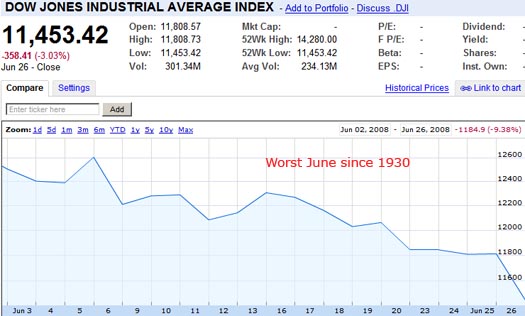
$140 a barrel and sent the market careening to the floor. Do you realize that the DOW is down
9.4% for the month?
In fact, the DOW is having the worst month since the Great Depression:
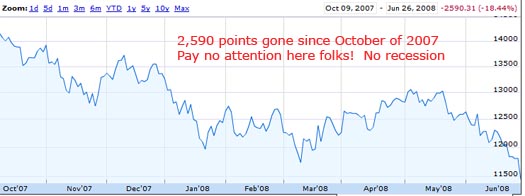
Click Here, or on the image, to see a larger, undistorted image.If that isn’t bad enough the DOW is down … 20% from last October:
Click Here, or on the image, to see a larger, undistorted image.Does anyone really still believe we are not in a recession? Come on now. And if you arrive at the conclusion that we are in a recession then you need to admit to yourself that the numbers being put out by the government simply do not coincide with reality. The problem that we now face is that we are in need of a paradigm shift. Those that are viewed at least by the overwhelming public as
"experts", the brokers, analysts, paid economists, agents, mortgage lenders, and pundits are to a large degree charlatans.
The fact that we now stand with oil at $140 a barrel, the U.S. Dollar tanking, the housing market collapsing, is proof that their belief system is a farce.It would now seem that we are using parallels from the Great Depression over and over: - "NEW YORK (MarketWatch)— U.S. stocks fell sharply Thursday with the blue-chip index enduring its worst June so far since 1930, and plunging to its lowest finish since Sept. 11, 2006, after getting slammed hard as crude soared to new highs and Goldman Sachs disparaged U.S. brokers and advised selling General Motors Corp."
"(The Economist) Housing Dropping Like a Brick: House prices are falling even faster than during the Great Depression"
"(Washington Post) The measure marks Washington’s most ambitious response to a housing slump more severe than any since the Great Depression. More than 1.2 million homes have fallen into foreclosure, and home prices are plummeting. Yesterday, the Standard & Poor’s/Case-Shiller Home Price Index of 20 cities reported that home prices fell 15.3 percent in April versus a year ago, the steepest decline since the index was created eight years ago."
|
Apparently this Great Depression talk is no longer just part of a historical series on this blog. I think given what is happening to the markets this month, it is important to remember a bit of history. Today we’ll look at the ever popular Frederick Lewis Allen and contrast how eerily similar market conditions are today.
This is part XII in our Great Depression series:At a certain point can we drop the faade and accept that things are really bad? Then and only then, can we start confronting the brutal reality that we have a lot of cleaning up to do. Yet it would seem that the mistakes from the past are being repeated once again.
Take a look at some of the things going on before the Crash of 1929: - “In view of what was about to happen, it is enlightening to recall how things looked at this juncture to the financial prophets, those gentlemen whose wizardly reputations were based upon their supposed ability to examine a set of graphs brought to them by a statistician and discover, from the relation of curve to curve and index to index, whether things were going to get better or worse.
“Their opinions differed, of course; there never has been a moment when the best financial opinion was unanimous. In examining these opinions, and the outgivings of eminent bankers, it must furthermore be acknowledged that a bullish statement cannot always be taken at its face value: few men like to assume the responsibility of spreading alarm by making dire predictions, nor is a banker with unsold securities on his hands likely to say anything which will make it more difficult to dispose of them, unquiet as his private mind may be. Finally, one must admit that prophecy is at best the most hazardous of occupations. Nevertheless, the general state of financial opinion in October, 1929, makes an instructive contrast with that in February and March, 1928, when, as we have seen, the skies had not appeared any too bright.”
|
I realize that there were many sitting on the sidelines wondering,
"this is absolutely insane and is completely wrong" yet kept their mouth shut because they didn’t want to be seen as a doom and gloomer or maybe their business simply did not allow open dissent.
But ironically our most prestigious and old institution, Harvard, was wrong yet again this week as it was wrong during the Great Depression, to wit: - "But if ever such medals were actually awarded, a goodly number of leather ones would have to be distributed at the same time. Not necessarily to the Harvard Economic Society although on October 19th, after having explained that business was “facing another period of readjustment," it predicted that "if recession should threaten serious consequences for business (as is not indicated at present) there is little doubt that the Reserve System would take steps to ease the money market and so check the movement." The Harvard soothsayers proved themselves quite fallible: as late as October 26th, after the wide-open crack in the stock market, they delivered cheerful judgment that "despite its severity, we believe that slump in stock prices will prove an intermediate movement not the precursor of a business depression such as would entail prolonged further liquidation." This judgment turned out, course, to be ludicrously wrong; but on the other hand the Harvard Economic Society was far from being really bullish.
Nor would Colonel Leonard P. Ayres of the Cleveland Trust Company get one of the leather medals. He almost qualified when, on October 15th, he delivered himself of the judgment that "there does not seem to be as yet much real evidence that the decline in stock prices is likely to forecast a serious recession in general business. Despite the slowing down in iron and steel production, in automobile output, and in building, the conditions which result in serious business depressions are not present." But the skies, as Colonel Ayres saw them, were at least partly cloudy. "It seems probable," he said, "that stocks have been passing not so much from the strong to the weak as from the smart to the dumb."
|
Now let us contrast that with what the Joint Center for Housing Studies put out via the center director in September of 2006: - "The headline hints of catastrophe: a dot-com repeat, a bubble bursting, an economic apocalypse. Cassandra, though, can stop wailing: the expected price corrections mark a slowing in the rate of increase— not a precipitous decline. This will not spark a chain reaction that will devastate home owners, builders, and communities. Contradicting another gloomy seer, Chicken Little, the sky is not falling."
|
Now you would think that this is enough, but this week Harvard put out yet another optimistic study on the state of housing. Looks like someone is being set up for another colossal forecast failure. You know it is important to highlight that during the Great Crash of 1929, even in that horrific month of October there were bursts of optimism in the market.
It took 3 years before hitting absolute bottom: - "The New York Times averages for fifty leading stocks had been almost cut in half, failing from a high of 311.90 in September to a low of 164.43 on November 13th; and the Times averages for twenty-five leading industrials had fared still worse, diving from 469.49 to 220.95.
The Big Bull Market was dead. Billions of dollars’ worth of profits-and paper profits-had disappeared. The grocer, the window-cleaner, and the seamstress had lost their capital. In every town there were families which had suddenly dropped ‘from showy affluence into debt. Investors who had dreamed of retiring to live on their fortunes now found themselves back once more at the very beginning of the long road to riches. Day by day the newspapers printed the grim reports of suicides.
Coolidge-Hoover Prosperity was not yet dead, but it was dying. Under the impact of the shock of panic, a multitude of ills which hitherto had passed unnoticed or had been offset by stock-market optimism began to beset the body economic, as poisons seep through the human system when a vital organ has ceased to function normally.
Although the liquidation of nearly three billion dollars of brokers’ loans contracted credit, and the Reserve Banks lowered the rediscount rate, and the way in which the larger banks and corporations of the country had survived the emergency without a single failure of large proportions offered real encouragement, nevertheless the poisons were there; overproduction of capital; overambitious (expansion of business concerns; overproduction of commodities under the stimulus of installment buying and buying with stock-market profits; the maintenance of an artificial price level for many commodities, the depressed condition of European trade.
No matter how many soothsayers of high finance proclaimed that all was well, no matter how earnestly the President set to work to repair the damage with soft words and White House conferences, a major depression was inevitably under way.
Nor was that all. Prosperity is more than an economic condition; it is a state of mind. The Big Bull Market had been more than the climax of a business cycle; it had been the climax of a cycle in American mass thinking and mass emotion. There was hardly a man or woman in the country whose attitude toward life had not been affected by it in some degree and was not now affected by the sudden and brutal shattering of hope… With the Big Bull Market zone and prosperity going, Americans were soon to find themselves living in an altered world which called for new adjustments, new ideas, new habits of thought, and a new order of values. The psychological climate was changing; the ever-shifting currents of American life were turning into new channels.
The Post-war Decade had come to its close. An era had ended."
|
Even though the DOW is down … 20% from its peak reached last year, there is still this general sentiment that things are winding down and 'all will be well'. Do people realize that companies have written off about
$391 billion in bad loans with some expectations looking at
[over] $1 trillion before things are done? What about those pesky option ARMs that are staring us directly in the face? We are quickly approaching the psychological end game. The farce will be up soon because there is simply too much debt floating out in the market.
It was never sustainable. The cracks are already being seen in the credit default swap market and derivatives are swimming in a market of multiple trillions— [[all of it approaching a half quadrillion dollars: normxxx]]— which is so absurd, that once people realize that no one has the Midas touch, the markets will start totally to evaporate.Cover your assets folks and make sure you are invested wisely for 2008. This is the year when the rubber meets the road. This will happen no matter what the financial engineers have in their Pollyanna models. M O R E. . .Normxxx ______________
The contents of any third-party letters/reports above do not necessarily reflect the opinions or viewpoint of normxxx. They are provided for informational/educational purposes only.
The content of any message or post by normxxx anywhere on this site is not to be construed as constituting market or investment advice. Such is intended for educational purposes only. Individuals should always consult with their own advisors for specific investment advice.