
Bernanke's Recession Is Here: 11 Reasons It Will Last Till 2011
By Paul B. Farrell, Marketwatch | 28 February 2008
ARROYO GRANDE, Calif.— Remember that hot 1973 Stealer's Wheel song marking the end of the Nixon era? "'Cause I don't think that I can take anymore. Clowns to the left of me, jokers to the right, here I am stuck in the middle with you!" It's still a perfect metaphor. Testifying before Congress: Fed Chairman Ben Bernanke on the left. Treasury Secretary Henry Paulson on the right. The American public stuck in the middle. Last summer they assured us the subprime-credit crisis was "contained." We now know that was a big lie. They knew, had the facts, early warnings, lied and are still lying. More proof? They just told Congress: "America will avoid a recession." Latest data tells a different story.
Clowns to the left ... jokers right ... stuck in the middle ... can't take it anymore. But we have to, we have to hang on at least 10 months more, praying they won't do too much more damage. But I'm afraid they will: more lies, blunders and incompetence will drag out this bear. Like the song says: "Got a feeling
something ain't right." Read the new InvestmentNews a professional journal for financial advisers. The lead headline grabs you: "Bad times for stocks could last many years." A long secular bear.
Do you believe it? That's the big question today: When's the next bull? How long will the bear last? And forget Washington's rhetoric about "no recession." The truth is, you can call it a "bear," "slow growth," a "downturn," a "recession"— call it whatever you want. Timing's the real question. How long will it last? When will it bottom? 2008? 2011?
Test your timing skill. You tell us, what'll drag this out 30 months, like in 2000-2002? Or shorten it? Here are 11 critical factors for your timing equation, things that could make this bear-recession shorter or longer. You tell us. Add a comment. What's your prediction: How long before the next bull?
1. Stagflation: Bernanke's no-win Achilles heel
Reading Fed-watcher William Fleckenstein's new book, "Greenspan's Bubbles: The Age of Ignorance at the Federal Reserve," you get the feeling that for 18 years America's banking system was run like a "new age" hippy commune, by a Ayn Rand free spirit who believed "anything goes." Now the Fed's run by a college professor and Fleckenstein says he's "in over his head."
Except this is the real world, a $13 trillion economy in a $48 trillion world, not a college seminar on economic theory. In the 1970s Nixon faced a similar problem, convinced then by Fed Chairman Arthur Burns: "No one ever lost an election on account of inflation." Wrong! Low rates generated inflation not growth. That stagflation triggered a bear/recession. Is Professor Ben trapped, repeating history?
2. Housing-credit meltdown: We've got a long way to go!
It's far from over folks and still spreading: Years of inventory, foreclosures, building slowdown, risky bond insurers, weak rating agencies, funds holding bad debt, freezing exits and fuzzy math on values. Yet Bernanke and Paulson still live in a Washington bubble of wishful-thinking fantasies.
Economic realists say what's needed is a massive $1.6 trillion demand-driven program (that's the record cash Corporate America's hoarding) not a dinky $160 billion supply-side "appease the voters" giveaway that ends up increasing the odds of a lengthy Nixon/Burns style bear-recession.
3. Commodities: World's new reserve 'currency,' not dollars
Forget paper money and IOUs. Commodities are the world's new "currency:" Hard stuff like oil, grains, metals, gold. And that means America is financing the growth of our enemies, surrendering our long-term economic power for short-term oil-guzzlers and plastic toys. We are responsible for making Russia and China into threatening world powers. Buffett warned us. We're selling the farm, piece by piece.
4. Toxic derivatives: World's $516 trillion ticking time bomb
Derivatives are great for deal-by-deal risk management in a $48 trillion GDP world. But leverage them 10 times over across the globe and we got a financial "weapon of mass economic destruction." Bill Gross warns that the world's new unregulated "shadow banking system" is printing new money, now at $516 trillion, out of thin air, with no "central banks of last resort" backing up the "Frankenstein" monsters they've created.
5. Massive debt: Everywhere, trade, federal, states, local
America's Comptroller General David Walker, Congress's head accountant who is leaving his position next month, warns our government is "bankrupting America." Using unethical accounting worse than Enron's. Fiscal responsibility lost. He sees "striking similarities" with Rome. Both parties are gluttons in a spending orgy. We spend-spend, load debt on future generations, then use accounting gimmicks to hide our greedy excesses: Hidden earmarks. Supplemental war appropriations. Meaningless IOUs after stealing from Social Security.
6. America's new 'pushers': Banks feeding consumer addicts
Trader's Daily captured it perfectly: "Never underestimate the power of the superpsycho, hyper-spending American consumer. Where there is no cash, they will sell their soul. Or just charge it. Let's just not think about what it all means for credit-card debt down the road." Meanwhile, the credit meltdown is making banks desperate for money. A recent Chase credit-card commercial fuels consumer addictions: Wife wants bigger television. Husband smiles. They shop to the pounding drumbeat of Queen's hit 80s song: "I want it all, I want it all, I want it all ... and I want it now!" Tag line: "Chase what matters!" Yes, Chase debt, all you addicts. Forget saving, spend like there's no tomorrow.
7. More wars: Pentagon predicts bigger, costlier conflicts
The Pentagon's internal studies see a perfect storm accelerating wars worldwide: Global population growth, limited natural resources and global warming. Our war machine is exploding. The Pentagon gets over 50% in the new federal budget. We're only 21% of the world's GDP, yet spend 47% of the world's total military expenditures. Our power-hungry mindset is becoming self-destructive, suicidal. Remember Nixon strategist Kevin Phillips' warning: "Most great nations, at the peak of their economic power, become arrogant and wage great world wars at great cost, wasting vast resources, taking on huge debt, and ultimately burning themselves out."
8. Greed: Wall Street and Corporate America's defining 'value'
Values start at the top. But the top won't change for 10 months. Leadership, statesmanship and character are vanishing. Five short years ago Corporate America and the mutual fund industry were consumed by greed. How quickly we forget. It's worse today. We see greed consuming not just Wall Street's clueless CEOs, but the entire industry: Outrageous bonuses of $38 billion amid mega-billion write-offs. Fire sales of billions more American equity to sovereign nations. From the top down, greed is driving America from bubble to bubble. Wall Street's already fueling the next bubble, trading on a volatile market.
9. Democracy failing: America now run by 35,000 lobbyists!
Forget government "of the people, by the people, and for the people." Adam Smith's "invisible hand" is now a small group of 35,000 highly paid, greedy lobbyists demanding handouts. They run America from the shadows, for those at the top of the economic food chain and vastly outnumber Washington's 537 elected officials. Nationally there's an estimated quarter million lobbyists, with hundreds of millions of dollars to buy favors in campaign contributions. Politicians talk "change," but America's lobbyists will still be working for their special interest clients in 2009. And they'll fight all "changes."
10. America's already in a recession, and in denial
This year's elections will be a huge factor in lengthening the recession. Our [[divided,: normxxx]] lame-duck government will delay action on critical issues. It reminds me of my days counseling addicts and alcoholics. Change never happened until they admitted they had a problem. Same here; same now. Vote for whomever, but this lame-duck mindset plus lingering partisan rancor will push any recovery at least into 2009, probably delay the next bull till 2010 or 2011.
Paulson and Bernanke can't even admit there's a recession. They'd have to take the blame for America's failed policies. And congressional Democrats are weak co-conspirators in this meltdown. Nobody has the guts to take responsibility. They're all like addicts and alcoholics, in denial, giving lip-service to "change," while they blame the other guys and support ineffectual stimulus plans.
11. Class warfare: Superrich vs. Main Street America
No matter who wins, the presidential campaign is warning us: A major battle's coming between "the rich and the rest"— over taxes, benefits, cuts, power. For years the media collaborated with Wall Street and Corporate America, hyping "Ownership, the New American Dream," where everyone benefits, shares the wealth, gains a piece-of-the-action, ownership in "The Dream" through the magic of housing, stocks, growth, profits, retirement plans. But the housing-credit contagion killed the dream.
Yes, the superrich did get richer. But "the rest" didn't. And they're waking up to a widening gap. A backlash is brewing and will explode ... delaying a recovery and a new bull. Clowns to the left, jokers on the right, we're stuck in the middle. Can't take it anymore? Add a timing comment. Tell us: When's the recovery? Next bull? Late 2008? Not till 2011?
ß§
Normxxx
______________
The contents of any third-party letters/reports above do not necessarily reflect the opinions or viewpoint of normxxx. They are provided for informational/educational purposes only.
The content of any message or post by normxxx anywhere on this site is not to be construed as constituting market or investment advice. Such is intended for educational purposes only. Individuals should always consult with their own advisors for specific investment advice.
- What Is A Safe Withdrawal Rate in Retirement?
- Using Asset Allocation to make money in a Flat Market
- Winning on the zigs, losing on the zags
- Beware of Annuities
Friday, February 29, 2008
Will India Unload Gold!?!
Will India Unload A Massive Quantity Of Gold & Silver On The Markets?
By Julian D.W. Phillips | 29 February 2008
Gold and silver prices are at their peak and look as though they are going to go higher still. Both gold and silver prices have been rising steadily over the years despite there being both a surplus and, in the case of silver, government selling of stockpiles. This tells us that the potential as well as the past surpluses are far lower and far more difficult to access than one thinks. Why?
The prime overall reason is that statistics may show these figures but are these amounts really available in the market place? The surplus is an overall figure that may or may not reach the marketplace. Whatever the surplus is, it will appear steadily over the year, not at any one time such as the start point. The current gold & silver prices tell us that neither is available over and above current market demand, or the prices of both would not be rising. At best, the full real picture of the gold & silver markets is nigh on impossible to quantify accurately (including the gold and silver stored away from statisticians eyes). How much gold & silver will come off tables and arms and ears and go down to a scrap merchant (then to the refinery and then to the market and et cetera) cannot be measured.
Take the situation in India, where the silver and gold markets, we are told, are very quiet and have been for several months. There are huge volumes of gold & silver bought over the last few decades there, so why doesn't it leave the homes in which it is kept and travel to the market? Why don't merchants then take it in at the prices they offer, parcel it up and ship it to the international markets to get the apparent profit?
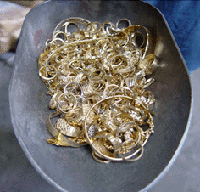
In India, the main buyers of silver and gold [70%] are rural people, who do not suffer income tax on their farming income. When they sell their produce they are paid cash and don't generally have a bank account. Rather than keep this paper medium of exchange in their house, they take the money and buy gold and silver for cash, which then make up their savings. Over the last few years the rising prices of the two precious metals has confirmed the wisdom of such policies.
However, should the need arise for them to sell their gold and silver, they approach their dealer. When he buys, he has to report the transaction "officially" and pay purchase tax, which is enormous relative to his profits. He also would have to expose his complete business to the authorities, whose reputation for administering businesses is appallingly corrupt. Should he then want to export this purchased metal, he needs to reflect the metal in his accounts and confirm purchase tax has been paid. With a similar aversion to tax as one has to the plague, dealers buy such scrap for cash and hoard it in their own private, invisible stores. Then out of the sight of Indian authorities again, he will hedge his long position on the international exchanges through a short position, matching the long position he has, thus removing the price risk on the metal (all this done in a secretive manner).
"There will be no exports of gold or silver from India!"
Remarkably, NO gold or silver is exported from India, despite the invisible surplus. The only sign of it is in the short positions [Commercial] on international exchanges. Hoarding of gold and silver in India is huge, proven by the fact that none is exported. More to the point: None will be exported; no matter what the gold and silver prices go to!
ß§
Normxxx
______________
The contents of any third-party letters/reports above do not necessarily reflect the opinions or viewpoint of normxxx. They are provided for informational/educational purposes only.
The content of any message or post by normxxx anywhere on this site is not to be construed as constituting market or investment advice. Such is intended for educational purposes only. Individuals should always consult with their own advisors for specific investment advice.
By Julian D.W. Phillips | 29 February 2008
Gold and silver prices are at their peak and look as though they are going to go higher still. Both gold and silver prices have been rising steadily over the years despite there being both a surplus and, in the case of silver, government selling of stockpiles. This tells us that the potential as well as the past surpluses are far lower and far more difficult to access than one thinks. Why?
The prime overall reason is that statistics may show these figures but are these amounts really available in the market place? The surplus is an overall figure that may or may not reach the marketplace. Whatever the surplus is, it will appear steadily over the year, not at any one time such as the start point. The current gold & silver prices tell us that neither is available over and above current market demand, or the prices of both would not be rising. At best, the full real picture of the gold & silver markets is nigh on impossible to quantify accurately (including the gold and silver stored away from statisticians eyes). How much gold & silver will come off tables and arms and ears and go down to a scrap merchant (then to the refinery and then to the market and et cetera) cannot be measured.
Take the situation in India, where the silver and gold markets, we are told, are very quiet and have been for several months. There are huge volumes of gold & silver bought over the last few decades there, so why doesn't it leave the homes in which it is kept and travel to the market? Why don't merchants then take it in at the prices they offer, parcel it up and ship it to the international markets to get the apparent profit?
In India, the main buyers of silver and gold [70%] are rural people, who do not suffer income tax on their farming income. When they sell their produce they are paid cash and don't generally have a bank account. Rather than keep this paper medium of exchange in their house, they take the money and buy gold and silver for cash, which then make up their savings. Over the last few years the rising prices of the two precious metals has confirmed the wisdom of such policies.However, should the need arise for them to sell their gold and silver, they approach their dealer. When he buys, he has to report the transaction "officially" and pay purchase tax, which is enormous relative to his profits. He also would have to expose his complete business to the authorities, whose reputation for administering businesses is appallingly corrupt. Should he then want to export this purchased metal, he needs to reflect the metal in his accounts and confirm purchase tax has been paid. With a similar aversion to tax as one has to the plague, dealers buy such scrap for cash and hoard it in their own private, invisible stores. Then out of the sight of Indian authorities again, he will hedge his long position on the international exchanges through a short position, matching the long position he has, thus removing the price risk on the metal (all this done in a secretive manner).
"There will be no exports of gold or silver from India!"Remarkably, NO gold or silver is exported from India, despite the invisible surplus. The only sign of it is in the short positions [Commercial] on international exchanges. Hoarding of gold and silver in India is huge, proven by the fact that none is exported. More to the point: None will be exported; no matter what the gold and silver prices go to!
ß§
Normxxx
______________
The contents of any third-party letters/reports above do not necessarily reflect the opinions or viewpoint of normxxx. They are provided for informational/educational purposes only.
The content of any message or post by normxxx anywhere on this site is not to be construed as constituting market or investment advice. Such is intended for educational purposes only. Individuals should always consult with their own advisors for specific investment advice.
Thursday, February 28, 2008
Not Your Father’s Mustache!?!
Investment Strategy: "Not Your Father’s Typical Recession!?!"
By Jeffrey Saut | February, 2008
Much has been written recently about whether the nation is "in" a recession, going into a recession, or not going into a recession. To answer this question, one first needs to define what a recession is. Back in the 1960’s we used to say, "A recession is when your neighbor loses his job; a depression is when you lose your job!" Of course, the modern day definition has become: "Two or more consecutive quarters of negative growth in Gross Domestic Product (GDP)."
However, I could make a pretty cogent argument that the population employment growth increases by roughly 1% a year and, therefore, if GDP growth falls below 1%, we are not employing all the available talent, and consequently, the country by default would be in a recession— but nobody agrees with my definition. The most accurate definition [[as widely accepted: normxxx]] is proffered by the National Bureau of Economic Research (NBER) that frames it this way:
Rare indeed, as seen in the recession charts we included in last week’s report and have attached again this week.
By studying the charts, one observes that until recently recessions have been a normal conclusion to the business cycle. As seen, however, recently this has not been the case. In past missives we have railed at the central banks, as well as the politicians, for their continuing efforts to prevent the normal business cycle from playing out. They did it again in January when the Federal Reserve panicked and cut interest rates by 75 basis points with a concurrent $150 billion economic stimulus package from the politicos. And if this is a typical recession, such maneuvers will likely ameliorate the downturn. But, what if this isn’t "your father’s typical recession?"
Consider this: typically a recession follows a tightening cycle by the central banks causing the entire interest rate spectrums’ yields to rise sharply. Clearly, this has not been the case. Moreover, recessions tend to occur in a high "real" interest rate environment where interest rates are higher than the inflation rate. Currently, when you compare the nominal, or headline, inflation rate to ANY of the government complex of interest rate yields (Fed Funds, 2-year T’bill, 10-year T’note, etc.), you find "negative" real interest rates.
Ladies and gentlemen, negative real rates have always sewn the seeds of economic recoveries. Further, recessions are accompanied by soaring unemployment reports, and heretofore this is just not happening. The final ingredient of the typical recession is a huge buildup of inventories, but given the current record low inventory-to-sales ratio, this too doesn’t "foot." Therefore, if we are entering a recession, it is probably a financially-induced recession and not your father’s typical recession, begging the question, "Will the typical remedies work?"
How we got into this mess can be directly traced to the "powers that be" attempting to stave off the normal business cycle via the engineering of a too-low Fed Funds interest rate (1%), too much liquidity (pumping up the money supply), and a financial complex that spun the situation into a spider web of leverage resulting in an enormous abuse of credit. See if you can follow this, too many fancy loans were made to people who could not afford them (No Doc Loans, 125% Mortgages, Option Arms, etc.). These loans were then packaged into residential and commercial mortgage-backed securities (RMBS / CMBS); and, in turn….
The RMBS / CMBS were repackaged into collateralized loan obligations (CLOs) which, after receiving some sort of insurance, were then yet further hedged using credit default swaps (CDSs). And, these complex securities were sold into even more complex vehicles like Structured Investment Vehicles (SIVs). At each step, more and more leverage (read: debt) was employed, leaving the entire mess looking like an inverted pyramid with the lonely mortgagee at the bottom, causing economist Hy Minsky to note, "All panics, manias and crises of a financial nature have their roots in an abuse of credit."
Panic, indeed, for when the poor mortgagees stopped paying their loans, the inverted pyramid toppled right about the time when the financial community was closing their year-end "books," which is why we have seen so many write-offs in the new year, as well as why the equity markets have been in a selling stampede. And, it looked like the equity markets were on their way to completing the stampede with a pornographic panic plunge one January morning— until the Fed panicked and cut interest rates by 75 bps before the opening bell. At the time we were speaking to The Wall Street Journal and remarked, "While Mr. Bernanke is clearly a very smart man, he seems to lack the market savvy of Paul Volcker in an era gone by."
To wit, if Mr. Volcker were still at the helm of the Fed, we think he would have let the markets plunge 500, 800, or even 1000 points so that they would reach a downside "clearing price" on their own accord. When they hit that low, stabilized and started to "lift," then and only then would Tall Paul have cut interest rates to "seal in" that low and put the wind at the back of the markets for a sustainable rally. What Mr. Bernanke did was best summarized by one old Wall Street wag who exclaimed, "He’s used the last aspirin in the bottle, yet we still have the headache!"
That headache spilled over several more sessions later, but on the day, the DJIA was off over 300 points early, then righted itself to close up nearly 300 points. That volatility gave us the second largest daily point swing in history and suggested a short-term trend change for the markets. Was it perfect? . . . Not really, because we never got the "I think I am going to be sick type of downside panic hour" so often associated with selling climax lows. (It did, however, come on day 18 of the envisioned 17 - 25 session 'selling stampede', so the timing was right); we recommended committing a modicum of capital to stock— so far, so good.
So where does this leave us? Well, the equity markets strung together three or more "up" sessions, indicating that the selling stampede is over. And, as long as those lows hold (11971 closing and/or 11634 intraday), we still have a chance of a good rally. Worrisome is the fact that there is a ubiquitous feeling that any downside retest of those lows will be successful and consequently should be bought.
While we are hopeful that will be the case, if those lows don’t hold, we will be at the point of capitulation where participants throw in the towel and walk away. We are also at the point where you are going to hear whispers about a friend being in financial trouble due to too much debt. Recall it was the January 4th employment report that accelerated the stock slide into a selling stampede, which we said would likely extend until the State of the Union address.
In the meantime, one theme we are certain of is "yield." The retiring baby boomers want yield in their retirement years combined with an adequate rate of return. This is consistent with Benjamin Graham’s definition of an investment operation, which reads, "An investment operation is one which, upon thorough analysis, promises safety of principal and an adequate return. Operations not meeting these requirements are speculative."
With interest rates near historic lows, bonds may satisfy the "safety of principal" requirement, but it is doubtful they will provide an "adequate return." The burgeoning demand by the "boomers" for yield should provide support for select dividend-paying stocks. One such name for your consideration is 7.5% yielding EV Energy Partners (EVEP/$30.01 /Outperform).
The call for this week: The question du jour is, "Will the rate cuts, combined with the economic stimulus package, be enough to prevent the normal ending to the business cycle even if this is not your father’s typical recession?" Evidentially, the D-J Transports think so given their current rally mode! Yet even if successful, the nation faces a painful deleveraging process that will take time. As John Stuart Mill wrote in 1867, "Panics do not destroy capital; they merely reveal the extent to which it has been previously destroyed into hopelessly unproductive works."

Click Here, or on the image, to see a larger, undistorted image.

Click Here, or on the image, to see a larger, undistorted image.
"Foretold is Forewarned"
Ever since the successful downside retest of the August 2007 "lows" that occurred in late November, we have repeatedly stated that while we remained constructive on stocks into year-end 2007, we were entering 2008 in a cautious mode. We reiterated that caution the first week of January when we said:
Regrettably, those employment numbers were ugly and we went on to warn participants that the stock slide was taking on the characteristics of a "selling stampede." As often stated in these missives, "selling stampedes", and/or "buying stampedes", typically last 17 to 25 sessions with only one— to three-day counter trend "pauses" before they exhaust themselves.
It just seems to be the rhythm of the thing in that it takes participants that long to either get bearish enough, or bullish enough, to capitulate; and, in the current case, "cough up" their stocks. While it is true a few stampedes have lasted 25 to 30 sessions, it is RARE to have one extend for more than 30 sessions.
Meanwhile, the "selling stampede," combined with softening economic statistics, has caused the politicians to spring into action with what looks to us like another ill-fated scheme to ward off the normal business cycle. Recall, it was on December 6, 2007 that the President’s last scheme debuted. Titled operation "Hope Now," it was designed to stop mortgage interest rates from resetting to higher levels and was supposed to help hundreds of thousands of mortgage holders. According to Barron’s, however, it has helped less than one hundred mortgagees to date.
Last week’s proposed "scheme" was a $145 billion economic-stimulus package, which is expected to contain hundreds of dollars of tax-rebates per taxpayer, as well as tax breaks to encourage businesses to buy new equipment. It seems to us that this scheme is also flawed since the current problems stem from too much debt. If so, recipients of the tax rebates will probably use them to pay down existing debts rather than spend them and stimulate the economy. As the President unveiled the plan, we found ourselves screaming at the TV screen, "Don’t you realize that trying to prevent the inevitable conclusion of the business cycle (read: recession) a few years ago is exactly what got us into the present predicament?!"
Clearly the Federal Reserve, like the politicos, is worried given Mr. Bernanke’s comments last week. Yet if the overspent, undersaved American consumer is finally sated with debt, the Fed could be "pushing on a string" by lowering interest rates. Further, the Fed may just be in a "box," for as Milton Friedman noted, "a central bank can control its exchange rates; it can control its money supply growth rate; or it can control its interest rate; but, it cannot control all three at the same time!"
However, ISI’s Ed Hyman framed the problem differently when he recently wrote, "Here’s the problem. If we have a U.S. recession, even a mild one, developing economies are likely to slow. U.S. unemployment is likely to rise above 5.5%. Developing economies are likely to dump goods on world markets. [And] All of this could launch protectionist legislation that would lead to the end."
Indeed, for many months we have railed against the increasing traction protectionism, intervention, and over-regulation are gaining inside the D.C. Beltway. The question thus becomes, "does growth collapse from here because of the weight of the credit crunch, or not?"
As the astute GaveKal organization opines,
To this point, it is worth considering that if congress approves the recently proposed defense spending plan, which calls for tens of billions of increased spending, it should spread massive amounts of dollars to small/medium businesses whose multiplier effect could go a long way in avoiding a recession. This is another reason we have been unwaveringly bullish on government IT, defense, and the homeland security complex for the past number of years. Most recently, we have turned constructive on the shares of Strong Buy-rated Cogent (COGT/$9.19).
With more than 500,000 aliens entering the U.S. every year the authorities need a 99.9% accurate fingerprint reading in less than 30 seconds, which is one of the products Cogent manufactures. The company’s $5.00 per share in cash implies that we are buying the rest of the company for $4.19 a share. If our analyst is correct, Cogent should earn $0.55 per share in 2009, meaning we are buying the shares at less than 10 times forward earnings (ex-cash per share). Since 2008 is a great product pipeline year, as well as a potentially favorable contract "win" year, we think the risk/reward ratio is right for investors.
To be sure, we continue to like the Government IT and Homeland Security themes. Still, the government service stocks have tumbled ~ 8% in January due to the broad market decline and in-line with the seasonal trading patterns seen in the group. Due to the sell-off, our sense is the group looks more attractive than it has in quite some time. Moreover, we think investors are beginning to look for investments that are acyclical to the broader market concerns surrounding the consumer, energy prices, subprime exposure, and housing problems. Given the current valuation, fundamentals, and lack of a fundamental correlation to the overall market, we believe the government services group can outperform the broader markets in 2008. In addition to Cogent, we see value in Stanley (SXE/$28.31/Outperform) and NCI (NCIT/$15.31/Outperform).
As for our Canadian jaunt recently, western Canada is "booming!" In Edmonton every other street was littered with signs proclaiming "help wanted!" This labor demand has occurred even in light of the new increased royalty-regime legislated by Alberta’s politicians. Clearly we over-reacted to said regime, but while we have not invested any new capital in Alberta since that regime decision, we have held our remaining "long" stock positions in the Abathasca Tar Sands companies. We remain bullish on Canada, consistent with our "stuff stock" theme; and don’t look now, but a headline in a British Columbia newspaper read, "B.C. Energy Shortfall Looming," which was a direct reference to the money that needs to be spent to upgrade B.C.’s electric infrastructure.
The call for this week: Last week Treasury Secretary Paulson, when referring to the potential economic stimulus plan, averred, "This is not an emergency. There is an urgent need." To which we ask, "If this is NOT an emergency, then why is it urgent?!" Clearly the politicos are worried about a recession and are pulling out all the "stops" to prevent the normal business cycle once again. While we don’t think the recession question will be answered for months, we do think the selling stampede is definitely at an end and suggest getting your "buy list" together for at least a trade and maybe something more. It will be interesting to see if, like us, the street interprets the Fed's January moves as "panic" [[they did: normxxx]]. Whatever the outcome, we think a change for the better is approaching and are busy readying accounts accordingly. And that’s the way it is! So get ready, get set….
Normxxx
______________
The contents of any third-party letters/reports above do not necessarily reflect the opinions or viewpoint of normxxx. They are provided for informational/educational purposes only.
The content of any message or post by normxxx anywhere on this site is not to be construed as constituting market or investment advice. Such is intended for educational purposes only. Individuals should always consult with their own advisors for specific investment advice.
By Jeffrey Saut | February, 2008
Much has been written recently about whether the nation is "in" a recession, going into a recession, or not going into a recession. To answer this question, one first needs to define what a recession is. Back in the 1960’s we used to say, "A recession is when your neighbor loses his job; a depression is when you lose your job!" Of course, the modern day definition has become: "Two or more consecutive quarters of negative growth in Gross Domestic Product (GDP)."
However, I could make a pretty cogent argument that the population employment growth increases by roughly 1% a year and, therefore, if GDP growth falls below 1%, we are not employing all the available talent, and consequently, the country by default would be in a recession— but nobody agrees with my definition. The most accurate definition [[as widely accepted: normxxx]] is proffered by the National Bureau of Economic Research (NBER) that frames it this way:
|
By studying the charts, one observes that until recently recessions have been a normal conclusion to the business cycle. As seen, however, recently this has not been the case. In past missives we have railed at the central banks, as well as the politicians, for their continuing efforts to prevent the normal business cycle from playing out. They did it again in January when the Federal Reserve panicked and cut interest rates by 75 basis points with a concurrent $150 billion economic stimulus package from the politicos. And if this is a typical recession, such maneuvers will likely ameliorate the downturn. But, what if this isn’t "your father’s typical recession?"
Consider this: typically a recession follows a tightening cycle by the central banks causing the entire interest rate spectrums’ yields to rise sharply. Clearly, this has not been the case. Moreover, recessions tend to occur in a high "real" interest rate environment where interest rates are higher than the inflation rate. Currently, when you compare the nominal, or headline, inflation rate to ANY of the government complex of interest rate yields (Fed Funds, 2-year T’bill, 10-year T’note, etc.), you find "negative" real interest rates.
Ladies and gentlemen, negative real rates have always sewn the seeds of economic recoveries. Further, recessions are accompanied by soaring unemployment reports, and heretofore this is just not happening. The final ingredient of the typical recession is a huge buildup of inventories, but given the current record low inventory-to-sales ratio, this too doesn’t "foot." Therefore, if we are entering a recession, it is probably a financially-induced recession and not your father’s typical recession, begging the question, "Will the typical remedies work?"
How we got into this mess can be directly traced to the "powers that be" attempting to stave off the normal business cycle via the engineering of a too-low Fed Funds interest rate (1%), too much liquidity (pumping up the money supply), and a financial complex that spun the situation into a spider web of leverage resulting in an enormous abuse of credit. See if you can follow this, too many fancy loans were made to people who could not afford them (No Doc Loans, 125% Mortgages, Option Arms, etc.). These loans were then packaged into residential and commercial mortgage-backed securities (RMBS / CMBS); and, in turn….
The RMBS / CMBS were repackaged into collateralized loan obligations (CLOs) which, after receiving some sort of insurance, were then yet further hedged using credit default swaps (CDSs). And, these complex securities were sold into even more complex vehicles like Structured Investment Vehicles (SIVs). At each step, more and more leverage (read: debt) was employed, leaving the entire mess looking like an inverted pyramid with the lonely mortgagee at the bottom, causing economist Hy Minsky to note, "All panics, manias and crises of a financial nature have their roots in an abuse of credit."
Panic, indeed, for when the poor mortgagees stopped paying their loans, the inverted pyramid toppled right about the time when the financial community was closing their year-end "books," which is why we have seen so many write-offs in the new year, as well as why the equity markets have been in a selling stampede. And, it looked like the equity markets were on their way to completing the stampede with a pornographic panic plunge one January morning— until the Fed panicked and cut interest rates by 75 bps before the opening bell. At the time we were speaking to The Wall Street Journal and remarked, "While Mr. Bernanke is clearly a very smart man, he seems to lack the market savvy of Paul Volcker in an era gone by."
To wit, if Mr. Volcker were still at the helm of the Fed, we think he would have let the markets plunge 500, 800, or even 1000 points so that they would reach a downside "clearing price" on their own accord. When they hit that low, stabilized and started to "lift," then and only then would Tall Paul have cut interest rates to "seal in" that low and put the wind at the back of the markets for a sustainable rally. What Mr. Bernanke did was best summarized by one old Wall Street wag who exclaimed, "He’s used the last aspirin in the bottle, yet we still have the headache!"
That headache spilled over several more sessions later, but on the day, the DJIA was off over 300 points early, then righted itself to close up nearly 300 points. That volatility gave us the second largest daily point swing in history and suggested a short-term trend change for the markets. Was it perfect? . . . Not really, because we never got the "I think I am going to be sick type of downside panic hour" so often associated with selling climax lows. (It did, however, come on day 18 of the envisioned 17 - 25 session 'selling stampede', so the timing was right); we recommended committing a modicum of capital to stock— so far, so good.
So where does this leave us? Well, the equity markets strung together three or more "up" sessions, indicating that the selling stampede is over. And, as long as those lows hold (11971 closing and/or 11634 intraday), we still have a chance of a good rally. Worrisome is the fact that there is a ubiquitous feeling that any downside retest of those lows will be successful and consequently should be bought.
While we are hopeful that will be the case, if those lows don’t hold, we will be at the point of capitulation where participants throw in the towel and walk away. We are also at the point where you are going to hear whispers about a friend being in financial trouble due to too much debt. Recall it was the January 4th employment report that accelerated the stock slide into a selling stampede, which we said would likely extend until the State of the Union address.
In the meantime, one theme we are certain of is "yield." The retiring baby boomers want yield in their retirement years combined with an adequate rate of return. This is consistent with Benjamin Graham’s definition of an investment operation, which reads, "An investment operation is one which, upon thorough analysis, promises safety of principal and an adequate return. Operations not meeting these requirements are speculative."
With interest rates near historic lows, bonds may satisfy the "safety of principal" requirement, but it is doubtful they will provide an "adequate return." The burgeoning demand by the "boomers" for yield should provide support for select dividend-paying stocks. One such name for your consideration is 7.5% yielding EV Energy Partners (EVEP/$30.01 /Outperform).
The call for this week: The question du jour is, "Will the rate cuts, combined with the economic stimulus package, be enough to prevent the normal ending to the business cycle even if this is not your father’s typical recession?" Evidentially, the D-J Transports think so given their current rally mode! Yet even if successful, the nation faces a painful deleveraging process that will take time. As John Stuart Mill wrote in 1867, "Panics do not destroy capital; they merely reveal the extent to which it has been previously destroyed into hopelessly unproductive works."

Click Here, or on the image, to see a larger, undistorted image.

Click Here, or on the image, to see a larger, undistorted image.
"Foretold is Forewarned"
Ever since the successful downside retest of the August 2007 "lows" that occurred in late November, we have repeatedly stated that while we remained constructive on stocks into year-end 2007, we were entering 2008 in a cautious mode. We reiterated that caution the first week of January when we said:
|
Regrettably, those employment numbers were ugly and we went on to warn participants that the stock slide was taking on the characteristics of a "selling stampede." As often stated in these missives, "selling stampedes", and/or "buying stampedes", typically last 17 to 25 sessions with only one— to three-day counter trend "pauses" before they exhaust themselves.
It just seems to be the rhythm of the thing in that it takes participants that long to either get bearish enough, or bullish enough, to capitulate; and, in the current case, "cough up" their stocks. While it is true a few stampedes have lasted 25 to 30 sessions, it is RARE to have one extend for more than 30 sessions.
Meanwhile, the "selling stampede," combined with softening economic statistics, has caused the politicians to spring into action with what looks to us like another ill-fated scheme to ward off the normal business cycle. Recall, it was on December 6, 2007 that the President’s last scheme debuted. Titled operation "Hope Now," it was designed to stop mortgage interest rates from resetting to higher levels and was supposed to help hundreds of thousands of mortgage holders. According to Barron’s, however, it has helped less than one hundred mortgagees to date.
Last week’s proposed "scheme" was a $145 billion economic-stimulus package, which is expected to contain hundreds of dollars of tax-rebates per taxpayer, as well as tax breaks to encourage businesses to buy new equipment. It seems to us that this scheme is also flawed since the current problems stem from too much debt. If so, recipients of the tax rebates will probably use them to pay down existing debts rather than spend them and stimulate the economy. As the President unveiled the plan, we found ourselves screaming at the TV screen, "Don’t you realize that trying to prevent the inevitable conclusion of the business cycle (read: recession) a few years ago is exactly what got us into the present predicament?!"
Clearly the Federal Reserve, like the politicos, is worried given Mr. Bernanke’s comments last week. Yet if the overspent, undersaved American consumer is finally sated with debt, the Fed could be "pushing on a string" by lowering interest rates. Further, the Fed may just be in a "box," for as Milton Friedman noted, "a central bank can control its exchange rates; it can control its money supply growth rate; or it can control its interest rate; but, it cannot control all three at the same time!"
However, ISI’s Ed Hyman framed the problem differently when he recently wrote, "Here’s the problem. If we have a U.S. recession, even a mild one, developing economies are likely to slow. U.S. unemployment is likely to rise above 5.5%. Developing economies are likely to dump goods on world markets. [And] All of this could launch protectionist legislation that would lead to the end."
Indeed, for many months we have railed against the increasing traction protectionism, intervention, and over-regulation are gaining inside the D.C. Beltway. The question thus becomes, "does growth collapse from here because of the weight of the credit crunch, or not?"
As the astute GaveKal organization opines,
|
To this point, it is worth considering that if congress approves the recently proposed defense spending plan, which calls for tens of billions of increased spending, it should spread massive amounts of dollars to small/medium businesses whose multiplier effect could go a long way in avoiding a recession. This is another reason we have been unwaveringly bullish on government IT, defense, and the homeland security complex for the past number of years. Most recently, we have turned constructive on the shares of Strong Buy-rated Cogent (COGT/$9.19).
With more than 500,000 aliens entering the U.S. every year the authorities need a 99.9% accurate fingerprint reading in less than 30 seconds, which is one of the products Cogent manufactures. The company’s $5.00 per share in cash implies that we are buying the rest of the company for $4.19 a share. If our analyst is correct, Cogent should earn $0.55 per share in 2009, meaning we are buying the shares at less than 10 times forward earnings (ex-cash per share). Since 2008 is a great product pipeline year, as well as a potentially favorable contract "win" year, we think the risk/reward ratio is right for investors.
To be sure, we continue to like the Government IT and Homeland Security themes. Still, the government service stocks have tumbled ~ 8% in January due to the broad market decline and in-line with the seasonal trading patterns seen in the group. Due to the sell-off, our sense is the group looks more attractive than it has in quite some time. Moreover, we think investors are beginning to look for investments that are acyclical to the broader market concerns surrounding the consumer, energy prices, subprime exposure, and housing problems. Given the current valuation, fundamentals, and lack of a fundamental correlation to the overall market, we believe the government services group can outperform the broader markets in 2008. In addition to Cogent, we see value in Stanley (SXE/$28.31/Outperform) and NCI (NCIT/$15.31/Outperform).
As for our Canadian jaunt recently, western Canada is "booming!" In Edmonton every other street was littered with signs proclaiming "help wanted!" This labor demand has occurred even in light of the new increased royalty-regime legislated by Alberta’s politicians. Clearly we over-reacted to said regime, but while we have not invested any new capital in Alberta since that regime decision, we have held our remaining "long" stock positions in the Abathasca Tar Sands companies. We remain bullish on Canada, consistent with our "stuff stock" theme; and don’t look now, but a headline in a British Columbia newspaper read, "B.C. Energy Shortfall Looming," which was a direct reference to the money that needs to be spent to upgrade B.C.’s electric infrastructure.
The call for this week: Last week Treasury Secretary Paulson, when referring to the potential economic stimulus plan, averred, "This is not an emergency. There is an urgent need." To which we ask, "If this is NOT an emergency, then why is it urgent?!" Clearly the politicos are worried about a recession and are pulling out all the "stops" to prevent the normal business cycle once again. While we don’t think the recession question will be answered for months, we do think the selling stampede is definitely at an end and suggest getting your "buy list" together for at least a trade and maybe something more. It will be interesting to see if, like us, the street interprets the Fed's January moves as "panic" [[they did: normxxx]]. Whatever the outcome, we think a change for the better is approaching and are busy readying accounts accordingly. And that’s the way it is! So get ready, get set….
Normxxx
______________
The contents of any third-party letters/reports above do not necessarily reflect the opinions or viewpoint of normxxx. They are provided for informational/educational purposes only.
The content of any message or post by normxxx anywhere on this site is not to be construed as constituting market or investment advice. Such is intended for educational purposes only. Individuals should always consult with their own advisors for specific investment advice.
Portfolio Construction
A Logical Approach To Portfolio Construction
By John Riley, Chief Strategist, Cornerstone | 15 February 2008
We start simply, by asking ourselves questions. We build the portfolio by first looking at long term trends, then intermediate trends and last, short term.
What are the overall long term trends?
The US stock market— With the potential for [[probability of: normxxx]] earnings disappointments and a slowing economy, the long term trend (several years) for the stock market is down. The economy will likely be held back by the still unfolding housing collapse, [[the credit/banking collapse: normxxx]], a retreat of consumers and rising unemployment. This should impact earnings negatively and send the market to levels not seen in a decade.
Strategy— Avoid US equities, sell into rallies. Invest in "bear market" funds or market hedges, such as several of the ETFs available that invest in the short side. This gives us our first piece of the asset allocation pie: Market Hedges
Inflation— What is the current environment? Are prices for goods and services rising or falling? This can be confusing sometimes because both can be happening at once. On the one hand, the cost of raw materials and labor costs are rising for the major manufacturers, but at the same time, foreign competition is forcing prices to the consumer down, squeezing profits.
Inflation in raw materials is a function of foreign consumption. This is a trend that is not likely to slow down any time soon. They have tasted capitalism and they like it. Millions of people will be migrating from rural areas in the 3rd world to more urban areas and along with that comes an almost geometric increase in the consumption of raw materials.
Strategy— The obvious answer is commodities and natural resources companies, especially oil. At various times the shift within the sector will go from food to base metals to industrial materials to oil and so on. But in general, this group has the biggest bullish push on it of any sector, with an expected bull market run that could last many years if not decades. Investing in natural resources, commodities and raw material companies is the next piece of the pie.
Lower interest rates— This is an interesting one. Lower short term interest rates does not mean lower long term interest rates. In fact, low short term interest rates does not mean a healthy economy. Interest rates in the 1930’s were at or near zero and the economy was still depressed. In Japan for the past 15 years, they have been going through a deflationary funk that interest rates at zero percent could not fix. Why are low interest rates likely not to help the economy? Because of too much debt. Almost every sector of the economy, from the government to the consumer is loaded down with [[paying off: normxxx]] record debt levels.
Strategy— As the Fed cranks up the presses to print more Dollars, the US Dollar is diluted and devalued. The best way to hedge the declining Dollar is to own the opposite asset. Foreign Debt and Gold [[and since most foreign countries soon will be racing us to the bottom, that leaves...: normxxx]]. See Cycle of Deflation.
Growing Trade Deficit— With the potential for declining earnings domestically and the continual growth of the trade deficit, foreign companies may pick up the slack for growth. Opportunities may be presenting themselves for foreign companies to do more business with each other as America’s share of the Global GDP continues to shrink.
Strategy— Owning International Equities may be a better source of equity growth compared to US stocks for the next several years.
Geo-Political Tensions– With the world the way it is today, war in the Middle East, hot spots in Asia, a recalcitrant Russia, and growing tensions in South America, a surprise, war or terrorism should be expected.
Strategy— Having some assets as a safe haven is important. Cash is king for this when it comes to principal safety and Treasuries are a place money runs to when there is global trouble. Since we are concerned with inflation, TIPs (Treasury Inflation Protection Securities) fill the bill here.
Momentum— The boys on Wall Street still control the game. They have defied the odds for years. The market should have had a correction years ago. The rally within a bear market that started in 2003 has gone on for much longer than most expected.
Strategy— Humility is important. No matter how right the evidence and statistics are, momentum can still carry the market higher in the face of terrible news or lower in the face of great news. Having a balanced fund in the portfolio gives the investor a piece of what the boys on Wall street are doing.
Market Rallies— Regardless of the market conditions, even in the worst bear markets, there are always rallies. And many of them are tradable rallies. In most cases, investors should sell into rallies. But once the asset allocation is set, investors can take advantage of the rallies.
Strategy— Always be prepared to trade. Not day trade, but take advantage of mis-priced securities, whatever they may be, whether they are stocks, bonds or whatever.
Allocation
Now that we have the assets picked, next is the allocation part. This is determined by how much risk the investor is willing to accept and how much of an impact the asset class is likely to have. We are constantly adjusting the allocation of the portfolio to take advantage of the shifting sands of the market place and economy. We tend to look at intermediate and short term trends when adjusting our allocation.
What are the intermediate trends? These could be an acceleration of the long term trend or counter trends to the long term. If an asset class has gone too far too fast, we may reduce our allocation in anticipation of a pullback. For instance, if oil were to race up to $120/bbl in the next two weeks based on tensions in the Middle East, we would be ready to cut our Natural Resources allocation. We would then increase it again after a significant pullback.
Short term opportunities could include trades and taking advantage of anticipated news. If it were expected that more banks were going to report huge losses due to sub-prime, we might increase our hedges specifically in the financial area. Or if some bad news came out for a stock that had been a consistent performer, and the stock dropped quickly, we might use that as an opportunity to trade, [[e.g., to buy, unless, 1) you figure the bad news will affect earnings for several years, or 2) it is hardly directly related to the company, and you believe you have a head start on the slower witted— warning: this is rarely true if the stock has already reacted, and, be humble, your 'long chain of consequences' may be only in your mind): normxxx]].
The strategy is fully flexible. In other words, if it appeared that the US market had become a good value again, asset allocation would then be adjusted to include US asset classes. Do not lock yourself into a certain pre-determined minimum or maximum percentage on any asset class. Asset Allocation is also not static. It needs constant monitoring and adjusting. In the current and foreseeable market and economic conditions, the old buy n’ hold mentality of the 90’s will not work. But if this logical approach to portfolio construction is something you agree with, then disciplined money management may be for you.
ß§
Normxxx
______________
The contents of any third-party letters/reports above do not necessarily reflect the opinions or viewpoint of normxxx. They are provided for informational/educational purposes only.
The content of any message or post by normxxx anywhere on this site is not to be construed as constituting market or investment advice. Such is intended for educational purposes only. Individuals should always consult with their own advisors for specific investment advice.
By John Riley, Chief Strategist, Cornerstone | 15 February 2008
|
We start simply, by asking ourselves questions. We build the portfolio by first looking at long term trends, then intermediate trends and last, short term.
The US stock market— With the potential for [[probability of: normxxx]] earnings disappointments and a slowing economy, the long term trend (several years) for the stock market is down. The economy will likely be held back by the still unfolding housing collapse, [[the credit/banking collapse: normxxx]], a retreat of consumers and rising unemployment. This should impact earnings negatively and send the market to levels not seen in a decade.
Strategy— Avoid US equities, sell into rallies. Invest in "bear market" funds or market hedges, such as several of the ETFs available that invest in the short side. This gives us our first piece of the asset allocation pie: Market Hedges
Inflation— What is the current environment? Are prices for goods and services rising or falling? This can be confusing sometimes because both can be happening at once. On the one hand, the cost of raw materials and labor costs are rising for the major manufacturers, but at the same time, foreign competition is forcing prices to the consumer down, squeezing profits.
Strategy— The obvious answer is commodities and natural resources companies, especially oil. At various times the shift within the sector will go from food to base metals to industrial materials to oil and so on. But in general, this group has the biggest bullish push on it of any sector, with an expected bull market run that could last many years if not decades. Investing in natural resources, commodities and raw material companies is the next piece of the pie.
Strategy— As the Fed cranks up the presses to print more Dollars, the US Dollar is diluted and devalued. The best way to hedge the declining Dollar is to own the opposite asset. Foreign Debt and Gold [[and since most foreign countries soon will be racing us to the bottom, that leaves...: normxxx]]. See Cycle of Deflation.
Strategy— Owning International Equities may be a better source of equity growth compared to US stocks for the next several years.
Strategy— Having some assets as a safe haven is important. Cash is king for this when it comes to principal safety and Treasuries are a place money runs to when there is global trouble. Since we are concerned with inflation, TIPs (Treasury Inflation Protection Securities) fill the bill here.
Strategy— Humility is important. No matter how right the evidence and statistics are, momentum can still carry the market higher in the face of terrible news or lower in the face of great news. Having a balanced fund in the portfolio gives the investor a piece of what the boys on Wall street are doing.
Market Rallies— Regardless of the market conditions, even in the worst bear markets, there are always rallies. And many of them are tradable rallies. In most cases, investors should sell into rallies. But once the asset allocation is set, investors can take advantage of the rallies.Strategy— Always be prepared to trade. Not day trade, but take advantage of mis-priced securities, whatever they may be, whether they are stocks, bonds or whatever.
Allocation
Now that we have the assets picked, next is the allocation part. This is determined by how much risk the investor is willing to accept and how much of an impact the asset class is likely to have. We are constantly adjusting the allocation of the portfolio to take advantage of the shifting sands of the market place and economy. We tend to look at intermediate and short term trends when adjusting our allocation.
What are the intermediate trends? These could be an acceleration of the long term trend or counter trends to the long term. If an asset class has gone too far too fast, we may reduce our allocation in anticipation of a pullback. For instance, if oil were to race up to $120/bbl in the next two weeks based on tensions in the Middle East, we would be ready to cut our Natural Resources allocation. We would then increase it again after a significant pullback.
Short term opportunities could include trades and taking advantage of anticipated news. If it were expected that more banks were going to report huge losses due to sub-prime, we might increase our hedges specifically in the financial area. Or if some bad news came out for a stock that had been a consistent performer, and the stock dropped quickly, we might use that as an opportunity to trade, [[e.g., to buy, unless, 1) you figure the bad news will affect earnings for several years, or 2) it is hardly directly related to the company, and you believe you have a head start on the slower witted— warning: this is rarely true if the stock has already reacted, and, be humble, your 'long chain of consequences' may be only in your mind): normxxx]].
The strategy is fully flexible. In other words, if it appeared that the US market had become a good value again, asset allocation would then be adjusted to include US asset classes. Do not lock yourself into a certain pre-determined minimum or maximum percentage on any asset class. Asset Allocation is also not static. It needs constant monitoring and adjusting. In the current and foreseeable market and economic conditions, the old buy n’ hold mentality of the 90’s will not work. But if this logical approach to portfolio construction is something you agree with, then disciplined money management may be for you.
ß§
Normxxx
______________
The contents of any third-party letters/reports above do not necessarily reflect the opinions or viewpoint of normxxx. They are provided for informational/educational purposes only.
The content of any message or post by normxxx anywhere on this site is not to be construed as constituting market or investment advice. Such is intended for educational purposes only. Individuals should always consult with their own advisors for specific investment advice.
The Real P/E Ratio?
February 2008 - What Is The Real P/E Ratio?
By The Comstock Partners, Inc. | 21 February 2008
There has been a lot of discussion about the correct way to measure valuations in the stock market. Comstock, in fact, wrote a piece published in Barron’s magazine a few years ago about what we consider to be the correct way to measure under or over valuation of the stock market. We now see that the confusion is worse than ever, and we will try to help clarify the issue with this "special report" on valuation metrics and explain why we believe that the stock market is extremely overvalued and will continue to decline to much lower levels on the major indices.
There is a section on our home page called "Limbo, Limbo— How Low Can It Go?" which we would encourage you to use to determine how low you think it can go by plugging in your own earnings estimate for 2008 and multiplying that number by the P/E ratio you expect the S&P 500 to sell at when the market reaches its low point or close to its low point.
If you watch and listen to the business news enough you must be getting very confused about whether the stock market is undervalued or overvalued. The bulls who appear on these financial shows assert that the stock market is inexpensive or cheap. They typically say, "This market is as cheap as it has been for the past 2 decades— or the past 18 years". They could also state that the P/E ratio is below the norm over very long periods of time at 14-15 times earnings. Actually, their statements are correct, but they are accurate only because they are using debatable earnings.
At other times during the same day you may hear a bearish market maven try to convince the interviewer that the market is substantially overvalued and has a long way to go on the downside before it gets to fair valuation. The bearish interviewee will either discuss why the P/E ratio at over 20 times 2008 earnings estimates or 19 times the latest 12 months earnings are closer to valuations near market tops than market bottoms and that the market is therefore highly vulnerable. Believe it or not, these analysts are also correct.
If the bearish analyst really wanted to pursue a more sophisticated way of explaining the overvaluation, he or she may discuss why trendline earnings (or smoothed earnings) are the best way to measure valuation and using that method the market is extremely overvalued. (We will get into smoothed earnings at the end of this report— but right now we will keep this simple.) The interviewer seldom if ever questions the disparity in the various market mavens approach to valuation. Let’s see if we can clear this up.
Essentially, few organizations are equipped to estimate the earnings of every company in the Standard and Poor’s 500 since it would require having analysts in every sector to study each individual stock and come up with the best guess possible. Because virtually no institution or money management firm does this themselves, we generally rely on organizations such as Standard & Poor’s to do the work for us.
If you go into the website at http://www2.standardandpoors.com/spf/xls/index/SP500EPSEST.XLS you will find a myriad of different earnings estimates from which you can choose. They show Reported Earnings, Operating Earnings, Core Earnings, Pension Interest Adjustment, and other earnings from which you can select. Rather than discuss all these different earnings numbers used by S&P, let’s just discuss the two main earnings numbers that Wall Street, in general, uses when discussing valuations. They either take the "reported earnings" or "operating earnings".
Typically, the bulls use "operating earnings" and the bears use "reported earnings" because operating earnings are higher and reported earnings are lower. Also, it makes sense for the bears to use the last 12 months of earnings because they are usually lower and the bulls use forward operating earnings to help make their case. The only difference in the two main earnings estimates used is that operating earnings exclude "write-offs" while reported earnings include "write-offs". That is the only difference!!! If you scroll down to the early 1990s on the S&P website you will see that the earnings and PE on both operating and reported earnings were virtually the same. But then we entered the greatest financial mania of all time in the late 1990s (including many write-offs) and the earnings numbers diverged.
Generally Deceptive Accounting Practices
There were so many "write-offs" by companies making unwise investments that operating earnings grew much faster than reported earnings [[also, companies were quick to note that most investors ignored "write-offs": normxxx]]. We will get to what these earnings numbers are presently in the next paragraph. But now, let’s try to use some common sense in determining which of the two earnings numbers make the most sense. Do you think that using "operating earnings" which EXCLUDE "write-offs" are the more reasonable numbers to use or "reported earnings" which are GAAP (Generally Accepted Accounting Practices) approved?
Comstock uses GAAP approved "reported earnings" because the "write offs" that were sporadic and unusual became common practice for many companies. Last year’s and this year’s Collateralized Debt Obligations (CDOs) are examples of poor investments that had to be "written off", and it’s hard to conceive of investors believing that these "write offs" should be excluded from earnings. Using "operating earnings" would be akin to playing in a major golf tournament that doesn’t count any penalty strokes for hitting the ball in a hazard or out of bounds.
Now let’s look at the numbers!! The "reported earnings" for 2007 were just under $73 while the "operating earnings" for 2007 were just over $84. The estimated numbers for 2008 are just under $100 for the "operating earnings" and just under $68 for the "reported earnings". By the way, these reported numbers have just recently been drastically revised downward due to the slowdown in the US economy.
Now you can see why there is such discrepancy in the market mavens’ point of view. If you are a bull you will say the market is trading at a very reasonable 14 multiple on the $98 of earnings in 2008. On the other hand if you are a bear or just a reasonable person you can see the market is trading at 19 times trailing earnings and about 20 times 2008 "reported earnings".
Now, whether you agree with the bulls, or us, we suggest that you click on "Limbo, Limbo-How Low Can It Go" on our home page and plug in the numbers you believe to be the most logical. As you can see in the NDR (Ned Davis Research) 75 year chart most of the market peaks topped at around 20 times earnings (until the financial mania) and the troughs occurred at around 10 times earnings (also until the financial mania). You should concentrate on the bottom clip of these charts on historical P/Es, but notice NDR also uses the same earnings as S&P.
Unless you believe that we will be trading at a "permanent plateau" as did the noted economist, Dr. Irving Fisher in 1929, you might want to consider the more distant peak and trough multiples. If you think we are going into a recession as we do (we are probably already in one) you might want to plug in a number on the low side or use the S&P reported estimate of $67.90. However, to be consistent with the long term NDR chart on P/Es in "Limbo, Limbo" you should use the last 12 months of $72.86. If you are a bull, I am sure you will want to use the forward "operating earnings" of $97.99.
Regardless of the number you plug in, you now have to come up with the P/E number you expect to see at the market bottom. We would suggest you take a look at all the historical market bottoms on the charts and determine just how bad this bear market could be in relationship to the other bear markets. The bears might want to use a P/E number of 10 or below to multiply times the earnings expected, while the bulls might want to use today’s P/E or higher and multiply by the earnings they expect.
Smoothed Or Trendline Earnings
Okay, this exercise has been fun and there is nothing wrong with the logic. However, if you really want to delve into an even better way of measuring valuation you should consider smoothed earnings. We will have to caution anyone who does not want to get a mind overload (which might require psychological help) to skip this section of the report. We will try to make this as simple as possible.
The best way to measure present earnings and future earnings is to smooth them out over long periods of time. The reason for this is that earnings can only grow at approximately 6% a year over the long term since it is limited by the growth in real GDP plus inflation— in other words, nominal GDP. Long term, real GDP cannot grow faster than the increase in the labor force plus productivity. Even if you don’t accept this premise, all you have to do is look at a long-term chart of earnings and draw a 6% growth line thru the earnings points and you will see how well it fits.
When you have an earnings chart like the NDR chart attached, you can see the variations above and below the 6% line. Since, it is clear that the earnings sometimes rise above the line and sometimes fall below the line, it is clear that earnings will revert to the mean of the 6% line. When earnings are rising above the line it is usually because of an increase in the margins of a certain sector of the economy that is not sustainable and if they fall below the line, it is usually because of a recession or a credit crunch.
The main point we are attempting to make is that trendline earnings (or smoothed earnings) are actually a better measure of valuation than the actual reported earnings of the S&P or any other estimate. For long-term readers of Comstock you know we prefer to smooth the earnings of the S&P 500 with a 9-year average to accomplish an even more accurate way to evaluate true earnings over time. Attached is the latest chart of the smoothed earnings discussed in this report. You can see from the chart going back to 1950 that every instance where actual earnings rose above trendline earnings was followed by a period where actual earnings went well below trendline earnings. We believe we have entered such a latter period now.
However, just as we would have advised you to use trendline earnings when actual earnings were above the trendline, we would continue to use trendline earnings when actual earnings fall below trendline earnings. Since trendline earnings are about $70 now, we would continue to use that number for all of 2008 (regardless of where actual earnings decline to in the recession) to multiply times the P/E you expect at the market bottom for valuation purposes. Since we expect the market to bottom at around 10 times earnings or less, the market has a long way to go on the downside if we are correct.
20 Year Annual Average from 1900 through 1997
[[Note: This chart and comments were published in the Spring of 1999.: normxxx]] Notice the incredible symmetry of the pattern. All the peaks and bottoms are approximately 30 years apart. For instance, peaks occurred in 1910, 1940, and 1969 whereas bottoms occurred in 1920, 1950 and 1980. If this pattern repeats and I expect that it will, the next peak is due near 1999-2000 and the next bottom near 2010. Thus, my conclusion is that the forthcoming peak in equity prices [[2000: normxxx]] will usher in a 10 year time of trouble. This is just what happened after the three prior peaks (i.e. 1910-1920, 1940-1950 and 1969-1980). Importantly, note that the twenty year return bottomed near zero in each case. In other words, at each prior bottom, you earned zero return over the prior twenty years. Thus, unless you’re a market timer during this period, you are better off being out of equities. [[That last bit of advice was probably not wise.: normxxx]]
Ned Davis Operating Earnings
Ned Davis Reported Earnings
Ned Davis Earnings Growth
The Chart Store Actual vs Trendline Earnings
ß§
Normxxx
______________
The contents of any third-party letters/reports above do not necessarily reflect the opinions or viewpoint of normxxx. They are provided for informational/educational purposes only.
The content of any message or post by normxxx anywhere on this site is not to be construed as constituting market or investment advice. Such is intended for educational purposes only. Individuals should always consult with their own advisors for specific investment advice.
By The Comstock Partners, Inc. | 21 February 2008
There has been a lot of discussion about the correct way to measure valuations in the stock market. Comstock, in fact, wrote a piece published in Barron’s magazine a few years ago about what we consider to be the correct way to measure under or over valuation of the stock market. We now see that the confusion is worse than ever, and we will try to help clarify the issue with this "special report" on valuation metrics and explain why we believe that the stock market is extremely overvalued and will continue to decline to much lower levels on the major indices.
There is a section on our home page called "Limbo, Limbo— How Low Can It Go?" which we would encourage you to use to determine how low you think it can go by plugging in your own earnings estimate for 2008 and multiplying that number by the P/E ratio you expect the S&P 500 to sell at when the market reaches its low point or close to its low point.
If you watch and listen to the business news enough you must be getting very confused about whether the stock market is undervalued or overvalued. The bulls who appear on these financial shows assert that the stock market is inexpensive or cheap. They typically say, "This market is as cheap as it has been for the past 2 decades— or the past 18 years". They could also state that the P/E ratio is below the norm over very long periods of time at 14-15 times earnings. Actually, their statements are correct, but they are accurate only because they are using debatable earnings.
At other times during the same day you may hear a bearish market maven try to convince the interviewer that the market is substantially overvalued and has a long way to go on the downside before it gets to fair valuation. The bearish interviewee will either discuss why the P/E ratio at over 20 times 2008 earnings estimates or 19 times the latest 12 months earnings are closer to valuations near market tops than market bottoms and that the market is therefore highly vulnerable. Believe it or not, these analysts are also correct.
If the bearish analyst really wanted to pursue a more sophisticated way of explaining the overvaluation, he or she may discuss why trendline earnings (or smoothed earnings) are the best way to measure valuation and using that method the market is extremely overvalued. (We will get into smoothed earnings at the end of this report— but right now we will keep this simple.) The interviewer seldom if ever questions the disparity in the various market mavens approach to valuation. Let’s see if we can clear this up.
Essentially, few organizations are equipped to estimate the earnings of every company in the Standard and Poor’s 500 since it would require having analysts in every sector to study each individual stock and come up with the best guess possible. Because virtually no institution or money management firm does this themselves, we generally rely on organizations such as Standard & Poor’s to do the work for us.
If you go into the website at http://www2.standardandpoors.com/spf/xls/index/SP500EPSEST.XLS you will find a myriad of different earnings estimates from which you can choose. They show Reported Earnings, Operating Earnings, Core Earnings, Pension Interest Adjustment, and other earnings from which you can select. Rather than discuss all these different earnings numbers used by S&P, let’s just discuss the two main earnings numbers that Wall Street, in general, uses when discussing valuations. They either take the "reported earnings" or "operating earnings".
Typically, the bulls use "operating earnings" and the bears use "reported earnings" because operating earnings are higher and reported earnings are lower. Also, it makes sense for the bears to use the last 12 months of earnings because they are usually lower and the bulls use forward operating earnings to help make their case. The only difference in the two main earnings estimates used is that operating earnings exclude "write-offs" while reported earnings include "write-offs". That is the only difference!!! If you scroll down to the early 1990s on the S&P website you will see that the earnings and PE on both operating and reported earnings were virtually the same. But then we entered the greatest financial mania of all time in the late 1990s (including many write-offs) and the earnings numbers diverged.
Generally Deceptive Accounting Practices
There were so many "write-offs" by companies making unwise investments that operating earnings grew much faster than reported earnings [[also, companies were quick to note that most investors ignored "write-offs": normxxx]]. We will get to what these earnings numbers are presently in the next paragraph. But now, let’s try to use some common sense in determining which of the two earnings numbers make the most sense. Do you think that using "operating earnings" which EXCLUDE "write-offs" are the more reasonable numbers to use or "reported earnings" which are GAAP (Generally Accepted Accounting Practices) approved?
Comstock uses GAAP approved "reported earnings" because the "write offs" that were sporadic and unusual became common practice for many companies. Last year’s and this year’s Collateralized Debt Obligations (CDOs) are examples of poor investments that had to be "written off", and it’s hard to conceive of investors believing that these "write offs" should be excluded from earnings. Using "operating earnings" would be akin to playing in a major golf tournament that doesn’t count any penalty strokes for hitting the ball in a hazard or out of bounds.
Now let’s look at the numbers!! The "reported earnings" for 2007 were just under $73 while the "operating earnings" for 2007 were just over $84. The estimated numbers for 2008 are just under $100 for the "operating earnings" and just under $68 for the "reported earnings". By the way, these reported numbers have just recently been drastically revised downward due to the slowdown in the US economy.
Now you can see why there is such discrepancy in the market mavens’ point of view. If you are a bull you will say the market is trading at a very reasonable 14 multiple on the $98 of earnings in 2008. On the other hand if you are a bear or just a reasonable person you can see the market is trading at 19 times trailing earnings and about 20 times 2008 "reported earnings".
Now, whether you agree with the bulls, or us, we suggest that you click on "Limbo, Limbo-How Low Can It Go" on our home page and plug in the numbers you believe to be the most logical. As you can see in the NDR (Ned Davis Research) 75 year chart most of the market peaks topped at around 20 times earnings (until the financial mania) and the troughs occurred at around 10 times earnings (also until the financial mania). You should concentrate on the bottom clip of these charts on historical P/Es, but notice NDR also uses the same earnings as S&P.
Unless you believe that we will be trading at a "permanent plateau" as did the noted economist, Dr. Irving Fisher in 1929, you might want to consider the more distant peak and trough multiples. If you think we are going into a recession as we do (we are probably already in one) you might want to plug in a number on the low side or use the S&P reported estimate of $67.90. However, to be consistent with the long term NDR chart on P/Es in "Limbo, Limbo" you should use the last 12 months of $72.86. If you are a bull, I am sure you will want to use the forward "operating earnings" of $97.99.
Regardless of the number you plug in, you now have to come up with the P/E number you expect to see at the market bottom. We would suggest you take a look at all the historical market bottoms on the charts and determine just how bad this bear market could be in relationship to the other bear markets. The bears might want to use a P/E number of 10 or below to multiply times the earnings expected, while the bulls might want to use today’s P/E or higher and multiply by the earnings they expect.
Smoothed Or Trendline Earnings
Okay, this exercise has been fun and there is nothing wrong with the logic. However, if you really want to delve into an even better way of measuring valuation you should consider smoothed earnings. We will have to caution anyone who does not want to get a mind overload (which might require psychological help) to skip this section of the report. We will try to make this as simple as possible.
The best way to measure present earnings and future earnings is to smooth them out over long periods of time. The reason for this is that earnings can only grow at approximately 6% a year over the long term since it is limited by the growth in real GDP plus inflation— in other words, nominal GDP. Long term, real GDP cannot grow faster than the increase in the labor force plus productivity. Even if you don’t accept this premise, all you have to do is look at a long-term chart of earnings and draw a 6% growth line thru the earnings points and you will see how well it fits.
When you have an earnings chart like the NDR chart attached, you can see the variations above and below the 6% line. Since, it is clear that the earnings sometimes rise above the line and sometimes fall below the line, it is clear that earnings will revert to the mean of the 6% line. When earnings are rising above the line it is usually because of an increase in the margins of a certain sector of the economy that is not sustainable and if they fall below the line, it is usually because of a recession or a credit crunch.
The main point we are attempting to make is that trendline earnings (or smoothed earnings) are actually a better measure of valuation than the actual reported earnings of the S&P or any other estimate. For long-term readers of Comstock you know we prefer to smooth the earnings of the S&P 500 with a 9-year average to accomplish an even more accurate way to evaluate true earnings over time. Attached is the latest chart of the smoothed earnings discussed in this report. You can see from the chart going back to 1950 that every instance where actual earnings rose above trendline earnings was followed by a period where actual earnings went well below trendline earnings. We believe we have entered such a latter period now.
However, just as we would have advised you to use trendline earnings when actual earnings were above the trendline, we would continue to use trendline earnings when actual earnings fall below trendline earnings. Since trendline earnings are about $70 now, we would continue to use that number for all of 2008 (regardless of where actual earnings decline to in the recession) to multiply times the P/E you expect at the market bottom for valuation purposes. Since we expect the market to bottom at around 10 times earnings or less, the market has a long way to go on the downside if we are correct.
20 Year Annual Average from 1900 through 1997
[[Note: This chart and comments were published in the Spring of 1999.: normxxx]] Notice the incredible symmetry of the pattern. All the peaks and bottoms are approximately 30 years apart. For instance, peaks occurred in 1910, 1940, and 1969 whereas bottoms occurred in 1920, 1950 and 1980. If this pattern repeats and I expect that it will, the next peak is due near 1999-2000 and the next bottom near 2010. Thus, my conclusion is that the forthcoming peak in equity prices [[2000: normxxx]] will usher in a 10 year time of trouble. This is just what happened after the three prior peaks (i.e. 1910-1920, 1940-1950 and 1969-1980). Importantly, note that the twenty year return bottomed near zero in each case. In other words, at each prior bottom, you earned zero return over the prior twenty years. Thus, unless you’re a market timer during this period, you are better off being out of equities. [[That last bit of advice was probably not wise.: normxxx]]
|
Ned Davis Operating Earnings
Ned Davis Reported Earnings
Ned Davis Earnings Growth
The Chart Store Actual vs Trendline Earnings
ß§
Normxxx
______________
The contents of any third-party letters/reports above do not necessarily reflect the opinions or viewpoint of normxxx. They are provided for informational/educational purposes only.
The content of any message or post by normxxx anywhere on this site is not to be construed as constituting market or investment advice. Such is intended for educational purposes only. Individuals should always consult with their own advisors for specific investment advice.
Wednesday, February 27, 2008
Short Sales In SoCal
Short Sale Report Volume 4: 16,646 Short Sales In Southern California.
By Dr. Housing Bubble | 22 February 2008
I prefer to take economic data and information like I take my sushi, raw with wasabi. In October, we reported the monumental tipping point of going over 10,000 short sales in Southern California. Those days now seem like a distant reality since as of today, there are 16,646 short sales in the Southern California housing market. There are a few graphs that we will be looking at in greater detail since these show the battle occurring in the housing trenches. Short sales are an important bellwether of the health in housing and until there is a slow-down in this area, we can put to rest any notion that we are even approaching bottom.
Also, there is this sudden notion that somehow we have been in the housing "slump" for ages and suddenly need to do every sort of bailout to keep housing prices sky high. Forget that housing has been on a tear for 10 years. It is as if there was no massive bubble and that even talking too much about 'the problem' is somehow going to make it worse. It may shift the market psychology a bit, but the reality is that you can’t make income appear out of thin air like David Copperfield. There lies the caveat. All this talk from politicians fails to address the fact that our current economy is based on large levels of conspicuous consumption and some major sector being in a bubble (housing having been merely the latest). Not something that bodes well for the future when the last bubble pops.
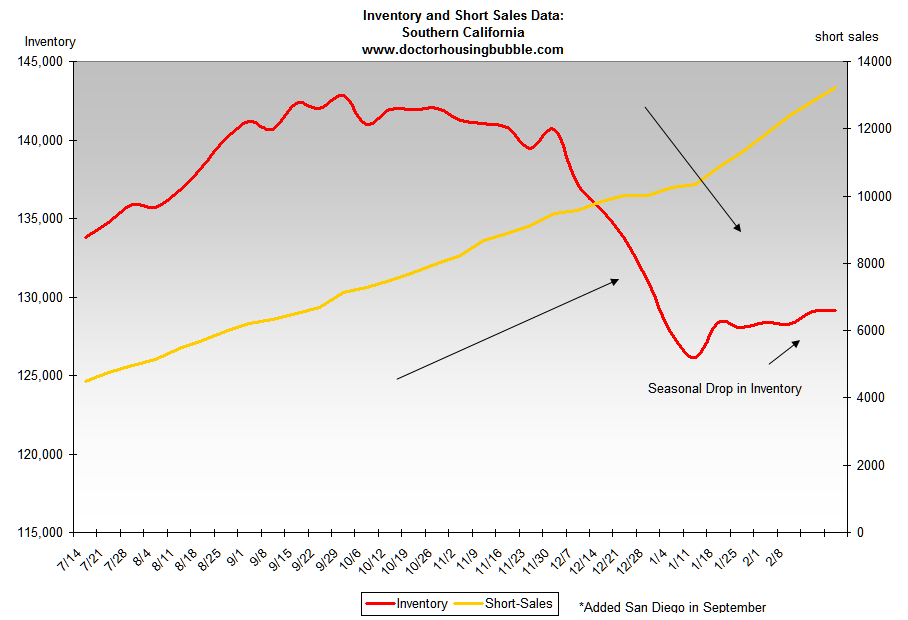
Click Here, or on the image, to see a larger, undistorted image.
The first graph shows inventory and short sales. As you can see, we are now out of the seasonal winter drop and inventory has been steadily increasing. Typically the peak in inventory numbers hits in spring and summer. Currently in Southern California we have 149,946 homes on the market. The chart above excludes San Diego inventory numbers since I do not have data beyond September but the short sale number does include San Diego numbers. According to DataQuick 9,983 homes sold in January. So let us do a bit of back of the napkin math:
Total SoCal Inventory (149,946) / Total Current SoCal Monthly Sales (9,983) = 15 Months
That’s right folks, we have over a year of inventory at the current sales rate, and take a look at the short sale inventory. This thing is increasing at exponential speed. There have been many studies discussing balanced sales figures but suffice it to say that 6 months of inventory is typically a balanced market for housing. We are nowhere close to that. Now let us take a look at another chart:
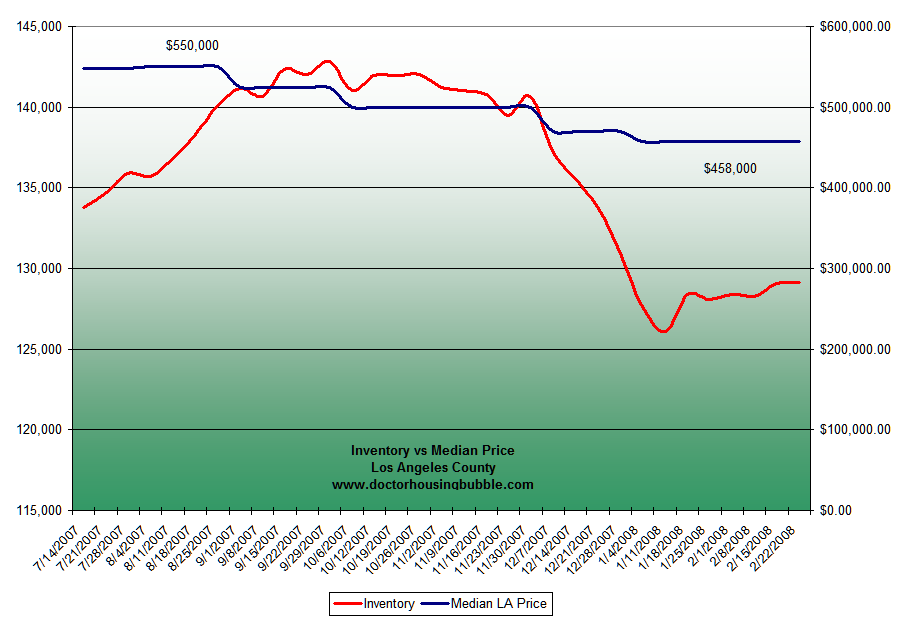
Click Here, or on the image, to see a larger, undistorted image.
This chart shows that from the peak of $550,000, Los Angeles County is now off its median peak by nearly $100,000. The importance of this chart is that it is an excellent predictor of where things will be heading. As you can see, inventory is increasing. Until inventory starts decreasing or sales start going through the roof, prices will not be going up. Aside from the credit crunch can it be that inventory is growing also because of reluctant sellers not realizing the reality of the current market? Are they swimming in a Freudian dream of housing delusion?
Do they not realize that California is in a $16 billion short fall and we are now using cockamamie ideas of balancing the budget such as closing schools (good for our future), firing teachers (higher unemployment), and letting out inmates (more home buyers!). The list of Real Homes of Genius only keeps expanding and the tide is now receding and we are going to be in housing purgatory for a very long time. The stories only get weirder and more complex as in any bubble. Greed makes people do absurd things. I recall reading a story about a farmer selling his entire livestock for a handful of tulip bulbs during that historical bubble only to realize that the one cow he kept snuck into his home at night and ate the entire tulip stock.
In this insane market we have to come to terms not only with high housing prices and defunct mortgage products, but we also have to admit that a majority of the population became speculators with the single biggest asset class in America whether they acknowledge it or not. This is a problem. First it was only a subprime thing. Then it was a subprime and credit market thing. Now it is a national emergency and every homeowner needs to be bailed out with Hope Now, Project Lifeline, Free Money Express, Wal-Mart Vouchers, 7-11 Ice Cream Relief, Mortgage Moratoriums, and every other Orwellian type of concoction you can think of. I won’t be surprised if some of these things fly since Americans are so addicted to credit they will fight tooth and nail once they realize they are maxed out.
Normxxx
______________
The contents of any third-party letters/reports above do not necessarily reflect the opinions or viewpoint of normxxx. They are provided for informational/educational purposes only.
The content of any message or post by normxxx anywhere on this site is not to be construed as constituting market or investment advice. Such is intended for educational purposes only. Individuals should always consult with their own advisors for specific investment advice.
By Dr. Housing Bubble | 22 February 2008
I prefer to take economic data and information like I take my sushi, raw with wasabi. In October, we reported the monumental tipping point of going over 10,000 short sales in Southern California. Those days now seem like a distant reality since as of today, there are 16,646 short sales in the Southern California housing market. There are a few graphs that we will be looking at in greater detail since these show the battle occurring in the housing trenches. Short sales are an important bellwether of the health in housing and until there is a slow-down in this area, we can put to rest any notion that we are even approaching bottom.
Also, there is this sudden notion that somehow we have been in the housing "slump" for ages and suddenly need to do every sort of bailout to keep housing prices sky high. Forget that housing has been on a tear for 10 years. It is as if there was no massive bubble and that even talking too much about 'the problem' is somehow going to make it worse. It may shift the market psychology a bit, but the reality is that you can’t make income appear out of thin air like David Copperfield. There lies the caveat. All this talk from politicians fails to address the fact that our current economy is based on large levels of conspicuous consumption and some major sector being in a bubble (housing having been merely the latest). Not something that bodes well for the future when the last bubble pops.

Click Here, or on the image, to see a larger, undistorted image.
The first graph shows inventory and short sales. As you can see, we are now out of the seasonal winter drop and inventory has been steadily increasing. Typically the peak in inventory numbers hits in spring and summer. Currently in Southern California we have 149,946 homes on the market. The chart above excludes San Diego inventory numbers since I do not have data beyond September but the short sale number does include San Diego numbers. According to DataQuick 9,983 homes sold in January. So let us do a bit of back of the napkin math:
Total SoCal Inventory (149,946) / Total Current SoCal Monthly Sales (9,983) = 15 Months
That’s right folks, we have over a year of inventory at the current sales rate, and take a look at the short sale inventory. This thing is increasing at exponential speed. There have been many studies discussing balanced sales figures but suffice it to say that 6 months of inventory is typically a balanced market for housing. We are nowhere close to that. Now let us take a look at another chart:

Click Here, or on the image, to see a larger, undistorted image.
This chart shows that from the peak of $550,000, Los Angeles County is now off its median peak by nearly $100,000. The importance of this chart is that it is an excellent predictor of where things will be heading. As you can see, inventory is increasing. Until inventory starts decreasing or sales start going through the roof, prices will not be going up. Aside from the credit crunch can it be that inventory is growing also because of reluctant sellers not realizing the reality of the current market? Are they swimming in a Freudian dream of housing delusion?
Do they not realize that California is in a $16 billion short fall and we are now using cockamamie ideas of balancing the budget such as closing schools (good for our future), firing teachers (higher unemployment), and letting out inmates (more home buyers!). The list of Real Homes of Genius only keeps expanding and the tide is now receding and we are going to be in housing purgatory for a very long time. The stories only get weirder and more complex as in any bubble. Greed makes people do absurd things. I recall reading a story about a farmer selling his entire livestock for a handful of tulip bulbs during that historical bubble only to realize that the one cow he kept snuck into his home at night and ate the entire tulip stock.
In this insane market we have to come to terms not only with high housing prices and defunct mortgage products, but we also have to admit that a majority of the population became speculators with the single biggest asset class in America whether they acknowledge it or not. This is a problem. First it was only a subprime thing. Then it was a subprime and credit market thing. Now it is a national emergency and every homeowner needs to be bailed out with Hope Now, Project Lifeline, Free Money Express, Wal-Mart Vouchers, 7-11 Ice Cream Relief, Mortgage Moratoriums, and every other Orwellian type of concoction you can think of. I won’t be surprised if some of these things fly since Americans are so addicted to credit they will fight tooth and nail once they realize they are maxed out.
Normxxx
______________
The contents of any third-party letters/reports above do not necessarily reflect the opinions or viewpoint of normxxx. They are provided for informational/educational purposes only.
The content of any message or post by normxxx anywhere on this site is not to be construed as constituting market or investment advice. Such is intended for educational purposes only. Individuals should always consult with their own advisors for specific investment advice.
Health Care In China
Health Care In China: Losing Patients
From The Economist Print Edition | 25 February 2008
Startling economic growth in China has not been matched by similar improvements in health care. The cost of treatment is becoming ever more prohibitive for the poor. Government spending is meagre. But nearly three years after declaring the system a failure, officials are at last getting ready to unveil a plan to fix it.
It will cost them
Some Chinese press reports say the long-awaited and much-debated reform plan is likely to be revealed at the annual session of China's parliament, which opens on March 5th. The outline is already clear: a stronger role for government, including more money from the central budget, and a drive towards universal health insurance. Changes are already in train.
The reforms reverse the market-driven policies of much of the past two decades. The outbreak in 2003 of SARS, an often fatal respiratory disease, made the government realise what a mess the health-care system had become. Government hospitals and clinics, starved of funding, had turned to raising money (and boosting ill-paid doctors' salaries) by prescribing ever more expensive treatment and diagnostic procedures. With the collapse and privatisation of state-owned enterprises, the vast majority of citizens had been left with no insurance. Many began avoiding even desperately needed treatment.
In 2003 the government introduced a new medical-insurance scheme in the countryside. This involves contributions from rural residents as well as local governments and, for the first time, the central government. The number of people taking part rose from 80m that year to more than 730m now. This month Wu Yi, a deputy prime minister, said all rural residents (about 800m is the usual official figure) should be insured by the end of this year.
The scheme is only a slight relief, if at all, for the poor. It often does not cover routine outpatient treatment. The average reimbursement rate is only 30-40%, and bills have to be paid in full in advance. So hospital stays are beyond the means of many. There is also a big loophole: those insured can get benefits only in their own localities. Many younger people from the countryside are working in cities where they have to pay all of their treatment costs. A new labour-contract law introduced this year requires employers to pay medical insurance for such workers. But migrants are often hired informally, making it easy for employers to evade such requirements.
Even though urban health care receives a disproportionate share of total government spending on health, many urban residents fare just as badly. Li Ling of Peking University estimates that more than half of the urban population has no insurance. Those who do are mostly civil servants and the staff of state-owned enterprises. At least until the labour-contract law was enacted, many private enterprises provided nothing. Last year the government introduced an urban insurance scheme (similar to the rural one) aimed at non-working residents, including children and university students. The aim is to have every urban citizen covered by 2010.
Much detail, however, is still unclear. A big issue is how to wean hospitals off their dependence on revenue from user payments. Policymakers and academics have been furiously debating whether the emphasis should be on government subsidies for hospitals or on reimbursements for patients. No target has yet been set for the maximum share of health expenditure to come from patients' own pockets. Ms Li, who has been advising the government on health reform, suggests a goal of 20% compared with over 50% at present.
Unlike for education, Chinese officials have also yet to set any specific targets for government spending as a percentage of GDP. The government spends a mere 0.8% of GDP on health (it was more than 1% in the 1980s). Henk Bekedam of the World Health Organisation says it could easily afford around 2.5%. But the government is being cautious. Reform, said Ms Wu last month, would be complicated. "Patience is needed," she said. Patients would say they have shown more than enough already.
Normxxx
______________
The contents of any third-party letters/reports above do not necessarily reflect the opinions or viewpoint of normxxx. They are provided for informational/educational purposes only.
The content of any message or post by normxxx anywhere on this site is not to be construed as constituting market or investment advice. Such is intended for educational purposes only. Individuals should always consult with their own advisors for specific investment advice.
From The Economist Print Edition | 25 February 2008
| An Orthodox Approach To Fixing The Unavailability Of Decent Health Care |
Startling economic growth in China has not been matched by similar improvements in health care. The cost of treatment is becoming ever more prohibitive for the poor. Government spending is meagre. But nearly three years after declaring the system a failure, officials are at last getting ready to unveil a plan to fix it.
It will cost themSome Chinese press reports say the long-awaited and much-debated reform plan is likely to be revealed at the annual session of China's parliament, which opens on March 5th. The outline is already clear: a stronger role for government, including more money from the central budget, and a drive towards universal health insurance. Changes are already in train.
The reforms reverse the market-driven policies of much of the past two decades. The outbreak in 2003 of SARS, an often fatal respiratory disease, made the government realise what a mess the health-care system had become. Government hospitals and clinics, starved of funding, had turned to raising money (and boosting ill-paid doctors' salaries) by prescribing ever more expensive treatment and diagnostic procedures. With the collapse and privatisation of state-owned enterprises, the vast majority of citizens had been left with no insurance. Many began avoiding even desperately needed treatment.
In 2003 the government introduced a new medical-insurance scheme in the countryside. This involves contributions from rural residents as well as local governments and, for the first time, the central government. The number of people taking part rose from 80m that year to more than 730m now. This month Wu Yi, a deputy prime minister, said all rural residents (about 800m is the usual official figure) should be insured by the end of this year.
The scheme is only a slight relief, if at all, for the poor. It often does not cover routine outpatient treatment. The average reimbursement rate is only 30-40%, and bills have to be paid in full in advance. So hospital stays are beyond the means of many. There is also a big loophole: those insured can get benefits only in their own localities. Many younger people from the countryside are working in cities where they have to pay all of their treatment costs. A new labour-contract law introduced this year requires employers to pay medical insurance for such workers. But migrants are often hired informally, making it easy for employers to evade such requirements.
Even though urban health care receives a disproportionate share of total government spending on health, many urban residents fare just as badly. Li Ling of Peking University estimates that more than half of the urban population has no insurance. Those who do are mostly civil servants and the staff of state-owned enterprises. At least until the labour-contract law was enacted, many private enterprises provided nothing. Last year the government introduced an urban insurance scheme (similar to the rural one) aimed at non-working residents, including children and university students. The aim is to have every urban citizen covered by 2010.
Much detail, however, is still unclear. A big issue is how to wean hospitals off their dependence on revenue from user payments. Policymakers and academics have been furiously debating whether the emphasis should be on government subsidies for hospitals or on reimbursements for patients. No target has yet been set for the maximum share of health expenditure to come from patients' own pockets. Ms Li, who has been advising the government on health reform, suggests a goal of 20% compared with over 50% at present.
Unlike for education, Chinese officials have also yet to set any specific targets for government spending as a percentage of GDP. The government spends a mere 0.8% of GDP on health (it was more than 1% in the 1980s). Henk Bekedam of the World Health Organisation says it could easily afford around 2.5%. But the government is being cautious. Reform, said Ms Wu last month, would be complicated. "Patience is needed," she said. Patients would say they have shown more than enough already.
Normxxx
______________
The contents of any third-party letters/reports above do not necessarily reflect the opinions or viewpoint of normxxx. They are provided for informational/educational purposes only.
The content of any message or post by normxxx anywhere on this site is not to be construed as constituting market or investment advice. Such is intended for educational purposes only. Individuals should always consult with their own advisors for specific investment advice.
Ja-pain
Japain
From The Economist print edition | 25 February 2008
The ghost of Japan's "lost decade" haunts the United States. As the consequences of America's burst housing bubble are felt through financial markets, it has become popular to ask whether Japan's awful experience of boom-and-bust has lessons for other rich countries facing, at best, sharp slowdowns. Japan's property-and-stockmarket bubble burst in 1990, creating bad loans equivalent in the end to about one-fifth of GDP. The economy began growing properly again only 12 years later, and only in 2005 could Japan say it had put financial stress and debt-deflation behind it. Even today the country's nominal GDP remains below its peak in the 1990s— a brutal measure of lost opportunities.
Yet ghosts can deceive. Similarities exist between Japan then and America today, notably the way that a financial crisis threatens the "real" economy. But the differences outnumber them. Japan should indeed be a source of worry— not, however, because other rich countries are destined for the same economic plughole, but because it is the world's second-biggest economy and it has still not tackled the fundamental causes of its malaise.
A Tale Of Two Crunches
Even by today's gloomiest assumptions, Japan's bust dwarfs America's, if in part because its boom did too. Take for instance the collapse in the equity market. America's S&P 500 is down just 8% from its 1999 peak. The Nikkei 225 share index is now nearly two-thirds below its 1989 peak. In commercial property, the comparison between the two boom-and-busts is almost as dramatic.
The more important difference, though, is how each country got into its mess and then responded to it. In America, the government can be blamed for inadequate oversight of the vast market in slicing and dicing mortgages, but it has reacted aggressively to the bust, with monetary and fiscal stimulus. Financial institutions are busy declaring their losses. In Japan, the government was deeply complicit in puffing up the market and complicit, too, in hiding the ensuing mess for years.
Japan's economy is still held back by its politicians (see article). Though much has changed since 1990, a the current cyclical slowdown is now laying bare Japan's structural shortcomings. A few years ago, people hoped that Japan, which is still a bigger economic power than China and has some marvellous companies, would help take up some of the slack in the world economy if America lagged; that now looks unlikely. Productivity is disastrously low: the return on new investment is around half that in America. Consumption is still flagging, thanks in part to companies' failure to increase wages. Bureaucratic blunders have cost the economy dearly, and Japan needs a swathe of reforms to trade and competition without which the economy will continue to disappoint.
The Liberal Democratic Party (LDP), which has ruled for the best part of half a century and remains a machine of pork and patronage, has given up trying to tackle these problems. What reformist tendencies it had under the maverick Junichiro Koizumi, prime minister between 2001 and 2006, have now gone into reverse. To make matters worse, last July the opposition Democratic Party of Japan (DPJ) won control of the upper house of the Diet (parliament). The constitution never envisaged upper and lower houses of the Diet being controlled by opposing parties, and since the upper house has nearly equal powers to the lower one, the opposition can frustrate virtually every government initiative.
Thus Yasuo Fukuda, prime minister since September, spent his first four months in office fighting to reauthorise a solitary refuelling ship operating in the Indian Ocean. Now the government is locked in grinding battles with the DPJ over bills to authorise a budget for the fiscal year that starts in April and to appoint a new governor of the Bank of Japan on March 19th.
But the problem is not merely a constitutional one. Japan is at an uncomfortable point: no longer a one-party state, yet still far from being a competitive democracy with rival parties alternating in power. Both main parties are riven by contradictions: both contain modernisers alongside a grizzled old guard of conservatives and socialists. Political chaos has allowed the old forces within the LDP— the factions, the conservative bureaucrats, the builders and the farmers— to reassert their influence. Meanwhile, the DPJ's leader, Ichiro Ozawa, who used to have a reformist streak, now sounds like an old-style LDP boss.
Japan's politics is skidding for the buffers. The crash may come as early as March, over budget differences. One way to avoid it, some politicians think, is for the LDP and the DPJ to form the kind of "grand coalition" which Mr Fukuda and Mr Ozawa talked about in November. This plan was thwarted when the rest of the DPJ leadership, rightly, balked: in effect, it would have taken Japan back towards being a one-party state, distributing largesse rather than reforming the economy.
Time For A Good Wash
Yet the buffers may be the best place for Japan. Or rather, a general election— perhaps a string of elections— offers the best chance of forcing parties to confront their inconsistencies, offering voters real choices rather than candidates who compete to bring home the bacon.
There are glimmers of hope. A cross-party group of modernising politicians, academics and businessmen has formed a pressure group, Sentaku (with connotations both of choice and of giving things a good wash). Radically, they want to decentralise the top-heavy system in which local politicians are in thrall to Tokyo's pork providers; they think the main parties should campaign on coherent manifestos; and they are urging ordinary Japanese, who do not readily bother their heads about such things, to reflect on the folly of voting for politicians who smother their districts in unused highways and bridges that lead nowhere— the visible blight of failed politics.
Many politicians say a general election would only add to the chaos. That is the argument of a political class grown fat on a broken system. Voters need a chance to start putting it right. If choice is chaos, bring it on.
Japan's Pain: Why Japan Keeps Failing
From Economist Print Edition | 25 February 2008
TOKYO | Feb 21st 2008—
Ten years ago Japan was on the point of financial and economic meltdown, with a political establishment utterly incapable of facing up to the crisis. Those Japanese who cared coined a not altogether pleasing English phrase: "Japan passing", implying not only that the world's second biggest economy was being passed by in a fast-changing world, but also that Japan could no longer even be taken seriously. A headline in The Economist at the time tried to sum up the situation more pithily: "Japan's amazing ability to disappoint" (see article).
Until recently, that dreadful time could be regarded as an awful nightmare from which the country had woken up, for Japan seemed to be starting to live up to expectations. A razzle-dazzle prime minister, Junichiro Koizumi, came to office in 2001, appearing to bring profound change both to the political establishment and to its ability to deal with economic problems which had festered since Japan's asset bubble burst in 1990.
Mr Koizumi forced banks and companies to clear up piles of bad loans. Companies, thus unburdened, started to make money once more, and from early 2002 the economy began to grow again. Mr Koizumi appeared to have weakened the special interests— farmers, the construction ministry, senior bureaucrats— to which his ruling Liberal Democratic Party (LDP) had long been in thrall and which had supported its near-unbroken rule over the past half-century. In effect, Mr Koizumi declared war on the old-style LDP.
Voters loved it. Under Mr Koizumi's banner of market-minded reform, they delivered a stunning general-election victory to the LDP and its coalition partner, New Komeito, in September 2005. When Mr Koizumi retired a year later, there was a widespread belief that Japan was set fair for economic modernisation.
Yet once more there is talk of "Japan passing". The stockmarket has fallen alarmingly since last summer, and has been in open rout for much of 2008 (see chart at left). Measured by the Nikkei 225 share index, Japanese shares are 27% below last year's July high: deep bear-market territory. Share prices are now back to their levels of September 2005— not even half where they stood 20 years ago. In January foreign investors pulled record amounts out of the Japanese stockmarket. Ask any money manager: Japan still has an amazing ability to disappoint.
The latest doubts concern the robustness of Japan's four-year recovery, during which the economy has grown at a remarkably steady 2% or so a year. Though the most recent GDP estimate, for the last quarter of 2007, suggests above-average growth, many economists point out that the series is notoriously volatile, business investment has probably been exaggerated, and the quarterly growth figure will therefore very likely be revised downwards. Economists at Goldman Sachs said in late January that the economy was already in recession; others who are not so sure claim it is a close-run thing.
Meanwhile, political chaos has reigned since last summer. It has unseated one prime minister, Shinzo Abe, who succeeded Mr Koizumi but resigned under nervous and physical strain in September 2007. And it has ensured only the vaguest grip on power for his successor, Yasuo Fukuda. The chaos was set in train when the opposition Democratic Party of Japan (DPJ), led by Ichiro Ozawa, became the dominant party in the upper house of the Diet (parliament) last July after elections for half the chamber's seats. It has now brought the impetus for growth-boosting reforms, or indeed for any joined-up policymaking at all, to a halt.
So now the LDP's Diet-affairs chairman, Tadamori Oshima, responsible for pushing through Mr Fukuda's agenda, such as it is, despairs that "investors and political establishments around the world take one look at Japan today and conclude that we politicians are incapable of deciding on anything, not even whether to put one foot in front of the other." With foreign investors selling out, says Mr Oshima, Japan is fast becoming as irrelevant as it was a decade ago. He asks this British correspondent to prescribe a decent shinguru moruto— single malt— for his depression.
Despair is spreading among the political class responsible for the mess. If the opposition deplored the "absence of a framework to sustain economic growth", you might take it with a pinch of salt. But the admission comes from none other than the economy minister, Hiroko Ota, who for good measure says that Japan can no longer be considered a "top-tier" economy. Although she identifies the problem correctly, she has disappointingly little to say about how to solve it.
Demographics darken Japan's prospects further. Its population is greying faster than that of any other big economy, so the old will become an increasing burden on workers. Today, one-fifth of Japanese are over 65; by 2015 the proportion will grow to one in four, or about 30m. Now, with Japan's birth rate well below replacement, at 1.32, and with little immigration to speak of, the population of 127m has already started to shrink and will fall each year by about 0.6% over the next half-century. It is predicted to drop below 100m by mid-century. Already, rural regions are emptying, and the shutters are closing on the centres of more and more small towns. Without robust economic growth, Japan faces pain, especially since the government has racked up high levels of national debt in an attempt to spend its way out of its post-bubble slump.
The Bureaucrats' Blunders
Even though companies are far sounder than they were a decade ago, with fewer debts and more focused operations, Japan's productivity is still pitifully low. A lack of investment is not the problem. Rather, low interest rates, an export boom and a business environment in which managers are scarcely accountable to shareholders may have generated too much of the stuff. Indeed, as Andrew Smithers of Smithers & Co points out, high investment and slow growth mean that Japan's return on new investment is around half the level in America. At least companies, notably Japan's exporters, have been making record profits. But now the impact on exports of higher oil prices, coupled with a sharp rise in the yen since last summer— a consequence largely of financial-market volatility— throws that profitability into question. That is even before considering what harm an American-led slowdown might do.
Were Japan's recovery broad-based, an export slowdown would matter less, because domestic consumption would take up the slack. Yet despite repeated predictions from economists, household spending has failed to follow a rise in business investment and exports.
The reason again lies with companies. Even where they have been making record profits, companies have hoarded their cash rather than pay more out in the form of higher wages, which have stagnated even as employment has increased. Now that a stronger yen and dearer oil are eating into profit margins, the situation may not improve soon. As a result, Mr Smithers notes, even after drawing down savings this decade, households still consume a smaller proportion of GDP than in any other rich country. It raises a question: was the path that Mr Koizumi chose to get Japan out of the economic swamp misguided, at least in part? By emphasising low interest rates (good for indebted companies but bad for savers) and low wages (ditto) to help companies out of their mess, Japan's economy has depended too much on exports and is now worryingly vulnerable to external shocks.
Politicians complain about firms' tendency to hoard cash, and urge firms to pay workers more. Yet the incompetence and unpredictability of politicians help explain the companies' caution. A year ago, for instance, in a well-intentioned attempt to crack down on predatory lending, the government all but destroyed the consumer-finance industry.
A more serious episode still started last summer, when a system for vetting new buildings was introduced in reaction to the endemic faking of earthquake-proofing data— itself a reaction to hasty new regulation brought in a few years back. The housing ministry was unable to get new software for the new system running in time. New-building approvals ground to a halt, and new construction fell by 40%.
Slowly, matters are righting themselves— new construction in December was just one-fifth below levels a year earlier. But the extraordinary effect of a single bureaucratic bungle has been to knock 0.6 percentage points off Japan's growth. The building-standards fiasco was one reason for the reduction in the government's growth forecast for the fiscal year to the end of March, from 2.1% to 1.3%.
These costly blunders were committed even before July's elections divided the Diet; with the current political chaos, the risks of things going wrong is still higher. The incompetence of politicians and bureaucrats does not just lead to expensive short-term disasters; it also threatens Japan's long-term growth prospects.
Japan needs a mass of economic reforms— a more open climate to foreign investment, for instance, lower tariffs on imported food, fewer subsidies for farmers, freer trade, better tax treatment of foreign companies, the abolition of a welter of business subsidies, a more flexible labour market, greater fiscal rectitude (national debt is currently around 180% of GDP), more accountability by pension funds and insurance companies, further privatisation of services and much more. Takatoshi Ito of Tokyo University, who sits on the Council on Economic and Fiscal Policy, the government's advisory body that drove structural reform during the Koizumi years, has calculated the economic benefit of pursuing the reforms the CEFP advocates, and the costs of abandoning them. Pursue reform, he argues, and Japan should be able to grow at a respectable 2% a year. Abandon it, and growth will crawl along at 1-1.4%.
And crawl it will, if Mr Ito is right, because Japan has abandoned reform. Blame a political establishment of underwhelming talent and vision, and an almighty constitutional mess.
The guilty men: Abe, Fukuda, Ozawa
First in line for blame is Mr Abe. Though he came to office as a self-styled reformer, nothing he has ever said or done suggests an interest in improving the economy. Once in office, he seems to have calculated that Japan would chug happily along, leaving him to pursue pet nationalist themes such as inculcating patriotism in schools. A tin ear for other issues left him oblivious to a growing chorus of dismay at decaying country towns, sluggish wage growth and a growing scandal of bureaucratic incompetence and corruption in the state pension system. On top of that, Mr Abe's government, though short-lived, was dogged by a seemingly endless series of financial scandals. The LDP's upper-house defeat was the punishment. Amazingly, Mr Abe appears to think he deserves another shot at high office— at 53, he is young by the standards of Japanese politicians.
Second in line are the ancient crocodiles of the LDP. In a panic, they closed around Mr Fukuda, who at 71 is the face of experience over Mr Abe's callow youth. Under Mr Koizumi and Mr Abe, decision-making had devolved from the LDP corridors to the prime minister and even as far down as the cabinet. Under Mr Fukuda, power has flowed back to the factions and to the party gerontocrats— notably two former prime ministers, Yasuhiro Nakasone (89) and Yoshiro Mori (70) as well as Tsuneo Watanabe (81), publisher of Japan's biggest-circulation newspaper, the Yomiuri Shimbun. It was Mr Watanabe who arranged the farcical secret meetings late last year between Mr Ozawa, leader of the opposition DPJ, and Mr Fukuda about forming a "grand coalition"— though he has not since bothered to inform his newspaper's readers about that.
Taking Back The Car Keys
In effect, a generational coup has taken place, with the keys to the political car taken back by the oldies. The result is that structural change is on hold. Negotiations to lower trade barriers with other countries have slowed. Tax reform to set the budget on an even keel has been put off. A senior reform-minded civil servant says that morale among modernising bureaucrats, those that favour privatisation and more competition, has sunk. None of them, he says, now dares propose growth-boosting reforms— as they used to under Mr Koizumi and even Mr Abe— for fear of incurring the disfavour of their political masters. Meanwhile, attacks on foreign investment are on the rise again among politicians and old-guard civil servants.
Mr Fukuda understands Japan's problems better than Mr Abe did. He spelt some of them out in his policy address to the Diet's new session last month: he underlined the need to overcome labour-market rigidities that discourage women and the elderly, and discriminate against Japan's army of workers who can find only temporary jobs. He bemoaned Japan's feeble standing as an international financial centre, thanks in part to hostility to foreign investment. He stressed the importance of putting the government's rickety finances to rights, and he has since championed the cause of consumers.
Yet both allies and opponents alike believe he has neither the gumption nor the authority forcefully to push for these goals. In particular, the government already looks like missing a long-agreed target to balance the budget, before interest payments, by 2011. In the government's latest budget, for the fiscal year beginning in April, the LDP's traditional clients, farmers and road-builders, are getting goodies denied them in recent years.
Third in line for blame comes the DPJ's Mr Ozawa. His party's ranks have plenty of young politicians favouring market-driven reforms. Deploring the one-party state that Japan has largely been under the LDP since the second world war, this bunch thinks Japan would be better served by competitive parties alternating in power. Perhaps Mr Ozawa does, too. After all, nearly two decades ago when he himself was a baron in the LDP, he first launched the debate about how Japan should modernise long before the political establishment was thinking about it. Ever since he stormed out of the LDP, he has vowed to bring it down.
Mr Ozawa's style, however, if occasionally brilliant, is also thin-skinned and autocratic: he does his deals in the shadows without consulting colleagues. These are hardly the right qualities for the leader of a party that makes such a great show of transparency and accountability.
Meanwhile, his mercurial character has only gotten more erratic. Since campaigning as the farmer's friend— admittedly a successful strategy in the upper-house elections, where rural votes carried a disproportionate weight— Mr Ozawa has come to sound like the old-style LDP bosses against whom he once turned. That unsettles the modernisers in his party, most of whom represent urban, more reform-minded constituencies.
And how else, apart from ascribing a growing erratic streak to Mr Ozawa, to explain the extraordinary about-face last November, when he switched from vowing to bring down Mr Fukuda and his government to cutting private deals with the prime minister? To the DPJ's modernisers, a grand coalition would spell doom to the party, which defines itself precisely by offering itself as an alternative to the LDP. Younger parliamentarians have become so dissatisfied with Mr Ozawa that Yukio Hatoyama, the DPJ's secretary-general, now says that he, and not Mr Ozawa, is answerable to the party caucus. It is a hint that Mr Ozawa, at least for the time being, has agreed to cede some authority.
Yet Mr Ozawa has a gun to the party's head. He knows that a split over his leadership might cause the DPJ to crumble. And should he choose to leave (he has flounced out of parties before), a handful of parliamentarians leaving with him would mean that the DPJ would almost certainly lose its upper-house majority.
Most of all, perhaps, blame two parties bursting with internal contradictions, a constitution that never envisaged opposing parties controlling the Diet's two chambers, and a culture that treats politics as a personal, sometimes family, business, not a means of offering voters choices about how their country should be run. An election would not solve these problems, but it might at least encourage parties to tell voters what they stand for.
Lastly, the voters must take some of the blame. Ten years ago, when The Economist lamented Japan's amazing ability to disappoint, one shrewd parliamentarian wrote in to challenge that. The headline, he said, should have read: "The Japanese people's amazing inability to be disappointed". A general election would at least give them the chance to start holding their politicians to a higher standard.
ß§
Normxxx
______________
The contents of any third-party letters/reports above do not necessarily reflect the opinions or viewpoint of normxxx. They are provided for informational/educational purposes only.
The content of any message or post by normxxx anywhere on this site is not to be construed as constituting market or investment advice. Such is intended for educational purposes only. Individuals should always consult with their own advisors for specific investment advice.
From The Economist print edition | 25 February 2008
| The World's Second-Biggest Economy Is Still In A Funk— And Politics Is The Problem |
The ghost of Japan's "lost decade" haunts the United States. As the consequences of America's burst housing bubble are felt through financial markets, it has become popular to ask whether Japan's awful experience of boom-and-bust has lessons for other rich countries facing, at best, sharp slowdowns. Japan's property-and-stockmarket bubble burst in 1990, creating bad loans equivalent in the end to about one-fifth of GDP. The economy began growing properly again only 12 years later, and only in 2005 could Japan say it had put financial stress and debt-deflation behind it. Even today the country's nominal GDP remains below its peak in the 1990s— a brutal measure of lost opportunities.Yet ghosts can deceive. Similarities exist between Japan then and America today, notably the way that a financial crisis threatens the "real" economy. But the differences outnumber them. Japan should indeed be a source of worry— not, however, because other rich countries are destined for the same economic plughole, but because it is the world's second-biggest economy and it has still not tackled the fundamental causes of its malaise.
A Tale Of Two Crunches
Even by today's gloomiest assumptions, Japan's bust dwarfs America's, if in part because its boom did too. Take for instance the collapse in the equity market. America's S&P 500 is down just 8% from its 1999 peak. The Nikkei 225 share index is now nearly two-thirds below its 1989 peak. In commercial property, the comparison between the two boom-and-busts is almost as dramatic.
The more important difference, though, is how each country got into its mess and then responded to it. In America, the government can be blamed for inadequate oversight of the vast market in slicing and dicing mortgages, but it has reacted aggressively to the bust, with monetary and fiscal stimulus. Financial institutions are busy declaring their losses. In Japan, the government was deeply complicit in puffing up the market and complicit, too, in hiding the ensuing mess for years.
Japan's economy is still held back by its politicians (see article). Though much has changed since 1990, a the current cyclical slowdown is now laying bare Japan's structural shortcomings. A few years ago, people hoped that Japan, which is still a bigger economic power than China and has some marvellous companies, would help take up some of the slack in the world economy if America lagged; that now looks unlikely. Productivity is disastrously low: the return on new investment is around half that in America. Consumption is still flagging, thanks in part to companies' failure to increase wages. Bureaucratic blunders have cost the economy dearly, and Japan needs a swathe of reforms to trade and competition without which the economy will continue to disappoint.
The Liberal Democratic Party (LDP), which has ruled for the best part of half a century and remains a machine of pork and patronage, has given up trying to tackle these problems. What reformist tendencies it had under the maverick Junichiro Koizumi, prime minister between 2001 and 2006, have now gone into reverse. To make matters worse, last July the opposition Democratic Party of Japan (DPJ) won control of the upper house of the Diet (parliament). The constitution never envisaged upper and lower houses of the Diet being controlled by opposing parties, and since the upper house has nearly equal powers to the lower one, the opposition can frustrate virtually every government initiative.
Thus Yasuo Fukuda, prime minister since September, spent his first four months in office fighting to reauthorise a solitary refuelling ship operating in the Indian Ocean. Now the government is locked in grinding battles with the DPJ over bills to authorise a budget for the fiscal year that starts in April and to appoint a new governor of the Bank of Japan on March 19th.
But the problem is not merely a constitutional one. Japan is at an uncomfortable point: no longer a one-party state, yet still far from being a competitive democracy with rival parties alternating in power. Both main parties are riven by contradictions: both contain modernisers alongside a grizzled old guard of conservatives and socialists. Political chaos has allowed the old forces within the LDP— the factions, the conservative bureaucrats, the builders and the farmers— to reassert their influence. Meanwhile, the DPJ's leader, Ichiro Ozawa, who used to have a reformist streak, now sounds like an old-style LDP boss.
Japan's politics is skidding for the buffers. The crash may come as early as March, over budget differences. One way to avoid it, some politicians think, is for the LDP and the DPJ to form the kind of "grand coalition" which Mr Fukuda and Mr Ozawa talked about in November. This plan was thwarted when the rest of the DPJ leadership, rightly, balked: in effect, it would have taken Japan back towards being a one-party state, distributing largesse rather than reforming the economy.
Time For A Good Wash
Yet the buffers may be the best place for Japan. Or rather, a general election— perhaps a string of elections— offers the best chance of forcing parties to confront their inconsistencies, offering voters real choices rather than candidates who compete to bring home the bacon.
There are glimmers of hope. A cross-party group of modernising politicians, academics and businessmen has formed a pressure group, Sentaku (with connotations both of choice and of giving things a good wash). Radically, they want to decentralise the top-heavy system in which local politicians are in thrall to Tokyo's pork providers; they think the main parties should campaign on coherent manifestos; and they are urging ordinary Japanese, who do not readily bother their heads about such things, to reflect on the folly of voting for politicians who smother their districts in unused highways and bridges that lead nowhere— the visible blight of failed politics.
Many politicians say a general election would only add to the chaos. That is the argument of a political class grown fat on a broken system. Voters need a chance to start putting it right. If choice is chaos, bring it on.
Japan's Pain: Why Japan Keeps Failing
From Economist Print Edition | 25 February 2008
TOKYO | Feb 21st 2008—
| How The Politicians Are To Blame For The Failure Of Japan's Recovery |
Ten years ago Japan was on the point of financial and economic meltdown, with a political establishment utterly incapable of facing up to the crisis. Those Japanese who cared coined a not altogether pleasing English phrase: "Japan passing", implying not only that the world's second biggest economy was being passed by in a fast-changing world, but also that Japan could no longer even be taken seriously. A headline in The Economist at the time tried to sum up the situation more pithily: "Japan's amazing ability to disappoint" (see article).Until recently, that dreadful time could be regarded as an awful nightmare from which the country had woken up, for Japan seemed to be starting to live up to expectations. A razzle-dazzle prime minister, Junichiro Koizumi, came to office in 2001, appearing to bring profound change both to the political establishment and to its ability to deal with economic problems which had festered since Japan's asset bubble burst in 1990.
Mr Koizumi forced banks and companies to clear up piles of bad loans. Companies, thus unburdened, started to make money once more, and from early 2002 the economy began to grow again. Mr Koizumi appeared to have weakened the special interests— farmers, the construction ministry, senior bureaucrats— to which his ruling Liberal Democratic Party (LDP) had long been in thrall and which had supported its near-unbroken rule over the past half-century. In effect, Mr Koizumi declared war on the old-style LDP.
Voters loved it. Under Mr Koizumi's banner of market-minded reform, they delivered a stunning general-election victory to the LDP and its coalition partner, New Komeito, in September 2005. When Mr Koizumi retired a year later, there was a widespread belief that Japan was set fair for economic modernisation.
Yet once more there is talk of "Japan passing". The stockmarket has fallen alarmingly since last summer, and has been in open rout for much of 2008 (see chart at left). Measured by the Nikkei 225 share index, Japanese shares are 27% below last year's July high: deep bear-market territory. Share prices are now back to their levels of September 2005— not even half where they stood 20 years ago. In January foreign investors pulled record amounts out of the Japanese stockmarket. Ask any money manager: Japan still has an amazing ability to disappoint.The latest doubts concern the robustness of Japan's four-year recovery, during which the economy has grown at a remarkably steady 2% or so a year. Though the most recent GDP estimate, for the last quarter of 2007, suggests above-average growth, many economists point out that the series is notoriously volatile, business investment has probably been exaggerated, and the quarterly growth figure will therefore very likely be revised downwards. Economists at Goldman Sachs said in late January that the economy was already in recession; others who are not so sure claim it is a close-run thing.
Meanwhile, political chaos has reigned since last summer. It has unseated one prime minister, Shinzo Abe, who succeeded Mr Koizumi but resigned under nervous and physical strain in September 2007. And it has ensured only the vaguest grip on power for his successor, Yasuo Fukuda. The chaos was set in train when the opposition Democratic Party of Japan (DPJ), led by Ichiro Ozawa, became the dominant party in the upper house of the Diet (parliament) last July after elections for half the chamber's seats. It has now brought the impetus for growth-boosting reforms, or indeed for any joined-up policymaking at all, to a halt.
So now the LDP's Diet-affairs chairman, Tadamori Oshima, responsible for pushing through Mr Fukuda's agenda, such as it is, despairs that "investors and political establishments around the world take one look at Japan today and conclude that we politicians are incapable of deciding on anything, not even whether to put one foot in front of the other." With foreign investors selling out, says Mr Oshima, Japan is fast becoming as irrelevant as it was a decade ago. He asks this British correspondent to prescribe a decent shinguru moruto— single malt— for his depression.
Despair is spreading among the political class responsible for the mess. If the opposition deplored the "absence of a framework to sustain economic growth", you might take it with a pinch of salt. But the admission comes from none other than the economy minister, Hiroko Ota, who for good measure says that Japan can no longer be considered a "top-tier" economy. Although she identifies the problem correctly, she has disappointingly little to say about how to solve it.
Demographics darken Japan's prospects further. Its population is greying faster than that of any other big economy, so the old will become an increasing burden on workers. Today, one-fifth of Japanese are over 65; by 2015 the proportion will grow to one in four, or about 30m. Now, with Japan's birth rate well below replacement, at 1.32, and with little immigration to speak of, the population of 127m has already started to shrink and will fall each year by about 0.6% over the next half-century. It is predicted to drop below 100m by mid-century. Already, rural regions are emptying, and the shutters are closing on the centres of more and more small towns. Without robust economic growth, Japan faces pain, especially since the government has racked up high levels of national debt in an attempt to spend its way out of its post-bubble slump.
The Bureaucrats' Blunders
Even though companies are far sounder than they were a decade ago, with fewer debts and more focused operations, Japan's productivity is still pitifully low. A lack of investment is not the problem. Rather, low interest rates, an export boom and a business environment in which managers are scarcely accountable to shareholders may have generated too much of the stuff. Indeed, as Andrew Smithers of Smithers & Co points out, high investment and slow growth mean that Japan's return on new investment is around half the level in America. At least companies, notably Japan's exporters, have been making record profits. But now the impact on exports of higher oil prices, coupled with a sharp rise in the yen since last summer— a consequence largely of financial-market volatility— throws that profitability into question. That is even before considering what harm an American-led slowdown might do.
Were Japan's recovery broad-based, an export slowdown would matter less, because domestic consumption would take up the slack. Yet despite repeated predictions from economists, household spending has failed to follow a rise in business investment and exports.
The reason again lies with companies. Even where they have been making record profits, companies have hoarded their cash rather than pay more out in the form of higher wages, which have stagnated even as employment has increased. Now that a stronger yen and dearer oil are eating into profit margins, the situation may not improve soon. As a result, Mr Smithers notes, even after drawing down savings this decade, households still consume a smaller proportion of GDP than in any other rich country. It raises a question: was the path that Mr Koizumi chose to get Japan out of the economic swamp misguided, at least in part? By emphasising low interest rates (good for indebted companies but bad for savers) and low wages (ditto) to help companies out of their mess, Japan's economy has depended too much on exports and is now worryingly vulnerable to external shocks.
Politicians complain about firms' tendency to hoard cash, and urge firms to pay workers more. Yet the incompetence and unpredictability of politicians help explain the companies' caution. A year ago, for instance, in a well-intentioned attempt to crack down on predatory lending, the government all but destroyed the consumer-finance industry.
A more serious episode still started last summer, when a system for vetting new buildings was introduced in reaction to the endemic faking of earthquake-proofing data— itself a reaction to hasty new regulation brought in a few years back. The housing ministry was unable to get new software for the new system running in time. New-building approvals ground to a halt, and new construction fell by 40%.
Slowly, matters are righting themselves— new construction in December was just one-fifth below levels a year earlier. But the extraordinary effect of a single bureaucratic bungle has been to knock 0.6 percentage points off Japan's growth. The building-standards fiasco was one reason for the reduction in the government's growth forecast for the fiscal year to the end of March, from 2.1% to 1.3%.
These costly blunders were committed even before July's elections divided the Diet; with the current political chaos, the risks of things going wrong is still higher. The incompetence of politicians and bureaucrats does not just lead to expensive short-term disasters; it also threatens Japan's long-term growth prospects.
Japan needs a mass of economic reforms— a more open climate to foreign investment, for instance, lower tariffs on imported food, fewer subsidies for farmers, freer trade, better tax treatment of foreign companies, the abolition of a welter of business subsidies, a more flexible labour market, greater fiscal rectitude (national debt is currently around 180% of GDP), more accountability by pension funds and insurance companies, further privatisation of services and much more. Takatoshi Ito of Tokyo University, who sits on the Council on Economic and Fiscal Policy, the government's advisory body that drove structural reform during the Koizumi years, has calculated the economic benefit of pursuing the reforms the CEFP advocates, and the costs of abandoning them. Pursue reform, he argues, and Japan should be able to grow at a respectable 2% a year. Abandon it, and growth will crawl along at 1-1.4%.
And crawl it will, if Mr Ito is right, because Japan has abandoned reform. Blame a political establishment of underwhelming talent and vision, and an almighty constitutional mess.
The guilty men: Abe, Fukuda, OzawaFirst in line for blame is Mr Abe. Though he came to office as a self-styled reformer, nothing he has ever said or done suggests an interest in improving the economy. Once in office, he seems to have calculated that Japan would chug happily along, leaving him to pursue pet nationalist themes such as inculcating patriotism in schools. A tin ear for other issues left him oblivious to a growing chorus of dismay at decaying country towns, sluggish wage growth and a growing scandal of bureaucratic incompetence and corruption in the state pension system. On top of that, Mr Abe's government, though short-lived, was dogged by a seemingly endless series of financial scandals. The LDP's upper-house defeat was the punishment. Amazingly, Mr Abe appears to think he deserves another shot at high office— at 53, he is young by the standards of Japanese politicians.
Second in line are the ancient crocodiles of the LDP. In a panic, they closed around Mr Fukuda, who at 71 is the face of experience over Mr Abe's callow youth. Under Mr Koizumi and Mr Abe, decision-making had devolved from the LDP corridors to the prime minister and even as far down as the cabinet. Under Mr Fukuda, power has flowed back to the factions and to the party gerontocrats— notably two former prime ministers, Yasuhiro Nakasone (89) and Yoshiro Mori (70) as well as Tsuneo Watanabe (81), publisher of Japan's biggest-circulation newspaper, the Yomiuri Shimbun. It was Mr Watanabe who arranged the farcical secret meetings late last year between Mr Ozawa, leader of the opposition DPJ, and Mr Fukuda about forming a "grand coalition"— though he has not since bothered to inform his newspaper's readers about that.
Taking Back The Car Keys
In effect, a generational coup has taken place, with the keys to the political car taken back by the oldies. The result is that structural change is on hold. Negotiations to lower trade barriers with other countries have slowed. Tax reform to set the budget on an even keel has been put off. A senior reform-minded civil servant says that morale among modernising bureaucrats, those that favour privatisation and more competition, has sunk. None of them, he says, now dares propose growth-boosting reforms— as they used to under Mr Koizumi and even Mr Abe— for fear of incurring the disfavour of their political masters. Meanwhile, attacks on foreign investment are on the rise again among politicians and old-guard civil servants.
Mr Fukuda understands Japan's problems better than Mr Abe did. He spelt some of them out in his policy address to the Diet's new session last month: he underlined the need to overcome labour-market rigidities that discourage women and the elderly, and discriminate against Japan's army of workers who can find only temporary jobs. He bemoaned Japan's feeble standing as an international financial centre, thanks in part to hostility to foreign investment. He stressed the importance of putting the government's rickety finances to rights, and he has since championed the cause of consumers.
Yet both allies and opponents alike believe he has neither the gumption nor the authority forcefully to push for these goals. In particular, the government already looks like missing a long-agreed target to balance the budget, before interest payments, by 2011. In the government's latest budget, for the fiscal year beginning in April, the LDP's traditional clients, farmers and road-builders, are getting goodies denied them in recent years.
Third in line for blame comes the DPJ's Mr Ozawa. His party's ranks have plenty of young politicians favouring market-driven reforms. Deploring the one-party state that Japan has largely been under the LDP since the second world war, this bunch thinks Japan would be better served by competitive parties alternating in power. Perhaps Mr Ozawa does, too. After all, nearly two decades ago when he himself was a baron in the LDP, he first launched the debate about how Japan should modernise long before the political establishment was thinking about it. Ever since he stormed out of the LDP, he has vowed to bring it down.
Mr Ozawa's style, however, if occasionally brilliant, is also thin-skinned and autocratic: he does his deals in the shadows without consulting colleagues. These are hardly the right qualities for the leader of a party that makes such a great show of transparency and accountability.
Meanwhile, his mercurial character has only gotten more erratic. Since campaigning as the farmer's friend— admittedly a successful strategy in the upper-house elections, where rural votes carried a disproportionate weight— Mr Ozawa has come to sound like the old-style LDP bosses against whom he once turned. That unsettles the modernisers in his party, most of whom represent urban, more reform-minded constituencies.
And how else, apart from ascribing a growing erratic streak to Mr Ozawa, to explain the extraordinary about-face last November, when he switched from vowing to bring down Mr Fukuda and his government to cutting private deals with the prime minister? To the DPJ's modernisers, a grand coalition would spell doom to the party, which defines itself precisely by offering itself as an alternative to the LDP. Younger parliamentarians have become so dissatisfied with Mr Ozawa that Yukio Hatoyama, the DPJ's secretary-general, now says that he, and not Mr Ozawa, is answerable to the party caucus. It is a hint that Mr Ozawa, at least for the time being, has agreed to cede some authority.
Yet Mr Ozawa has a gun to the party's head. He knows that a split over his leadership might cause the DPJ to crumble. And should he choose to leave (he has flounced out of parties before), a handful of parliamentarians leaving with him would mean that the DPJ would almost certainly lose its upper-house majority.
Most of all, perhaps, blame two parties bursting with internal contradictions, a constitution that never envisaged opposing parties controlling the Diet's two chambers, and a culture that treats politics as a personal, sometimes family, business, not a means of offering voters choices about how their country should be run. An election would not solve these problems, but it might at least encourage parties to tell voters what they stand for.
Lastly, the voters must take some of the blame. Ten years ago, when The Economist lamented Japan's amazing ability to disappoint, one shrewd parliamentarian wrote in to challenge that. The headline, he said, should have read: "The Japanese people's amazing inability to be disappointed". A general election would at least give them the chance to start holding their politicians to a higher standard.
ß§
Normxxx
______________
The contents of any third-party letters/reports above do not necessarily reflect the opinions or viewpoint of normxxx. They are provided for informational/educational purposes only.
The content of any message or post by normxxx anywhere on this site is not to be construed as constituting market or investment advice. Such is intended for educational purposes only. Individuals should always consult with their own advisors for specific investment advice.
Slavic Village: Ghost Town, USA
Special Report: Cleveland, USA— Ghost Town Created By America’s Loan Scandal
Click here for a link to complete article and photo montage:
By Dominic Rushe, TheSundayTimes, UK | 24 February 2008
Look through squinted eyes and you can still see what once attracted people to Cleveland’s Slavic Village. The area took its name from the Czech and Polish immigrants who settled there in the mid-19th century to work the city’s wool and steel mills. Its tree-lined streets and attractive, wood-framed homes were once home to a community filled with factory workers, young families and first-time homebuyers. Small pockets still have that family feel, but decline set in during the 1980s as those jobs moved overseas and drug dealers and violence moved in. The city authorities cracked down, local people rallied round, and until a few years ago residents said life in the village seemed to be improving again. Then came the sub-prime debacle.
Now Slavic Village looks as if it has been hit by a hurricane. And this man-made disaster rivals hurricane Katrina when it comes to displacing families. The 2005 storm displaced some 35,000 people in the worst-hit districts of New Orleans. Since 2003 34,156 people have lost their homes to repossession just in the Cleveland area, according to Case Western Reserve University, and the pace of those losses is accelerating. The new year is barely two months old and so far there have been 1,857 foreclosures in the Cleveland area.
Slavic Village has street after empty street of boarded-up houses, their roofs caving in, collapsed balconies hanging from the fronts of buildings. Some people seem to have just upped and left, leaving their belongings behind for the rats and vandals. Owners have put up signs offering their burnt-out homes for a $500 (£250) downpayment. Bins and rubbish litter the street. Signs warn trespassers the structures are unsafe. People have spray-painted "No copper" or "No metal" on their doors to deter crooks who have stripped anything of value from these decaying shells. Even brick steps have been ripped off, leaving houses that look as if they are floating on a dark sea of garbage.
Slavic Village is Ground Zero for a tragedy being repeated across America. The dramatic rise and fall of the sub-prime mortgage market has left borrowers across the country facing repossession. In 2002 there were 101 foreclosures in Cleveland. In 2005 the number was 2,000, last year it was almost 8,000. Across America the number of foreclosures rose 79% last year, according to Realtytrac, an American property analyst, as people, many of whom would never have received loans in the past, have failed to keep up their mortgage payments.
Similar, and in some cases worse, situations can be found in cities from California to Nevada to Michigan to Massachusetts to New York to Maryland, D.C., and Virgina to Florida. The reverberations from this crisis have been felt across the world, wiping billions off the value of banks’ investments and making them reluctant to lend money even to each other, a problem that drove Britain’s Northern Rock to the edge of collapse [[and into Nationalization: normxxx]].
Cleveland’s mayor Frank Jackson knows who to blame: Wall Street. The mayor’s office is suing some of the world’s biggest banks. including Citigroup, Goldman Sachs, HSBC and Royal Bank of Scotland’s Greenwich Capital, claiming they acted like organised criminals financing the sale of products that they knew could do nothing but harm to Cleveland. Sub-prime mortgages have proved as bad as drugs in the destruction they have wrought on the community, he said.
Low interest rates and rising house prices convinced Wall Street that sub-prime loans were a safe bet. With Wall Street’s blessing a once niche and— frankly— dodgy product aimed at borrowers with bad credit histories went mainstream. The mayor’s writ sets out in black and white just how much money was once available in this market. Brokers targeted people in areas like Slavic Village offering loans to people with poor credit records. Those loans were then pooled together (securitised) and sold on to investors around the world. If a few loans failed, there were others to pick up the loss and, if house prices rose, repossession or refinancing would cover the debt.
RBS’s Greenwich Capital underwrote more than $180 billion in securities backed by sub-prime mortgages, according to the suit. HSBC issued more than $200 billion in such securities and also made loans to people through Household Finance, its sub-prime lending arm. Between 2004 and 2007, the suit states, HSBC moved to foreclose on 1,300 loans in the Cleveland area.
When the sub-prime mortgage market imploded, HSBC and its rivals lost billions but their debt to Cleveland has yet to be paid, said Jackson. The city’s property taxes are falling, people are leaving the city. As the city’s income falls, its expenses are rising. Vacant properties attract crime. Arson rates are soaring. Cleveland used to spend $1.7m a year tearing down abandoned properties. Last year that figure had reached $6m— as far as the budget would stretch. "We tore down 1,000 structures and we didn’t make a dent," said Jackson.
"They created the demand and in a market like ours that was completely unable to withstand the failures that arose. We did not have the increase in the real-estate markets that other areas of the country experienced. We have had a difficult economy over the past decade as we have moved from a manufacturing economy to a services economy. We have struggled here. They created an environment where there was no other outcome than the foreclosures. We saw it coming. How could Wall Street not see it coming?" Many others take the same view. "They knew," said Robert Triozzi, Cleveland’s director of law. "They knew."
Two years ago Aquila Eberhardt saw an advertisement in the local paper offering loans to people with poor credit histories. The 29-year-old single mother had not worked for three years and had trouble keeping up with credit-card payments.
"The advertisement said that if I looked at this house they would put me up in a hotel," she said. At the time her social-security benefits were worth about $1,400 a month and she had $1,300 in savings. A week after she visited the offices of a local estate agent she had a loan for $103,589 and had become a first-time homebuyer. "I thought this is crazy. I told them I didn’t even have any pay slips to show them. They told me I would be okay and that I could afford it because I would be paying about $400 a month."
Almost as soon as she moved into the three-bedroom house in Slavic Village she was horrified to receive her first mortgage bill for $681, a figure she says she cannot afford and one she has struggled to keep up with ever since. The house is in disrepair. She lives in dread that something will happen to the roof, which she cannot afford to fix. Neighbours have moved out; their houses have been boarded up. But Eberhardt says she has nowhere else to go. On March 17 she must go to court and face eviction.
Credit checks, ignored when she took out her loans, are in vogue again at financial institutions. Eberhardt’s credit score has been further destroyed by her home-loan disaster, making it all but impossible for her to pass the financial checks set by most landlords. In pursuing the dream of homeownership she has lost her life savings, what was left of her creditworthiness and is now set to lose her home. "I don’t think I should ever have been given this loan, but they tricked me. If I knew I was going to get into this big a mess, I would never have done it," said Eberhardt.
Barbara Anderson, 60, has lived in Slavic Village for 25 years and says predatory lending is nothing new. Anderson, a community activist who is now a city liaison officer, nearly lost her own home in the 1990s when a new loan company took it over and her interest rate shot up from 7% to 20%. The unscrupulous have always targeted the poor. What’s different now is the scale of the problem, she said.
"Why would a bank want to harass me? Why are they so concerned about me paying an extra $40?" she said. "Because I was isolated I thought it was just me. It wasn’t about just me it’s about the terrorisation of a whole city," said Anderson. She feels the banks should take the biggest share of the blame, but homebuyers have some responsibility too she said: "The papers you sign affect an entire city. When something happens to your loan it affects me. If something happens to your loan, it affects my taxes, it brings down my house’s value, it adds a criminal element. It’s a terror to the neighbourhood.
"Somebody once said we have found the smoking gun and everyone’s fingerprints are on it," she said. "That’s how I feel about it. We all can take some blame for some of this." The crisis is likely to get worse before it gets better. As home prices fall and lending standards tighten, more people are defaulting on their mortgages, potentially causing billions of dollars in additional losses. Some 1.6m mortgage holders defaulted on home loans last year, and at least that many are expected to default this year, according to Moody’s Economy.com, a financial website.
A December 2006 study by the Center for Responsible Lending (CRL), a Washington-based lobby group, predicted that sub-prime foreclosures would cost American households as much as $164 billion. The nationwide study predicted that 19.4% of such loans taken out between 2005 and 2006 would fail. Even during the period of strongly rising house prices, sub-prime foreclosures were high. Some 13% of these home loans ended in foreclosure within five years of being taken out, according to CRL.
And those rising house prices masked another problem that is only now starting to emerge. Many homeowners who were struggling with their loans were using equity from their rising house price to refinance their mortgages. With the housing boom over, and lenders tightening their standards, troubled borrowers could end up without the equity they need to refinance their loan or to sell their home and pay off their loans. According to the CRL, when these distressed borrowers are added to the foreclosure rates, the total "failure rate" for sub-prime loans approaches 25%.
Rather than a stepping stone to standard loans, as their champions once promoted them, sub-prime loans have left borrowers mired in spiralling debts. The CRL report said: "In reality, many borrowers refinance from one sub-prime loan to another, losing equity each time to cover the cost of getting a new loan. When we analyse the likelihood of foreclosure for borrowers who repeatedly refinance, we find that the risk of losing the home climbs to 36%."
Last month the CRL put out a new report "Sub-prime Spillover" that attempted to quantify the impact of the crisis on the larger community. According to the report, foreclosures on sub-prime home loans originated in 2005 and 2006 will devalue the properties of 40.6m neighbouring homes. Homeowners living near foreclosed properties will see their property values decrease $5,000 on average. The report estimates that the total decline in house values and tax base from nearby foreclosures will be $202 billion.
"For all the headlines we are seeing, this situation is going to get worse," said Kathleen Day, a CRL spokeswoman. "There has been irresponsibility all along the line. Many of these loans were made to people who never had the ability to repay. It’s ridiculous, like selling someone a car without a steering wheel and then being surprised when they crash. Sub-prime loans need not be bad but once you stop assessing the borrowers’ ability to pay and the interest payments don’t reflect the borrowers’ ability to pay, that’s crazy."
Next week Ohio gets its chance to vote for the Republican and Democrat candidates who will fight it out to be the next president. Anderson set out her views to the Democrat front-runner Barack Obama during a recent visit: "Families that used to sit in their homes around the kitchen table are now sitting around a steering wheel. Some children who should be in their beds at night are laying in the backseats of cars. Their closets are the trunks of those cars and what should be a personal bathroom is now a bathroom in any public area. It ain’t right," she told the senator. "It ain’t right," repeated the senator. He didn’t offer much else by way of solution.
As the crisis gets worse, so will the clamour for action. So far there has been a cool reception to President George Bush’s latest action plan. Project Lifeline is backed by six big mortgage lenders and aims to slow the rising tide of foreclosures. Borrowers who are at least three months behind on mortgage payments can apply to the lender for a 30-day "pause" on foreclosure proceedings. If the delay is granted, then borrower and lender can work out a more affordable repayment scheme. Bankrupt homeowners or those who face foreclosure within the next month do not qualify.
The new plan follows a programme announced in December that would freeze interest rates on certain sub-prime loans. Unlike that effort, this plan will apply to all home mortgages. Reaction was tepid at best. An analysis by Economy.com found that 425,000 households would be eligible to benefit, but in practice only a fraction of that number would be helped. Day said the government was both underestimating the problem and overestimating the ability of the industry to deal with it.
And as home prices fall and lending standards tighten, borrowers further up the economic ladder are starting to feel the pinch. In middle-class Maple Heights, a Cleveland suburb just 15 minutes drive from Slavic Village, foreclosures are starting to take their toll. "This is a white-collar, upper-middle-class neighbourhood," said Lindsey Sacher of East Side Organizing Project, a Cleveland nonprofit group. "But people got sick and then they couldn’t afford their payments."
Now with debts mounting and home values falling "people are just leaving this city. If you look at the areas of the country that are losing the most population, this region is number six. Numbers one to five are areas hit by hurricane Katrina," said Sacher. "We are hoping the next president will have some comprehensive plan to work this out."
The rest of the world will be hoping so, too.
The Crisis In Figures
Number Of Families With A Sub-Prime Mortgage: 7.2m
Proportion Of Sub-Prime Mortgages In Default: 14.4%
Sub-Prime Loans Outstanding: $1,300 Billion
Sub-Prime Loans Outstanding In 2003: $332 Billion
Percentage Increase From 2003: 292%
Proportion Of Loans Approved Without Fully Documented Income: 43%-50%
Number Of Sub-Prime Mortgages That Will Have Their Interest Rate Reset This Year: 1.8m
Typical Rise In Monthly Payment (Third Year): 30%-50%
Sub-Prime Share Of All New Mortgages In 2006: 28%
Sub-Prime Share Of All New Mortgages In 2003: 8%
Number Of Homes Not In Foreclosure Whose Value Will Decline In 2008-9 As Sub-Prime Foreclosures Lower The Prices Of Surrounding Homes: 45m
Value Of That Decline: $233 billion
M O R E. . .
Normxxx
______________
The contents of any third-party letters/reports above do not necessarily reflect the opinions or viewpoint of normxxx. They are provided for informational/educational purposes only.
The content of any message or post by normxxx anywhere on this site is not to be construed as constituting market or investment advice. Such is intended for educational purposes only. Individuals should always consult with their own advisors for specific investment advice.
Click here for a link to complete article and photo montage:
By Dominic Rushe, TheSundayTimes, UK | 24 February 2008
Look through squinted eyes and you can still see what once attracted people to Cleveland’s Slavic Village. The area took its name from the Czech and Polish immigrants who settled there in the mid-19th century to work the city’s wool and steel mills. Its tree-lined streets and attractive, wood-framed homes were once home to a community filled with factory workers, young families and first-time homebuyers. Small pockets still have that family feel, but decline set in during the 1980s as those jobs moved overseas and drug dealers and violence moved in. The city authorities cracked down, local people rallied round, and until a few years ago residents said life in the village seemed to be improving again. Then came the sub-prime debacle.
Now Slavic Village looks as if it has been hit by a hurricane. And this man-made disaster rivals hurricane Katrina when it comes to displacing families. The 2005 storm displaced some 35,000 people in the worst-hit districts of New Orleans. Since 2003 34,156 people have lost their homes to repossession just in the Cleveland area, according to Case Western Reserve University, and the pace of those losses is accelerating. The new year is barely two months old and so far there have been 1,857 foreclosures in the Cleveland area.
Slavic Village has street after empty street of boarded-up houses, their roofs caving in, collapsed balconies hanging from the fronts of buildings. Some people seem to have just upped and left, leaving their belongings behind for the rats and vandals. Owners have put up signs offering their burnt-out homes for a $500 (£250) downpayment. Bins and rubbish litter the street. Signs warn trespassers the structures are unsafe. People have spray-painted "No copper" or "No metal" on their doors to deter crooks who have stripped anything of value from these decaying shells. Even brick steps have been ripped off, leaving houses that look as if they are floating on a dark sea of garbage.
Slavic Village is Ground Zero for a tragedy being repeated across America. The dramatic rise and fall of the sub-prime mortgage market has left borrowers across the country facing repossession. In 2002 there were 101 foreclosures in Cleveland. In 2005 the number was 2,000, last year it was almost 8,000. Across America the number of foreclosures rose 79% last year, according to Realtytrac, an American property analyst, as people, many of whom would never have received loans in the past, have failed to keep up their mortgage payments.
Similar, and in some cases worse, situations can be found in cities from California to Nevada to Michigan to Massachusetts to New York to Maryland, D.C., and Virgina to Florida. The reverberations from this crisis have been felt across the world, wiping billions off the value of banks’ investments and making them reluctant to lend money even to each other, a problem that drove Britain’s Northern Rock to the edge of collapse [[and into Nationalization: normxxx]].
Cleveland’s mayor Frank Jackson knows who to blame: Wall Street. The mayor’s office is suing some of the world’s biggest banks. including Citigroup, Goldman Sachs, HSBC and Royal Bank of Scotland’s Greenwich Capital, claiming they acted like organised criminals financing the sale of products that they knew could do nothing but harm to Cleveland. Sub-prime mortgages have proved as bad as drugs in the destruction they have wrought on the community, he said.
|
Low interest rates and rising house prices convinced Wall Street that sub-prime loans were a safe bet. With Wall Street’s blessing a once niche and— frankly— dodgy product aimed at borrowers with bad credit histories went mainstream. The mayor’s writ sets out in black and white just how much money was once available in this market. Brokers targeted people in areas like Slavic Village offering loans to people with poor credit records. Those loans were then pooled together (securitised) and sold on to investors around the world. If a few loans failed, there were others to pick up the loss and, if house prices rose, repossession or refinancing would cover the debt.
RBS’s Greenwich Capital underwrote more than $180 billion in securities backed by sub-prime mortgages, according to the suit. HSBC issued more than $200 billion in such securities and also made loans to people through Household Finance, its sub-prime lending arm. Between 2004 and 2007, the suit states, HSBC moved to foreclose on 1,300 loans in the Cleveland area.
When the sub-prime mortgage market imploded, HSBC and its rivals lost billions but their debt to Cleveland has yet to be paid, said Jackson. The city’s property taxes are falling, people are leaving the city. As the city’s income falls, its expenses are rising. Vacant properties attract crime. Arson rates are soaring. Cleveland used to spend $1.7m a year tearing down abandoned properties. Last year that figure had reached $6m— as far as the budget would stretch. "We tore down 1,000 structures and we didn’t make a dent," said Jackson.
"They created the demand and in a market like ours that was completely unable to withstand the failures that arose. We did not have the increase in the real-estate markets that other areas of the country experienced. We have had a difficult economy over the past decade as we have moved from a manufacturing economy to a services economy. We have struggled here. They created an environment where there was no other outcome than the foreclosures. We saw it coming. How could Wall Street not see it coming?" Many others take the same view. "They knew," said Robert Triozzi, Cleveland’s director of law. "They knew."
Two years ago Aquila Eberhardt saw an advertisement in the local paper offering loans to people with poor credit histories. The 29-year-old single mother had not worked for three years and had trouble keeping up with credit-card payments.
"The advertisement said that if I looked at this house they would put me up in a hotel," she said. At the time her social-security benefits were worth about $1,400 a month and she had $1,300 in savings. A week after she visited the offices of a local estate agent she had a loan for $103,589 and had become a first-time homebuyer. "I thought this is crazy. I told them I didn’t even have any pay slips to show them. They told me I would be okay and that I could afford it because I would be paying about $400 a month."
Almost as soon as she moved into the three-bedroom house in Slavic Village she was horrified to receive her first mortgage bill for $681, a figure she says she cannot afford and one she has struggled to keep up with ever since. The house is in disrepair. She lives in dread that something will happen to the roof, which she cannot afford to fix. Neighbours have moved out; their houses have been boarded up. But Eberhardt says she has nowhere else to go. On March 17 she must go to court and face eviction.
Credit checks, ignored when she took out her loans, are in vogue again at financial institutions. Eberhardt’s credit score has been further destroyed by her home-loan disaster, making it all but impossible for her to pass the financial checks set by most landlords. In pursuing the dream of homeownership she has lost her life savings, what was left of her creditworthiness and is now set to lose her home. "I don’t think I should ever have been given this loan, but they tricked me. If I knew I was going to get into this big a mess, I would never have done it," said Eberhardt.
Barbara Anderson, 60, has lived in Slavic Village for 25 years and says predatory lending is nothing new. Anderson, a community activist who is now a city liaison officer, nearly lost her own home in the 1990s when a new loan company took it over and her interest rate shot up from 7% to 20%. The unscrupulous have always targeted the poor. What’s different now is the scale of the problem, she said.
"Why would a bank want to harass me? Why are they so concerned about me paying an extra $40?" she said. "Because I was isolated I thought it was just me. It wasn’t about just me it’s about the terrorisation of a whole city," said Anderson. She feels the banks should take the biggest share of the blame, but homebuyers have some responsibility too she said: "The papers you sign affect an entire city. When something happens to your loan it affects me. If something happens to your loan, it affects my taxes, it brings down my house’s value, it adds a criminal element. It’s a terror to the neighbourhood.
"Somebody once said we have found the smoking gun and everyone’s fingerprints are on it," she said. "That’s how I feel about it. We all can take some blame for some of this." The crisis is likely to get worse before it gets better. As home prices fall and lending standards tighten, more people are defaulting on their mortgages, potentially causing billions of dollars in additional losses. Some 1.6m mortgage holders defaulted on home loans last year, and at least that many are expected to default this year, according to Moody’s Economy.com, a financial website.
A December 2006 study by the Center for Responsible Lending (CRL), a Washington-based lobby group, predicted that sub-prime foreclosures would cost American households as much as $164 billion. The nationwide study predicted that 19.4% of such loans taken out between 2005 and 2006 would fail. Even during the period of strongly rising house prices, sub-prime foreclosures were high. Some 13% of these home loans ended in foreclosure within five years of being taken out, according to CRL.
And those rising house prices masked another problem that is only now starting to emerge. Many homeowners who were struggling with their loans were using equity from their rising house price to refinance their mortgages. With the housing boom over, and lenders tightening their standards, troubled borrowers could end up without the equity they need to refinance their loan or to sell their home and pay off their loans. According to the CRL, when these distressed borrowers are added to the foreclosure rates, the total "failure rate" for sub-prime loans approaches 25%.
Rather than a stepping stone to standard loans, as their champions once promoted them, sub-prime loans have left borrowers mired in spiralling debts. The CRL report said: "In reality, many borrowers refinance from one sub-prime loan to another, losing equity each time to cover the cost of getting a new loan. When we analyse the likelihood of foreclosure for borrowers who repeatedly refinance, we find that the risk of losing the home climbs to 36%."
Last month the CRL put out a new report "Sub-prime Spillover" that attempted to quantify the impact of the crisis on the larger community. According to the report, foreclosures on sub-prime home loans originated in 2005 and 2006 will devalue the properties of 40.6m neighbouring homes. Homeowners living near foreclosed properties will see their property values decrease $5,000 on average. The report estimates that the total decline in house values and tax base from nearby foreclosures will be $202 billion.
"For all the headlines we are seeing, this situation is going to get worse," said Kathleen Day, a CRL spokeswoman. "There has been irresponsibility all along the line. Many of these loans were made to people who never had the ability to repay. It’s ridiculous, like selling someone a car without a steering wheel and then being surprised when they crash. Sub-prime loans need not be bad but once you stop assessing the borrowers’ ability to pay and the interest payments don’t reflect the borrowers’ ability to pay, that’s crazy."
Next week Ohio gets its chance to vote for the Republican and Democrat candidates who will fight it out to be the next president. Anderson set out her views to the Democrat front-runner Barack Obama during a recent visit: "Families that used to sit in their homes around the kitchen table are now sitting around a steering wheel. Some children who should be in their beds at night are laying in the backseats of cars. Their closets are the trunks of those cars and what should be a personal bathroom is now a bathroom in any public area. It ain’t right," she told the senator. "It ain’t right," repeated the senator. He didn’t offer much else by way of solution.
As the crisis gets worse, so will the clamour for action. So far there has been a cool reception to President George Bush’s latest action plan. Project Lifeline is backed by six big mortgage lenders and aims to slow the rising tide of foreclosures. Borrowers who are at least three months behind on mortgage payments can apply to the lender for a 30-day "pause" on foreclosure proceedings. If the delay is granted, then borrower and lender can work out a more affordable repayment scheme. Bankrupt homeowners or those who face foreclosure within the next month do not qualify.
The new plan follows a programme announced in December that would freeze interest rates on certain sub-prime loans. Unlike that effort, this plan will apply to all home mortgages. Reaction was tepid at best. An analysis by Economy.com found that 425,000 households would be eligible to benefit, but in practice only a fraction of that number would be helped. Day said the government was both underestimating the problem and overestimating the ability of the industry to deal with it.
And as home prices fall and lending standards tighten, borrowers further up the economic ladder are starting to feel the pinch. In middle-class Maple Heights, a Cleveland suburb just 15 minutes drive from Slavic Village, foreclosures are starting to take their toll. "This is a white-collar, upper-middle-class neighbourhood," said Lindsey Sacher of East Side Organizing Project, a Cleveland nonprofit group. "But people got sick and then they couldn’t afford their payments."
Now with debts mounting and home values falling "people are just leaving this city. If you look at the areas of the country that are losing the most population, this region is number six. Numbers one to five are areas hit by hurricane Katrina," said Sacher. "We are hoping the next president will have some comprehensive plan to work this out."
The rest of the world will be hoping so, too.
The Crisis In Figures
Number Of Families With A Sub-Prime Mortgage: 7.2m
Proportion Of Sub-Prime Mortgages In Default: 14.4%
Sub-Prime Loans Outstanding: $1,300 Billion
Sub-Prime Loans Outstanding In 2003: $332 Billion
Percentage Increase From 2003: 292%
Proportion Of Loans Approved Without Fully Documented Income: 43%-50%
Number Of Sub-Prime Mortgages That Will Have Their Interest Rate Reset This Year: 1.8m
Typical Rise In Monthly Payment (Third Year): 30%-50%
Sub-Prime Share Of All New Mortgages In 2006: 28%
Sub-Prime Share Of All New Mortgages In 2003: 8%
Number Of Homes Not In Foreclosure Whose Value Will Decline In 2008-9 As Sub-Prime Foreclosures Lower The Prices Of Surrounding Homes: 45m
Value Of That Decline: $233 billion
M O R E. . .
Normxxx
______________
The contents of any third-party letters/reports above do not necessarily reflect the opinions or viewpoint of normxxx. They are provided for informational/educational purposes only.
The content of any message or post by normxxx anywhere on this site is not to be construed as constituting market or investment advice. Such is intended for educational purposes only. Individuals should always consult with their own advisors for specific investment advice.
Sunday, February 24, 2008
AmericaSticksItToTheWorld
German State-Owned (Landesbanks) Banks On Verge Of Collapse
By Wolfgang Reuter, | 20 February 2008
translated from the German by Christopher Sultan
The future is far from bright for Germany's banks.
KfW's Ingrid Matthäus-Maier is accused of botching the IKB crisis. [[Obviously, the Germans must use a different finger than us! : normxxx]]
Ingrid Matthäus-Maier, a member of the center-left Social Democratic Party (SPD) and the CEO of the state-owned KfW banking group, is undoubtedly in one of Germany's highest earnings brackets. Although her annual salary of €418,000 ($614,000) is substantially lower than that of her counterpart at Deutsche Bank, Josef Ackermann, who earns a tidy €13 million a year, she does earn more than twice the salary of German Chancellor Angela Merkel, who has to make do with a mere €200,000.
That's nice for Matthäus-Maier. A lawyer by profession who was a financial expert for the SPD for many years, she would not have been able to get on the board of a private bank in 1999, the year she joined the board of KfW— she lacked the banking experience required by law. But KfW is not subject to the same regulations as other banks, which explains why Matthäus-Maier doesn't owe government auditors an explanation— not even now, in the wake of recent public accusations that she botched the IKB crisis.
As the head of KfW, Matthäus-Maier is a major shareholder in IKB, the Düsseldorf-based bank that is on the brink of bankruptcy and is only being kept afloat by a series of government bailouts running into the billions (more...). Last week was marked by one crisis meeting after the next, but the headstrong government banker had more than the future of IKB on her mind. Indeed, she seemed more concerned about her employment contract and whether it would be extended. Her demands triggered an irritated reaction from the head of the KfW supervisory board, Economics Minister Michael Glos, as well as from others present at the meetings.
Two days later, it was announced that former IKB CEO Stefan Ortseifen could look forward to a princely retirement pension of €31,500 a month— effectively a token of appreciation for his failures. Ortseifen, after investing billions in the high-risk US subprime mortgage sector, insisted that the "uncertainties in the American mortgage market" would have "practically no effect" on IKB's investments. A few days later, IKB was on the verge of bankruptcy, with its supposed wonderful US investments worth little more than the paper they were printed on.
And German banks are not the only ones being hard hit by the subprime crisis. In the UK, the government earlier this week announced plans to temporarily nationalize the troubled bank Northern Rock until market conditions improved. The bank ran into difficulties last year as a result of the global credit crunch and was forced to ask the Bank of England for a bail-out. The House of Commons passed emergency legislation to nationalize the bank in the early hours of Wednesday morning, and the bill is expected to be approved by the House of Lords by the end of the week.
Amateurism And Greed
Ortseifen and Matthäus-Maier are perfect examples of the fatal mix of amateurism, greed and political protection that is symptomatic for many of Germany's state-owned, partially state-owned and public sector banks. It is an environment that can only thrive in the shadow of the state— and that has drained more than €20 billion from the public treasury within the last decade.
Until now, the government has always been there to pick up the tab in the end. Fully aware of this safety net, the executives at state-owned banks gambled with their employers' assets as if there was no tomorrow. Munich-based BayernLB did it with stocks in Singapore, Bankgesellschaft Berlin with real estate investments, and WestLB with holdings in British companies.
Anyone who is not responsible for bearing the consequences of the risks he or she takes can easily turn into a gambler. And the bets kept increasing in recent years, getting more and more public-sector banks into financial hot water. Now the banks find themselves lacking the assets they need to weather the turmoil of an international financial crisis.
Matthäus-Maier's bank KfW has already had to provide IKB with close to €5 billion in a series of three bailouts. With KfW itself gradually running out of cash, the federal government has now contributed another €1.9 billion.
The state of North Rhine-Westphalia has injected €1 billion into WestLB, another state-owned bank, as well as providing the ailing bank with another €3 billion in loan guarantees. The situation is even worse in Saxony, where the state has issued €2.73 billion in loan guarantees to Sachsen LB, that state's Landesbank, as Germany's state-backed regional banks are known. The other state-owned banks are providing another €14 billion in guarantees. Hamburg-based HSH Nordbank urgently needs €1 billion in fresh capital, while BayernLB last week reported a €1.9 billion write-down as a result of subprime exposure. BayernLB announced Tuesday that the bank's chief executive, Werner Schmidt, will be stepping down as of March 1 as a result of the crisis.
The situation for Germany's public banks has become so dramatic that it threatens to topple what has been one of the key pillars of the country's banking system. The state-owned banks are supposed to bail each other out when necessary, but the problem is that many are in trouble themselves and hardly in a position to help their peers. And things could get even worse.
If an industry giant like WestLB were forced to its knees— which almost happened two weeks ago— at least two other state-owned banks and a dozen savings and loan associations would crumple along with it. The member banks of the German Savings Banks Finance Group (Sparkassen-Finanzgruppe) are closely interlinked, and they are required to vouchsafe loans for each other— as long as they are in a position to do so, that is. The failure of a major state-owned bank like WestLB would also inevitably affect corporate customers, forcing some of them into bankruptcy.
Graphic: The federal government's rescue measures for IKB
It is a nightmare scenario that the government financial supervisory authority now believes is increasingly likely. Germany's public-sector banks speculated far more heavily than private banks in American on subprime mortgage securities. Now these banks' beleaguered executives are calling on the government to bail them out of a disaster of their own making. It is a paradoxical situation, because the government, responding to pressure from Brussels [[a euphemism for the ECB: normxxx]], was required to withdraw its guarantee of protection for state-owned banks as of July 2005. Since then, it has only been liable for risks incurred before that date.
The consequences of the change were devastating for the public-sector banks, which suddenly found their business model pulled out from under their feet. In the days of government backing, they were able to borrow money at lower rates, which in turn allowed them to offer loans at lower rates than their private competitors. But that advantage ended in 2005. Hard up for funds, many of the public-sector banks began speculating with high-risk securities. According to a former bank executive, many "literally packed the vaults with these investments" shortly before the cut-off date. Others even continued to do so after the cut-off date. Lacking a functioning business model, they turned to what was essentially gambling— and lost.
Saving Their Skins
The hard-hit German banks are now trying desperately to save their skins. The situation is most dramatic at Düsseldorf-based IKB, the first German bank that was almost driven into bankruptcy by the US real estate crisis. Last week, once again, IKB's equity capital vanished into thin air. Jochen Sanio, president of Germany's banking supervisory agency BaFin, threatened to close the bank on Friday unless it could raise €1.5 billion ($2.2 billion). But KfW, IKB's biggest shareholder, was no longer able to bail out the Düsseldorf bank without jeopardizing its own official mission, namely supporting small and mid-sized businesses.

IKB has received several state bailouts.
In the end, the federal government and private banks came up with the funds for the bailout. For Finance Minister Peer Steinbrück, it was critical that IKB not be allowed to go under. The bankruptcy of a bank with such a high credit rating would trigger an unprecedented loss of confidence in the German financial market. In addition, a number of other banks had deposits at IKB worth a total of €18 billion.
"The issue here is ultimately about choosing the lesser evil, and about what is less damaging to the economy," Steinbrück explained at last Wednesday's meeting of the KfW supervisory board, shortly before the board decided to bail out the bank once again. Last Friday, the finance ministry justified the financial injection in a letter to the budget committee of the German parliament, the Bundestag: "Otherwise, we could have seen massive effects on the banking sector, with corresponding effects on the real economy."
A short time earlier, it had been WestLB that was almost ruined by the US subprime mortgage crisis. In a crisis meeting two weeks ago, the two savings and loan associations in North Rhine-Westphalia that own half of WestLB had to admit that they were unable to come up with €1 billion in fresh capital for the ailing bank. They insisted that it was up to the state to cover another €3 billion in risks.
But the state refused, arguing that the savings banks had declined to pledge their shares in WestLB to the state in return for its assumption of the risk, just as they had refused to bring in a private investor. The two sides became embroiled in heated negotiations, until Axel Weber, the head of the German central bank, the Bundesbank, intervened.
Weber proved to be persuasive. Köln-Bonner Sparkasse, a savings bank, had €340 million in deposits with WestLB, which it would be forced to write off if the bank went under. In other words, Weber argued, a WestLB failure would deeply jeopardize Köln-Bonner Sparkasse, as well as at least three other savings banks in North Rhine-Westphalia.
If that happened, the corporate customers of the affected banks could end up without access to their money for weeks, possibly even months. Despite the fact that the customers' deposits are in fact guaranteed, any bank insolvency is preceded by a moratorium on all bank transactions. This, Weber argued, would only lead to further bankruptcies, especially since the remaining savings banks in North Rhine-Westphalia, as their association presidents conceded, would have trouble satisfying the regional economy's liquidity requirements, because they already have a total of €43 billion in WestLB loans on their books. Furthermore, many of these banks also invested in American subprime mortgage securities, which they too would have to write off. The Westphalia-Lippe savings bank association, for instance, invested €100 million in the securities that triggered the worldwide financial crisis.
The officials involved painted grim scenarios. What would happen if customers were to withdraw their deposits from the savings banks en masse? And what if the insolvency of WestLB led to difficulties at two other state-owned banks, HSH Nordbank and BayernLB? How would that affect Bavaria and Hamburg, where the banks are headquartered? Would the public-sector banking system even be capable of surviving the failure of three state-owned banks? Could this in fact lead to the collapse of the entire economy, which would affect growth rates, unemployment and, ultimately, the well-being of society for many years to come? [[And, just think, they can blame it all on us! : normxxx]] In the end, the participants were so drained that they agreed to a compromise.
Six months ago, BaFin president Jochen Sanio was heavily criticized when he warned of the "worst financial crisis since 1931." But now many politicians are convinced that the situation is far more serious than they had assumed until now.
In an effort to confront the crisis head-on, Jürgen Rüttgers, the governor of North Rhine-Westphalia, has urged Finance Minister Steinbrück to set up a round table of all the parties involved so they can discuss the issue and reach some kind of solution.
The federal states could still restructure the state-owned banking sector— by allowing private minority shareholders, for example, or by merging their banks. If a crash does occur, third parties will be dictating the conditions. There will be fire sales of assets, as was the case in Saxony, at significantly less-favorable prices.
But Steinbrück is hesitant. He recently told advisors that if he gives in to Rüttgers' demands, he could end up being "stuck" with the problems. There are also growing calls for the federal government to bail out the states and help them solve their problems. But this is something Steinbrück is apparently unwilling to consider.
The minister also has other things on his agenda— his fellow SPD member Matthäus-Maier's contract, for example, which will not be extended, but also isn't set to expire until mid-2009. That's when someone else will take over at the helm of KfW— and that person will be nominated by Angela Merkel's Christian Democrats.
Related Spiegel Online Link
ß§
Normxxx
______________
The contents of any third-party letters/reports above do not necessarily reflect the opinions or viewpoint of normxxx. They are provided for informational/educational purposes only.
The content of any message or post by normxxx anywhere on this site is not to be construed as constituting market or investment advice. Such is intended for educational purposes only. Individuals should always consult with their own advisors for specific investment advice.
By Wolfgang Reuter, | 20 February 2008
translated from the German by Christopher Sultan
|
The future is far from bright for Germany's banks.
KfW's Ingrid Matthäus-Maier is accused of botching the IKB crisis. [[Obviously, the Germans must use a different finger than us! : normxxx]]Ingrid Matthäus-Maier, a member of the center-left Social Democratic Party (SPD) and the CEO of the state-owned KfW banking group, is undoubtedly in one of Germany's highest earnings brackets. Although her annual salary of €418,000 ($614,000) is substantially lower than that of her counterpart at Deutsche Bank, Josef Ackermann, who earns a tidy €13 million a year, she does earn more than twice the salary of German Chancellor Angela Merkel, who has to make do with a mere €200,000.
That's nice for Matthäus-Maier. A lawyer by profession who was a financial expert for the SPD for many years, she would not have been able to get on the board of a private bank in 1999, the year she joined the board of KfW— she lacked the banking experience required by law. But KfW is not subject to the same regulations as other banks, which explains why Matthäus-Maier doesn't owe government auditors an explanation— not even now, in the wake of recent public accusations that she botched the IKB crisis.
As the head of KfW, Matthäus-Maier is a major shareholder in IKB, the Düsseldorf-based bank that is on the brink of bankruptcy and is only being kept afloat by a series of government bailouts running into the billions (more...). Last week was marked by one crisis meeting after the next, but the headstrong government banker had more than the future of IKB on her mind. Indeed, she seemed more concerned about her employment contract and whether it would be extended. Her demands triggered an irritated reaction from the head of the KfW supervisory board, Economics Minister Michael Glos, as well as from others present at the meetings.
Two days later, it was announced that former IKB CEO Stefan Ortseifen could look forward to a princely retirement pension of €31,500 a month— effectively a token of appreciation for his failures. Ortseifen, after investing billions in the high-risk US subprime mortgage sector, insisted that the "uncertainties in the American mortgage market" would have "practically no effect" on IKB's investments. A few days later, IKB was on the verge of bankruptcy, with its supposed wonderful US investments worth little more than the paper they were printed on.
And German banks are not the only ones being hard hit by the subprime crisis. In the UK, the government earlier this week announced plans to temporarily nationalize the troubled bank Northern Rock until market conditions improved. The bank ran into difficulties last year as a result of the global credit crunch and was forced to ask the Bank of England for a bail-out. The House of Commons passed emergency legislation to nationalize the bank in the early hours of Wednesday morning, and the bill is expected to be approved by the House of Lords by the end of the week.
Amateurism And Greed
Ortseifen and Matthäus-Maier are perfect examples of the fatal mix of amateurism, greed and political protection that is symptomatic for many of Germany's state-owned, partially state-owned and public sector banks. It is an environment that can only thrive in the shadow of the state— and that has drained more than €20 billion from the public treasury within the last decade.
Until now, the government has always been there to pick up the tab in the end. Fully aware of this safety net, the executives at state-owned banks gambled with their employers' assets as if there was no tomorrow. Munich-based BayernLB did it with stocks in Singapore, Bankgesellschaft Berlin with real estate investments, and WestLB with holdings in British companies.
Anyone who is not responsible for bearing the consequences of the risks he or she takes can easily turn into a gambler. And the bets kept increasing in recent years, getting more and more public-sector banks into financial hot water. Now the banks find themselves lacking the assets they need to weather the turmoil of an international financial crisis.
Matthäus-Maier's bank KfW has already had to provide IKB with close to €5 billion in a series of three bailouts. With KfW itself gradually running out of cash, the federal government has now contributed another €1.9 billion.
The state of North Rhine-Westphalia has injected €1 billion into WestLB, another state-owned bank, as well as providing the ailing bank with another €3 billion in loan guarantees. The situation is even worse in Saxony, where the state has issued €2.73 billion in loan guarantees to Sachsen LB, that state's Landesbank, as Germany's state-backed regional banks are known. The other state-owned banks are providing another €14 billion in guarantees. Hamburg-based HSH Nordbank urgently needs €1 billion in fresh capital, while BayernLB last week reported a €1.9 billion write-down as a result of subprime exposure. BayernLB announced Tuesday that the bank's chief executive, Werner Schmidt, will be stepping down as of March 1 as a result of the crisis.
The situation for Germany's public banks has become so dramatic that it threatens to topple what has been one of the key pillars of the country's banking system. The state-owned banks are supposed to bail each other out when necessary, but the problem is that many are in trouble themselves and hardly in a position to help their peers. And things could get even worse.
If an industry giant like WestLB were forced to its knees— which almost happened two weeks ago— at least two other state-owned banks and a dozen savings and loan associations would crumple along with it. The member banks of the German Savings Banks Finance Group (Sparkassen-Finanzgruppe) are closely interlinked, and they are required to vouchsafe loans for each other— as long as they are in a position to do so, that is. The failure of a major state-owned bank like WestLB would also inevitably affect corporate customers, forcing some of them into bankruptcy.
Graphic: The federal government's rescue measures for IKBIt is a nightmare scenario that the government financial supervisory authority now believes is increasingly likely. Germany's public-sector banks speculated far more heavily than private banks in American on subprime mortgage securities. Now these banks' beleaguered executives are calling on the government to bail them out of a disaster of their own making. It is a paradoxical situation, because the government, responding to pressure from Brussels [[a euphemism for the ECB: normxxx]], was required to withdraw its guarantee of protection for state-owned banks as of July 2005. Since then, it has only been liable for risks incurred before that date.
The consequences of the change were devastating for the public-sector banks, which suddenly found their business model pulled out from under their feet. In the days of government backing, they were able to borrow money at lower rates, which in turn allowed them to offer loans at lower rates than their private competitors. But that advantage ended in 2005. Hard up for funds, many of the public-sector banks began speculating with high-risk securities. According to a former bank executive, many "literally packed the vaults with these investments" shortly before the cut-off date. Others even continued to do so after the cut-off date. Lacking a functioning business model, they turned to what was essentially gambling— and lost.
Saving Their Skins
The hard-hit German banks are now trying desperately to save their skins. The situation is most dramatic at Düsseldorf-based IKB, the first German bank that was almost driven into bankruptcy by the US real estate crisis. Last week, once again, IKB's equity capital vanished into thin air. Jochen Sanio, president of Germany's banking supervisory agency BaFin, threatened to close the bank on Friday unless it could raise €1.5 billion ($2.2 billion). But KfW, IKB's biggest shareholder, was no longer able to bail out the Düsseldorf bank without jeopardizing its own official mission, namely supporting small and mid-sized businesses.

IKB has received several state bailouts.
In the end, the federal government and private banks came up with the funds for the bailout. For Finance Minister Peer Steinbrück, it was critical that IKB not be allowed to go under. The bankruptcy of a bank with such a high credit rating would trigger an unprecedented loss of confidence in the German financial market. In addition, a number of other banks had deposits at IKB worth a total of €18 billion.
"The issue here is ultimately about choosing the lesser evil, and about what is less damaging to the economy," Steinbrück explained at last Wednesday's meeting of the KfW supervisory board, shortly before the board decided to bail out the bank once again. Last Friday, the finance ministry justified the financial injection in a letter to the budget committee of the German parliament, the Bundestag: "Otherwise, we could have seen massive effects on the banking sector, with corresponding effects on the real economy."
A short time earlier, it had been WestLB that was almost ruined by the US subprime mortgage crisis. In a crisis meeting two weeks ago, the two savings and loan associations in North Rhine-Westphalia that own half of WestLB had to admit that they were unable to come up with €1 billion in fresh capital for the ailing bank. They insisted that it was up to the state to cover another €3 billion in risks.
But the state refused, arguing that the savings banks had declined to pledge their shares in WestLB to the state in return for its assumption of the risk, just as they had refused to bring in a private investor. The two sides became embroiled in heated negotiations, until Axel Weber, the head of the German central bank, the Bundesbank, intervened.
Weber proved to be persuasive. Köln-Bonner Sparkasse, a savings bank, had €340 million in deposits with WestLB, which it would be forced to write off if the bank went under. In other words, Weber argued, a WestLB failure would deeply jeopardize Köln-Bonner Sparkasse, as well as at least three other savings banks in North Rhine-Westphalia.
If that happened, the corporate customers of the affected banks could end up without access to their money for weeks, possibly even months. Despite the fact that the customers' deposits are in fact guaranteed, any bank insolvency is preceded by a moratorium on all bank transactions. This, Weber argued, would only lead to further bankruptcies, especially since the remaining savings banks in North Rhine-Westphalia, as their association presidents conceded, would have trouble satisfying the regional economy's liquidity requirements, because they already have a total of €43 billion in WestLB loans on their books. Furthermore, many of these banks also invested in American subprime mortgage securities, which they too would have to write off. The Westphalia-Lippe savings bank association, for instance, invested €100 million in the securities that triggered the worldwide financial crisis.
The officials involved painted grim scenarios. What would happen if customers were to withdraw their deposits from the savings banks en masse? And what if the insolvency of WestLB led to difficulties at two other state-owned banks, HSH Nordbank and BayernLB? How would that affect Bavaria and Hamburg, where the banks are headquartered? Would the public-sector banking system even be capable of surviving the failure of three state-owned banks? Could this in fact lead to the collapse of the entire economy, which would affect growth rates, unemployment and, ultimately, the well-being of society for many years to come? [[And, just think, they can blame it all on us! : normxxx]] In the end, the participants were so drained that they agreed to a compromise.
Six months ago, BaFin president Jochen Sanio was heavily criticized when he warned of the "worst financial crisis since 1931." But now many politicians are convinced that the situation is far more serious than they had assumed until now.
In an effort to confront the crisis head-on, Jürgen Rüttgers, the governor of North Rhine-Westphalia, has urged Finance Minister Steinbrück to set up a round table of all the parties involved so they can discuss the issue and reach some kind of solution.
The federal states could still restructure the state-owned banking sector— by allowing private minority shareholders, for example, or by merging their banks. If a crash does occur, third parties will be dictating the conditions. There will be fire sales of assets, as was the case in Saxony, at significantly less-favorable prices.
But Steinbrück is hesitant. He recently told advisors that if he gives in to Rüttgers' demands, he could end up being "stuck" with the problems. There are also growing calls for the federal government to bail out the states and help them solve their problems. But this is something Steinbrück is apparently unwilling to consider.
The minister also has other things on his agenda— his fellow SPD member Matthäus-Maier's contract, for example, which will not be extended, but also isn't set to expire until mid-2009. That's when someone else will take over at the helm of KfW— and that person will be nominated by Angela Merkel's Christian Democrats.
Related Spiegel Online Link
- State Intervenes to Prevent Subprime Death: German Government Gives Bank Billion-Euro Bailout (02/14/2008)
- Desperate Measures: Fed Under Fire after Huge Rate Cuts (01/31/2008)
- Banking Crisis: WestLB Reports Billion Euro Loss as German Stocks Plunge (01/21/2008)
- 'An Absolute Betrayal of Investor Confidence': Recession Fears Grow as Hypo Real Market Value Plummets (01/16/2008)
- Crumbling Pillars: Trouble Ahead for German State-Owned Banking System (12/19/2007)
- Subprime Aftershocks: Saxony State Bank Saved from Possible Collapse by Sale (12/13/2007)
- The Banks Put the Brakes On: Credit Crunch Hits Small Businesses (12/06/2007)
- 'We Suffer the Consequences': Loan Crisis Hits German Taxpayers (12/06/2007)
|
ß§
Normxxx
______________
The contents of any third-party letters/reports above do not necessarily reflect the opinions or viewpoint of normxxx. They are provided for informational/educational purposes only.
The content of any message or post by normxxx anywhere on this site is not to be construed as constituting market or investment advice. Such is intended for educational purposes only. Individuals should always consult with their own advisors for specific investment advice.
National Average of Current Mortgate Rates
Rates from Best Mortgage Rates at ForBestAdvice - Real Estate
With the 1 year LIBOR Rate at 2.77%, there is not a big hurry to refinance "reasonable" ARMS now.
.
See it all better formatted at Best Mortgage Rates
With the 1 year LIBOR Rate at 2.77%, there is not a big hurry to refinance "reasonable" ARMS now.
Mortgage Loans
NATIONAL OVERNIGHT AVERAGES Today Last Wk
30 yr fixed mortgage 5.94% 5.76%
15 yr fixed mortgage 5.43% 5.20%
5/1 ARM mortgage 5.17% 5.02%
30 yr fixed jumbo mortgage 6.90% 6.78%
5/1 jumbo ARM mortgage 5.82% 5.67%
.
Home Equity Loans
NATIONAL OVERNIGHT AVERAGES Today Last Wk
$30K HELOC 5.77% 5.78%
$50K HELOC 5.18% 5.18%
$30K Home Equity Loan 7.60% 7.60%
$50K Home Equity Loan 7.34% 7.34%
$75K Home Equity Loan 7.34% 7.34%
.
See it all better formatted at Best Mortgage Rates
Saturday, February 23, 2008
A Painful Fix
A Painful Fix For The Credit Crisis
Click here for a link to complete article:
By Jim Jubak | 22 February 2008
It's the end of the beginning for the [[most recent phase of the: normxxx]] credit crisis: There are now plans to split up the companies that insure bonds and derivatives based on mortgages and buyout loans. What that means for you and me is that the credit crunch— which has hobbled the stock and bond markets and is causing the U.S. economy to grind to a halt— would be over in 2008 [[2009? 2010? 2011?: normxxx]] rather than producing a Japanese-style lost decade.
The breakup plans also would lead to tens of billions more in write-downs from banks and other investment companies that have already written down tens of billions. And I'd expect the likely losers from these plans would fight them tooth and nail in the courts. It could be years before all the litigation was settled. But confirmation that a big insurer like Ambac Financial Group (ABK) is well along in talks to pursue this kind of breakup will provoke a rush to the exits by investors and institutions. They know prices for risky debt aren't going to get any better and could indeed get a whole lot worse. That giant whoosh you'll hear is the sound of somewhere between $50 billion and $125 billion in losses getting flushed down the toilet by the end of 2008. And that's a good thing. This drastic medicine is the only remedy that would put the financial markets on a relatively quick path to health. Anything else promises to stretch this crisis out for years and years and keep the U.S. economy grinding along in low gear.
Like A 1930s Bank Run
The crisis of confidence that has gripped the debt markets is like an old-fashioned, Depression-era run on the banks— but now with trillions of dollars on the line. In a bank run, depositors, fearing their bank might not have enough capital to cover its obligations, rushed to pull out their money before it all disappeared. The bank would try to call in whatever loans it could to provide cash and, of course, stopped making loans. If the run was fast and heavy enough, the bank would shut its doors, freezing the accounts of depositors who hadn't been quick enough to pull out their money and calling in all outstanding loans to the borrowers who depended on the bank.
If the bank was big enough, the run and subsequent closing of its doors could send ripples out across the banking sector as customers at other banks began to worry about whether their banks were safe [[and banking creditors of the now closed bank suddenly faced possibly crippling losses of their own: normxxx]]. That often led to runs on other banks [[and the failures of other banks because of the runs or loan losses to banks already failed: normxxx]], and a banking crisis like the panics of 1930-33, when 2,489 banks failed [[at least in part because the head of the Federal Reserve— which had been set up in 1913 precisely to act as the 'bank of last resort', lending as necessary to banks undergoing runs, etc.— deemed it 'immoral' to rescue banks which had engaged in 'risky' practices— known as 'moral hazard' today: normxxx]].
The Rise And Fall Of Trust
In the current credit crisis, as in the bad old days of bank runs, the key questions are: Whom can you trust to pay what they owe? How do you restore confidence to the system? For individual depositors, that question was answered by the 1933 creation of the Federal Deposit Insurance Corp., which guarantees the safety of bank deposits (up to $100,000, anyway). In the debt markets, it's not so simple. There were three primary ways to figure out whom to trust:
Ratings. Bonds and credit derivatives, the things with names like collateralized debt obligations and mortgage-backed securities, were built on top of mortgages, car loans, credit card receivables and so on. They came with ratings from companies such as Standard & Poor's, Moody's, and Fitch that indicated how likely the credit was to go bad.
Insurance. Investors who weren't certain they wanted to trust a rating (or who wanted extra security) and borrowers who wanted to get a higher rating (and thus pay less for the money they were borrowing), could pay an insurance company like Ambac or MBIA (MBI) to 'guarantee' a bond or derivative against default.
The derivative market. A derivative called a credit-default swap let companies buy and sell the risk of a default on a debt. In October, for example, a financial company or investor wanting to insure a $10 million basket of already top-rated AAA commercial mortgages against default would have paid another financial company or investor a "premium" of about $39,000 to do so.
Over the past year, however, the crisis in the debt markets has stripped away each layer of guarantee and left investors completely at sea over how to figure out whom to trust:
First, the subprime-mortgage crisis told buyers of debt they couldn't trust ratings. Moody's, Standard & Poor's and Fitch started to downgrade AAA and other highly rated bundles of mortgages and mortgage derivatives that they had rated only six months or a year ago [[often, as much as 5 to 10 grades at one whack: normxxx]]. The ratings on this debt couldn't have fallen that much so fast unless the original ratings were way out of whack, the market quickly concluded.
Second, with highly rated debt suddenly turning risky, the market started to take a harder look at how much it could trust the insurance against default purchased from the bond insurance companies. The amount of debt guaranteed by the insurers dwarfed their capital. In the municipal market, the original core business of these insurers, they had guaranteed about $1 trillion in bonds [[but this was not considered imprudent; municipal bonds have a very low default rate— less than 0.1% even for the lowest rated bonds*: normxxx]]. In the new business of insuring credit derivatives, the insurers had backed $1.2 trillion in debt. That's a lot of insurance given that the largest insurer in this business, MBIA, has by its own count about $17 billion in total claims-paying ability, after raising $3.1 billion in capital in the past two months [[and the default rate for these derivatives had never been tested in a 'stressed' market; the assumed default rate was based on perhaps a decade or so of history and formal mathematical models developed by the same people who had invented most of these instruments!: normxxx]].
And third, credit-default insurance first soared in price and then fell in credibility— to near zero in some markets. The same AAA-rated bundle of mortgages that cost $39,000 to insure not many months ago had ballooned to $214,000 to insure by Feb. 15. The increase for buying a credit-default swap to insure a similar $10 million package of riskier BBB-rated commercial mortgages had climbed to $1.5 million from $672,000. But, increasingly, even the availability of credit-default insurance wasn't enough to create buyers in parts of the debt markets deemed suspect (e.g., anything to do with mortgages or consumer debt). By the end of 2007, the market for commercial paper backed by mortgages and other such assets had dried up almost completely because there were no buyers for this short-term debt, typically used to fund company operations [[Again, if banks and mortgage brokers can no longer sell the mortgages they originate, they quickly run out of funds to originate new mortgages.: normxxx]].
An Ultimatum
The final result was the debt-market equivalent of a run on the bank. Beginning Jan. 22 and continuing through the second week of February, such "fly by night" borrowers as the Port Authority of New York and New Jersey, the University of Pittsburgh Medical Center and Nevada Power took billions in debt to one of the periodic auctions that sets a new floating interest rate for these issues and saw 80% of the deals fail to find any bid.
To make matters worse, the big banks that make this auction market for municipal-debt issues declined to make a market by buying this debt themselves [[although that is a role they normally fulfill: normxxx]]. Their balance sheets were already so stretched thin by their own problems, that they couldn't afford to take on any more paper, however sound.
Essentially, buyers had lost confidence, and the market had shut down. On one day, Feb. 13, 129 auctions failed. Interest rates automatically climb after a failed auction, so a low-risk borrower like the University of Pittsburgh Medical Center is looking at its interest rate climbing from 3.5% to 10% and as much as 17% [[and the Port Authority of New York and New Jersey wound up paying 20%, which has since come down to 8%— still more than double what they usually paid: normxxx]].
But the failed auction and the shutdown of a $300 billion hunk of the municipal-debt market finally spurred government into action, although not the government in Washington. New York Gov. Eliot Spitzer and Insurance Superintendent Eric Dinallo, who have just a bit of clout because the country's biggest financial markets are in their state, gave the insurance companies an ultimatum on Feb. 15:
Fix the problem by raising enough money to preserve your AAA ratings and restore confidence in the municipal market or face action that would break the companies into two pieces. One piece, the "good" company, would keep the portfolio of low-risk insurance for the municipal market. The other piece, the "bad" company, would get the high-risk paper.
Banks Launch Counterattack
The banks hate this idea. It would leave all the risky paper in their portfolios insured by the bad company. Ratings and prices for this debt would plunge. So it's not a surprise that big banks have been trying to hammer out a $15 billion bailout for the insurers. No one is sure if they'll get the deed done or if $15 billion is enough.
The banks also have launched a counterattack on the Spitzer-Dinallo effort, saying it's doomed because the complexities of who owns what debt and who should pay what costs would take years to unravel in court. I think that's probably true but largely irrelevant. No owner of any of these debt securities would want to remain illiquid while the courts slowly crept toward some ruling and then heard appeals on what these debt instruments were worth. The smart thing to do, if this plan has any chance of moving forward, is to sell. And that's just what banks and other holders of the least risky of this risky paper have been doing. Not in the open market. There, buyers remain resolutely on strike; they're not going back into the market until they know the "run on the bank" is over and their money will be safe tomorrow.
The Fed To The Rescue
Fortunately for the folks who run for-profit banks, there's always the U.S. Federal Reserve. That 'bank' opened a new window Dec. 12 called the Term Auction Facility that accepts "damaged" assets as collateral for new loans. The Fed will take the paper that no one else wants to buy because they rightly don't have any faith in its value, and in return it will issue nice, new, full faith and credit of the United States of America dollar bills. So far the banks have borrowed $50 billion from the Fed this way.
Right now it looks like— I dearly hope I'm right— the state of New York, the Federal Reserve and private "vulture" investors have combined, perhaps without any conscious planning, to create a classic carrot-and-stick resolution to the debt-market crisis, one that would clear out all the debt that no one trusts and push a giant reset button for the markets. The stick is the threat to destroy the ratings in the riskiest part of the debt markets by breaking the debt insurers into two parts and sticking the weaker part with the riskiest debt.
The carrot is a chance to sell parts of that risky portfolio to the Fed and to private investors who are willing to buy if the price is right. The write-offs from that are likely to be considerable— anywhere from $50 billion to $125 billion more than the considerable amount that's been written off so far. That doesn't seem like much of a carrot until you remember that estimates of total write-offs have climbed to $400 billion. Makes $50 billion seem like a real bargain, no?
Developments On Past Columns
"Bet on dividend-paying stocks": When I added Enbridge (ENB) to Jubak's Picks on Dec. 18, I advised you to buy these shares of the parent oil- and gas-pipeline company if you wanted growth and to buy Enbridge Energy Partners, a master limited partnership, if you wanted income. (On that date I added the latter to my Dividend Stocks for Income Investors portfolio.) At the time, the master limited partnership yielded 7.6%, and Enbridge shares yielded 3.2%.
So what happened when the company announced fourth-quarter 2007 earnings on Feb. 6? Enbridge beat Wall Street's earnings-per-share consensus estimate by two pennies (a 32% increase in earnings per share from the fourth quarter of 2006) and raised its quarterly dividend by 7.3%, to 33 cents from 30.75 cents a share. Shares of Enbridge now yield 3.28%. As good as the short-term results are, however, the reason to own shares of Enbridge is its long-term pipeline. Enbridge has an impressive number of pipeline projects set to start pumping up revenue in the next two to three years.
The Alberta Clipper Expansion is projected to deliver as many as 800,000 barrels a day of heavy crude from Alberta's oil sands to Wisconsin by mid-2010. The Southern Access Expansion will deliver 400,000 barrels a day of heavy crude to Chicago and southern Illinois from Wisconsin in 2009. The Clarity pipeline will transport natural gas from the Barnett Shale and Anadarko Basin in Texas. As of Feb. 22, I'm increasing my target price for shares of Enbridge to $46 a share by December 2008 from my prior target of $44.50 by November 2008.
"Make money off China's nightmare": I added Fortescue Metals Group (FSUMF) to Jubak's Picks with an eye on the annual price negotiations between Chinese steel companies and the three big iron-ore producers that control 75% of the global iron-ore trade. I was looking for the negotiations to produce an increase of 50% or so on top of already high iron-ore prices for 2008. Well, the talks are over, and it looks like the price of ore will jump by 60% to 70% in 2008.
That's good news for Fortescue, the largest of the smaller companies exploiting newly discovered iron-ore deposits in Western Australia. The company is set to deliver its first ore in May, and, as of a January report, construction of a mine, rail line and port are on schedule. As of Feb. 22, I'm raising my target price for Fortescue to $9.25 a share by September 2008 from my prior target of $8.50 by July 2008. (Full disclosure: I own shares of Fortescue in my personal portfolio.)
Please note that recommendations in Jubak's Picks are for a 12- to 18-month time horizon. For suggestions to help navigate the treacherous interest-rate environment, see Jubak's portfolio of Dividend Stocks for Income Investors. For picks with a truly long-term perspective, see Jubak's 50 Best Stocks in the World or Future Fantastic 50 Portfolio.
M O R E. . .
Normxxx
______________
The contents of any third-party letters/reports above do not necessarily reflect the opinions or viewpoint of normxxx. They are provided for informational/educational purposes only.
The content of any message or post by normxxx anywhere on this site is not to be construed as constituting market or investment advice. Such is intended for educational purposes only. Individuals should always consult with their own advisors for specific investment advice.
Click here for a link to complete article:
By Jim Jubak | 22 February 2008
| Splitting the debt insurers in two— an idea the banks hate— would be drastic medicine. But for the financial markets, it's the only relatively fast-acting antidote available. |
It's the end of the beginning for the [[most recent phase of the: normxxx]] credit crisis: There are now plans to split up the companies that insure bonds and derivatives based on mortgages and buyout loans. What that means for you and me is that the credit crunch— which has hobbled the stock and bond markets and is causing the U.S. economy to grind to a halt— would be over in 2008 [[2009? 2010? 2011?: normxxx]] rather than producing a Japanese-style lost decade.
The breakup plans also would lead to tens of billions more in write-downs from banks and other investment companies that have already written down tens of billions. And I'd expect the likely losers from these plans would fight them tooth and nail in the courts. It could be years before all the litigation was settled. But confirmation that a big insurer like Ambac Financial Group (ABK) is well along in talks to pursue this kind of breakup will provoke a rush to the exits by investors and institutions. They know prices for risky debt aren't going to get any better and could indeed get a whole lot worse. That giant whoosh you'll hear is the sound of somewhere between $50 billion and $125 billion in losses getting flushed down the toilet by the end of 2008. And that's a good thing. This drastic medicine is the only remedy that would put the financial markets on a relatively quick path to health. Anything else promises to stretch this crisis out for years and years and keep the U.S. economy grinding along in low gear.
Like A 1930s Bank Run
The crisis of confidence that has gripped the debt markets is like an old-fashioned, Depression-era run on the banks— but now with trillions of dollars on the line. In a bank run, depositors, fearing their bank might not have enough capital to cover its obligations, rushed to pull out their money before it all disappeared. The bank would try to call in whatever loans it could to provide cash and, of course, stopped making loans. If the run was fast and heavy enough, the bank would shut its doors, freezing the accounts of depositors who hadn't been quick enough to pull out their money and calling in all outstanding loans to the borrowers who depended on the bank.
If the bank was big enough, the run and subsequent closing of its doors could send ripples out across the banking sector as customers at other banks began to worry about whether their banks were safe [[and banking creditors of the now closed bank suddenly faced possibly crippling losses of their own: normxxx]]. That often led to runs on other banks [[and the failures of other banks because of the runs or loan losses to banks already failed: normxxx]], and a banking crisis like the panics of 1930-33, when 2,489 banks failed [[at least in part because the head of the Federal Reserve— which had been set up in 1913 precisely to act as the 'bank of last resort', lending as necessary to banks undergoing runs, etc.— deemed it 'immoral' to rescue banks which had engaged in 'risky' practices— known as 'moral hazard' today: normxxx]].
The Rise And Fall Of Trust
In the current credit crisis, as in the bad old days of bank runs, the key questions are: Whom can you trust to pay what they owe? How do you restore confidence to the system? For individual depositors, that question was answered by the 1933 creation of the Federal Deposit Insurance Corp., which guarantees the safety of bank deposits (up to $100,000, anyway). In the debt markets, it's not so simple. There were three primary ways to figure out whom to trust:
Ratings. Bonds and credit derivatives, the things with names like collateralized debt obligations and mortgage-backed securities, were built on top of mortgages, car loans, credit card receivables and so on. They came with ratings from companies such as Standard & Poor's, Moody's, and Fitch that indicated how likely the credit was to go bad.
Insurance. Investors who weren't certain they wanted to trust a rating (or who wanted extra security) and borrowers who wanted to get a higher rating (and thus pay less for the money they were borrowing), could pay an insurance company like Ambac or MBIA (MBI) to 'guarantee' a bond or derivative against default.
The derivative market. A derivative called a credit-default swap let companies buy and sell the risk of a default on a debt. In October, for example, a financial company or investor wanting to insure a $10 million basket of already top-rated AAA commercial mortgages against default would have paid another financial company or investor a "premium" of about $39,000 to do so.
Over the past year, however, the crisis in the debt markets has stripped away each layer of guarantee and left investors completely at sea over how to figure out whom to trust:
First, the subprime-mortgage crisis told buyers of debt they couldn't trust ratings. Moody's, Standard & Poor's and Fitch started to downgrade AAA and other highly rated bundles of mortgages and mortgage derivatives that they had rated only six months or a year ago [[often, as much as 5 to 10 grades at one whack: normxxx]]. The ratings on this debt couldn't have fallen that much so fast unless the original ratings were way out of whack, the market quickly concluded.
Second, with highly rated debt suddenly turning risky, the market started to take a harder look at how much it could trust the insurance against default purchased from the bond insurance companies. The amount of debt guaranteed by the insurers dwarfed their capital. In the municipal market, the original core business of these insurers, they had guaranteed about $1 trillion in bonds [[but this was not considered imprudent; municipal bonds have a very low default rate— less than 0.1% even for the lowest rated bonds*: normxxx]]. In the new business of insuring credit derivatives, the insurers had backed $1.2 trillion in debt. That's a lot of insurance given that the largest insurer in this business, MBIA, has by its own count about $17 billion in total claims-paying ability, after raising $3.1 billion in capital in the past two months [[and the default rate for these derivatives had never been tested in a 'stressed' market; the assumed default rate was based on perhaps a decade or so of history and formal mathematical models developed by the same people who had invented most of these instruments!: normxxx]].
|
And third, credit-default insurance first soared in price and then fell in credibility— to near zero in some markets. The same AAA-rated bundle of mortgages that cost $39,000 to insure not many months ago had ballooned to $214,000 to insure by Feb. 15. The increase for buying a credit-default swap to insure a similar $10 million package of riskier BBB-rated commercial mortgages had climbed to $1.5 million from $672,000. But, increasingly, even the availability of credit-default insurance wasn't enough to create buyers in parts of the debt markets deemed suspect (e.g., anything to do with mortgages or consumer debt). By the end of 2007, the market for commercial paper backed by mortgages and other such assets had dried up almost completely because there were no buyers for this short-term debt, typically used to fund company operations [[Again, if banks and mortgage brokers can no longer sell the mortgages they originate, they quickly run out of funds to originate new mortgages.: normxxx]].
An Ultimatum
The final result was the debt-market equivalent of a run on the bank. Beginning Jan. 22 and continuing through the second week of February, such "fly by night" borrowers as the Port Authority of New York and New Jersey, the University of Pittsburgh Medical Center and Nevada Power took billions in debt to one of the periodic auctions that sets a new floating interest rate for these issues and saw 80% of the deals fail to find any bid.
To make matters worse, the big banks that make this auction market for municipal-debt issues declined to make a market by buying this debt themselves [[although that is a role they normally fulfill: normxxx]]. Their balance sheets were already so stretched thin by their own problems, that they couldn't afford to take on any more paper, however sound.
Essentially, buyers had lost confidence, and the market had shut down. On one day, Feb. 13, 129 auctions failed. Interest rates automatically climb after a failed auction, so a low-risk borrower like the University of Pittsburgh Medical Center is looking at its interest rate climbing from 3.5% to 10% and as much as 17% [[and the Port Authority of New York and New Jersey wound up paying 20%, which has since come down to 8%— still more than double what they usually paid: normxxx]].
But the failed auction and the shutdown of a $300 billion hunk of the municipal-debt market finally spurred government into action, although not the government in Washington. New York Gov. Eliot Spitzer and Insurance Superintendent Eric Dinallo, who have just a bit of clout because the country's biggest financial markets are in their state, gave the insurance companies an ultimatum on Feb. 15:
Fix the problem by raising enough money to preserve your AAA ratings and restore confidence in the municipal market or face action that would break the companies into two pieces. One piece, the "good" company, would keep the portfolio of low-risk insurance for the municipal market. The other piece, the "bad" company, would get the high-risk paper.
Banks Launch Counterattack
The banks hate this idea. It would leave all the risky paper in their portfolios insured by the bad company. Ratings and prices for this debt would plunge. So it's not a surprise that big banks have been trying to hammer out a $15 billion bailout for the insurers. No one is sure if they'll get the deed done or if $15 billion is enough.
The banks also have launched a counterattack on the Spitzer-Dinallo effort, saying it's doomed because the complexities of who owns what debt and who should pay what costs would take years to unravel in court. I think that's probably true but largely irrelevant. No owner of any of these debt securities would want to remain illiquid while the courts slowly crept toward some ruling and then heard appeals on what these debt instruments were worth. The smart thing to do, if this plan has any chance of moving forward, is to sell. And that's just what banks and other holders of the least risky of this risky paper have been doing. Not in the open market. There, buyers remain resolutely on strike; they're not going back into the market until they know the "run on the bank" is over and their money will be safe tomorrow.
The Fed To The Rescue
Fortunately for the folks who run for-profit banks, there's always the U.S. Federal Reserve. That 'bank' opened a new window Dec. 12 called the Term Auction Facility that accepts "damaged" assets as collateral for new loans. The Fed will take the paper that no one else wants to buy because they rightly don't have any faith in its value, and in return it will issue nice, new, full faith and credit of the United States of America dollar bills. So far the banks have borrowed $50 billion from the Fed this way.
Right now it looks like— I dearly hope I'm right— the state of New York, the Federal Reserve and private "vulture" investors have combined, perhaps without any conscious planning, to create a classic carrot-and-stick resolution to the debt-market crisis, one that would clear out all the debt that no one trusts and push a giant reset button for the markets. The stick is the threat to destroy the ratings in the riskiest part of the debt markets by breaking the debt insurers into two parts and sticking the weaker part with the riskiest debt.
The carrot is a chance to sell parts of that risky portfolio to the Fed and to private investors who are willing to buy if the price is right. The write-offs from that are likely to be considerable— anywhere from $50 billion to $125 billion more than the considerable amount that's been written off so far. That doesn't seem like much of a carrot until you remember that estimates of total write-offs have climbed to $400 billion. Makes $50 billion seem like a real bargain, no?
Developments On Past Columns
"Bet on dividend-paying stocks": When I added Enbridge (ENB) to Jubak's Picks on Dec. 18, I advised you to buy these shares of the parent oil- and gas-pipeline company if you wanted growth and to buy Enbridge Energy Partners, a master limited partnership, if you wanted income. (On that date I added the latter to my Dividend Stocks for Income Investors portfolio.) At the time, the master limited partnership yielded 7.6%, and Enbridge shares yielded 3.2%.
So what happened when the company announced fourth-quarter 2007 earnings on Feb. 6? Enbridge beat Wall Street's earnings-per-share consensus estimate by two pennies (a 32% increase in earnings per share from the fourth quarter of 2006) and raised its quarterly dividend by 7.3%, to 33 cents from 30.75 cents a share. Shares of Enbridge now yield 3.28%. As good as the short-term results are, however, the reason to own shares of Enbridge is its long-term pipeline. Enbridge has an impressive number of pipeline projects set to start pumping up revenue in the next two to three years.
The Alberta Clipper Expansion is projected to deliver as many as 800,000 barrels a day of heavy crude from Alberta's oil sands to Wisconsin by mid-2010. The Southern Access Expansion will deliver 400,000 barrels a day of heavy crude to Chicago and southern Illinois from Wisconsin in 2009. The Clarity pipeline will transport natural gas from the Barnett Shale and Anadarko Basin in Texas. As of Feb. 22, I'm increasing my target price for shares of Enbridge to $46 a share by December 2008 from my prior target of $44.50 by November 2008.
"Make money off China's nightmare": I added Fortescue Metals Group (FSUMF) to Jubak's Picks with an eye on the annual price negotiations between Chinese steel companies and the three big iron-ore producers that control 75% of the global iron-ore trade. I was looking for the negotiations to produce an increase of 50% or so on top of already high iron-ore prices for 2008. Well, the talks are over, and it looks like the price of ore will jump by 60% to 70% in 2008.
That's good news for Fortescue, the largest of the smaller companies exploiting newly discovered iron-ore deposits in Western Australia. The company is set to deliver its first ore in May, and, as of a January report, construction of a mine, rail line and port are on schedule. As of Feb. 22, I'm raising my target price for Fortescue to $9.25 a share by September 2008 from my prior target of $8.50 by July 2008. (Full disclosure: I own shares of Fortescue in my personal portfolio.)
Please note that recommendations in Jubak's Picks are for a 12- to 18-month time horizon. For suggestions to help navigate the treacherous interest-rate environment, see Jubak's portfolio of Dividend Stocks for Income Investors. For picks with a truly long-term perspective, see Jubak's 50 Best Stocks in the World or Future Fantastic 50 Portfolio.
M O R E. . .
Normxxx
______________
The contents of any third-party letters/reports above do not necessarily reflect the opinions or viewpoint of normxxx. They are provided for informational/educational purposes only.
The content of any message or post by normxxx anywhere on this site is not to be construed as constituting market or investment advice. Such is intended for educational purposes only. Individuals should always consult with their own advisors for specific investment advice.
The Swiss Say Money’s Tight
When The Swiss Say Money’s Tight, The Depression's Gone Global
By Michael Fox | 14 February 2008
Okay, people, if the foreclosure rate, the banks closing perfectly good credit card accounts, or the loss of thousands of jobs a month hasn’t convinced you, this is Earthshaking. Because, as depressed as the real estate market has been, and as volatile as the stock market has been, bonds have been the conservative investment of choice for large investment fund managers and large, long-term individual investors. Secretly, who hasn’t aspired to "retire and clip coupons?" (Note to the young’uns: tax-free municipal bonds used to have perforations like a sheet of stamps, and each coupon represented a monthly or quarterly interest payment that was like tax-free cash, thus the expression amongst the wealthy, "clipping coupons"; it has nothing to do with 20¢ off a box of Tide). Now this:
Wednesday, Feberuary 13, Warren Buffett, the billionaire head of Berkshire Hathaway Fund offered to personally shore-up the four companies that insure all bonds, and are at risk of having their own credit-worthiness downgraded (which would send a huge ripple of skittishness throughout the economy— a ripple, in my opinion, just waiting to happen).
Mr. Bufett’s offer has been publicly rebuffed, and, yet, such bravado on the part of MBIA and Ambac isn’t making anyone feel the rock solid security they’re trying to convey. Everyone knows that when the defaults begin in bundled mortgage backed securities, they will not be able to come up with the $800 billion, and then, those holding more traditional bonds, those issued by municipalities and states, will be dependent upon the tax income of those entities, which are dwindling as the home foreclosure rate goes up.
And the Swiss are having none of it. So, February 13, New York City's Health and Hospitals Corp.’s auction of $64.9 million failed. Likewise, the Port Authority (of New York and New Jersey), saw its auction debt soar to 20 percent on Feb. 12 from 4.3 percent a week ago [[since dropped to a still punishing 8%: normxxx]].
Meanwhile, the CFO of MBIA, Charles Chaplin (no kidding), has taken his show on the road, telling everyone who’ll listen that everything’s okay, nothing to see over here, have faith. Earlier this week he announced that they had enough to cover any degree of failure that may occur, and today, he’ll be testifying before Congress that "A bailout of highly credit-worthy companies, who, at most, are at risk of losing the very highest ratings available, is misplaced." But no disclosure of details has been made. So far, this roadshow is all talk, and I, for one would prefer to see the balance sheets. As the bonds themselves aren’t selling, the interest rate will have to go up to entice buyers. But that just increases the risk for the insurers. The problem snowballs.
By the way, did anyone notice that platinum hit $2,000./ounce? No wonder.
ß§
Normxxx
______________
The contents of any third-party letters/reports above do not necessarily reflect the opinions or viewpoint of normxxx. They are provided for informational/educational purposes only.
The content of any message or post by normxxx anywhere on this site is not to be construed as constituting market or investment advice. Such is intended for educational purposes only. Individuals should always consult with their own advisors for specific investment advice.
By Michael Fox | 14 February 2008
Okay, people, if the foreclosure rate, the banks closing perfectly good credit card accounts, or the loss of thousands of jobs a month hasn’t convinced you, this is Earthshaking. Because, as depressed as the real estate market has been, and as volatile as the stock market has been, bonds have been the conservative investment of choice for large investment fund managers and large, long-term individual investors. Secretly, who hasn’t aspired to "retire and clip coupons?" (Note to the young’uns: tax-free municipal bonds used to have perforations like a sheet of stamps, and each coupon represented a monthly or quarterly interest payment that was like tax-free cash, thus the expression amongst the wealthy, "clipping coupons"; it has nothing to do with 20¢ off a box of Tide). Now this:
|
Wednesday, Feberuary 13, Warren Buffett, the billionaire head of Berkshire Hathaway Fund offered to personally shore-up the four companies that insure all bonds, and are at risk of having their own credit-worthiness downgraded (which would send a huge ripple of skittishness throughout the economy— a ripple, in my opinion, just waiting to happen).
|
Mr. Bufett’s offer has been publicly rebuffed, and, yet, such bravado on the part of MBIA and Ambac isn’t making anyone feel the rock solid security they’re trying to convey. Everyone knows that when the defaults begin in bundled mortgage backed securities, they will not be able to come up with the $800 billion, and then, those holding more traditional bonds, those issued by municipalities and states, will be dependent upon the tax income of those entities, which are dwindling as the home foreclosure rate goes up.
And the Swiss are having none of it. So, February 13, New York City's Health and Hospitals Corp.’s auction of $64.9 million failed. Likewise, the Port Authority (of New York and New Jersey), saw its auction debt soar to 20 percent on Feb. 12 from 4.3 percent a week ago [[since dropped to a still punishing 8%: normxxx]].
Meanwhile, the CFO of MBIA, Charles Chaplin (no kidding), has taken his show on the road, telling everyone who’ll listen that everything’s okay, nothing to see over here, have faith. Earlier this week he announced that they had enough to cover any degree of failure that may occur, and today, he’ll be testifying before Congress that "A bailout of highly credit-worthy companies, who, at most, are at risk of losing the very highest ratings available, is misplaced." But no disclosure of details has been made. So far, this roadshow is all talk, and I, for one would prefer to see the balance sheets. As the bonds themselves aren’t selling, the interest rate will have to go up to entice buyers. But that just increases the risk for the insurers. The problem snowballs.
By the way, did anyone notice that platinum hit $2,000./ounce? No wonder.
ß§
Normxxx
______________
The contents of any third-party letters/reports above do not necessarily reflect the opinions or viewpoint of normxxx. They are provided for informational/educational purposes only.
The content of any message or post by normxxx anywhere on this site is not to be construed as constituting market or investment advice. Such is intended for educational purposes only. Individuals should always consult with their own advisors for specific investment advice.
WS Rescues Are Failing
Why Wall Street Rescues Are Failing
By Jon Markman | 23 February 2008
The financial system has become dependent on debt and the transfer of risk via convoluted debt instruments, creating a mess that will require hundreds of billions of dollars and unprecedented global cooperation to fix [[and years and years of pain! : normxxx]].
Since the wheels started coming off the stock market last summer, investors have looked to at least seven white knights to end the distress with a bold stroke. Yet each, including Federal Reserve Chairman Ben Bernanke and U.S. superinvestor Warren Buffett, has failed to lift investors' spirits for more than a couple of weeks, ultimately leaving stocks to tumble ever lower. Why? The fundamental problem in the world economy is that it grew over the past two decades to be incredibly reliant on optimistic risk takers' willingness to accept increasingly complex IOUs from companies, banks and government institutions— as investments instead of real assets [[casually produced instruments of credit (IOUs/derivatives) replaced actual money in all manner of trade: normxxx]]. Now we are seeing the same movie play back in reverse, as massive investor losses in debts once believed to be as safe as real money have led to falling confidence, rising pessimism and extreme risk avoidance.
In a gentler era, debt was important but not as vital to world finance [[it served largely as a lubricant, a way to enable unsynchronized financial events to 'mesh': normxxx]]. But, in recent years, debt became the oxygen of the world financial system [[high pressure oxygen, at that: normxxx]], along with a fanciful means of 'transferring its risks' from borrowers and issuers [[and conservative investors— VERY conservative investors: normxxx]]to [[self-selected, risk assuming (for a price): normxxx]] investors. To the extent that neither debt nor its conveyances are now trusted by anyone, even from organizations once considered rock-solid, the entire global banking system is asphyxiating before our eyes.
The first symptoms appeared in subprime-mortgage debts and seemed to be confined to the faltering U.S. home-construction industry. Then we learned that mortgages had been "securitized" and thus had become a problem for brokerages that issued and traded them. Next it turned out that banks held warehouses full of these securities [[which they had been caught holding when the lenders suddenly disappeared: normxxx]] and would suffer large losses.
Then it turned out that these damaged credits had been used as collateral for further bank loans, amplifying losses as margin calls demanded selling at deteriorating prices. Then we learned that not just banks but also corporations, states and cities had created and traded their own versions of the convoluted debt instruments and risk-transfer mechanisms that once seemed so promising. And in turn we learned about the troubled $45 trillion market for insurance on all of these credits.
The Threat Of The Obscure
Now, with our antennae up, virtually every week we discover a new large but obscure corner of the U.S. and world financial system that— unknown to all but a few practitioners— depends on the confidence of debt buyers in order to survive. And they are all today gasping for breath. Take, for instance, the obscure tender-option-bond programs or auction-rate securities that I wrote about in my past two columns. These lightly regulated, trillion-dollar financing programs underpin our civic infrastructure, and their possible failure seriously threatens the health of our cities, hospitals and transportation networks.
We are not quite talking about a terminal illness here, but close enough. This slow-motion asphyxiation is worse than a flu or pneumonia, and it's more resistant to treatment than cancer. And that's why the problems besetting the market are not solvable by conventional fiscal or monetary policy changes, political gestures or mere tens of billions of dollars in new investments [[or even the injection of almost three quarters of a trillion dollars, by the Fed and ECB, into the maelstrom: normxxx]].
To breathe a meaningful amount of new oxygen into the financial system, and thus effect a lasting reversal in the fortunes of major banks and stocks, experts now believe will require hundreds of billions of dollars just as a baseline. Plus we'll need to see a restoration of confidence in dishonored regulatory bodies, bank execs and ratings agencies, and quite possibly wholesale changes in the way financial companies are governed and managed worldwide. For all that, add the most precious commodity of all: time.
Until U.S., European and Asian central banks, investors and governments can coordinate a solution on an unprecedented scale, all interim white knights are doomed to fail. With them will go every minor stock market rally such as the one that kicked off at the start of this week.
Everyone Wants To Play The Hero
Let's catalog the knights that have been eagerly anticipated and then failed so far:
Each white knight offered hope that a few cough drops and slaps on the back would unclog the financial system's airways and send stocks on their merry way. Most have pushed stocks up for a week or two. Yet ultimately the folks with the most at stake— and who really understand what's going on— have re-entered the market as ardent sellers, pushing stocks to new lows. To grasp the magnitude of the problem that has freaked out investors, please sit through a quick, glib explanation of world financial regulations and then consider some basic math, courtesy of Australian derivatives expert Satyajit Das.
First of all, capital requirements at major banks are governed by the Bank for International Settlements, or BIS. In a set of accords hammered out in Basel, Switzerland, in 2004, regulators determined that banks must hold equity capital equal to 8% to 10% of their total loans outstanding. In other words, they need about $1 million in capital to make $10 million in loans.
That doesn't sound so hard. But all of those loan-loss write-downs that you have heard about lately have eroded banks' capital base. And there are many more multibillion-dollar write-downs to come. Plus, you may recall from previous columns (see "Your 'safe' money isn't so safe") that most large banks created off-balance-sheet entities called structured investment vehicles, or SIVs, for the purpose of generating fees by speculating on a variety of highly leveraged loans. Now that many of those loans have gone kaput, accounting regulations have required that banks bring the SIVs back onto their balance sheets. Since they are considered liabilities, they further weigh on those BIS capital requirements.
No Magic Bullet
Das figures there is $1 trillion to $2 trillion in SIVs, leveraged loans, warehoused loans and other assorted junk coming onto banks' books, all of which will tie up liquidity. Add to that the $150 billion to $250 billion in losses already recorded. Then add the roughly $100 billion that authorities believe will be required as reserves to shore up the troubled monoline insurers Ambac Financial Group (ABK) and MBIA (MBI). Call it $1.5 TRillion in total (the midrange). So to reserve against that, Das figures banks need at least $250 billion to $400 billion in new capital, because the deficit is constantly growing.
At present the global banking system has about $2 trillion in capital in total. So banks need to raise something like 10% to 25% of that amount in short order at a time when the market is scared and earnings are plunging.
Where will that money come from? The answer is nowhere, at least not very quickly. And that is why the markets are in danger of asphyxiation. It's also why the economy is threatened: For despite the lower cost of money, it's hard for businesses to get loans for expansion because banks need to keep as many dollars as possible on their balance sheets to meet reserve requirements.
One semi-reasonable way out at this point is a cheat: Bankers may need to throw BIS regulations out the window and rewrite the world's financial rule book [[the Japanese banks did just that, at the end of the last century— but they also basically went out of the 'new' lending business for several years— and only rolled over 'critical' loans: normxxx]]. Another alternative is for central banks to take all of the bad loans onto government books and print enough money to make them whole. That would lead to mind-blowing inflation and a loss of confidence, but at least it could hit the restart button on the global liquidity machine. Beaten-up commercial bank and brokerage stocks would then roar higher as they have after every other financial crisis, though from a much lower level.
I'll have more on potential fixes next week. In the meantime, I leave you with Das' bottom line: "The most fundamental thing is that people are pretending there is a magic bullet when there isn't one," he said.
Fine Print
To learn more about the BIS capital-rules framework known as Basel II, click here. . . . To learn more about Das' views and the origins of the credit crisis, read my Sept. 20 column, "Are we headed for an epic bear market?" . . . To learn more about the problems with cities' and states' obligations, see my Feb. 7 column, "The big threat of muni debt." . . .
To learn more about Singaporean politicians' growing skepticism of investments by the country's sovereign wealth fund, check out this MSN Money blog item. To learn more about the problems with insurance on credit derivatives, check out my Jan. 24 column, "A bad market? You ain't seen nothin'."
ß§
Normxxx
______________
The contents of any third-party letters/reports above do not necessarily reflect the opinions or viewpoint of normxxx. They are provided for informational/educational purposes only.
The content of any message or post by normxxx anywhere on this site is not to be construed as constituting market or investment advice. Such is intended for educational purposes only. Individuals should always consult with their own advisors for specific investment advice.
By Jon Markman | 23 February 2008
The financial system has become dependent on debt and the transfer of risk via convoluted debt instruments, creating a mess that will require hundreds of billions of dollars and unprecedented global cooperation to fix [[and years and years of pain! : normxxx]].
Since the wheels started coming off the stock market last summer, investors have looked to at least seven white knights to end the distress with a bold stroke. Yet each, including Federal Reserve Chairman Ben Bernanke and U.S. superinvestor Warren Buffett, has failed to lift investors' spirits for more than a couple of weeks, ultimately leaving stocks to tumble ever lower. Why? The fundamental problem in the world economy is that it grew over the past two decades to be incredibly reliant on optimistic risk takers' willingness to accept increasingly complex IOUs from companies, banks and government institutions— as investments instead of real assets [[casually produced instruments of credit (IOUs/derivatives) replaced actual money in all manner of trade: normxxx]]. Now we are seeing the same movie play back in reverse, as massive investor losses in debts once believed to be as safe as real money have led to falling confidence, rising pessimism and extreme risk avoidance.
In a gentler era, debt was important but not as vital to world finance [[it served largely as a lubricant, a way to enable unsynchronized financial events to 'mesh': normxxx]]. But, in recent years, debt became the oxygen of the world financial system [[high pressure oxygen, at that: normxxx]], along with a fanciful means of 'transferring its risks' from borrowers and issuers [[and conservative investors— VERY conservative investors: normxxx]]to [[self-selected, risk assuming (for a price): normxxx]] investors. To the extent that neither debt nor its conveyances are now trusted by anyone, even from organizations once considered rock-solid, the entire global banking system is asphyxiating before our eyes.
The first symptoms appeared in subprime-mortgage debts and seemed to be confined to the faltering U.S. home-construction industry. Then we learned that mortgages had been "securitized" and thus had become a problem for brokerages that issued and traded them. Next it turned out that banks held warehouses full of these securities [[which they had been caught holding when the lenders suddenly disappeared: normxxx]] and would suffer large losses.
Then it turned out that these damaged credits had been used as collateral for further bank loans, amplifying losses as margin calls demanded selling at deteriorating prices. Then we learned that not just banks but also corporations, states and cities had created and traded their own versions of the convoluted debt instruments and risk-transfer mechanisms that once seemed so promising. And in turn we learned about the troubled $45 trillion market for insurance on all of these credits.
The Threat Of The Obscure
Now, with our antennae up, virtually every week we discover a new large but obscure corner of the U.S. and world financial system that— unknown to all but a few practitioners— depends on the confidence of debt buyers in order to survive. And they are all today gasping for breath. Take, for instance, the obscure tender-option-bond programs or auction-rate securities that I wrote about in my past two columns. These lightly regulated, trillion-dollar financing programs underpin our civic infrastructure, and their possible failure seriously threatens the health of our cities, hospitals and transportation networks.
We are not quite talking about a terminal illness here, but close enough. This slow-motion asphyxiation is worse than a flu or pneumonia, and it's more resistant to treatment than cancer. And that's why the problems besetting the market are not solvable by conventional fiscal or monetary policy changes, political gestures or mere tens of billions of dollars in new investments [[or even the injection of almost three quarters of a trillion dollars, by the Fed and ECB, into the maelstrom: normxxx]].
To breathe a meaningful amount of new oxygen into the financial system, and thus effect a lasting reversal in the fortunes of major banks and stocks, experts now believe will require hundreds of billions of dollars just as a baseline. Plus we'll need to see a restoration of confidence in dishonored regulatory bodies, bank execs and ratings agencies, and quite possibly wholesale changes in the way financial companies are governed and managed worldwide. For all that, add the most precious commodity of all: time.
Until U.S., European and Asian central banks, investors and governments can coordinate a solution on an unprecedented scale, all interim white knights are doomed to fail. With them will go every minor stock market rally such as the one that kicked off at the start of this week.
Everyone Wants To Play The Hero
Let's catalog the knights that have been eagerly anticipated and then failed so far:
- Bernanke and his power to lower interest rates. Cheaper money hasn't worked; banks are hoarding it by raising loan requirements.
- Buffett and his power to buy distressed banks and insurers. He's interested in only the most valuable casualties, leaving the worst and most dangerous institutions to dangle from nooses.
- Sovereign wealth funds and their ability to inject $10 billion-plus at a shot into battered banks. They're no smarter than the average investor, just larger. Even their sizable efforts so far amount to little more than a drop in the proverbial bucket, and they face mounting criticism and resistance at home.
- Treasury Secretary Henry Paulson and his ability to force bankers to the table. Every smart private businessperson who has entered the Bush administration has failed once inside; Paulson's winter program to rescue banks' structured investment vehicles went nowhere.
- Congress and its ability to write tax-rebate checks. The prospect of a $160 billion injection into the U.S. economy, amounting to 1% of gross domestic product, boosted stocks for little more than two weeks. That sugar high is over.
- President Bush and his ability to coerce lenders to freeze mortgage rates. Prospects of a work-out plan for overstretched private mortgage holders rallied home builders for two weeks before petering out; it's too limited.
- New York Gov. Eliot Spitzer and his ability to split up bond insurance companies, saving the muni bond business. The plan will be tied up in the courts for years; it attempts to rescue states and cities at the expense of public shareholders and bondholders.
Each white knight offered hope that a few cough drops and slaps on the back would unclog the financial system's airways and send stocks on their merry way. Most have pushed stocks up for a week or two. Yet ultimately the folks with the most at stake— and who really understand what's going on— have re-entered the market as ardent sellers, pushing stocks to new lows. To grasp the magnitude of the problem that has freaked out investors, please sit through a quick, glib explanation of world financial regulations and then consider some basic math, courtesy of Australian derivatives expert Satyajit Das.
First of all, capital requirements at major banks are governed by the Bank for International Settlements, or BIS. In a set of accords hammered out in Basel, Switzerland, in 2004, regulators determined that banks must hold equity capital equal to 8% to 10% of their total loans outstanding. In other words, they need about $1 million in capital to make $10 million in loans.
That doesn't sound so hard. But all of those loan-loss write-downs that you have heard about lately have eroded banks' capital base. And there are many more multibillion-dollar write-downs to come. Plus, you may recall from previous columns (see "Your 'safe' money isn't so safe") that most large banks created off-balance-sheet entities called structured investment vehicles, or SIVs, for the purpose of generating fees by speculating on a variety of highly leveraged loans. Now that many of those loans have gone kaput, accounting regulations have required that banks bring the SIVs back onto their balance sheets. Since they are considered liabilities, they further weigh on those BIS capital requirements.
No Magic Bullet
Das figures there is $1 trillion to $2 trillion in SIVs, leveraged loans, warehoused loans and other assorted junk coming onto banks' books, all of which will tie up liquidity. Add to that the $150 billion to $250 billion in losses already recorded. Then add the roughly $100 billion that authorities believe will be required as reserves to shore up the troubled monoline insurers Ambac Financial Group (ABK) and MBIA (MBI). Call it $1.5 TRillion in total (the midrange). So to reserve against that, Das figures banks need at least $250 billion to $400 billion in new capital, because the deficit is constantly growing.
At present the global banking system has about $2 trillion in capital in total. So banks need to raise something like 10% to 25% of that amount in short order at a time when the market is scared and earnings are plunging.
Where will that money come from? The answer is nowhere, at least not very quickly. And that is why the markets are in danger of asphyxiation. It's also why the economy is threatened: For despite the lower cost of money, it's hard for businesses to get loans for expansion because banks need to keep as many dollars as possible on their balance sheets to meet reserve requirements.
One semi-reasonable way out at this point is a cheat: Bankers may need to throw BIS regulations out the window and rewrite the world's financial rule book [[the Japanese banks did just that, at the end of the last century— but they also basically went out of the 'new' lending business for several years— and only rolled over 'critical' loans: normxxx]]. Another alternative is for central banks to take all of the bad loans onto government books and print enough money to make them whole. That would lead to mind-blowing inflation and a loss of confidence, but at least it could hit the restart button on the global liquidity machine. Beaten-up commercial bank and brokerage stocks would then roar higher as they have after every other financial crisis, though from a much lower level.
I'll have more on potential fixes next week. In the meantime, I leave you with Das' bottom line: "The most fundamental thing is that people are pretending there is a magic bullet when there isn't one," he said.
Fine Print
To learn more about the BIS capital-rules framework known as Basel II, click here. . . . To learn more about Das' views and the origins of the credit crisis, read my Sept. 20 column, "Are we headed for an epic bear market?" . . . To learn more about the problems with cities' and states' obligations, see my Feb. 7 column, "The big threat of muni debt." . . .
To learn more about Singaporean politicians' growing skepticism of investments by the country's sovereign wealth fund, check out this MSN Money blog item. To learn more about the problems with insurance on credit derivatives, check out my Jan. 24 column, "A bad market? You ain't seen nothin'."
ß§
Normxxx
______________
The contents of any third-party letters/reports above do not necessarily reflect the opinions or viewpoint of normxxx. They are provided for informational/educational purposes only.
The content of any message or post by normxxx anywhere on this site is not to be construed as constituting market or investment advice. Such is intended for educational purposes only. Individuals should always consult with their own advisors for specific investment advice.
The Muddle Through Fed
By John Mauldin | 23 February 2008
This week the Fed offered us their forecasts for 2008 - 2010 for the economy, inflation and employment. We will look at some of the details which I think will be of interest. Then we glance at some data on the savings rate which suggests consumer spending may be in for more of a challenge than many think. There is a lot of ground to cover.
The Muddle Through Fed
Long time readers know I coined the term 'The Muddle Through Economy' early this decade to describe an economy that was growing, but doing so below the long term growth trend. The first time I used the term was in January of 2002, and it was an apt description of the economic landscape for the next two years, before the economy began to grow around the long term trend of 3%.
Last year, I suggested we would see a return to The Muddle Through Economy for 2008 and probably through 2009. If the Bush tax cuts are not kept largely intact, 2010 could be challenging as well. I still think we are in a recession and that absent large policy mistakes it will not be a deep recession, but it will be longer than the last two we have been through. And the recovery will be slower than is usual.
This week, the Federal Reserve joined the Muddle Through camp, as we will see below. The Fed now makes three year projections every quarter. I applaud the transparency but I wonder if they are going to enjoy the process after they have built a very public track record in a few years. Let's look at their projections and then make some observations. We will look in depth at the minutes because they contain some important insights.
The process of producing the forecast is interesting. The members of the Board of Governors (up to 7, though currently at 5) and the presidents of the Federal Reserve Banks (12), all of whom participate in the deliberations of the FOMC, provide projections for economic growth, unemployment, and inflation in 2008, 2009, and 2010. Each of the members has their own economists on staff, and they each independently come up with their own forecast (more on this later). From the minutes:
The table below is directly from the minutes of the January 30-31 meeting. It includes both current projections and how they have changed since October. The average Fed member is considerably more bearish than they were in October. Note that of the 17 (my count) forecasts, they disregarded the three most bearish and the three most bullish, to come up with a central tendency, and then they give us the range. While they offer ranges, I will compute the average of that range. (You can read the minutes here.)
The Fed forecast suggests that GDP will be 1.6% for this year and 2.4% for 2009. That is decidedly Muddle Through territory. Last October they thought the economy would grow 0.5% faster than this, so that is a significant drop in their forecast in just three months. Interestingly, inflation for the year is projected to be 2.1% - 2.4% and core inflation will be 2.1%, quite the difference from what we are experiencing now. To get to that average, they are clearly expecting that inflation is going to slow significantly in the latter part of the year [[the 'infamous' second half of the year when all good things come to pass— NOT! : normxxx]].
This helps explains their recent aggressive rate cuts. Normally, you would think they would be worried about creating even more inflation as a result of rate cuts. Their projections are for significantly lower inflation for the latter half of the year. This is not intellectually inconsistent, as recessions are generally disinflationary.
So, let's look at the table.

Click Here, or on the image, to see a larger, undistorted image.
Risks To The Downside
The minutes from the January Fed meeting are quite frankly bearish. In just one paragraph on the housing market, they used the words "fell," "plunged," "dropped," "moved down," "declined," and "restrained." The one positive word was "rebound," which was used in the context of a rise in multi-family housing starts. But multi-family starts are likely to continue to rise as families losing their homes will be looking to move into apartments.
Reading these minutes, you get the distinct feeling that this is a Fed that is very concerned about the immediate future of the economy. You can take it to the bank that there will be more rate cuts. A 2% Fed funds rate by this summer would not surprise me. Nine of the seventeen forecasts were for a 2008 GDP of between 1% and 1.5%. And then think about the following paragraphs from the forecast:
So, they think it could get worse. And that last sentence was discussed again in the minutes, and referred to as an "adverse feedback loop." Let's look at that paragraph:
One last paragraph of Fed speak and then we'll move on, but this is important. It deals with their thoughts on inflation:
The minutes clearly and specifically conveyed the concern that there was a great deal of uncertainty due to a wide variety of factors, including the crisis in the credit markets and inflation. And they should be concerned about inflation. The CPI is up from 2% in August to 4.3% in January, even as the economy was slowing in the 4th quarter [[however, this was not unanticipated because of earlier events in the economy, whose expression was delayed until the 4th quarter: normxxx]] Normally, a slowing economy is disinflationary. That is reflected in their forecast, and I agree. But it is a concern.
Now, some of my thoughts and speculation. This is about as bearish a forecast as we [are likely] see from the Fed. While it could go slightly lower next quarter, what do you think the reaction of the markets would be if the Fed came out and forecast an outright recession? Or for unemployment to go to 6%, or for inflation to hang around 4% while they are cutting rates? There would be knee deep blood in the streets.
It will be interesting to see how the forecasts change over time. If we are in a recession, how will they factor in past known performance? If we have negative growth for the first two quarters of this year (a real possibility), then to get to the average 1.6% growth in GDP forecast for 2008, that would mean a rather robust recovery of 3% growth in the latter half of the year! But they forecast a slow economy in 2009 [[maybe only the first half?: normxxx]]
If the recovery in the latter half of this year is in the 2% range, then overall growth for the year will be well below 1% for 2008, assuming we are in recession. When they make their forecast this summer, will we see that reflected? The Fed has picked a particularly tough time to start making quarterly projections. I don't think it is politically possible for them to forecast a recession. Then, a year or two from now, they will have clearly missed it, and then how much confidence will people have in their forecasts? I don't envy them.
Consumers Gone Wild
Dennis Gartman brought some very interesting research by the Fed to my attention, on the savings rate and consumer spending. We all know that the savings rate for US consumers is dropping. Just take a look at the following chart:

Click Here, or on the image, to see a larger, undistorted image.
Let's go to Dennis's letter from this morning:
This is indicative of something I have been writing about for some time: the collapse of the housing market and a recession is going to be a wake up call for consumers, and especially those approaching retirement. The thought that "You better be careful what you wish for, you might just get it good and hard" comes to mind when people bemoan the low savings rate in the US. There are several points we can take away from this research. Even when the current credit crisis gets resolved (and let's hope the rumors which made the stock market go to the moon in 15 minutes today about Ambac getting financial backing are true), we are not going to see a return to the days of loose credit. It is going to be harder and more expensive to get a loan for all sorts of consumer credit.
Those who have used their homes as piggy banks to spend more than they make are going to have considerably more difficulty in the future. With housing values likely to drop another 15%, there is going to be less equity to borrow. It is just that simple. Further, just as there was a positive wealth effect from rising home prices, there is going to be a negative wealth effect from falling home prices. Homes are the largest portion by far of the US consumer's net worth. Consumers, and especially those who are close to retiring, are going to realize that the home value they thought they had is drifting away. They will realize they are going to need to save more.
On an individual basis, saving more is a good thing. But when an entire economy goes back to saving a mere 3% - 5%, that is going to have to come directly out of consumer spending. And since consumer spending is 70% of the economy that will be a serious 1% - 2% annualized head wind for GDP growth for several years— until businesses adjust. Muddle Through, indeed.
Yes, I realize that the savings rate does not include contributions to retirement plans, growth or capital gains in the value of stocks, etc. Thus, it is not quite as dire as it sounds. And that is why savings rates will not go back to 10%. But it will rise. Count on it.
ß§
Normxxx
______________
The contents of any third-party letters/reports above do not necessarily reflect the opinions or viewpoint of normxxx. They are provided for informational/educational purposes only.
The content of any message or post by normxxx anywhere on this site is not to be construed as constituting market or investment advice. Such is intended for educational purposes only. Individuals should always consult with their own advisors for specific investment advice.
By John Mauldin | 23 February 2008
This week the Fed offered us their forecasts for 2008 - 2010 for the economy, inflation and employment. We will look at some of the details which I think will be of interest. Then we glance at some data on the savings rate which suggests consumer spending may be in for more of a challenge than many think. There is a lot of ground to cover.
The Muddle Through Fed
Long time readers know I coined the term 'The Muddle Through Economy' early this decade to describe an economy that was growing, but doing so below the long term growth trend. The first time I used the term was in January of 2002, and it was an apt description of the economic landscape for the next two years, before the economy began to grow around the long term trend of 3%.
Last year, I suggested we would see a return to The Muddle Through Economy for 2008 and probably through 2009. If the Bush tax cuts are not kept largely intact, 2010 could be challenging as well. I still think we are in a recession and that absent large policy mistakes it will not be a deep recession, but it will be longer than the last two we have been through. And the recovery will be slower than is usual.
This week, the Federal Reserve joined the Muddle Through camp, as we will see below. The Fed now makes three year projections every quarter. I applaud the transparency but I wonder if they are going to enjoy the process after they have built a very public track record in a few years. Let's look at their projections and then make some observations. We will look in depth at the minutes because they contain some important insights.
The process of producing the forecast is interesting. The members of the Board of Governors (up to 7, though currently at 5) and the presidents of the Federal Reserve Banks (12), all of whom participate in the deliberations of the FOMC, provide projections for economic growth, unemployment, and inflation in 2008, 2009, and 2010. Each of the members has their own economists on staff, and they each independently come up with their own forecast (more on this later). From the minutes:
|
The table below is directly from the minutes of the January 30-31 meeting. It includes both current projections and how they have changed since October. The average Fed member is considerably more bearish than they were in October. Note that of the 17 (my count) forecasts, they disregarded the three most bearish and the three most bullish, to come up with a central tendency, and then they give us the range. While they offer ranges, I will compute the average of that range. (You can read the minutes here.)
The Fed forecast suggests that GDP will be 1.6% for this year and 2.4% for 2009. That is decidedly Muddle Through territory. Last October they thought the economy would grow 0.5% faster than this, so that is a significant drop in their forecast in just three months. Interestingly, inflation for the year is projected to be 2.1% - 2.4% and core inflation will be 2.1%, quite the difference from what we are experiencing now. To get to that average, they are clearly expecting that inflation is going to slow significantly in the latter part of the year [[the 'infamous' second half of the year when all good things come to pass— NOT! : normxxx]].
This helps explains their recent aggressive rate cuts. Normally, you would think they would be worried about creating even more inflation as a result of rate cuts. Their projections are for significantly lower inflation for the latter half of the year. This is not intellectually inconsistent, as recessions are generally disinflationary.
So, let's look at the table.

Click Here, or on the image, to see a larger, undistorted image.
Risks To The Downside
The minutes from the January Fed meeting are quite frankly bearish. In just one paragraph on the housing market, they used the words "fell," "plunged," "dropped," "moved down," "declined," and "restrained." The one positive word was "rebound," which was used in the context of a rise in multi-family housing starts. But multi-family starts are likely to continue to rise as families losing their homes will be looking to move into apartments.
Reading these minutes, you get the distinct feeling that this is a Fed that is very concerned about the immediate future of the economy. You can take it to the bank that there will be more rate cuts. A 2% Fed funds rate by this summer would not surprise me. Nine of the seventeen forecasts were for a 2008 GDP of between 1% and 1.5%. And then think about the following paragraphs from the forecast:
|
So, they think it could get worse. And that last sentence was discussed again in the minutes, and referred to as an "adverse feedback loop." Let's look at that paragraph:
|
One last paragraph of Fed speak and then we'll move on, but this is important. It deals with their thoughts on inflation:
|
The minutes clearly and specifically conveyed the concern that there was a great deal of uncertainty due to a wide variety of factors, including the crisis in the credit markets and inflation. And they should be concerned about inflation. The CPI is up from 2% in August to 4.3% in January, even as the economy was slowing in the 4th quarter [[however, this was not unanticipated because of earlier events in the economy, whose expression was delayed until the 4th quarter: normxxx]] Normally, a slowing economy is disinflationary. That is reflected in their forecast, and I agree. But it is a concern.
Now, some of my thoughts and speculation. This is about as bearish a forecast as we [are likely] see from the Fed. While it could go slightly lower next quarter, what do you think the reaction of the markets would be if the Fed came out and forecast an outright recession? Or for unemployment to go to 6%, or for inflation to hang around 4% while they are cutting rates? There would be knee deep blood in the streets.
It will be interesting to see how the forecasts change over time. If we are in a recession, how will they factor in past known performance? If we have negative growth for the first two quarters of this year (a real possibility), then to get to the average 1.6% growth in GDP forecast for 2008, that would mean a rather robust recovery of 3% growth in the latter half of the year! But they forecast a slow economy in 2009 [[maybe only the first half?: normxxx]]
If the recovery in the latter half of this year is in the 2% range, then overall growth for the year will be well below 1% for 2008, assuming we are in recession. When they make their forecast this summer, will we see that reflected? The Fed has picked a particularly tough time to start making quarterly projections. I don't think it is politically possible for them to forecast a recession. Then, a year or two from now, they will have clearly missed it, and then how much confidence will people have in their forecasts? I don't envy them.
Consumers Gone Wild
Dennis Gartman brought some very interesting research by the Fed to my attention, on the savings rate and consumer spending. We all know that the savings rate for US consumers is dropping. Just take a look at the following chart:

Click Here, or on the image, to see a larger, undistorted image.
Let's go to Dennis's letter from this morning:
|
This is indicative of something I have been writing about for some time: the collapse of the housing market and a recession is going to be a wake up call for consumers, and especially those approaching retirement. The thought that "You better be careful what you wish for, you might just get it good and hard" comes to mind when people bemoan the low savings rate in the US. There are several points we can take away from this research. Even when the current credit crisis gets resolved (and let's hope the rumors which made the stock market go to the moon in 15 minutes today about Ambac getting financial backing are true), we are not going to see a return to the days of loose credit. It is going to be harder and more expensive to get a loan for all sorts of consumer credit.
Those who have used their homes as piggy banks to spend more than they make are going to have considerably more difficulty in the future. With housing values likely to drop another 15%, there is going to be less equity to borrow. It is just that simple. Further, just as there was a positive wealth effect from rising home prices, there is going to be a negative wealth effect from falling home prices. Homes are the largest portion by far of the US consumer's net worth. Consumers, and especially those who are close to retiring, are going to realize that the home value they thought they had is drifting away. They will realize they are going to need to save more.
On an individual basis, saving more is a good thing. But when an entire economy goes back to saving a mere 3% - 5%, that is going to have to come directly out of consumer spending. And since consumer spending is 70% of the economy that will be a serious 1% - 2% annualized head wind for GDP growth for several years— until businesses adjust. Muddle Through, indeed.
Yes, I realize that the savings rate does not include contributions to retirement plans, growth or capital gains in the value of stocks, etc. Thus, it is not quite as dire as it sounds. And that is why savings rates will not go back to 10%. But it will rise. Count on it.
ß§
Normxxx
______________
The contents of any third-party letters/reports above do not necessarily reflect the opinions or viewpoint of normxxx. They are provided for informational/educational purposes only.
The content of any message or post by normxxx anywhere on this site is not to be construed as constituting market or investment advice. Such is intended for educational purposes only. Individuals should always consult with their own advisors for specific investment advice.
Thursday, February 21, 2008
A Recession Election?
Walker's World: A Recession Election?
By Martin Walker, UPI Editor Emeritus | 4 February 2008
In a sense, it barely matters whether the U.S. plunges into what economists formally call a recession, which is when the gross domestic product turns negative (that means when the total economy actually shrinks) for two successive quarters. Whether the country does dip into recession or remains stuck throughout the year at stagnant or very low growth, the political fallout will remain. We will hear the tired old phrase from the 1992 campaign— "It's the economy, stupid"— until we are sick of it.
There will be endless calls to protect American jobs, constant complaints about China's food and product safety and its currency manipulation. There will be speeches about the loss of white-collar jobs to India, or about oil-rich sheiks soaking American drivers while depending on U.S. military protection. And whatever happens on Wall Street or Main Street or in Europe or China, there will be hundreds of thousands of families losing their homes through foreclosures.
So it will feel like bad economic times. Oil prices may drop a bit as global demand slows. But food prices are set to continue rising, as China and India demand more meat protein and arable land is foolishly turned over to biofuel crops. The U.S. economy is going to feel squeezed. Construction normally accounts for about $600 billion of the $13 trillion U.S. GDP, or close to 5 percent of the economy. But new housing starts are down by half, and commercial construction is slowing fast— and real estate, rental and leasing accounts for $1.5 trillion a year. The troubles in this sector are going to knock at least 2 percentage points off GDP growth this year, along with the slowing sales of carpets and curtains and kitchens and bathrooms and all the other goods the construction sector needs.
Can the export boom from the falling dollar make up for this? It will not be easy. Exports account for about $1.3 trillion a year, and imports about $2 trillion. Exports would have to increase by $300 billion this year to make up for the shortfall in construction. Part of the problem is the monstrous U.S. trade deficit of around $700 billion. To bring imports and exports back into balance would mean raising exports by 50 percent. This is not going to happen, particularly since China has now overtaken the United States and jumped into second place behind Germany as the world's top exporter. It might be easier to try raising exports and cutting imports by 25 percent each— which would probably send China's economy into a tailspin.
All of these sums in the hundreds of billions put into perspective the relatively modest "stimulus package" of $150 billion now before Congress. It is not going to make a great deal of difference, even if the deal is reached fast and the checks are mailed out in time to make a difference to consumer spending in the first half of this year. What the package will do is increase the federal budget deficit, which had come down to a relatively manageable $164 billion. It will now be heading north of $300 billion, and still higher when the slowing economy cuts tax revenues.
The price to be paid for this is two-fold; first in the increased inflation, and second in the higher costs of paying interest on the federal debt, which is already $8 trillion. The interest payments are over $300 billion a year. Combined with the defense budget and the extra costs of the Iraq and Afghan wars, the higher interest payments mean that about $1 trillion is coming right off the top of the federal budget for essentially negative/waste items.
The tragedy here is that the American Society of Civil Engineers calculates that there is a backlog of $1.6 trillion in essential and urgent infrastructure projects like road and bridge repair, clean water provision and port expansion. That is the kind of federal spending that would translate directly into American jobs, American products, American earnings and American quality of life. And it is being crowded out by the ballooning deficit.
The current economic slowdown is not going to be the only problem on the minds of the presidential candidates and the American voter this year. Whoever becomes the next president either knows now or will find out soon that the baby-boom generation starts to retire in massive numbers during the next four years. The costs in Social Security and Medicare are going to rise and keep on rising.
If a Democrat, the next president is going to have to find a way to finance all this while trying to keep the promise to introduce a universal healthcare program, which will not be cheap. If a Republican, president John McCain will be trying to tackle all this while keeping the tax cuts of his predecessor, and also introducing new ones. He has pledged to cut corporate taxes and institute (read my lips) "no new taxes".
The economic prospects are not inviting, whether the country formally slips into recession this year or not. It will feel like hard times and economic crisis, and in the heat of campaigning the politicians will react and overreact. This makes it all the more likely that they will do the worst possible thing— listen to the protectionist voices and promise measures to undermine the liberal world trading regime of which the U.S. economy has been the greatest beneficiary!
ß§
Normxxx
______________
The contents of any third-party letters/reports above do not necessarily reflect the opinions or viewpoint of normxxx. They are provided for informational/educational purposes only.
The content of any message or post by normxxx anywhere on this site is not to be construed as constituting market or investment advice. Such is intended for educational purposes only. Individuals should always consult with their own advisors for specific investment advice.
By Martin Walker, UPI Editor Emeritus | 4 February 2008
|
In a sense, it barely matters whether the U.S. plunges into what economists formally call a recession, which is when the gross domestic product turns negative (that means when the total economy actually shrinks) for two successive quarters. Whether the country does dip into recession or remains stuck throughout the year at stagnant or very low growth, the political fallout will remain. We will hear the tired old phrase from the 1992 campaign— "It's the economy, stupid"— until we are sick of it.
There will be endless calls to protect American jobs, constant complaints about China's food and product safety and its currency manipulation. There will be speeches about the loss of white-collar jobs to India, or about oil-rich sheiks soaking American drivers while depending on U.S. military protection. And whatever happens on Wall Street or Main Street or in Europe or China, there will be hundreds of thousands of families losing their homes through foreclosures.
So it will feel like bad economic times. Oil prices may drop a bit as global demand slows. But food prices are set to continue rising, as China and India demand more meat protein and arable land is foolishly turned over to biofuel crops. The U.S. economy is going to feel squeezed. Construction normally accounts for about $600 billion of the $13 trillion U.S. GDP, or close to 5 percent of the economy. But new housing starts are down by half, and commercial construction is slowing fast— and real estate, rental and leasing accounts for $1.5 trillion a year. The troubles in this sector are going to knock at least 2 percentage points off GDP growth this year, along with the slowing sales of carpets and curtains and kitchens and bathrooms and all the other goods the construction sector needs.
Can the export boom from the falling dollar make up for this? It will not be easy. Exports account for about $1.3 trillion a year, and imports about $2 trillion. Exports would have to increase by $300 billion this year to make up for the shortfall in construction. Part of the problem is the monstrous U.S. trade deficit of around $700 billion. To bring imports and exports back into balance would mean raising exports by 50 percent. This is not going to happen, particularly since China has now overtaken the United States and jumped into second place behind Germany as the world's top exporter. It might be easier to try raising exports and cutting imports by 25 percent each— which would probably send China's economy into a tailspin.
All of these sums in the hundreds of billions put into perspective the relatively modest "stimulus package" of $150 billion now before Congress. It is not going to make a great deal of difference, even if the deal is reached fast and the checks are mailed out in time to make a difference to consumer spending in the first half of this year. What the package will do is increase the federal budget deficit, which had come down to a relatively manageable $164 billion. It will now be heading north of $300 billion, and still higher when the slowing economy cuts tax revenues.
The price to be paid for this is two-fold; first in the increased inflation, and second in the higher costs of paying interest on the federal debt, which is already $8 trillion. The interest payments are over $300 billion a year. Combined with the defense budget and the extra costs of the Iraq and Afghan wars, the higher interest payments mean that about $1 trillion is coming right off the top of the federal budget for essentially negative/waste items.
The tragedy here is that the American Society of Civil Engineers calculates that there is a backlog of $1.6 trillion in essential and urgent infrastructure projects like road and bridge repair, clean water provision and port expansion. That is the kind of federal spending that would translate directly into American jobs, American products, American earnings and American quality of life. And it is being crowded out by the ballooning deficit.
The current economic slowdown is not going to be the only problem on the minds of the presidential candidates and the American voter this year. Whoever becomes the next president either knows now or will find out soon that the baby-boom generation starts to retire in massive numbers during the next four years. The costs in Social Security and Medicare are going to rise and keep on rising.
If a Democrat, the next president is going to have to find a way to finance all this while trying to keep the promise to introduce a universal healthcare program, which will not be cheap. If a Republican, president John McCain will be trying to tackle all this while keeping the tax cuts of his predecessor, and also introducing new ones. He has pledged to cut corporate taxes and institute (read my lips) "no new taxes".
The economic prospects are not inviting, whether the country formally slips into recession this year or not. It will feel like hard times and economic crisis, and in the heat of campaigning the politicians will react and overreact. This makes it all the more likely that they will do the worst possible thing— listen to the protectionist voices and promise measures to undermine the liberal world trading regime of which the U.S. economy has been the greatest beneficiary!
ß§
Normxxx
______________
The contents of any third-party letters/reports above do not necessarily reflect the opinions or viewpoint of normxxx. They are provided for informational/educational purposes only.
The content of any message or post by normxxx anywhere on this site is not to be construed as constituting market or investment advice. Such is intended for educational purposes only. Individuals should always consult with their own advisors for specific investment advice.
Tuesday, February 19, 2008
Mother Of All Meltdowns
America’s Economy Risks Mother Of All Meltdowns
By Martin Wolf | 19 February 2008

"I would tell audiences that we were facing not a bubble but a froth— lots of small, local bubbles that never grew to a scale that could threaten the health of the overall economy."
—Alan Greenspan, The Age of Turbulence.
That used to be Mr Greenspan’s view of the US housing bubble. He was wrong, alas. So how bad might this downturn get? To answer this question we should ask a true bear. My favourite one is Nouriel Roubini of New York University’s Stern School of Business, founder of RGE monitor.
Recently, Professor Roubini’s scenarios have been dire enough to make the flesh creep. But his thinking deserves to be taken seriously. He first predicted a US recession in July 2006*. At that time, his view was extremely controversial. It is so no longer. Now he states that there is "a rising probability of a ‘catastrophic’ financial and economic outcome"**. The characteristics of this scenario are, he argues: "A vicious circle where a deep recession makes the financial losses more severe and where, in turn, large and growing financial losses and a financial meltdown make the recession even more severe."
Prof Roubini is even fonder of lists than I am. Here are his 12, yes, 12 steps to financial disaster.
12 steps to meltdown. In all, argues Prof Roubini: "Total losses in the financial system will add up to more than $1,000bn and the economic recession will become deeper, more protracted and severe." This, he suggests, is the "nightmare scenario" keeping Ben Bernanke and colleagues at the US Federal Reserve awake. It explains why, having failed to appreciate the dangers for so long, the Fed has lowered rates by 200 basis points so far this year. This is insurance against a financial meltdown.
Is this kind of scenario at least plausible? It is. Furthermore, we can be confident that it would, if it came to pass, end all stories about "decoupling". If it lasts six quarters, as Prof Roubini warns, offsetting policy action in the rest of the world would be too little, too late.
Can the Fed head this danger off? In a subsequent piece, Prof Roubini gives eight reasons why it cannot***. (He really loves lists!) These are, in brief: US monetary easing is constrained by risks to the dollar and inflation; aggressive easing deals only with illiquidity, not insolvency; the monoline insurers will lose their credit ratings, with dire consequences; overall losses will be too large for sovereign wealth funds to deal with; public intervention is too small to stabilise housing losses; the Fed cannot address the problems of the shadow financial system; regulators cannot find a good middle way between transparency over losses and regulatory forbearance, both of which are needed; and, finally, the transactions-oriented financial system is itself in deep crisis.
The risks are indeed high and the ability of the authorities to deal with them more limited than most people hope or suspect. This is not to suggest that there are no ways out. Unfortunately, they are poisonous ones. In the last resort, governments resolve financial crises [[or perish: normxxx]]. This is an iron law. Rescues can occur via overt government assumption of bad debt, inflation, or both. Japan chose the first, much to the distaste of its ministry of finance. But Japan is a creditor country whose savers have complete confidence in the solvency of their government. The US, however, is a debtor. It must keep the trust of foreigners. Should it fail to do so, the inflationary solution becomes probable. This is quite enough to explain why gold costs $930 an ounce.
The connection between the bursting of the housing bubble and the fragility of the financial system has created huge dangers, for the US and the rest of the world. The US public sector is now coming to the rescue, led by the Fed. In the end, they will succeed. But the journey is likely to be wretchedly uncomfortable.
*A Coming Recession in the US Economy? July 17 2006, www.rgemonitor.com
**The Rising Risk of a Systemic Financial Meltdown, February 5 2008
***Can the Fed and Policy Makers Avoid a Systemic Financial Meltdown? Most Likely Not, February 8 2008
ß§
Normxxx
______________
The contents of any third-party letters/reports above do not necessarily reflect the opinions or viewpoint of normxxx. They are provided for informational/educational purposes only.
The content of any message or post by normxxx anywhere on this site is not to be construed as constituting market or investment advice. Such is intended for educational purposes only. Individuals should always consult with their own advisors for specific investment advice.
By Martin Wolf | 19 February 2008

"I would tell audiences that we were facing not a bubble but a froth— lots of small, local bubbles that never grew to a scale that could threaten the health of the overall economy."
—Alan Greenspan, The Age of Turbulence.
That used to be Mr Greenspan’s view of the US housing bubble. He was wrong, alas. So how bad might this downturn get? To answer this question we should ask a true bear. My favourite one is Nouriel Roubini of New York University’s Stern School of Business, founder of RGE monitor.
Recently, Professor Roubini’s scenarios have been dire enough to make the flesh creep. But his thinking deserves to be taken seriously. He first predicted a US recession in July 2006*. At that time, his view was extremely controversial. It is so no longer. Now he states that there is "a rising probability of a ‘catastrophic’ financial and economic outcome"**. The characteristics of this scenario are, he argues: "A vicious circle where a deep recession makes the financial losses more severe and where, in turn, large and growing financial losses and a financial meltdown make the recession even more severe."
Prof Roubini is even fonder of lists than I am. Here are his 12, yes, 12 steps to financial disaster.
12 steps to meltdown. In all, argues Prof Roubini: "Total losses in the financial system will add up to more than $1,000bn and the economic recession will become deeper, more protracted and severe." This, he suggests, is the "nightmare scenario" keeping Ben Bernanke and colleagues at the US Federal Reserve awake. It explains why, having failed to appreciate the dangers for so long, the Fed has lowered rates by 200 basis points so far this year. This is insurance against a financial meltdown.
Is this kind of scenario at least plausible? It is. Furthermore, we can be confident that it would, if it came to pass, end all stories about "decoupling". If it lasts six quarters, as Prof Roubini warns, offsetting policy action in the rest of the world would be too little, too late.
Can the Fed head this danger off? In a subsequent piece, Prof Roubini gives eight reasons why it cannot***. (He really loves lists!) These are, in brief: US monetary easing is constrained by risks to the dollar and inflation; aggressive easing deals only with illiquidity, not insolvency; the monoline insurers will lose their credit ratings, with dire consequences; overall losses will be too large for sovereign wealth funds to deal with; public intervention is too small to stabilise housing losses; the Fed cannot address the problems of the shadow financial system; regulators cannot find a good middle way between transparency over losses and regulatory forbearance, both of which are needed; and, finally, the transactions-oriented financial system is itself in deep crisis.
The risks are indeed high and the ability of the authorities to deal with them more limited than most people hope or suspect. This is not to suggest that there are no ways out. Unfortunately, they are poisonous ones. In the last resort, governments resolve financial crises [[or perish: normxxx]]. This is an iron law. Rescues can occur via overt government assumption of bad debt, inflation, or both. Japan chose the first, much to the distaste of its ministry of finance. But Japan is a creditor country whose savers have complete confidence in the solvency of their government. The US, however, is a debtor. It must keep the trust of foreigners. Should it fail to do so, the inflationary solution becomes probable. This is quite enough to explain why gold costs $930 an ounce.
The connection between the bursting of the housing bubble and the fragility of the financial system has created huge dangers, for the US and the rest of the world. The US public sector is now coming to the rescue, led by the Fed. In the end, they will succeed. But the journey is likely to be wretchedly uncomfortable.
*A Coming Recession in the US Economy? July 17 2006, www.rgemonitor.com
**The Rising Risk of a Systemic Financial Meltdown, February 5 2008
***Can the Fed and Policy Makers Avoid a Systemic Financial Meltdown? Most Likely Not, February 8 2008
ß§
Normxxx
______________
The contents of any third-party letters/reports above do not necessarily reflect the opinions or viewpoint of normxxx. They are provided for informational/educational purposes only.
The content of any message or post by normxxx anywhere on this site is not to be construed as constituting market or investment advice. Such is intended for educational purposes only. Individuals should always consult with their own advisors for specific investment advice.
Medicare Won't Pay For Errors!
Medicare Won't Pay Hospitals For Errors
By Lauran Neergaard, AP Medical Writer | 19 February 2008
WASHINGTON— It's a new way to push for patient safety: Don't pay hospitals when they commit certain errors. Medicare will start hitting hospitals where it hurts in October, and other insurers are hot on the trail.
"Money talks," says Dr. Steven Gordon, infectious disease chief at the Cleveland Clinic Foundation. "Every hospital CFO, this gets their attention." And patients' first sign that something is changing may involve lessening of a big indignity: Today, one in four hospitalized patients is outfitted with a urinary catheter. The tubes trigger more than half a million urinary tract infections a year, the most common hospital-caused infection.
Yet many patients don't even need catheters— they're an automatic precaution after certain surgeries— and many who do have them, have them for days longer than necessary. Why? The University of Michigan reported the first national study of catheter practices last month, finding nearly half of hospitals don't even keep track of who gets one. Fewer than one in 10 hospitals does a daily check to see if the catheter is still needed, a simple but proven infection-reducing system.
With those infections topping Medicare's do-not-pay list, Gordon says hospitals already are beginning to get choosier about who needs catheters, and to yank them faster. Even when a hospital makes a preventable error, it still can be reimbursed for the extra treatment that patient will now require. Some errors can add $10,000 to $100,000 to the cost of a patient's stay.
Beginning Oct. 1, Medicare no longer will pay those extra-care costs for eight preventable hospital errors, including catheter-caused urinary tract infections, injuries from falls [[unmonitored, this is inviting hospitals to "tie down" their frailer patients— including the elderly and children— or anyone deemed 'uncooperative'.: normxxx]], and leaving objects in the body after surgery. Nor can hospitals bill the injured patient for those extra costs. Next year, Medicare will add three more errors to the no-pay list; ventilator-caused pneumonia and drug-resistant staph infections are top candidates. Medicare, which insures about 44 million elderly and disabled people, estimates the move will save the government about $190 million over five years.
It also has sparked a movement: Private insurance giants like Aetna are moving to make hospitals absorb the cost of serious errors. Pennsylvania last month said it would follow Medicare's example and stop Medicaid payments, too. The American Hospital Association is urging members to voluntarily quit billing for treatment of serious errors, and hospitals in a number of states, from Minnesota to Vermont, have announced they will.
Many hospitals already were trying to improve patient safety for a bigger reason— to prevent suffering and death— and a question is whether making them literally pay for mistakes will spur greater improvements. But some novel attempts are under way:
But doctors, nurses and others bring new germs into rooms every time they enter, raising the question of whether sterilizing between check-ins will really lead to fewer infections.
"There's no question they can sterilize a room," Wellmont chief executive Dr. Richard Salluzzo says of the $180,000 machines. "Has it prevented infection? We don't have the answer to that yet."
He hopes to have enough data to tell by year's end.
"We've had a long history in medicine of this problem continuing to occur no matter what kind of very careful steps we've devised," says clinical affairs chief Dr. Darrell Campbell, a well-known patient safety specialist. "But, we want to get to zero."
There is some concern that the no-pay push could make hospitals hide certain errors, inadvertently or even more or less deliberately, or just trade one problem for another. Pull a urinary catheter too soon, for example, and a fragile patient may fall going to the bathroom, says Michigan's Campbell.
"I don't know how much is really preventable," adds the Cleveland Clinic's Gordon. "We want to chase zero, but we'll probably never get to zero."
___
ß§
Normxxx
______________
The contents of any third-party letters/reports above do not necessarily reflect the opinions or viewpoint of normxxx. They are provided for informational/educational purposes only.
The content of any message or post by normxxx anywhere on this site is not to be construed as constituting market or investment advice. Such is intended for educational purposes only. Individuals should always consult with their own advisors for specific investment advice.
By Lauran Neergaard, AP Medical Writer | 19 February 2008
WASHINGTON— It's a new way to push for patient safety: Don't pay hospitals when they commit certain errors. Medicare will start hitting hospitals where it hurts in October, and other insurers are hot on the trail.
|
|
"Money talks," says Dr. Steven Gordon, infectious disease chief at the Cleveland Clinic Foundation. "Every hospital CFO, this gets their attention." And patients' first sign that something is changing may involve lessening of a big indignity: Today, one in four hospitalized patients is outfitted with a urinary catheter. The tubes trigger more than half a million urinary tract infections a year, the most common hospital-caused infection.
Yet many patients don't even need catheters— they're an automatic precaution after certain surgeries— and many who do have them, have them for days longer than necessary. Why? The University of Michigan reported the first national study of catheter practices last month, finding nearly half of hospitals don't even keep track of who gets one. Fewer than one in 10 hospitals does a daily check to see if the catheter is still needed, a simple but proven infection-reducing system.
With those infections topping Medicare's do-not-pay list, Gordon says hospitals already are beginning to get choosier about who needs catheters, and to yank them faster. Even when a hospital makes a preventable error, it still can be reimbursed for the extra treatment that patient will now require. Some errors can add $10,000 to $100,000 to the cost of a patient's stay.
Beginning Oct. 1, Medicare no longer will pay those extra-care costs for eight preventable hospital errors, including catheter-caused urinary tract infections, injuries from falls [[unmonitored, this is inviting hospitals to "tie down" their frailer patients— including the elderly and children— or anyone deemed 'uncooperative'.: normxxx]], and leaving objects in the body after surgery. Nor can hospitals bill the injured patient for those extra costs. Next year, Medicare will add three more errors to the no-pay list; ventilator-caused pneumonia and drug-resistant staph infections are top candidates. Medicare, which insures about 44 million elderly and disabled people, estimates the move will save the government about $190 million over five years.
|
It also has sparked a movement: Private insurance giants like Aetna are moving to make hospitals absorb the cost of serious errors. Pennsylvania last month said it would follow Medicare's example and stop Medicaid payments, too. The American Hospital Association is urging members to voluntarily quit billing for treatment of serious errors, and hospitals in a number of states, from Minnesota to Vermont, have announced they will.
Many hospitals already were trying to improve patient safety for a bigger reason— to prevent suffering and death— and a question is whether making them literally pay for mistakes will spur greater improvements. But some novel attempts are under way:
|
But doctors, nurses and others bring new germs into rooms every time they enter, raising the question of whether sterilizing between check-ins will really lead to fewer infections.
"There's no question they can sterilize a room," Wellmont chief executive Dr. Richard Salluzzo says of the $180,000 machines. "Has it prevented infection? We don't have the answer to that yet."
He hopes to have enough data to tell by year's end.
- Nurses count surgical sponges to make sure they're all out before a patient is sewn up, but every hospital occasionally misses some. In University of Michigan operating rooms, doctors are testing sponges tagged with bar code-like radiofrequency chips. Wave a wand and a beep sounds if a sponge is still in the wound. Or, nurses can drop used sponges into a "smart" bucket that counts how many are missing.
"We've had a long history in medicine of this problem continuing to occur no matter what kind of very careful steps we've devised," says clinical affairs chief Dr. Darrell Campbell, a well-known patient safety specialist. "But, we want to get to zero."
- In U-Michigan's hospital halls, physician assistants are assigned to spy to tell if fellow workers wash hands both when entering and exiting patient rooms. Workers are better at remembering on the way in, but they don't want to carry germs back to the nurses' station or elevator buttons, either, Campbell notes. Some bugs can live on cool hospital surfaces for weeks.
There is some concern that the no-pay push could make hospitals hide certain errors, inadvertently or even more or less deliberately, or just trade one problem for another. Pull a urinary catheter too soon, for example, and a fragile patient may fall going to the bathroom, says Michigan's Campbell.
|
"I don't know how much is really preventable," adds the Cleveland Clinic's Gordon. "We want to chase zero, but we'll probably never get to zero."
___
ß§
Normxxx
______________
The contents of any third-party letters/reports above do not necessarily reflect the opinions or viewpoint of normxxx. They are provided for informational/educational purposes only.
The content of any message or post by normxxx anywhere on this site is not to be construed as constituting market or investment advice. Such is intended for educational purposes only. Individuals should always consult with their own advisors for specific investment advice.
Consumers, Factories In Reverse
Evidence Of Consumers, Factories In Reverse
By Investor's Business Daily | 19 February 2008
(Investor's Business Daily, Feb. 19, 2008)— Factories are in retreat, consumers are losing hope and a leading U.S. index falls deeper into recessionary territory, according to separate gloomy reports out Friday.
New York Fed's Empire State mfg index fell to -11.72 in February, the lowest since April 2003, from 9.03 in January. Wall Street expected 7. Readings below zero signal contraction. The volatile index doesn't always match more-established factory data, but it gives an early peek into monthly economic conditions. Other timely data were bearish, too. The Reuters/University of Michigan consumer sentiment index dropped 8.8 points to 69.6, the lowest since February 1992. Falling home and stock prices, declining jobs and soaring food and energy costs are taking a toll.
The IBD/TIPP Economic Optimism Index, released earlier in the week, showed confidence improving but still very negative. "The consumer is screaming that they need help," said Lakshman Achuthan, managing director of the Economic Cycle Research Institute. ECRI's leading U.S. index edged down 0.1 point to 133.4 in the week ended Feb. 8. But the annualized growth rate sank to -9.1%, the lowest since the 2001 recession. But ECRI isn't quite ready to call an end to the six-year expansion.
Industrial output rose just 0.1% in January, the Federal Reserve said Friday, in line with views. Utility and tech strength overcame housing and auto weakness. The slim gain in production "is the latest in a string of mixed economic reports that point to an economy that is wobbling but still not falling over dead," Stuart Hoffman, chief economist at PNC Financial, said in a note. Stocks fell on the day's data but rallied late. The Nasdaq closed down 0.5% and the Dow 0.2%. The S&P 500 ended 0.1% higher.
Futures traders unanimously expect the Fed to cut interest rates by 50 basis points to 2.5% at its March 18 meeting. And there's a decent bet that it'll cut by 75 basis points. Fed chief Ben Bernanke said last week the central bank will "act in a timely manner" to head off recession. But he still sees growth and expects it to pick up later in the year. That sowed confusion over how aggressive the Fed will be.
Some analysts say policymakers need to be more active. "They don't realize that the ground is kind of softening right under our feet," Achuthan said. "We haven't had a recession yet but that doesn't mean they don't have to worry." Meanwhile, January import prices rose 1.7% on soaring oil costs, the Labor Department said Friday. Prices jumped 13.7% vs. last year, the most since Labor began tracking the data in 1982. Import prices ex oil rose 0.6% vs. December and 3.6% over last year. Chinese goods prices posted record monthly and yearly gains.
Some economists fear that high energy costs and a weaker dollar will fuel an upsurge in inflation. But many say a weak economy should keep inflation under wraps. "Consumers are losing the battle at the gas pump and import prices are rising, but we're winning the war on inflation at the check-out counter," Achuthan said, noting that [even] Wal-Mart (NYSE:WMT) has been cutting prices to counter weak demand.
ß§
Normxxx
______________
The contents of any third-party letters/reports above do not necessarily reflect the opinions or viewpoint of normxxx. They are provided for informational/educational purposes only.
The content of any message or post by normxxx anywhere on this site is not to be construed as constituting market or investment advice. Such is intended for educational purposes only. Individuals should always consult with their own advisors for specific investment advice.
By Investor's Business Daily | 19 February 2008
(Investor's Business Daily, Feb. 19, 2008)— Factories are in retreat, consumers are losing hope and a leading U.S. index falls deeper into recessionary territory, according to separate gloomy reports out Friday.
New York Fed's Empire State mfg index fell to -11.72 in February, the lowest since April 2003, from 9.03 in January. Wall Street expected 7. Readings below zero signal contraction. The volatile index doesn't always match more-established factory data, but it gives an early peek into monthly economic conditions. Other timely data were bearish, too. The Reuters/University of Michigan consumer sentiment index dropped 8.8 points to 69.6, the lowest since February 1992. Falling home and stock prices, declining jobs and soaring food and energy costs are taking a toll.
The IBD/TIPP Economic Optimism Index, released earlier in the week, showed confidence improving but still very negative. "The consumer is screaming that they need help," said Lakshman Achuthan, managing director of the Economic Cycle Research Institute. ECRI's leading U.S. index edged down 0.1 point to 133.4 in the week ended Feb. 8. But the annualized growth rate sank to -9.1%, the lowest since the 2001 recession. But ECRI isn't quite ready to call an end to the six-year expansion.
Industrial output rose just 0.1% in January, the Federal Reserve said Friday, in line with views. Utility and tech strength overcame housing and auto weakness. The slim gain in production "is the latest in a string of mixed economic reports that point to an economy that is wobbling but still not falling over dead," Stuart Hoffman, chief economist at PNC Financial, said in a note. Stocks fell on the day's data but rallied late. The Nasdaq closed down 0.5% and the Dow 0.2%. The S&P 500 ended 0.1% higher.
Futures traders unanimously expect the Fed to cut interest rates by 50 basis points to 2.5% at its March 18 meeting. And there's a decent bet that it'll cut by 75 basis points. Fed chief Ben Bernanke said last week the central bank will "act in a timely manner" to head off recession. But he still sees growth and expects it to pick up later in the year. That sowed confusion over how aggressive the Fed will be.
Some analysts say policymakers need to be more active. "They don't realize that the ground is kind of softening right under our feet," Achuthan said. "We haven't had a recession yet but that doesn't mean they don't have to worry." Meanwhile, January import prices rose 1.7% on soaring oil costs, the Labor Department said Friday. Prices jumped 13.7% vs. last year, the most since Labor began tracking the data in 1982. Import prices ex oil rose 0.6% vs. December and 3.6% over last year. Chinese goods prices posted record monthly and yearly gains.
Some economists fear that high energy costs and a weaker dollar will fuel an upsurge in inflation. But many say a weak economy should keep inflation under wraps. "Consumers are losing the battle at the gas pump and import prices are rising, but we're winning the war on inflation at the check-out counter," Achuthan said, noting that [even] Wal-Mart (NYSE:WMT) has been cutting prices to counter weak demand.
ß§
Normxxx
______________
The contents of any third-party letters/reports above do not necessarily reflect the opinions or viewpoint of normxxx. They are provided for informational/educational purposes only.
The content of any message or post by normxxx anywhere on this site is not to be construed as constituting market or investment advice. Such is intended for educational purposes only. Individuals should always consult with their own advisors for specific investment advice.
Monday, February 18, 2008
Treasury Bond Massacre...
The Looming Treasury Bond Massacre...
By Clive Maund | 16 February 2008
Like frightened rabbits scurrying back to the apparent safety of their hutches, investors rattled by the sub-prime shocks and the associated tremors in stockmarkets have been fleeing to the perceived safety of Treasury Bonds and Notes. The bad news is that this time the poacher knows where the rabbits are hiding and rabbit stew is on the menu tonight.
Let's just stop and think about this for a moment— just what is a Treasury Bond?— it is a piece of paper telling you that you are going to receive a fixed sum of US dollars at some designated point in the future. In the meantime you are going to receive interest, called a coupon, at a variable rate that depends on how the price of the bond fluctuates during the intervening years until redemption. Given the outlook for inflation, interest rates, the US economy and the US dollar, US bonds must rank among the least attractive investments on earth.
Buyers or holders of US bonds at this point are making a number of erroneous and dangerous assumptions— including that interest rates and inflation will remain within reasonable bounds and that the US dollar will retain a reasonably high percentage of its value during the life of the bond. As we know the Fed has lowered short-term rates as an emergency measure, and immediately the crisis ends— and even if it doesn't, it will raise them again. The official inflation statistics are highly misleading— real world inflation is much higher than government figures and is increasing rapidly. The outlook for the US dollar remains dire. Thus the downside risk for bonds is very considerable, and it is likely to be made a lot worse by the fact that investors are going to start demanding much higher returns for the growing risks involved in being a lender.
We will now look at the charts for Treasury Bonds and Treasury Bills, starting with the 1-year chart for the 30-year T Bond. At first glance things look fairly rosy on all the charts presented here. On the 1-year chart for the 30-year T Bond we can see that it remains in an uptrend that has been in force from the low of last June. However, on closer inspection we can also see definite signs of deterioration in the recent past. In the first place, a 5-wave sequence has been completed since last June, which is normally followed, as a minimum, by a 3-wave reaction that breaks the price well below the main uptrend channel. Another important point to observe is that each successive up wave has become steeper with the last one, wave 5, ending with a throwover breakout Island Top, signaling exhaustion of the uptrend.
In addition to marking the end of the 5th wave of the series, this Island Top is also thought to mark the end of the uptrend in force from last June, for the reasons just given above. Still another point to observe is the fact that the wave 5 advance did not succeed in taking prices comfortably clear of the wave 3 peak, and the support in the vicinity of that peak is already being severely tested and looks set to fail shortly. The now large gap between the 50 and 200-day moving averages is another factor suggesting that the time is at hand for a change of trend. It doesn't take a great effort of imagination for holders of T Bonds here to join the dots and come to a conclusion about what to do with them, especially given the current comparatively good prices on offer, which are not expected to last much longer.
On the long-term chart for the 30-year T Bond it is interesting to observe that it is still close to its all time highs— all the more reason to get rid of it given the dire outlook. Although close to its highs, we can see that it has, in fact, been weakening for a long time, with a bearish Rising Wedge gradually giving way to a rectangular trading range in recent years, following a breach of the important uptrend line. With prices up at the top of the trading range it is clearly a good place to offload them. Looking at this chart it is hard to envisage the severe bear market that surely lies ahead which will trash the prices of all US Treasuries.

Click Here, or on the image, to see a larger, undistorted image.
We will look now at the 10-year Treasury Note. As we will see there is not a lot of difference between the charts for Bonds and the charts for Notes, although Notes currently look stronger.

Click Here, or on the image, to see a larger, undistorted image.
On the 1-year chart for the 10-year T Note the picture is much the same as that for the 30-year T Bond, with both having completed a 5 wave sequence, and an Island Reversal also appearing on the Note chart in January. The most noticeable difference is the stronger 5th wave on the Note chart that took it well clear of the 3rd wave peak and thus far it has not reacted back much following this up wave, so that it is still way above its first support level, unlike Bonds which did not clear the 3rd wave peak by much and are already down on their 1st support level. So, Notes are stronger than Bonds at this point, but that won't help them much as the Island Reversal on both charts signals that they will both go down in unison.

Click Here, or on the image, to see a larger, undistorted image.
The long-term 10-year T Note chart does not go back as far as the long-term Bond chart above. On this chart we can see how the large bullish Falling Wedge between 2003 and mid-2007 predicated a new uptrend, and we have seen a strong uptrend develop as "funk money" has fled to the Treasury market as a perceived safe haven. However, the steep uptrend is now believed to have run its course, with the Island Top in the middle of the important resistance level towards the 2003 high, that can just be made out on this chart, looking like the uptrend's last gasp. The overbought status at that point is made clear by the MACD indicator at the bottom of the chart.

Click Here, or on the image, to see a larger, undistorted image.
Even though it looks on this chart as if we could see a little more upside short-term, or the development of a high trading range before it goes lower, it looks set to react soon on this 1-year chart, without any further significant progress. If your objective is capital appreciation or simply to obtain a reasonable return on capital employed it is very hard to make a case for owning US Treasuries— on the contrary there is a compelling case for avoiding them or getting rid of them. Fundamentally the outlook is dire— the US economy is weakening at an alarming rate— the country is technically bankrupt and running such massive deficits that it makes bankruptcy in the normal sense of the word look tame.
Short-term interest rates are being held at an artificially low level by the Fed and that must end, meanwhile long-term rates are rising sharply. Inflation in the US is high and rising, and it is grossly understated by official statistics. The dollar continues to be debased at a breathtaking pace and renewed severe decline appears to be inevitable, despite the enthusiastic efforts of other countries and trading blocs to emulate the US by debasing their own currencies. Technically, as we have seen, the recent strong uptrend in Treasuries appears to have run its course and the prospect is for a retreat that could easily accelerate into a savage and severe bear market. Given the unprecedented dangers to the world financial system at this time, US Treasuries could easily end up priced at a mere fraction of their current values.
Could this analysis be confounded by Treasuries breaking above the strong resistance at their 2003 highs and accelerating into an even steeper parabolic spike?— of course it could— anything is possible in markets. However, such a development looks highly unlikely at this point, and traders taking positions in anticipation of the Treasury uptrend breaking down can guard against an upside breakout and spike by the simple expedient of placing stops above the 2003 highs.
There is an article doing the rounds that makes the argument that with the election season powering up in the US, the elites will order the press to support the dollar at every turn and "gin up" the economy, and also surmises that the G7 ministers have decided that competitive devaluation against the dollar is getting them nowhere, and they will therefore turn on gold instead, this being the underlying reason for the IMF announcing that it will sell some of its gold reserves. This combined with a drop in demand for gold from China and India will conspire to ensure a seasonal drop in the gold price from now on until August, it also presupposes.
In addition it claims that the Saudi's will likely help out their old friend George by dropping the oil price over the Summer ahead of the election. This article makes a lot of assumptions, not the least of which is that the elites maintain complete control over the economy, major financial institutions, the press and even the mindset of international investors, when the events of the past 6 months have clearly demonstrated that they have lost control [[or never had it in the first place! : normxxx]]. The elites have, with their market deregulation and financial engineering, bred an enormous Godzilla like monster which, having eaten its fill, has busted out of its pen and is on the rampage, and it is actually rather amusing to watch its former masters running after it in a futile effort to regain control, whilst at the same time trying to fool the world at large that they still have any semblance of control.
The article also overlooks the fact that the same Plutocratic elites control both the Democratic and Republican parties— the election is nothing but a pantomime performed to maintain the illusion of democracy for the masses— every single second you spend watching electioneering in the US is a second of your life wasted. It is of course flattering to gold that the G7 ministers should think that depressing its price is an alternative to the path of competitive devaluation against the dollar, the only trouble is that the notion is absurd— a rising gold price may bear witness to the incompetence of their policies, but since when has incompetence in high places been an insuperable problem? So what if the gold price rises?
Sometimes you have to be cruel to be kind. While Treasuries have undeniably made impressive gains over the past 8 months, anyone continuing to hold them forthwith given the now appalling and worsening fundamental outlook and the recent technical deterioration must be classed as a fool. The only exception being those elements on Wall St and elsewhere who are intentionally misallocating the resources of others into Treasuries for abstruse reasons.
ß§
Normxxx
______________
The contents of any third-party letters/reports above do not necessarily reflect the opinions or viewpoint of normxxx. They are provided for informational/educational purposes only.
The content of any message or post by normxxx anywhere on this site is not to be construed as constituting market or investment advice. Such is intended for educational purposes only. Individuals should always consult with their own advisors for specific investment advice.
By Clive Maund | 16 February 2008
Like frightened rabbits scurrying back to the apparent safety of their hutches, investors rattled by the sub-prime shocks and the associated tremors in stockmarkets have been fleeing to the perceived safety of Treasury Bonds and Notes. The bad news is that this time the poacher knows where the rabbits are hiding and rabbit stew is on the menu tonight.
Let's just stop and think about this for a moment— just what is a Treasury Bond?— it is a piece of paper telling you that you are going to receive a fixed sum of US dollars at some designated point in the future. In the meantime you are going to receive interest, called a coupon, at a variable rate that depends on how the price of the bond fluctuates during the intervening years until redemption. Given the outlook for inflation, interest rates, the US economy and the US dollar, US bonds must rank among the least attractive investments on earth.
Buyers or holders of US bonds at this point are making a number of erroneous and dangerous assumptions— including that interest rates and inflation will remain within reasonable bounds and that the US dollar will retain a reasonably high percentage of its value during the life of the bond. As we know the Fed has lowered short-term rates as an emergency measure, and immediately the crisis ends— and even if it doesn't, it will raise them again. The official inflation statistics are highly misleading— real world inflation is much higher than government figures and is increasing rapidly. The outlook for the US dollar remains dire. Thus the downside risk for bonds is very considerable, and it is likely to be made a lot worse by the fact that investors are going to start demanding much higher returns for the growing risks involved in being a lender.
We will now look at the charts for Treasury Bonds and Treasury Bills, starting with the 1-year chart for the 30-year T Bond. At first glance things look fairly rosy on all the charts presented here. On the 1-year chart for the 30-year T Bond we can see that it remains in an uptrend that has been in force from the low of last June. However, on closer inspection we can also see definite signs of deterioration in the recent past. In the first place, a 5-wave sequence has been completed since last June, which is normally followed, as a minimum, by a 3-wave reaction that breaks the price well below the main uptrend channel. Another important point to observe is that each successive up wave has become steeper with the last one, wave 5, ending with a throwover breakout Island Top, signaling exhaustion of the uptrend.
In addition to marking the end of the 5th wave of the series, this Island Top is also thought to mark the end of the uptrend in force from last June, for the reasons just given above. Still another point to observe is the fact that the wave 5 advance did not succeed in taking prices comfortably clear of the wave 3 peak, and the support in the vicinity of that peak is already being severely tested and looks set to fail shortly. The now large gap between the 50 and 200-day moving averages is another factor suggesting that the time is at hand for a change of trend. It doesn't take a great effort of imagination for holders of T Bonds here to join the dots and come to a conclusion about what to do with them, especially given the current comparatively good prices on offer, which are not expected to last much longer.
On the long-term chart for the 30-year T Bond it is interesting to observe that it is still close to its all time highs— all the more reason to get rid of it given the dire outlook. Although close to its highs, we can see that it has, in fact, been weakening for a long time, with a bearish Rising Wedge gradually giving way to a rectangular trading range in recent years, following a breach of the important uptrend line. With prices up at the top of the trading range it is clearly a good place to offload them. Looking at this chart it is hard to envisage the severe bear market that surely lies ahead which will trash the prices of all US Treasuries.

Click Here, or on the image, to see a larger, undistorted image.
We will look now at the 10-year Treasury Note. As we will see there is not a lot of difference between the charts for Bonds and the charts for Notes, although Notes currently look stronger.

Click Here, or on the image, to see a larger, undistorted image.
On the 1-year chart for the 10-year T Note the picture is much the same as that for the 30-year T Bond, with both having completed a 5 wave sequence, and an Island Reversal also appearing on the Note chart in January. The most noticeable difference is the stronger 5th wave on the Note chart that took it well clear of the 3rd wave peak and thus far it has not reacted back much following this up wave, so that it is still way above its first support level, unlike Bonds which did not clear the 3rd wave peak by much and are already down on their 1st support level. So, Notes are stronger than Bonds at this point, but that won't help them much as the Island Reversal on both charts signals that they will both go down in unison.

Click Here, or on the image, to see a larger, undistorted image.
The long-term 10-year T Note chart does not go back as far as the long-term Bond chart above. On this chart we can see how the large bullish Falling Wedge between 2003 and mid-2007 predicated a new uptrend, and we have seen a strong uptrend develop as "funk money" has fled to the Treasury market as a perceived safe haven. However, the steep uptrend is now believed to have run its course, with the Island Top in the middle of the important resistance level towards the 2003 high, that can just be made out on this chart, looking like the uptrend's last gasp. The overbought status at that point is made clear by the MACD indicator at the bottom of the chart.

Click Here, or on the image, to see a larger, undistorted image.
Even though it looks on this chart as if we could see a little more upside short-term, or the development of a high trading range before it goes lower, it looks set to react soon on this 1-year chart, without any further significant progress. If your objective is capital appreciation or simply to obtain a reasonable return on capital employed it is very hard to make a case for owning US Treasuries— on the contrary there is a compelling case for avoiding them or getting rid of them. Fundamentally the outlook is dire— the US economy is weakening at an alarming rate— the country is technically bankrupt and running such massive deficits that it makes bankruptcy in the normal sense of the word look tame.
Short-term interest rates are being held at an artificially low level by the Fed and that must end, meanwhile long-term rates are rising sharply. Inflation in the US is high and rising, and it is grossly understated by official statistics. The dollar continues to be debased at a breathtaking pace and renewed severe decline appears to be inevitable, despite the enthusiastic efforts of other countries and trading blocs to emulate the US by debasing their own currencies. Technically, as we have seen, the recent strong uptrend in Treasuries appears to have run its course and the prospect is for a retreat that could easily accelerate into a savage and severe bear market. Given the unprecedented dangers to the world financial system at this time, US Treasuries could easily end up priced at a mere fraction of their current values.
Could this analysis be confounded by Treasuries breaking above the strong resistance at their 2003 highs and accelerating into an even steeper parabolic spike?— of course it could— anything is possible in markets. However, such a development looks highly unlikely at this point, and traders taking positions in anticipation of the Treasury uptrend breaking down can guard against an upside breakout and spike by the simple expedient of placing stops above the 2003 highs.
There is an article doing the rounds that makes the argument that with the election season powering up in the US, the elites will order the press to support the dollar at every turn and "gin up" the economy, and also surmises that the G7 ministers have decided that competitive devaluation against the dollar is getting them nowhere, and they will therefore turn on gold instead, this being the underlying reason for the IMF announcing that it will sell some of its gold reserves. This combined with a drop in demand for gold from China and India will conspire to ensure a seasonal drop in the gold price from now on until August, it also presupposes.
In addition it claims that the Saudi's will likely help out their old friend George by dropping the oil price over the Summer ahead of the election. This article makes a lot of assumptions, not the least of which is that the elites maintain complete control over the economy, major financial institutions, the press and even the mindset of international investors, when the events of the past 6 months have clearly demonstrated that they have lost control [[or never had it in the first place! : normxxx]]. The elites have, with their market deregulation and financial engineering, bred an enormous Godzilla like monster which, having eaten its fill, has busted out of its pen and is on the rampage, and it is actually rather amusing to watch its former masters running after it in a futile effort to regain control, whilst at the same time trying to fool the world at large that they still have any semblance of control.
The article also overlooks the fact that the same Plutocratic elites control both the Democratic and Republican parties— the election is nothing but a pantomime performed to maintain the illusion of democracy for the masses— every single second you spend watching electioneering in the US is a second of your life wasted. It is of course flattering to gold that the G7 ministers should think that depressing its price is an alternative to the path of competitive devaluation against the dollar, the only trouble is that the notion is absurd— a rising gold price may bear witness to the incompetence of their policies, but since when has incompetence in high places been an insuperable problem? So what if the gold price rises?
Sometimes you have to be cruel to be kind. While Treasuries have undeniably made impressive gains over the past 8 months, anyone continuing to hold them forthwith given the now appalling and worsening fundamental outlook and the recent technical deterioration must be classed as a fool. The only exception being those elements on Wall St and elsewhere who are intentionally misallocating the resources of others into Treasuries for abstruse reasons.
ß§
Normxxx
______________
The contents of any third-party letters/reports above do not necessarily reflect the opinions or viewpoint of normxxx. They are provided for informational/educational purposes only.
The content of any message or post by normxxx anywhere on this site is not to be construed as constituting market or investment advice. Such is intended for educational purposes only. Individuals should always consult with their own advisors for specific investment advice.
Peak Oil?
Peak Oil, Right Around The Corner?
Click here for a link to many more articles available through the Energy Bulletin homepage:
By Staff | 8 February 2008
Peak-Oilers Put Money Where Mouths Are
by Jeffrey Ball, WSJ (Enviromental Capital blog) | 7 February 2008
The peak-oil debate no longer is a matter just of the planet’s future. Now it’s the subject of a one-sided $100,000 bet. Reveling in the role of the gad fly tweaking the elephant, a group of peak-oil proponents has 'challenged' prominent oil-industry consultancy Cambridge Energy Research Associates (CERA) to a not-so-friendly wager.
If CERA proves correct in its prediction that global oil production will rise by 20 million barrels per day by 2017, then the challengers, the Association for the Study of Peak Oil & Gas, will hand CERA a check for $100,000 nine years hence. If oil production falls short of CERA’s projection, as the group known as ASPO projects, ASPO will get the bragging rights and the check— and donate the money to charity.
CERA, the Boston-based company headed by prominent consultant Daniel Yergin, forecasts that global oil-production capacity could rise to 112 million barrels per day in 2017. Today, according to CERA, capacity is about 91 million barrels.
"That’s a vision in search of reality," Steve Andrews, co-founder of ASPO’s U.S. branch, said in a statement it sent out yesterday. Who knows whether ASPO’s finances will peak before then. But along with its press release, ASPO sent a copy of what it said is a bank letter of credit guaranteeing its $100,000 bet.
ASPO believes the peak in global oil production is, in its words, "near." If true, that wouldn’t mean oil production is about to stop. It would mean that the era of cheap oil is over for good, with production entering a long-term decline. The oil industry dismisses the peak-oil argument as, fundamentally, Luddite. It concedes oil is getting harder to find, and that the world will need other sources of energy to meet growing demand. But it argues that peak-oil predictions have been made many times before, only to be proven wrong when technology rooted out new troves of black gold.
ASPO pumped out its press release just as CERA is gearing up for its big annual conference next week in Houston. The event typically draws some of the oil industry’s biggest luminaries. A CERA spokeswoman declined to comment. Randy Udall, also a co-founder of ASPO’s U.S. chapter, said he wasn’t planning on attending the CERA confab. "I don’t know that we have the entry fee," he said. "It’s a high-dollar deal."
BP To ‘Put Lights Out’ On North Sea
by David Strahan, Last Oil Shock | 6 February 2008
BP chief executive Tony Hayward stressed the company’s commitment to the North Sea during its results press conference yesterday, saying it would continue to produce there "until we put the lights out".
Asked by lastoilshock when that would be, Mr Hayward said production could continue for at least 15-20 years, but that this would depend on the tax regime. The province faces declining production and rising costs, he said, so "the fiscal structure needs to continue to develop to ensure that all of the marginal barrels are developed".
Asked whether he agreed with Shell chief executive Jeroen van der Veer’s judgment that "easy oil" would peak by 2015, Mr Hayward said "The question I always have in my mind is what’s conventional and what’s non-conventional. My personal view is that peak oil will occur more likely driven by demand than supply, and I don’t expect that to occur in 2015".
Why The Price Of 'Peak Oil' Is Famine
by Ambrose Evans-Pritchard, Telegraph (UK) | 9 Februay 2009|
Vulnerable regions of the world face the risk of famine over the next three years as rising energy costs spill over into a food crunch, according to US investment bank Goldman Sachs [[this is IAW the latest CIA estimates: normxxx]]. "We've never been at a point in commodities where we are today," said Jeff Currie, the bank's commodity chief and closely watched oil guru. Global oil output has been stagnant for four years, failing to keep up with rampant demand from Asia and the Mid-East. China's imports rose 14% last year. Biofuels from grain, oil seed and sugar are plugging the gap, but drawing away food supplies at a time when the world is adding more than 70m [[mostly Chinese and Indian: normxxx]] mouths to feed a year.
"Markets are as tight as a drum and now the US has hit the stimulus button," said Mr Currie in his 2008 outlook. "We have never seen this before when commodity prices were already at record highs. Over the next 18 to 36 months we are probably going into crisis mode across the commodity complex." The key is going to be agriculture. China is terrified of the current situation. It has real physical shortages," he said, noting that China still has memories of starvation in the 1960s seared into its collective memory.
Peak Oil Rapidly Approaching Warns Oil Analyst
by Jeff Florian, AME Info Fn ("Middle East Finance and Economy") | 7 February 2008
One of the hottest topics in the energy industry is the debate about peak oil, which refers to the point in time when global oil production goes into terminal decline. Estimates vary widely as to when peak oil will occur. The US and UK say 'officially' that peak oil will not happen before 2030. Others, like oil expert author David Strahan, believe it will happen much sooner.
Speaking at the recent World Energy Summit in Abu Dhabi, Strahan said the world is rapidly approaching peak oil, which he estimates will occur around 2017, but no later than 2020. The consequences of peak oil will be a severe drop in the availability of conventional oil, a spike in oil prices, and a subsequent financial and social crisis that would far exceed the current shockwaves that are being felt by the sub-prime credit crunch, he argued. Strahan offered a dizzying array of facts and figures to support his estimates about peak oil. He strongly believes that the world is 'well-explored' for oil.
Interview With ‘Dean of Oil Analysts’ Maxwell: Oil Shortages Start in 2010; Peak Oil Hits 2012 - 2015
by EnergyTechStocks.com | February 4 - 7, 2008
It all boils down to this, Maxwell told EnergyTechStocks.com: We live in a world where there is only about 1.2% more oil available each year, not enough to keep up with 1.5% annual demand growth. Between now and 2010, this supply shortfall will be made up through a drawdown in inventories, helped out by a slowdown in demand in 2008 and 2009 due to a recession or near-recession in the U.S.
But in 2010, Maxwell said, the shortfall will become greater than can be made up by what’s still in inventory, and thus will begin a long period of global oil scarcity that will get worse starting in 2012 or 2013, which is when Maxwell foresees a "peak" in conventional oil production. It gets even worse in 2015, which is when he expects a peak in the production of all liquids, a category that includes condensates, tar sands oil and biodiesel.
Maxwell described the period 2010 through 2015 as the "letting down" of production. In 2015, he said, the all-liquids peak arrives, after which production "starts down," even as demand continues up. He added that production will start down even though new oilfields will go into production, and even if there is only a 4.5% average annual depletion rate from existing fields, which is what Cambridge Energy Research Associates has optimistically concluded. (Others believe the depletion rate is significantly higher.)
As the nightmare worsens, Maxwell sees cities in many countries where people depend on kerosene having to do without this life-sustaining fuel. If this prediction of Maxwell’s turns out to be correct, one can easily imagine a sharp rise in the number of environmental immigrants flooding into the more developed countries in Europe and Asia. This could lead to excruciating social unrest that produces outbreaks of violence, as some experts have already predicted.
When will the nightmare end? Maxwell said that by 2025, "We can create some answers." He explained that both plug-in electric vehicles and cellulosic biofuel made from garbage are "wonderful ideas"; however, given that it takes 10 to 15 years or longer to turn over the world’s vehicular fleet, such technological breakthroughs won’t happen quickly enough to prevent the nightmare from happening.
Which leaves unanswered the question of greatest importance in most people’s minds: how high is the price of gasoline going to go?
Part 2 of 4: U.S. Pump Prices to Hit $12 to $15 a Gallon
Posted: February 5, 2008
Think $3 a gallon is high? Get ready for $12 to $15 a gallon within a few years, the "dean" of energy analysts predicted during a discussion about the future of energy that sounded like a preliminary draft of a valedictory address.
Maxwell said it will take $12 to $15 a gallon to get Americans to let go of what he called the "precious freedom of mobility." As much as Maxwell laments the loss, he sees no other way for the U.S. to impose enough conservation to deal with the growing imbalance between oil demand and supply that he sees developing around 2010 and getting worse in 2012 or 2013, as the world hits a "peak" in conventional oil production.
Because he expects Americans to hang on for dear life to their freedom of mobility, Maxwell says there will have to be a "stomping exercise" to "get them to let go." Basically, Maxwell said, Americans’ freedom of mobility will have to be stomped on by allowing the supply-constrained price of oil to steadily rise starting in 2010, reaching $180 a barrel in 2015 and $300 a barrel in 2020.
Maxwell doesn’t see how this stomping exercise can be avoided. While he sees great promise in oil demand-reducing technologies such as cellulosic biofuel and plug-in electric vehicles, he says there just isn’t enough time left to displace the upwards of 1 billion oil-consuming cars and trucks that are expected to be on global highways when oil production peaks and starts down early in the next decade. Even if the world were suddenly to find a number of huge new oilfields— an unlikely possibility— it would still take too long to develop them to head off this crisis, he noted.
One can only imagine the anger Americans will feel if and when they are staring at $15 a gallon pump prices. (In Europe, presumably, prices might be even higher, unless European nations decide to remove some of their gasoline taxes, which they financially can ill afford to do.) While Maxwell’s "Nightmare on Main Street" scenario may sound far off, the fact is whoever wins the White House this November will likely face the voters’ wrath, especially if he or she wins reelection.
As much as Maxwell discussed the scary future he envisions, he also discussed how this future should produce some companies that pay off nicely for investors.
Part 3 of 4: ‘Deep Oil’ Drillers Like Pride Should Do Well
Posted: February 6, 2008
Want to make some money during the period of global oil scarcity that Charles T. Maxwell, "dean" of energy analysts, says is right around the corner? According to Maxwell, there is money to be made in oil drilling companies, especially those with the equipment to tackle the new frontiers of the business, namely deep oil drilling in the bottom of the ocean.
During a lengthy discussion with EnergyTechStocks.com, Maxwell, senior energy analyst at Weeden & Co., said a lot of oil and natural gas is going to be recovered from new fields that lie beneath 4,000 to 8,000 feet of water, plus another 15,000 to 20,000 feet of land below that. While he said that all this new energy won’t be enough to prevent a "peak" in liquids production in 2015, it should do wonders for the bottom lines of several oil drilling companies.
Maxwell said that seismic studies are showing that there should be a lot of oil and/or natural gas fields in deep water off India, China, Australia, Russia, Indonesia, the U.S. Gulf Coast, the North Sea, Brazil and Angola. While these new fields will be extremely expensive to exploit, he said that they should be affordable when, as he predicts, oil is selling at roughly $150 to $160 a barrel (in today’s dollars) in seven or eight years time.
Deep oil drillers may make investors a lot of money in two ways, Maxwell said, reiterating what he first said on the PBS program Consuelo Mack’s Wealthtrack. On that program Maxwell said, "Offshore drilling will continue to be very profitable. The oil companies can finance it quite easily with their cash flows." He added, "There will be acquisitions as the industry consolidates. There are eight of them now. I think there will be four of them in three or four years."
As he first indicated on Wealthtrack, Maxwell’s top drilling pick is Pride International Inc. He told EnergyTechStocks.com that while Pride is known for its rigs that work in shallower water, 70% of the company’s assets (in terms of value) are tied up in deepwater rigs (three drillships and 11 semi-submersibles), with another couple of rigs on order. Maxwell further expects Pride to be one of the companies that ultimately gets acquired.
For similar reasons, other drilling companies that Maxwell said should do well include: Transocean Inc., Noble Corp. and Diamond Offshore Drilling Inc. They are among a group of 10 or so drilling firms that Maxwell said already are "making a terrible lot of money." As evidence of that, Maxwell said that two years ago this group collectively had about $32 billion debt, while today it’s only about $2 billion.
Part 4 of 4: Oil Crisis Will Lead to 10-Year Financial & Political Crisis
Posted: February 7, 2008
A growing chorus of voices is screaming for the United States to undertake a Manhattan Project-type program to wean America off its oil dependency. But as Charles T. Maxwell, the "dean" of Wall Street’s energy analysts, looks into the future, he deeply fears that Washington won’t do anything to head off the oil crisis he sees rapidly developing starting in 2010. He says this will make the financial crisis he fears even worse. Also, because Washington will be seen by angry voters (who will be paying $12 to $15 for a gallon a gas) as the cause of their "Nightmare on Main Street," Maxwell sees the American political system being shaken to its roots.
Princeton and Oxford-educated Maxwell believes that if the Democrats are in power, their core constituencies— farmers, workers and intellectuals— will be ranged against one another, resulting in an impasse. If the Republicans are in power, he expects whatever "solution" they come up with to be politically untenable because it will be premised on people with money continuing to consume as before, with the have-nots expected to do without.
Seeing no chance of a timely political response to America’s looming oil calamity, Maxwell, senior energy analyst at Weeden & Co., expects an oil-induced financial crisis to start somewhere in the 2010 to 2015 timeframe. He said that, unlike the recession the U.S. appears to be in today, "This will not be six months of hell and then we come out of it." Rather, Maxwell expects this financial crisis to last at least 10 or 12 years, as the world goes through a prolonged period of price-induced rationing (eg, oil up to $300 a barrel and U.S. pump prices up to $15 a gallon), while waiting for new technologies that can wean nations off their oil dependency to take hold in the marketplace. (It will take time to change over the world’s one billion or so oil-consuming cars and trucks.)
As this combined oil and financial crisis worsens, Maxwell would not be surprised if the U.S. government started functioning the way it did in World War II, when the democratic dialogue was often 'put on hold' so that unilateral decisions could be made by people given special powers.
Desperately seeking energy
by Toby Frost, Lincoln Journal, MA | 6 February 2008
"How many of you have seen the Al Gore movie, ‘An Inconvenient Truth?’" That question was asked last week, in the Tarbell Room of the ASPO-USA library, by Richard Lawrence, director and co-founder, the U.S. branch of the Association for the Study of Peak Oil and Gas.
Almost every hand shot up. Probably 30 Lincolnites had gathered that night to hear Lawrence speak about peak oil. As the show of hands revealed, most of us already knew— peak oil is the point at which the earth's reserve supply of oil and gas reaches (or perhaps has already reached) its peak. It’s all downhill from there. Another way of putting it is that if we haven't already reached the tipping point, we're just about to.
M O R E. . .
Normxxx
______________
The contents of any third-party letters/reports above do not necessarily reflect the opinions or viewpoint of normxxx. They are provided for informational/educational purposes only.
The content of any message or post by normxxx anywhere on this site is not to be construed as constituting market or investment advice. Such is intended for educational purposes only. Individuals should always consult with their own advisors for specific investment advice.
Click here for a link to many more articles available through the Energy Bulletin homepage:
By Staff | 8 February 2008
Peak-Oilers Put Money Where Mouths Are
by Jeffrey Ball, WSJ (Enviromental Capital blog) | 7 February 2008
The peak-oil debate no longer is a matter just of the planet’s future. Now it’s the subject of a one-sided $100,000 bet. Reveling in the role of the gad fly tweaking the elephant, a group of peak-oil proponents has 'challenged' prominent oil-industry consultancy Cambridge Energy Research Associates (CERA) to a not-so-friendly wager.
If CERA proves correct in its prediction that global oil production will rise by 20 million barrels per day by 2017, then the challengers, the Association for the Study of Peak Oil & Gas, will hand CERA a check for $100,000 nine years hence. If oil production falls short of CERA’s projection, as the group known as ASPO projects, ASPO will get the bragging rights and the check— and donate the money to charity.
CERA, the Boston-based company headed by prominent consultant Daniel Yergin, forecasts that global oil-production capacity could rise to 112 million barrels per day in 2017. Today, according to CERA, capacity is about 91 million barrels.
"That’s a vision in search of reality," Steve Andrews, co-founder of ASPO’s U.S. branch, said in a statement it sent out yesterday. Who knows whether ASPO’s finances will peak before then. But along with its press release, ASPO sent a copy of what it said is a bank letter of credit guaranteeing its $100,000 bet.
ASPO believes the peak in global oil production is, in its words, "near." If true, that wouldn’t mean oil production is about to stop. It would mean that the era of cheap oil is over for good, with production entering a long-term decline. The oil industry dismisses the peak-oil argument as, fundamentally, Luddite. It concedes oil is getting harder to find, and that the world will need other sources of energy to meet growing demand. But it argues that peak-oil predictions have been made many times before, only to be proven wrong when technology rooted out new troves of black gold.
ASPO pumped out its press release just as CERA is gearing up for its big annual conference next week in Houston. The event typically draws some of the oil industry’s biggest luminaries. A CERA spokeswoman declined to comment. Randy Udall, also a co-founder of ASPO’s U.S. chapter, said he wasn’t planning on attending the CERA confab. "I don’t know that we have the entry fee," he said. "It’s a high-dollar deal."
|
BP To ‘Put Lights Out’ On North Sea
by David Strahan, Last Oil Shock | 6 February 2008
BP chief executive Tony Hayward stressed the company’s commitment to the North Sea during its results press conference yesterday, saying it would continue to produce there "until we put the lights out".
Asked by lastoilshock when that would be, Mr Hayward said production could continue for at least 15-20 years, but that this would depend on the tax regime. The province faces declining production and rising costs, he said, so "the fiscal structure needs to continue to develop to ensure that all of the marginal barrels are developed".
Asked whether he agreed with Shell chief executive Jeroen van der Veer’s judgment that "easy oil" would peak by 2015, Mr Hayward said "The question I always have in my mind is what’s conventional and what’s non-conventional. My personal view is that peak oil will occur more likely driven by demand than supply, and I don’t expect that to occur in 2015".
Why The Price Of 'Peak Oil' Is Famine
by Ambrose Evans-Pritchard, Telegraph (UK) | 9 Februay 2009|
Vulnerable regions of the world face the risk of famine over the next three years as rising energy costs spill over into a food crunch, according to US investment bank Goldman Sachs [[this is IAW the latest CIA estimates: normxxx]]. "We've never been at a point in commodities where we are today," said Jeff Currie, the bank's commodity chief and closely watched oil guru. Global oil output has been stagnant for four years, failing to keep up with rampant demand from Asia and the Mid-East. China's imports rose 14% last year. Biofuels from grain, oil seed and sugar are plugging the gap, but drawing away food supplies at a time when the world is adding more than 70m [[mostly Chinese and Indian: normxxx]] mouths to feed a year.
"Markets are as tight as a drum and now the US has hit the stimulus button," said Mr Currie in his 2008 outlook. "We have never seen this before when commodity prices were already at record highs. Over the next 18 to 36 months we are probably going into crisis mode across the commodity complex." The key is going to be agriculture. China is terrified of the current situation. It has real physical shortages," he said, noting that China still has memories of starvation in the 1960s seared into its collective memory.
Peak Oil Rapidly Approaching Warns Oil Analyst
by Jeff Florian, AME Info Fn ("Middle East Finance and Economy") | 7 February 2008
One of the hottest topics in the energy industry is the debate about peak oil, which refers to the point in time when global oil production goes into terminal decline. Estimates vary widely as to when peak oil will occur. The US and UK say 'officially' that peak oil will not happen before 2030. Others, like oil expert author David Strahan, believe it will happen much sooner.
Speaking at the recent World Energy Summit in Abu Dhabi, Strahan said the world is rapidly approaching peak oil, which he estimates will occur around 2017, but no later than 2020. The consequences of peak oil will be a severe drop in the availability of conventional oil, a spike in oil prices, and a subsequent financial and social crisis that would far exceed the current shockwaves that are being felt by the sub-prime credit crunch, he argued. Strahan offered a dizzying array of facts and figures to support his estimates about peak oil. He strongly believes that the world is 'well-explored' for oil.
Interview With ‘Dean of Oil Analysts’ Maxwell: Oil Shortages Start in 2010; Peak Oil Hits 2012 - 2015
by EnergyTechStocks.com | February 4 - 7, 2008
|
It all boils down to this, Maxwell told EnergyTechStocks.com: We live in a world where there is only about 1.2% more oil available each year, not enough to keep up with 1.5% annual demand growth. Between now and 2010, this supply shortfall will be made up through a drawdown in inventories, helped out by a slowdown in demand in 2008 and 2009 due to a recession or near-recession in the U.S.
But in 2010, Maxwell said, the shortfall will become greater than can be made up by what’s still in inventory, and thus will begin a long period of global oil scarcity that will get worse starting in 2012 or 2013, which is when Maxwell foresees a "peak" in conventional oil production. It gets even worse in 2015, which is when he expects a peak in the production of all liquids, a category that includes condensates, tar sands oil and biodiesel.
Maxwell described the period 2010 through 2015 as the "letting down" of production. In 2015, he said, the all-liquids peak arrives, after which production "starts down," even as demand continues up. He added that production will start down even though new oilfields will go into production, and even if there is only a 4.5% average annual depletion rate from existing fields, which is what Cambridge Energy Research Associates has optimistically concluded. (Others believe the depletion rate is significantly higher.)
As the nightmare worsens, Maxwell sees cities in many countries where people depend on kerosene having to do without this life-sustaining fuel. If this prediction of Maxwell’s turns out to be correct, one can easily imagine a sharp rise in the number of environmental immigrants flooding into the more developed countries in Europe and Asia. This could lead to excruciating social unrest that produces outbreaks of violence, as some experts have already predicted.
When will the nightmare end? Maxwell said that by 2025, "We can create some answers." He explained that both plug-in electric vehicles and cellulosic biofuel made from garbage are "wonderful ideas"; however, given that it takes 10 to 15 years or longer to turn over the world’s vehicular fleet, such technological breakthroughs won’t happen quickly enough to prevent the nightmare from happening.
Which leaves unanswered the question of greatest importance in most people’s minds: how high is the price of gasoline going to go?
Part 2 of 4: U.S. Pump Prices to Hit $12 to $15 a Gallon
Posted: February 5, 2008
| As America enters a world of ever-increasing oil scarcity, there is going to be a "horrific" rise in the price Americans pay for gasoline, Charles T. Maxwell, senior energy analyst at Weeden & Co., told EnergyTechStocks.com. |
Think $3 a gallon is high? Get ready for $12 to $15 a gallon within a few years, the "dean" of energy analysts predicted during a discussion about the future of energy that sounded like a preliminary draft of a valedictory address.
Maxwell said it will take $12 to $15 a gallon to get Americans to let go of what he called the "precious freedom of mobility." As much as Maxwell laments the loss, he sees no other way for the U.S. to impose enough conservation to deal with the growing imbalance between oil demand and supply that he sees developing around 2010 and getting worse in 2012 or 2013, as the world hits a "peak" in conventional oil production.
Because he expects Americans to hang on for dear life to their freedom of mobility, Maxwell says there will have to be a "stomping exercise" to "get them to let go." Basically, Maxwell said, Americans’ freedom of mobility will have to be stomped on by allowing the supply-constrained price of oil to steadily rise starting in 2010, reaching $180 a barrel in 2015 and $300 a barrel in 2020.
Maxwell doesn’t see how this stomping exercise can be avoided. While he sees great promise in oil demand-reducing technologies such as cellulosic biofuel and plug-in electric vehicles, he says there just isn’t enough time left to displace the upwards of 1 billion oil-consuming cars and trucks that are expected to be on global highways when oil production peaks and starts down early in the next decade. Even if the world were suddenly to find a number of huge new oilfields— an unlikely possibility— it would still take too long to develop them to head off this crisis, he noted.
One can only imagine the anger Americans will feel if and when they are staring at $15 a gallon pump prices. (In Europe, presumably, prices might be even higher, unless European nations decide to remove some of their gasoline taxes, which they financially can ill afford to do.) While Maxwell’s "Nightmare on Main Street" scenario may sound far off, the fact is whoever wins the White House this November will likely face the voters’ wrath, especially if he or she wins reelection.
As much as Maxwell discussed the scary future he envisions, he also discussed how this future should produce some companies that pay off nicely for investors.
Part 3 of 4: ‘Deep Oil’ Drillers Like Pride Should Do Well
Posted: February 6, 2008
Want to make some money during the period of global oil scarcity that Charles T. Maxwell, "dean" of energy analysts, says is right around the corner? According to Maxwell, there is money to be made in oil drilling companies, especially those with the equipment to tackle the new frontiers of the business, namely deep oil drilling in the bottom of the ocean.
During a lengthy discussion with EnergyTechStocks.com, Maxwell, senior energy analyst at Weeden & Co., said a lot of oil and natural gas is going to be recovered from new fields that lie beneath 4,000 to 8,000 feet of water, plus another 15,000 to 20,000 feet of land below that. While he said that all this new energy won’t be enough to prevent a "peak" in liquids production in 2015, it should do wonders for the bottom lines of several oil drilling companies.
Maxwell said that seismic studies are showing that there should be a lot of oil and/or natural gas fields in deep water off India, China, Australia, Russia, Indonesia, the U.S. Gulf Coast, the North Sea, Brazil and Angola. While these new fields will be extremely expensive to exploit, he said that they should be affordable when, as he predicts, oil is selling at roughly $150 to $160 a barrel (in today’s dollars) in seven or eight years time.
Deep oil drillers may make investors a lot of money in two ways, Maxwell said, reiterating what he first said on the PBS program Consuelo Mack’s Wealthtrack. On that program Maxwell said, "Offshore drilling will continue to be very profitable. The oil companies can finance it quite easily with their cash flows." He added, "There will be acquisitions as the industry consolidates. There are eight of them now. I think there will be four of them in three or four years."
As he first indicated on Wealthtrack, Maxwell’s top drilling pick is Pride International Inc. He told EnergyTechStocks.com that while Pride is known for its rigs that work in shallower water, 70% of the company’s assets (in terms of value) are tied up in deepwater rigs (three drillships and 11 semi-submersibles), with another couple of rigs on order. Maxwell further expects Pride to be one of the companies that ultimately gets acquired.
For similar reasons, other drilling companies that Maxwell said should do well include: Transocean Inc., Noble Corp. and Diamond Offshore Drilling Inc. They are among a group of 10 or so drilling firms that Maxwell said already are "making a terrible lot of money." As evidence of that, Maxwell said that two years ago this group collectively had about $32 billion debt, while today it’s only about $2 billion.
Part 4 of 4: Oil Crisis Will Lead to 10-Year Financial & Political Crisis
Posted: February 7, 2008
A growing chorus of voices is screaming for the United States to undertake a Manhattan Project-type program to wean America off its oil dependency. But as Charles T. Maxwell, the "dean" of Wall Street’s energy analysts, looks into the future, he deeply fears that Washington won’t do anything to head off the oil crisis he sees rapidly developing starting in 2010. He says this will make the financial crisis he fears even worse. Also, because Washington will be seen by angry voters (who will be paying $12 to $15 for a gallon a gas) as the cause of their "Nightmare on Main Street," Maxwell sees the American political system being shaken to its roots.
Princeton and Oxford-educated Maxwell believes that if the Democrats are in power, their core constituencies— farmers, workers and intellectuals— will be ranged against one another, resulting in an impasse. If the Republicans are in power, he expects whatever "solution" they come up with to be politically untenable because it will be premised on people with money continuing to consume as before, with the have-nots expected to do without.
Seeing no chance of a timely political response to America’s looming oil calamity, Maxwell, senior energy analyst at Weeden & Co., expects an oil-induced financial crisis to start somewhere in the 2010 to 2015 timeframe. He said that, unlike the recession the U.S. appears to be in today, "This will not be six months of hell and then we come out of it." Rather, Maxwell expects this financial crisis to last at least 10 or 12 years, as the world goes through a prolonged period of price-induced rationing (eg, oil up to $300 a barrel and U.S. pump prices up to $15 a gallon), while waiting for new technologies that can wean nations off their oil dependency to take hold in the marketplace. (It will take time to change over the world’s one billion or so oil-consuming cars and trucks.)
As this combined oil and financial crisis worsens, Maxwell would not be surprised if the U.S. government started functioning the way it did in World War II, when the democratic dialogue was often 'put on hold' so that unilateral decisions could be made by people given special powers.
Desperately seeking energy
by Toby Frost, Lincoln Journal, MA | 6 February 2008
"How many of you have seen the Al Gore movie, ‘An Inconvenient Truth?’" That question was asked last week, in the Tarbell Room of the ASPO-USA library, by Richard Lawrence, director and co-founder, the U.S. branch of the Association for the Study of Peak Oil and Gas.
Almost every hand shot up. Probably 30 Lincolnites had gathered that night to hear Lawrence speak about peak oil. As the show of hands revealed, most of us already knew— peak oil is the point at which the earth's reserve supply of oil and gas reaches (or perhaps has already reached) its peak. It’s all downhill from there. Another way of putting it is that if we haven't already reached the tipping point, we're just about to.
|
M O R E. . .
Normxxx
______________
The contents of any third-party letters/reports above do not necessarily reflect the opinions or viewpoint of normxxx. They are provided for informational/educational purposes only.
The content of any message or post by normxxx anywhere on this site is not to be construed as constituting market or investment advice. Such is intended for educational purposes only. Individuals should always consult with their own advisors for specific investment advice.
CXOadvisory Investing Notes
Blog- Investing Notes By CXO Advisory Group LLC. | 18 February 2008
Are prominent stock market bloggers in aggregate able to predict the market's direction? The Ticker Sense Blogger Sentiment Poll "is a survey of the web's most prominent investment bloggers, asking 'What is your outlook on the U.S. stock market for the next 30 days?'" (bullish, bearish or neutral) on a weekly basis. The site currently lists 30 contributing bloggers. Participation has changed over time. Based on results from Guru Grades and other stock market sentiment studies [[e.g., Investor Intelligence's famous weekly survey of investment newsletters' advice: normxxx]], we hypothesize that blogger sentiment: (1) mostly reacts to what just happened in the stock market; and, (2) does not predict stock market behavior. Using the 81 aggregate measurements from the poll since inception, we find that...
Because Ticker Sense collects data weekly, we look at weekly measurements and changes in weekly measurements. Because the poll question asks for a 30-day outlook, we test the forecasts against stock market behavior four weeks into the future. We use the S&P 500 index to represent the U.S. stock market. Because polling takes place Thursday-Sunday, we use the coincident Friday close to represent the state of the stock market for each poll. For example, the close of 1331 on Friday, 2/8/08 coincides with poll results for Monday, 2/11/08. We use [% Bullish] minus [% Bearish] as the net sentiment measure for each poll.
The following chart compares the coincident S&P 500 index and net blogger sentiment over the past 84 weeks (there were no surveys for 11/27/06, 1/1/07 and 11/19/07). Net blogger sentiment was mostly negative for the first year, but switched to a more bullish regime in the summer of 2007. On these visually comparable scales, blogger sentiment is much more volatile than the stock market. The fairly large week-to-week swings in net blogger sentiment suggest either that the bloggers are very sensitive to changes in market conditions, or that participation in polling varies considerably across weeks. A persistent change in participation could explain the switch to a more bullish outlook [[Note: this has been documented for the weekly survey of members (Investor sentiment) by the American Association of Individual Investors: normxxx]].
For a more precise test of the relationship, we look at poll-to-poll changes in net blogger sentiment versus associated stock market returns.

Click Here, or on the image, to see a larger, undistorted image.
The following scatter plot relates poll-to-poll changes in net blogger sentiment to weekly changes in the S&P 500 index for concurrent intervals. If bloggers as a group react to what just happened in the stock market, a best-fit line would run from the lower left to the upper right. Based on 80 poll-to-poll changes, there is little support for this hypothesis. The Pearson correlation for these data is 0.23. The R-squared statistic for the relationship is 0.05, indicating that the change in the stock market over the past week explains 5% of the change in blogger sentiment during that week [[or simply pure chance, since I am assuming he is using 95% confidence intervals.: normxxx]]. Moreover, the 'best-fit' line has flattened considerably in recent months.
How well does net blogger sentiment predict future stock returns?

Click Here, or on the image, to see a larger, undistorted image.
The next scatter plot relates the 4-week future change in the S&P 500 index to net blogger sentiment:
- If net blogger sentiment significantly forecasts stock market behavior, a best-fit line would run from the lower left to the upper right [[and with relatively little deviation from the line: normxxx]].
- If net blogger sentiment is a significantly contrary indicator for stock market behavior, a best-fit line would run from the upper left to the lower right [[and with relatively little deviation from the line: normxxx]].
- If net blogger sentiment does not predict stock market behavior at all, the plot would show no pattern [[and would assume the appearance of a circular blob: normxxx]].
Based on 77 observations, the data indicate that bloggers are a somewhat contrary indicator for the stock market. The Pearson correlation for the distribution is -0.34, suggesting that bloggers as a group lean somewhat the wrong way with respect to future stock market direction. The R-squared statistic is 0.12, meaning that net blogger sentiment explains about 12% of stock returns over the next month [[which, again, I am assuming is in the realm of pure chance (since he omitted to include a significance test): normxxx]]. As sample size has grown, these statistics have varied considerably.

Click Here, or on the image, to see a larger, undistorted image.
In summary, analysis of Ticker Sense Blogger Sentiment Poll results suggests that aggregate blogger sentiment has some contrary predictive power for future market direction.
For related research, see Blog Synthesis: Sentimental Journey.
Saturday, February 16, 2008
What Would Warren Do?
By John Mauldin | 16 February 2008
In this issue:
Warren Buffet to the Rescue?
How to Earn 20% in Tax-Free Income
What Would Warren Do?
A Crisis Creates an Opportunity
It's All About Valuations
It was only a few years ago that I use to sit down at this computer on Friday and wonder what I would write about. In today's environment, there is enough to write three e-letters and still leave interesting copy on the editing floor. Today we look at the rather disturbing developments in the municipal bond market, Warren Buffett's offer to "rescue" the tax-exempt insurers, and ponder what the resolution will be. We also look at corporate earnings, and note how they have been downgraded significantly over the last year. There is (or will be) a connection between stock market prices, valuation, the current credit crisis, and the economy. There is a lot of ground to cover.
Warren Buffet to the Rescue?
You have got to hand it to Warren Buffett. He does have a sense of humor. This week Buffett offered to take the tax-exempt insurance business from the various monoline firms (Ambac, MBIA, FGIC) at a lowball price, and leave them with all the toxic waste from the various structured vehicles they insured. This would mean the investment banks who are counting on that insurance to hold down their losses from the subprime garbage they have on their books would see any hopes of getting anything from the monoline firms reduced to zero.
Why would the investment banks let that happen? Surely they should step in and recapitalize the firms, which while expensive, would be less than the losses they would be forced to immediately take should the monolines fail. Why let Warren get what is a very profitable business which could eventually allow the banks to get their money back? I and a lot of people were scratching our heads, wondering "What was Warren thinking?" He is very savvy and shrewd, and even though he cultivates a down-home image, he is a world-class vulture capitalist (which by the way is a compliment in my book). So why would he make an offer that is seemingly a non-starter?
To be sure, if Buffett was allowed to take the tax-exempt business, the concern in that market would immediately vanish. It would be the equivalent of walking into a child's room in a crisis and saying, "Daddy's home. It's alright." But to understand what I think is really going on, we have to step back and examine the crisis (and that is almost too understated a term for it) in the normally boring world of tax-exempt bonds.
How to Earn 20% in Tax-Free Income
Last summer we were repeatedly told subprime problems would not spread to other markets. "The problems will be contained," proclaimed one authority after another. Now of course we know that this is not the case. The subprime contagion has spread to all sorts of markets far and wide. Small towns in Norway have lost money to subprime borrowers in the US. The most recent development has been in a rather obscure market called the auction-rate note market. Auction-rate securities are an unusual type of long-term bond that behaves like a short-term bond. While the terms vary, let me quickly try and describe a typical bond, for those who are not familiar with them.
A tax-exempt authority like a school district, hospital district, or municipality will issue a long-term bond, but within the covenants of the bond is the stipulation that it will be auctioned every 7 or 30 days. The issuer does this because it allows them to pay a lower overall rate. Buyers are short-term money market funds and investors who are looking for a slightly higher yield than they can get in a money market fund. These bonds are auctioned by the usual suspects: Lehman, Citigroup, UBS, Merrill, and their kin. In essence, these banks make a market in the bonds.
Let's say a buyer says to UBS, "I will buy Small City School District bonds if they will pay me 4% for the next 30 days." The bonds go to the person who is willing to take the lowest interest rate for any given period. At the end of 30 days, the buyer can re-bid or tell UBS that he wants them to take the bonds back. In which latter case, UBS will buy them back, and put them on the list to be sold to another bidder the next day. Why would someone be willing to take a chance on the bonds of a school or hospital district they have no direct knowledge of? Because these various tax-exempt authorities buy insurance from the monoline insurance companies that will give them an investment-grade rating. An investor simply looks at the rating and makes a buy decision.
That was all well and good when you could trust the ratings. Now the creditworthiness of the monoline insurance companies is in serious doubt. Ambac, MBIA, GFIC and others have been downgraded by the rating agencies or are in imminent danger of having their ratings cut. And without their ratings, they have nothing to sell. A rating cut is essentially a death knell for the company. But it is also a potential crisis for those who have bought the insurance.
And now, these auctions are "failing." By that it is meant that there are not enough buyers to take all the paper. The investment banks are being forced to take back that paper, and they don't want it. Much of the auction market is shut down. Now, here is the unusual feature of most of these bonds. If for some reason the auction fails, the interest rate is automatically set higher, so that whoever is stuck with the bonds is compensated for the loss of liquidity. And often that rate is a severe blow to the issuer.
Take the Port Authority of New Jersey (PANJ). Their $100,000,000 auction-rate bond offering failed just recently. Their interest rate went from about 4% to 20%! It is costing them an extra $300,000 a week. That is serious money. No one would seriously contend that the PANJ is a financial risk. But buyers simply do not want to take the risk for 4%. I suspect that the PANJ will quickly put together a $100 million offering and buy back the expensive bonds, but in the meantime they are paying higher rates than they could get from the local Tony Soprano over by the docks.
Good friend and bond maven John Woolway sent me a list of auction-rate bonds. Last week bonds from Puerto Rico, rated AAA, were paying 4.3%. Today the bid is 8.75%, and if the auction fails the rate goes to 12%! The taxpayers of Puerto Rico will have to pay that extra cost. Does anyone seriously think Puerto Rico is not creditworthy? But this is a market that is simply frozen. Buyers are on strike. There are bonds of many solid issuers that are bidding almost 10% and will reset to 15% if their auctions fail, up from 4-5% last week. Understand, less than 1% of tax-exempt bonds fail. These are good-quality tax-free credits we are talking about, yet the possible interest rate is higher than CCC junk bonds.
The increased cost of interest is a serious blow to some smaller issuers. One hospital district would lose 25% of the operating profits that allow it to purchase new equipment and maintain their facilities. School districts could have to make very ugly choices about where to make cuts in their budgets. So, what are they doing? They are calling every politician on their rolodexes complaining about the problem. Fix the problem NOW. This week. So, what does Governor Elliot Spitzer of New York do yesterday? He threatens the monoline companies, telling them they have three to five days to find sufficient capital or the state will step in and take charge. And the state does in effect have that authority, as the states are the regulatory authorities.
One concept being floated is to break the monolines up into two banks, a good bank and a bad bank. The good bank would get the very profitable tax-exempt insurance business, and the bad bank would get all the bad subprime and structured vehicle debt. Another is that the monolines raise enough capital to get through the crisis. Some suggest the US government step in, as it did with Chrysler.
But the negotiations for additional capital are going rather slowly, or so it seems to those sitting on the outside. (I am sure if you're on the inside it seems like warp speed.) To get the US government to step in would take even more time. And as I said last week, the spearhead for solving the current credit crisis is fixing the monolines. Nothing is going to get resolved with the current phase of the credit crisis until their problems are fixed.
What Would Warren Do?
Which now makes Buffett's offer rather intriguing. Spitzer the very next day comes in and says you have 3-5 days to get something done. That may or may not be possible. The issues are exceedingly complex and the egos are huge. Careers are on the line. The "easy button" for the regulators is "Let Warren Do It." Problem solved. Of course, investment banks and other investors (pension plans, insurance companies, hedge funds, and mutual funds) are out tens of billions of dollars. But they can just go get some more capital from Abu Dhabi or China. Why should we worry about large investment banks, who basically created the problem?
Well, gentle reader, it is not that simple. UBS estimates that investment banks from around the world could have to write off yet another $203 billion in debt if the monolines fail, in addition to the $152 billion they have already written down. I am not so concerned about the stock prices of the investment banks taking a hit. That is just the cost of their greed. I am more concerned about the hit to the US and European economies. Those large investment banks are the source of loans to corporate America and Europe, and to much of the rest of the world. They finance our credit cards and auto loans. And when their capital base is impaired, it means that credit becomes harder (if not impossible) to obtain— for everybody. Interest rates go way up. Deals don't get done.
I and my partners talk to people (mostly in hedge funds) in the credit markets a lot. I can tell you that the leveraged loan business is almost nonexistent. There has not been a new CLO created since May. SIVs are for all intents and purposes being shut down as fast as possible. Credit standards at banks are tightening and getting into territory that typically reflects recessionary conditions. The good news is that the monolines will not have to come up with 100% of the capital of a failed subprime CDO, for example, all at once. The original CDO would have a theoretical life of 30 years. So the monoline would have 30 years to pay out the interest and principle. With enough initial capital, they could buy the time to survive.
The key is getting enough in a tough credit environment, with the main potential investors already suffering severely from problems of insufficient capital. It looks like we will know in a few weeks. And maybe Buffett's offer goes from being a joke to being gold for his investors [[the last I heard, Warren and Berkshire Hathaway were sitting on a cool $40bn in cash: normxxx]]. It would be interesting to know if he had any idea that Spitzer was going to hold a gun to the monolines' collective heads. Or maybe he is just the beneficiary of good timing. We will see.
A Crisis Creates an Opportunity
Senior bank loans are currently routinely trading below junk bonds from the same corporation. This is of course crazy. If there is a problem with a corporation, the bank loans get paid first, while the bonds wait in line. So why are they trading beneath the junk bonds? Because there are forced sellers in the marketplace. Many CLOs which own corporate debt have covenants that force them to liquidate under certain conditions. They are often selling medium-term high-quality bank loans for prices as low as $.80 to par value (or $1.00). This potential extra return is on top of rising credit spreads. This will eventually correct itself. The value of the bank loans will rise and/or the value of the junk bonds will fall. But the forced selling is creating some very interesting valuation opportunities.
There are some very attractive rates if you understand the credit markets. If you don't, it is too late to go to school on credit, but there will be some very interesting opportunities for those who do. And while most of us will not get a chance to play in this market, it is important that there are those who can, as it will help get things back to normal. And by normal, I mean risk premiums from the early part of the decade, not those of 2006-7.
It's All About Valuations
This week we saw consumer confidence in the US drop to the lowest level since 1992 [[but note that that's a contrary indicator! : normxxx]]. Manufacturing is flat to down, depending on which survey you read. Ben Bernanke all but said we are in recession, or as nearly as a Fed Chairman can. But the stock market is not paying attention. Things are going to get better, we continually hear. The recession is already priced into the stock market. So now is the time to buy. I might suggest a little caution. I was having dinner with good friend and savvy analyst Ed Easterling last Tuesday, and about halfway through dinner he slyly asked if I had looked lately at the estimates for 2008 earnings from S&P for the S&P 500. As I had not, he pulled out a few sheets of paper and showed me some rather interesting numbers.
For the record, I wrote in early 2007 that earnings estimates would be lowered as we moved into recession. So, now let's look at whether that has come to pass. On January 18, 2007 S&P estimated that as-reported earnings for 2007 would be $89.10 per share. The index was at 1426, which gave a forward P/E (price to earnings) of 16. And the real number for 2007? It was $71.56, so down about 20% from the estimates at the beginning of the year, and down 12% from 2006. Not a good year, as it turned out.
Now, S&P came out with an estimate for 2008 on March 30 of last year. They projected earnings of $92.30 for this year. By the end of the year that was down to $83.98, which would give a forward P/E of 17.48, which is starting to be pricey. And what are they currently projecting for 2008? $71.20, which is roughly what the earnings were for 2007. That also puts us into a rather sporty P/E at current levels of 19.2 on a forward basis.
But wait. It gets worse. They project that for the four quarters ending in June the earnings will be down to $65.15, which yields a very high P/E of 21 at today's prices. Do you think the stock market could be at risk if we get into a full-blown recession and P/E ratios are at the top of historical valuations, except for the 2000 bubble valuations? Further, earnings typically soften during a recession, so it is likely that actual earnings will go down from here. S&P estimates that earnings for the S&P 500 will rise 20% in H2 of 2008, from 2007. That is a rather robust recovery in their projections. And one that is looking increasingly unlikely.
As I have written before, the research shows that the reason bear markets stretch out over time is that it takes several earnings disappointments to truly put the majority of investors in a bearish mood. Of course, the opposite is true, in that several earnings surprises in a row will make investors much more bullish. But should we expect earnings to fall for two years in a row? As it turns out, Ed has done some research that suggests we should. Look at the following graph. It shows earnings growth or decline since 1950 (www.crestmontresearch.com)

Click Here, or on the image, to see a larger, undistorted image.

Click Here, or on the image, to see a larger, undistorted image.
Note that earnings swing a great deal around that 6.6% average growth. It would be very unusual for earnings in a recessionary year to not exhibit much lower growth. Note that in the last two recessions they dropped well below 10%. My bet is that earnings for the S&P 500 are going to be revised down again and again as the year goes on. A 10% drop in earnings will mean that the market has a P/E of 22, if the market stays where it is. That is hard to imagine.
The market goes in long cycles from high valuations to low valuations and back to high. These cycles are anywhere from 13 to 17 years. We are just in the 8th year of this cycle, and we have not seen anything close to low valuations.
As Ed points out:
Maybe it will be different this time. But that is a dangerous assumption, as we watch the twin bubbles of housing and the credit markets implode all over the developed world. The bubbles may be even worse in England. I find it hard to get enthusiastic about overall stock market returns at today's valuations, and given the environment.
ß§
Normxxx
______________
The contents of any third-party letters/reports above do not necessarily reflect the opinions or viewpoint of normxxx. They are provided for informational/educational purposes only.
The content of any message or post by normxxx anywhere on this site is not to be construed as constituting market or investment advice. Such is intended for educational purposes only. Individuals should always consult with their own advisors for specific investment advice.
By John Mauldin | 16 February 2008
In this issue:
Warren Buffet to the Rescue?
How to Earn 20% in Tax-Free Income
What Would Warren Do?
A Crisis Creates an Opportunity
It's All About Valuations
It was only a few years ago that I use to sit down at this computer on Friday and wonder what I would write about. In today's environment, there is enough to write three e-letters and still leave interesting copy on the editing floor. Today we look at the rather disturbing developments in the municipal bond market, Warren Buffett's offer to "rescue" the tax-exempt insurers, and ponder what the resolution will be. We also look at corporate earnings, and note how they have been downgraded significantly over the last year. There is (or will be) a connection between stock market prices, valuation, the current credit crisis, and the economy. There is a lot of ground to cover.
Warren Buffet to the Rescue?
You have got to hand it to Warren Buffett. He does have a sense of humor. This week Buffett offered to take the tax-exempt insurance business from the various monoline firms (Ambac, MBIA, FGIC) at a lowball price, and leave them with all the toxic waste from the various structured vehicles they insured. This would mean the investment banks who are counting on that insurance to hold down their losses from the subprime garbage they have on their books would see any hopes of getting anything from the monoline firms reduced to zero.
Why would the investment banks let that happen? Surely they should step in and recapitalize the firms, which while expensive, would be less than the losses they would be forced to immediately take should the monolines fail. Why let Warren get what is a very profitable business which could eventually allow the banks to get their money back? I and a lot of people were scratching our heads, wondering "What was Warren thinking?" He is very savvy and shrewd, and even though he cultivates a down-home image, he is a world-class vulture capitalist (which by the way is a compliment in my book). So why would he make an offer that is seemingly a non-starter?
To be sure, if Buffett was allowed to take the tax-exempt business, the concern in that market would immediately vanish. It would be the equivalent of walking into a child's room in a crisis and saying, "Daddy's home. It's alright." But to understand what I think is really going on, we have to step back and examine the crisis (and that is almost too understated a term for it) in the normally boring world of tax-exempt bonds.
How to Earn 20% in Tax-Free Income
Last summer we were repeatedly told subprime problems would not spread to other markets. "The problems will be contained," proclaimed one authority after another. Now of course we know that this is not the case. The subprime contagion has spread to all sorts of markets far and wide. Small towns in Norway have lost money to subprime borrowers in the US. The most recent development has been in a rather obscure market called the auction-rate note market. Auction-rate securities are an unusual type of long-term bond that behaves like a short-term bond. While the terms vary, let me quickly try and describe a typical bond, for those who are not familiar with them.
A tax-exempt authority like a school district, hospital district, or municipality will issue a long-term bond, but within the covenants of the bond is the stipulation that it will be auctioned every 7 or 30 days. The issuer does this because it allows them to pay a lower overall rate. Buyers are short-term money market funds and investors who are looking for a slightly higher yield than they can get in a money market fund. These bonds are auctioned by the usual suspects: Lehman, Citigroup, UBS, Merrill, and their kin. In essence, these banks make a market in the bonds.
Let's say a buyer says to UBS, "I will buy Small City School District bonds if they will pay me 4% for the next 30 days." The bonds go to the person who is willing to take the lowest interest rate for any given period. At the end of 30 days, the buyer can re-bid or tell UBS that he wants them to take the bonds back. In which latter case, UBS will buy them back, and put them on the list to be sold to another bidder the next day. Why would someone be willing to take a chance on the bonds of a school or hospital district they have no direct knowledge of? Because these various tax-exempt authorities buy insurance from the monoline insurance companies that will give them an investment-grade rating. An investor simply looks at the rating and makes a buy decision.
That was all well and good when you could trust the ratings. Now the creditworthiness of the monoline insurance companies is in serious doubt. Ambac, MBIA, GFIC and others have been downgraded by the rating agencies or are in imminent danger of having their ratings cut. And without their ratings, they have nothing to sell. A rating cut is essentially a death knell for the company. But it is also a potential crisis for those who have bought the insurance.
And now, these auctions are "failing." By that it is meant that there are not enough buyers to take all the paper. The investment banks are being forced to take back that paper, and they don't want it. Much of the auction market is shut down. Now, here is the unusual feature of most of these bonds. If for some reason the auction fails, the interest rate is automatically set higher, so that whoever is stuck with the bonds is compensated for the loss of liquidity. And often that rate is a severe blow to the issuer.
Take the Port Authority of New Jersey (PANJ). Their $100,000,000 auction-rate bond offering failed just recently. Their interest rate went from about 4% to 20%! It is costing them an extra $300,000 a week. That is serious money. No one would seriously contend that the PANJ is a financial risk. But buyers simply do not want to take the risk for 4%. I suspect that the PANJ will quickly put together a $100 million offering and buy back the expensive bonds, but in the meantime they are paying higher rates than they could get from the local Tony Soprano over by the docks.
Good friend and bond maven John Woolway sent me a list of auction-rate bonds. Last week bonds from Puerto Rico, rated AAA, were paying 4.3%. Today the bid is 8.75%, and if the auction fails the rate goes to 12%! The taxpayers of Puerto Rico will have to pay that extra cost. Does anyone seriously think Puerto Rico is not creditworthy? But this is a market that is simply frozen. Buyers are on strike. There are bonds of many solid issuers that are bidding almost 10% and will reset to 15% if their auctions fail, up from 4-5% last week. Understand, less than 1% of tax-exempt bonds fail. These are good-quality tax-free credits we are talking about, yet the possible interest rate is higher than CCC junk bonds.
The increased cost of interest is a serious blow to some smaller issuers. One hospital district would lose 25% of the operating profits that allow it to purchase new equipment and maintain their facilities. School districts could have to make very ugly choices about where to make cuts in their budgets. So, what are they doing? They are calling every politician on their rolodexes complaining about the problem. Fix the problem NOW. This week. So, what does Governor Elliot Spitzer of New York do yesterday? He threatens the monoline companies, telling them they have three to five days to find sufficient capital or the state will step in and take charge. And the state does in effect have that authority, as the states are the regulatory authorities.
One concept being floated is to break the monolines up into two banks, a good bank and a bad bank. The good bank would get the very profitable tax-exempt insurance business, and the bad bank would get all the bad subprime and structured vehicle debt. Another is that the monolines raise enough capital to get through the crisis. Some suggest the US government step in, as it did with Chrysler.
But the negotiations for additional capital are going rather slowly, or so it seems to those sitting on the outside. (I am sure if you're on the inside it seems like warp speed.) To get the US government to step in would take even more time. And as I said last week, the spearhead for solving the current credit crisis is fixing the monolines. Nothing is going to get resolved with the current phase of the credit crisis until their problems are fixed.
What Would Warren Do?
Which now makes Buffett's offer rather intriguing. Spitzer the very next day comes in and says you have 3-5 days to get something done. That may or may not be possible. The issues are exceedingly complex and the egos are huge. Careers are on the line. The "easy button" for the regulators is "Let Warren Do It." Problem solved. Of course, investment banks and other investors (pension plans, insurance companies, hedge funds, and mutual funds) are out tens of billions of dollars. But they can just go get some more capital from Abu Dhabi or China. Why should we worry about large investment banks, who basically created the problem?
Well, gentle reader, it is not that simple. UBS estimates that investment banks from around the world could have to write off yet another $203 billion in debt if the monolines fail, in addition to the $152 billion they have already written down. I am not so concerned about the stock prices of the investment banks taking a hit. That is just the cost of their greed. I am more concerned about the hit to the US and European economies. Those large investment banks are the source of loans to corporate America and Europe, and to much of the rest of the world. They finance our credit cards and auto loans. And when their capital base is impaired, it means that credit becomes harder (if not impossible) to obtain— for everybody. Interest rates go way up. Deals don't get done.
I and my partners talk to people (mostly in hedge funds) in the credit markets a lot. I can tell you that the leveraged loan business is almost nonexistent. There has not been a new CLO created since May. SIVs are for all intents and purposes being shut down as fast as possible. Credit standards at banks are tightening and getting into territory that typically reflects recessionary conditions. The good news is that the monolines will not have to come up with 100% of the capital of a failed subprime CDO, for example, all at once. The original CDO would have a theoretical life of 30 years. So the monoline would have 30 years to pay out the interest and principle. With enough initial capital, they could buy the time to survive.
The key is getting enough in a tough credit environment, with the main potential investors already suffering severely from problems of insufficient capital. It looks like we will know in a few weeks. And maybe Buffett's offer goes from being a joke to being gold for his investors [[the last I heard, Warren and Berkshire Hathaway were sitting on a cool $40bn in cash: normxxx]]. It would be interesting to know if he had any idea that Spitzer was going to hold a gun to the monolines' collective heads. Or maybe he is just the beneficiary of good timing. We will see.
A Crisis Creates an Opportunity
Senior bank loans are currently routinely trading below junk bonds from the same corporation. This is of course crazy. If there is a problem with a corporation, the bank loans get paid first, while the bonds wait in line. So why are they trading beneath the junk bonds? Because there are forced sellers in the marketplace. Many CLOs which own corporate debt have covenants that force them to liquidate under certain conditions. They are often selling medium-term high-quality bank loans for prices as low as $.80 to par value (or $1.00). This potential extra return is on top of rising credit spreads. This will eventually correct itself. The value of the bank loans will rise and/or the value of the junk bonds will fall. But the forced selling is creating some very interesting valuation opportunities.
There are some very attractive rates if you understand the credit markets. If you don't, it is too late to go to school on credit, but there will be some very interesting opportunities for those who do. And while most of us will not get a chance to play in this market, it is important that there are those who can, as it will help get things back to normal. And by normal, I mean risk premiums from the early part of the decade, not those of 2006-7.
It's All About Valuations
This week we saw consumer confidence in the US drop to the lowest level since 1992 [[but note that that's a contrary indicator! : normxxx]]. Manufacturing is flat to down, depending on which survey you read. Ben Bernanke all but said we are in recession, or as nearly as a Fed Chairman can. But the stock market is not paying attention. Things are going to get better, we continually hear. The recession is already priced into the stock market. So now is the time to buy. I might suggest a little caution. I was having dinner with good friend and savvy analyst Ed Easterling last Tuesday, and about halfway through dinner he slyly asked if I had looked lately at the estimates for 2008 earnings from S&P for the S&P 500. As I had not, he pulled out a few sheets of paper and showed me some rather interesting numbers.
For the record, I wrote in early 2007 that earnings estimates would be lowered as we moved into recession. So, now let's look at whether that has come to pass. On January 18, 2007 S&P estimated that as-reported earnings for 2007 would be $89.10 per share. The index was at 1426, which gave a forward P/E (price to earnings) of 16. And the real number for 2007? It was $71.56, so down about 20% from the estimates at the beginning of the year, and down 12% from 2006. Not a good year, as it turned out.
Now, S&P came out with an estimate for 2008 on March 30 of last year. They projected earnings of $92.30 for this year. By the end of the year that was down to $83.98, which would give a forward P/E of 17.48, which is starting to be pricey. And what are they currently projecting for 2008? $71.20, which is roughly what the earnings were for 2007. That also puts us into a rather sporty P/E at current levels of 19.2 on a forward basis.
But wait. It gets worse. They project that for the four quarters ending in June the earnings will be down to $65.15, which yields a very high P/E of 21 at today's prices. Do you think the stock market could be at risk if we get into a full-blown recession and P/E ratios are at the top of historical valuations, except for the 2000 bubble valuations? Further, earnings typically soften during a recession, so it is likely that actual earnings will go down from here. S&P estimates that earnings for the S&P 500 will rise 20% in H2 of 2008, from 2007. That is a rather robust recovery in their projections. And one that is looking increasingly unlikely.
As I have written before, the research shows that the reason bear markets stretch out over time is that it takes several earnings disappointments to truly put the majority of investors in a bearish mood. Of course, the opposite is true, in that several earnings surprises in a row will make investors much more bullish. But should we expect earnings to fall for two years in a row? As it turns out, Ed has done some research that suggests we should. Look at the following graph. It shows earnings growth or decline since 1950 (www.crestmontresearch.com)

Click Here, or on the image, to see a larger, undistorted image.
|

Click Here, or on the image, to see a larger, undistorted image.
Note that earnings swing a great deal around that 6.6% average growth. It would be very unusual for earnings in a recessionary year to not exhibit much lower growth. Note that in the last two recessions they dropped well below 10%. My bet is that earnings for the S&P 500 are going to be revised down again and again as the year goes on. A 10% drop in earnings will mean that the market has a P/E of 22, if the market stays where it is. That is hard to imagine.
The market goes in long cycles from high valuations to low valuations and back to high. These cycles are anywhere from 13 to 17 years. We are just in the 8th year of this cycle, and we have not seen anything close to low valuations.
As Ed points out:
|
Maybe it will be different this time. But that is a dangerous assumption, as we watch the twin bubbles of housing and the credit markets implode all over the developed world. The bubbles may be even worse in England. I find it hard to get enthusiastic about overall stock market returns at today's valuations, and given the environment.
ß§
Normxxx
______________
The contents of any third-party letters/reports above do not necessarily reflect the opinions or viewpoint of normxxx. They are provided for informational/educational purposes only.
The content of any message or post by normxxx anywhere on this site is not to be construed as constituting market or investment advice. Such is intended for educational purposes only. Individuals should always consult with their own advisors for specific investment advice.
Buy Less But Pay Lots More
Buy Less But Pay Lots More, And Get A Misleading Rise In Sales
By Floyd Norris | 16 February 2008
Faced with tightening credit and a slowing economy, America’s consumers are being forced to scale back their purchases pretty much across the board, but high and rising prices of necessities are keeping their overall purchases rising at an apparently strong rate. The retail sales report for January showed overall retail sales that were stronger than many economists had expected, and was well received by the stock market on Wednesday, the day it was released.
In total, retail sales are running more than 4 percent over the level of a year ago, an increase that is above the overall inflation rate and much stronger than the sales were when the last recession began in early 2001. But the overall change is misleading. One reason for its strength is that prices of necessities are up sharply over the past year, meaning that those items consume more and more of the household budget, leaving less for other things.
Over all, Americans are spending about 13 percent more on food and energy now than a year ago. The figures, as are all the figures shown in the charts accompanying this article, are based on three-month moving averages of seasonally adjusted figures, and compare this year with last year. The biggest cause of that increase is gasoline, of course. Americans are spending 22 percent more now at gasoline stations than they did a year ago. Food costs are up nearly 6 percent, a smaller amount but still a drain on budgets.
As can be seen in the charts below, when the economy was entering recession in early 2001, total retail sales were growing at a much slower rate than they are now. But the necessities of food and energy were growing at a much slower rate, and that rate was falling rapidly. Those declines in prices helped to offset the impact of the downturn on consumers. But the situation is less bright now for many categories of retailers. One chart shows the combined sales of general merchandise stores, like department and clothing stores and discounters like Kmart. The figures include shoes and jewelry, and show that total sales now are up less than 4 percent over the past year, a lower rate than in early 2001.

Click Here, or on the image, to see a larger, undistorted image.
Although not shown separately in the charts, department store sales are now declining at an annual rate of almost 3 percent, but other general merchandise stores are doing better, perhaps reflecting decisions by some consumers to save money by shopping at discounters. Among clothing retailers, sales at both shoe stores and men’s clothing stores have declined from a year ago, and the 1.1 percent gain for women’s clothing stores is the smallest in several years. Stores dedicated to women’s clothing now take in about four times as much as stores dedicated to men’s clothing, a proportion that has been rising gradually in recent years.
The final chart above shows an annual decline in sales of furniture and appliances, including electronic equipment. That is no surprise given the fall in home sales, but it may come as a surprise that sales from computer stores are now falling at an annual rate of almost 5 percent.
ß§
Normxxx
______________
The contents of any third-party letters/reports above do not necessarily reflect the opinions or viewpoint of normxxx. They are provided for informational/educational purposes only.
The content of any message or post by normxxx anywhere on this site is not to be construed as constituting market or investment advice. Such is intended for educational purposes only. Individuals should always consult with their own advisors for specific investment advice.
By Floyd Norris | 16 February 2008
Faced with tightening credit and a slowing economy, America’s consumers are being forced to scale back their purchases pretty much across the board, but high and rising prices of necessities are keeping their overall purchases rising at an apparently strong rate. The retail sales report for January showed overall retail sales that were stronger than many economists had expected, and was well received by the stock market on Wednesday, the day it was released.
In total, retail sales are running more than 4 percent over the level of a year ago, an increase that is above the overall inflation rate and much stronger than the sales were when the last recession began in early 2001. But the overall change is misleading. One reason for its strength is that prices of necessities are up sharply over the past year, meaning that those items consume more and more of the household budget, leaving less for other things.
Over all, Americans are spending about 13 percent more on food and energy now than a year ago. The figures, as are all the figures shown in the charts accompanying this article, are based on three-month moving averages of seasonally adjusted figures, and compare this year with last year. The biggest cause of that increase is gasoline, of course. Americans are spending 22 percent more now at gasoline stations than they did a year ago. Food costs are up nearly 6 percent, a smaller amount but still a drain on budgets.
As can be seen in the charts below, when the economy was entering recession in early 2001, total retail sales were growing at a much slower rate than they are now. But the necessities of food and energy were growing at a much slower rate, and that rate was falling rapidly. Those declines in prices helped to offset the impact of the downturn on consumers. But the situation is less bright now for many categories of retailers. One chart shows the combined sales of general merchandise stores, like department and clothing stores and discounters like Kmart. The figures include shoes and jewelry, and show that total sales now are up less than 4 percent over the past year, a lower rate than in early 2001.

Click Here, or on the image, to see a larger, undistorted image.
Although not shown separately in the charts, department store sales are now declining at an annual rate of almost 3 percent, but other general merchandise stores are doing better, perhaps reflecting decisions by some consumers to save money by shopping at discounters. Among clothing retailers, sales at both shoe stores and men’s clothing stores have declined from a year ago, and the 1.1 percent gain for women’s clothing stores is the smallest in several years. Stores dedicated to women’s clothing now take in about four times as much as stores dedicated to men’s clothing, a proportion that has been rising gradually in recent years.
The final chart above shows an annual decline in sales of furniture and appliances, including electronic equipment. That is no surprise given the fall in home sales, but it may come as a surprise that sales from computer stores are now falling at an annual rate of almost 5 percent.
ß§
Normxxx
______________
The contents of any third-party letters/reports above do not necessarily reflect the opinions or viewpoint of normxxx. They are provided for informational/educational purposes only.
The content of any message or post by normxxx anywhere on this site is not to be construed as constituting market or investment advice. Such is intended for educational purposes only. Individuals should always consult with their own advisors for specific investment advice.
Friday, February 15, 2008
What the Indicators Say
Contrarian And Sentiment Indicators
By Henry To | 15 February 2008
Note: Please take part in our latest poll on our discussion forum! The latest poll— conducted by regular guest commentator Bill Rempel— is an attempt to gauge your personality type, especially as it relates to the art of investing or trading. Feedback is also welcome.
Dear Subscribers,
I want to begin our commentary by reviewing our 7 most recent signals in our DJIA Timing System:
1st signal entered: 50% long position on September 7, 2006 at 11,385;
2nd signal entered: Additional 50% long position on September 25, 2006 at 11,505;
3rd signal entered: 100% long position SOLD on May 8, 2007 at 13,299, giving us gains of 1,914 and 1,794 points, respectively.
4th signal entered: 50% short position on October 4, 2007 at 13,956;
5th signal entered: 50% short position COVERED on January 9, 2008 at 12,630, giving us a gain of 1,326 points.
6th signal entered: 50% long position on January 9, 2008 at 12,630, giving us a loss of 447.87 points as of Friday at the close.
7th signal entered: Additional 50% long position on January 22, 2008 at 11,715, giving us a gain of 467.13 points as of Friday at the close.
Before we go on with our commentary, it is important to remember that ALL of our above signals— similar to the majority of our past signals— were initially met with wide skepticism and sometimes, even anger. For example, when we effectively went 100% long in late September 2006, we were met with emails and messages questioning why we would go long given the "impending four-year cycle low," "bearish looking charts," etc. This was again the case when we established a 50% short position in early October 2007. At that time, many folks were looking for a "blow off top" to end this bull market in light of the beginning of the Fed easing cycle.
225 basis points later, all the major equity market indices are lower than where they were in early October of last year. Today, the situation is no different. Many folks who missed the subprime crisis and its potential/current impact on the equity markets are now calling for more downside— not only in housing but in the equity markets as well. However, it is important to remember that— even if one can get the timing of the subprime/housing crisis correctly (and this is a big "if" not only for most retail investors, but for most Wall Street strategists and analysts as well), it does not translate to an automatic "tell" on the equity markets.
Henry, why do you say that? Doesn't a recession or a credit crisis automatically translate into a bear market for stocks?
As I have mentioned in our commentaries over the last several weeks, it is important to keep in mind that the latest bubble has been in U.S. housing and structured finance products that were related to U.S. housing. Undoubtedly, this can also be extended into residential (and some commercial) real estate in other parts of the world, such as the UK, France, Australia, Spain, India, and so forth.
The point is: Unlike the late 1990s— when the bubble was centered on U.S. large cap growth stocks (technology as well as others like Home Depot, Wal-Mart, etc.), the current bubble was centered on something else. That means the "2000 to 2002 playbook," or following the path of the 2000 to 2002 bear market, at least when it comes to predicting the future path of U.S. equities, is non-sensical.
More importantly, similar to the aftermath of the 1990s large cap growth bubble, the Fed is now using monetary policy to target the subsequent economic weakness, as opposed to policies that directly address the housing bubble. We can argue the pro/cons and the effectiveness of this policy all day, but it is important to remember that:
1) In the tradition of the Greenspan Fed, the Bernanke Fed does not consider the "most likely" scenario when it comes to implementing policy, but a "worst-case scenario" that has a reasonable chance of occurring. Hence, in the midst of a credit crisis, the Fed will always accommodate market participants and will more often than not surprise by easing more than market participants expect;
2) To the extent that the Fed bails out market participants, its target is generally the average U.S. consumer, and not overstretched folks who bought houses and paid more than they can afford via exotic means. This has the effect of "cushioning" the U.S. economy without posing "moral hazard" problems or "socializing losses" further down the road.
Most likely, this will also mean any "excess liquidity" will flow to asset classes that were generally not in bubble territory during the last few years (such as U.S. equities), similar to the performance of U.S. REITs during the 2000 to 2002 bear market in stocks (REITs rose 26.4%, 13.9%, and 3.8% during the 2000, 2001, and 2002 calendar years, respectively). While I am not predicting a 20% rise in U.S. equities in 2008, subscribers should keep in mind that U.S. equities (excluding energy and materials), as we have discussed many times before, are still one of the most undervalued asset classes in the world[!?!], especially compared to government bonds, commodities, and global REITs (one can still find some value in private real estate).
Combined with the fact that the U.S. dollar is also very undervalued, especially relative to the Euro, British Pound, and Australian dollar, the global allure of U.S. equities will get stronger as global estate comes down in price and as the global economy starts to slow down. While the short-term is "anything goes," I would not be surprised if the Dow Industrials hits the 20,000 level in four to five years time (this translates to an 11% to 14% annualized return over the next four to five years, which in actuality, isn't that aggressive) as global capital rotates to U.S. equities going forward.
As far as the possible impact of a recession on U.S. equity prices, we had discussed this in last weekend's commentary ("Looking Beyond a Recession"). Specifically, if we follow the timeline of the late 1990 to early 1991 recession (which in many ways, is more comparable to today's economic environment than the 2001 recession), the Dow Industrials and/or the S&P 500 should bottom out during the first month of the first quarter that the U.S. experiences negative GDP growth.
Assuming we experience negative GDP growth during this quarter, and assuming that the U.S. only experiences a mild recession, then the stock market, in all likelihood bottomed out in late January. This assertion is made all the more conceivable given that information travels much more quickly than it did in the pre-internet days of the early 1990s. If the U.S. does indeed experience a recession this year, it would definitely be the most anticipated recession in U.S. history.
Let us now take a look at a contrarian/sentiment indicator that we have discussed in the past— but which we have not updated as frequently for our readers. Newer readers may not know this, but the Conference Board's Consumer Confidence Index has acted as a very reliable contrarian indicator from a historical standpoint. While it has always been significantly better in calling bottoms during a bear market, it has also worked well in calling for significant tops during the 2000 to 2002 cyclical bear market— with one of its most successful contrarian signal coming on March 2002 at a Consumer Confidence reading of 110.7 and a DJIA print of 10,403.90.
During the subsequent four-and-a-half months, the DJIA declined more than 2,500 points. More recently, the Consumer Confidence Index gave us a "strong buy" signal during October 2005, and later foretold the beginning of a bear market with its "rounding top" during the first half of 2007. Following is a monthly chart showing the Consumer Confidence Index vs. the Dow Industrials from January 1981 to January 2008:

Click Here, or on the image, to see a larger, undistorted image.
The last time the Consumer Confidence Index gave us such an oversold reading was at the end of October 2005— the Dow Industrials would go on to rally over 15% over the next 12 months. The fact that this reading is now at a similar level to that of the October 2005 (not to mention the October 2001 reading) suggests that subscribers who are still cautious should start to think about implementing long positions in the stock market, if they had not done so already. This signal is especially powerful given the once-in-a-decade/generation oversold readings that we saw in the stock market (as exemplified by the new 52-week high/low readings, the NYSE ARMS Index peaks, the percent of stocks above their 200-day EMAs on both the NYSE and the NASDAQ, etc.) during late January.
Another sentiment indicator— the insider buy-to-sell ratio, most recently at 1.44 for the month of January— is now at its highest reading since 1994/1995— immediately before the tremendous "bull run" we experienced during the late 1990s. Prior to 1994/1995, the only instances when we experienced similar (bullish) readings in the insider buy-to-sell ratio was in late 1990 (right at the bottom of the late 1990 to early 1991 recession) and early 1988, or immediately after the October 1987 crash. Following is a chart, courtesy of Bloomberg, showing these instances as well as the amount of short interest on the NYSE:

Click Here, or on the image, to see a larger, undistorted image.
Given the recent popularity of 120/20 and 130/30 funds, the recent spike in the NYSE short interest should be taken with a grain of salt— at least in terms of its predictive powers for the stock market going forward. However, one thing is undeniable: Company insiders have historically been "correct" on the future direction of the U.S. stock market when they have acted in such a bullish manner. Even with the aggressive company buyback programs over the last few years, company insiders have never bought this many shares relative to how much they are selling since 1995. Again, while the stock market can "do anything" over the next few months, I continue to be long-term bullish on the U.S. stock market, especially in selected companies within the consumer discretionary, financial, health care, and technology sectors.
ß§
Normxxx
______________
The contents of any third-party letters/reports above do not necessarily reflect the opinions or viewpoint of normxxx. They are provided for informational/educational purposes only.
The content of any message or post by normxxx anywhere on this site is not to be construed as constituting market or investment advice. Such is intended for educational purposes only. Individuals should always consult with their own advisors for specific investment advice.
By Henry To | 15 February 2008
Note: Please take part in our latest poll on our discussion forum! The latest poll— conducted by regular guest commentator Bill Rempel— is an attempt to gauge your personality type, especially as it relates to the art of investing or trading. Feedback is also welcome.
Dear Subscribers,
I want to begin our commentary by reviewing our 7 most recent signals in our DJIA Timing System:
1st signal entered: 50% long position on September 7, 2006 at 11,385;
2nd signal entered: Additional 50% long position on September 25, 2006 at 11,505;
3rd signal entered: 100% long position SOLD on May 8, 2007 at 13,299, giving us gains of 1,914 and 1,794 points, respectively.
4th signal entered: 50% short position on October 4, 2007 at 13,956;
5th signal entered: 50% short position COVERED on January 9, 2008 at 12,630, giving us a gain of 1,326 points.
6th signal entered: 50% long position on January 9, 2008 at 12,630, giving us a loss of 447.87 points as of Friday at the close.
7th signal entered: Additional 50% long position on January 22, 2008 at 11,715, giving us a gain of 467.13 points as of Friday at the close.
Before we go on with our commentary, it is important to remember that ALL of our above signals— similar to the majority of our past signals— were initially met with wide skepticism and sometimes, even anger. For example, when we effectively went 100% long in late September 2006, we were met with emails and messages questioning why we would go long given the "impending four-year cycle low," "bearish looking charts," etc. This was again the case when we established a 50% short position in early October 2007. At that time, many folks were looking for a "blow off top" to end this bull market in light of the beginning of the Fed easing cycle.
225 basis points later, all the major equity market indices are lower than where they were in early October of last year. Today, the situation is no different. Many folks who missed the subprime crisis and its potential/current impact on the equity markets are now calling for more downside— not only in housing but in the equity markets as well. However, it is important to remember that— even if one can get the timing of the subprime/housing crisis correctly (and this is a big "if" not only for most retail investors, but for most Wall Street strategists and analysts as well), it does not translate to an automatic "tell" on the equity markets.
Henry, why do you say that? Doesn't a recession or a credit crisis automatically translate into a bear market for stocks?
|
As I have mentioned in our commentaries over the last several weeks, it is important to keep in mind that the latest bubble has been in U.S. housing and structured finance products that were related to U.S. housing. Undoubtedly, this can also be extended into residential (and some commercial) real estate in other parts of the world, such as the UK, France, Australia, Spain, India, and so forth.
The point is: Unlike the late 1990s— when the bubble was centered on U.S. large cap growth stocks (technology as well as others like Home Depot, Wal-Mart, etc.), the current bubble was centered on something else. That means the "2000 to 2002 playbook," or following the path of the 2000 to 2002 bear market, at least when it comes to predicting the future path of U.S. equities, is non-sensical.
More importantly, similar to the aftermath of the 1990s large cap growth bubble, the Fed is now using monetary policy to target the subsequent economic weakness, as opposed to policies that directly address the housing bubble. We can argue the pro/cons and the effectiveness of this policy all day, but it is important to remember that:
1) In the tradition of the Greenspan Fed, the Bernanke Fed does not consider the "most likely" scenario when it comes to implementing policy, but a "worst-case scenario" that has a reasonable chance of occurring. Hence, in the midst of a credit crisis, the Fed will always accommodate market participants and will more often than not surprise by easing more than market participants expect;
2) To the extent that the Fed bails out market participants, its target is generally the average U.S. consumer, and not overstretched folks who bought houses and paid more than they can afford via exotic means. This has the effect of "cushioning" the U.S. economy without posing "moral hazard" problems or "socializing losses" further down the road.
|
Most likely, this will also mean any "excess liquidity" will flow to asset classes that were generally not in bubble territory during the last few years (such as U.S. equities), similar to the performance of U.S. REITs during the 2000 to 2002 bear market in stocks (REITs rose 26.4%, 13.9%, and 3.8% during the 2000, 2001, and 2002 calendar years, respectively). While I am not predicting a 20% rise in U.S. equities in 2008, subscribers should keep in mind that U.S. equities (excluding energy and materials), as we have discussed many times before, are still one of the most undervalued asset classes in the world[!?!], especially compared to government bonds, commodities, and global REITs (one can still find some value in private real estate).
Combined with the fact that the U.S. dollar is also very undervalued, especially relative to the Euro, British Pound, and Australian dollar, the global allure of U.S. equities will get stronger as global estate comes down in price and as the global economy starts to slow down. While the short-term is "anything goes," I would not be surprised if the Dow Industrials hits the 20,000 level in four to five years time (this translates to an 11% to 14% annualized return over the next four to five years, which in actuality, isn't that aggressive) as global capital rotates to U.S. equities going forward.
As far as the possible impact of a recession on U.S. equity prices, we had discussed this in last weekend's commentary ("Looking Beyond a Recession"). Specifically, if we follow the timeline of the late 1990 to early 1991 recession (which in many ways, is more comparable to today's economic environment than the 2001 recession), the Dow Industrials and/or the S&P 500 should bottom out during the first month of the first quarter that the U.S. experiences negative GDP growth.
Assuming we experience negative GDP growth during this quarter, and assuming that the U.S. only experiences a mild recession, then the stock market, in all likelihood bottomed out in late January. This assertion is made all the more conceivable given that information travels much more quickly than it did in the pre-internet days of the early 1990s. If the U.S. does indeed experience a recession this year, it would definitely be the most anticipated recession in U.S. history.
Let us now take a look at a contrarian/sentiment indicator that we have discussed in the past— but which we have not updated as frequently for our readers. Newer readers may not know this, but the Conference Board's Consumer Confidence Index has acted as a very reliable contrarian indicator from a historical standpoint. While it has always been significantly better in calling bottoms during a bear market, it has also worked well in calling for significant tops during the 2000 to 2002 cyclical bear market— with one of its most successful contrarian signal coming on March 2002 at a Consumer Confidence reading of 110.7 and a DJIA print of 10,403.90.
During the subsequent four-and-a-half months, the DJIA declined more than 2,500 points. More recently, the Consumer Confidence Index gave us a "strong buy" signal during October 2005, and later foretold the beginning of a bear market with its "rounding top" during the first half of 2007. Following is a monthly chart showing the Consumer Confidence Index vs. the Dow Industrials from January 1981 to January 2008:

Click Here, or on the image, to see a larger, undistorted image.
The last time the Consumer Confidence Index gave us such an oversold reading was at the end of October 2005— the Dow Industrials would go on to rally over 15% over the next 12 months. The fact that this reading is now at a similar level to that of the October 2005 (not to mention the October 2001 reading) suggests that subscribers who are still cautious should start to think about implementing long positions in the stock market, if they had not done so already. This signal is especially powerful given the once-in-a-decade/generation oversold readings that we saw in the stock market (as exemplified by the new 52-week high/low readings, the NYSE ARMS Index peaks, the percent of stocks above their 200-day EMAs on both the NYSE and the NASDAQ, etc.) during late January.
Another sentiment indicator— the insider buy-to-sell ratio, most recently at 1.44 for the month of January— is now at its highest reading since 1994/1995— immediately before the tremendous "bull run" we experienced during the late 1990s. Prior to 1994/1995, the only instances when we experienced similar (bullish) readings in the insider buy-to-sell ratio was in late 1990 (right at the bottom of the late 1990 to early 1991 recession) and early 1988, or immediately after the October 1987 crash. Following is a chart, courtesy of Bloomberg, showing these instances as well as the amount of short interest on the NYSE:

Click Here, or on the image, to see a larger, undistorted image.
Given the recent popularity of 120/20 and 130/30 funds, the recent spike in the NYSE short interest should be taken with a grain of salt— at least in terms of its predictive powers for the stock market going forward. However, one thing is undeniable: Company insiders have historically been "correct" on the future direction of the U.S. stock market when they have acted in such a bullish manner. Even with the aggressive company buyback programs over the last few years, company insiders have never bought this many shares relative to how much they are selling since 1995. Again, while the stock market can "do anything" over the next few months, I continue to be long-term bullish on the U.S. stock market, especially in selected companies within the consumer discretionary, financial, health care, and technology sectors.
ß§
Normxxx
______________
The contents of any third-party letters/reports above do not necessarily reflect the opinions or viewpoint of normxxx. They are provided for informational/educational purposes only.
The content of any message or post by normxxx anywhere on this site is not to be construed as constituting market or investment advice. Such is intended for educational purposes only. Individuals should always consult with their own advisors for specific investment advice.
EMs Face Reckoning
Developing Economies Face Reckoning As U.S. Stumbles
By Patrick Barta and Marcus Walker | February 2008
Developing economies— where 85% of the world's population lives— are maturing and are far less fragile than they were a decade ago. But they aren't yet strong enough to escape the pain of a slowdown in the industrialized world and hardly sufficiently large or self-sufficient enough to hold up global growth on their own.
Those realities were underscored last month, as stocks in China, India and other parts of developing Asia swooned along with their Western counterparts, amid fears of a global recession. Hong Kong's Hang Seng Index suffered its biggest one-day point decline ever, and Indonesian shares also dropped substantially. While many Asian markets also rebounded strongly, worries persist that developing-world markets remain at risk of the gathering economic storm.
Many emerging markets are reliant on exports to rich countries. And while local sources of economic growth, including consumer spending, have taken root in China and elsewhere, they aren't enough to keep developing countries from seriously slowing if their export engines sputter.
Economists have been debating for years whether the developing world is robust enough to motor ahead should the mammoth U.S. economy soften. That theory of "decoupling" now faces a real-world test, and was a major topic at the gathering of the world's business and political elite recently at Davos, Switzerland.
"No country can decouple from the U.S.," said Kamal Nath, India's trade minister, at Davos. "The question is only the degree of impact."
American consumers hold far greater sway over the world economy's fate than do their counterparts in the big emerging markets: They spent about $9.5 trillion last year— nearly six times as much as Chinese and Indian consumers between them, said Stephen Roach, chairman of Morgan Stanley in Asia.
In Thailand, shoe exports are already cooling and some apparel factories have already closed. In China, furniture makers are facing weaker sales. Hua Chao Art & Furniture in Zhongshan says exports to the U.S. fell about 17% in 2007 compared with the previous year, in part because of the U.S. housing bust. "Production may shrink and jobs may be cut accordingly," said a sales manager at the company.
International brewing giant SABMiller PLC, based in London, says beer sales have slowed in some emerging markets, including Asia and Africa, where growth in those two markets slid to 8% in the fourth quarter of 2007 from 30% a year earlier. Remittances— money sent home by emigrants working in the U.S.— have started to slow in Mexico as construction jobs north of the border disappear.
In Latvia, Kazakhstan and South Africa, the price of insuring debt has skyrocketed— a simple reflection of the international credit markets and an indication that investors see more risk. It now costs $155,000 to insure $10 million of Latvian debt from default, up from $15,000 in August, according to Markit Group, a London credit-information firm.
"One has to remember that the U.S. remains the dominant economy globally,". says Ifzal Ali, chief economist of the Asian Development Bank in Manila. To argue that emerging-market economic growth can be sustained without the U.S. is "quite a stretch and can be quite misleading," he says. The U.S, after all, accounts for 22.5% of the world economy, according to the latest World Bank estimates. Japan, along with Germany, France, Italy, Spain and the United Kingdom, account for an additional 23.6% [[and note that, since Europe and Japan are still far more export oriented than the US, they are also likely to slow, if the US slows, though perhaps not nearly as much: normxxx]].
That isn't to say emerging markets are headed for disaster. China, by far the largest emerging economy, is still on track to grow strongly in 2008 [[but that is somewhat deceptive, as China needs a minimum growth of 6% - 7% just to breakeven (it needs at least 10% in order to keep its masses moving in an orderly way to the big city centers, and to provide them with jobs when they get there); anything less is moving towards depression: normxxx]]. That could keep commodity prices from collapsing— despite the latest fears of a correction. Chinese demand, in turn, could help sustain resource-rich countries in Latin America, Africa and Southeast Asia. Economists at Anglo-Australian mining giant Rio Tinto predict that commodity prices will remain at historically high levels for a long time to come because of China, which accounted for between 60% and 90% of the increase in world demand for steel, aluminum and copper between 2000 and 2006.
Emerging-market spending on infrastructure also is likely to continue [[and may even increase in reserve-rich countries: normxxx]]. China's latest five-year plan calls for more than $100 billion in railway construction, including a $22 billion Beijing-to-Shanghai high-speed railway. Russia, India and oil-rich Middle Eastern countries are nearly as ambitious. The trend benefits multinational companies such as Caterpillar Inc. and General Electric Co. Emerging markets "never totally decoupled" from the economies of richer countries, GE Chairman Jeff Immelt said in a conference call with analysts last week, but are "becoming increasingly decoupled." GE is betting on continued strong demand for its aircraft engines from Latin American airlines, and for its generation equipment in India, South Africa and other places with "power shortages everywhere," he said.
War Chests
In the late 1990s, several emerging markets ran out of foreign reserves and defaulted on debts. In the decade since, some have built huge war chests. Brazil sits on a cushion of $185 billion. Russia has stored some of the country's oil revenues in a fund valued at $160 billion. In all, emerging markets have an estimated $4.1 trillion in central-bank reserves. "This time we have something of a vaccine when the U.S. sneezes," says Claudio X. Gonzalez, chairman of Kimberly-Clark de Mexico SA, referring to Mexico's estimated $7 billion on hand from oil-export revenues, a recent sale of toll roads, and other sources. "This extra money won't entirely free us from the effects of a U.S. slowdown, but it should help."
In the unlikely event that growth in industrialized countries as a group fell to zero— which last occurred in the early 1980s— growth in Asia outside Japan would be halved from last year's 8.7%, economists at Lehman Brothers calculate. Their current forecast calls for a more modest slowdown, to about 7.6%, but they warn that a "serious downturn" is now "plausible."
Emerging markets— the term applies to what once were known as developing countries or the Third World— historically have been the weak links of the global economy. Many suffered from poverty, economic mismanagement, corruption and the fickleness of international investors. But a lot has changed. Living standards in a handful of Asian economies— South Korea, Singapore, Hong Kong— have risen to the level of some European countries. Even excluding those success stories, emerging markets have been growing at better than a 7% pace over the past few years, double the rate of big industrialized countries, according to the International Monetary Fund.
But emerging markets aren't immune if demand for imports falters in the U.S. and Europe and fails to revive in Japan. Many emerging markets depend more than ever on exports. In Asia excluding Japan, exports were the equivalent of about 55% of gross domestic product in 2007, compared with slightly less than 40% in the recessionary year of 2001, according to Lehman Brothers. "The set of countries that is trying to grow on exports is still quite large, and they're not all going to be able to," says Simon Johnson, chief economist at the International Monetary Fund.
Taiwan, Singapore and South Korea are particularly exposed to U.S. consumers, because they are major suppliers of semiconductors and other high-tech goods that Americans snap up [[except in recessionary times: normxxx]]. Singapore's economy contracted for the first time in four years during the fourth quarter of 2007, largely because of slowing exports. In Thailand, several apparel-related businesses have closed. Shoe exporters say demand growth, running at double-digit-percentage increases in early 2007, has been cut in half, in part because of a strengthening baht.
'Still Buying Shoes'
"It's been a bit slow" lately, says Thamrong Tritiprasert, chairman of the footwear committee of the Federation of Thai Industries, a manufacturing association. But 2008 should be strong, he says, in part because Thailand is expanding to other markets, including Europe. "Even when there's a recession, people are still buying shoes," he says [[but not as often or as many or as expensive: normxxx]]. The most-successful economies in Europe's former communist bloc have likewise staked their futures on trade with rich countries.
Slovakia has become the Detroit of Europe, thanks to massive factory building in recent years by foreign car makers, including Volkswagen AG of Germany and South Korea's Kia Motor Corp. Slovakia's exports, dominated by cars, are equivalent to 70% of GDP, and surging car production has pushed economic growth above 8% in the past two years. But most customers are in Western Europe, where consumer spending was already in retreat late last year.
Turkish makers of refrigerators, washing machines and televisions also are looking to Western Europe. Vestel Group, based in Istanbul, gets three-quarters of its $3.6 billion in annual revenue from exports, and more than 90% of those exports go to the European Union. The company is benefiting from Europeans' shift from old-fashioned TVs to flat-screen models. But, as Vestel's corporate-finance director, Figen Cevik, says: "If consumer confidence deteriorates, people might postpone their purchases" of flat-screen TVs.
Mexico is particularly vulnerable to a U.S. slowdown, because some 23% of its annual economic output comes from exports to the U.S. Shipments of finished cars to the U.S. last year fell 60,000 units to 1.2 million, though to date Mexico has offset those declines with increased sales to other parts of the world. Mexico's exports of manpower are also under threat. The U.S. housing slump has led to the loss of some 100,000 construction jobs, many filled by illegal immigrants. That has dramatically slowed the growth of money sent back home by migrants. After nearly quadrupling to $24 billion in 2006 from $6.6 billion in 2000, remittances sent back to Mexico grew perhaps 3% last year, according to the Inter-American Development Bank. That is the slowest rate of growth in more than 20 years.
Many emerging markets had hoped to reduce reliance on U.S. and European consumers by boosting domestic spending. Yet while consumer expenditures have increased in many places, they haven't kept pace with other sources of growth. Consumer spending now makes up a smaller percentage of economic activity in China, Brazil and India than in the early 1990s, according to data from forecasting firm Global Insight. In China, consumer spending now accounts for about 35% of the economy, compared with 46% in 1990— and more than 70% currently in the U.S.
Thailand's Ferrari Showroom
In Thailand, hopeful developers have built or renovated ultra-high-end malls throughout the central business district. One, called "Siam Paragon," includes a Ferrari showroom and luxury fashion boutiques. Yet staff say most big-ticket items are purchased by foreign tourists or expatriates. At an Adidas boutique in one of the malls, sales agent Jiraporn Duangchisin says sales are down some 70% over the past few months. "I don't know where all the people have gone," she says. Financial problems in the U.S. and Europe also pose a risk to emerging economies, thanks to the unifying force of globalization. In the year to October 2007, Brazilian stocks moved in the same direction as the S&P 500 more than 90% of the time, according to data from Citigroup. For India, the figure was 70%. [[And, in all EMs, most divergences from the developed world stock markets are to the downside because of some local 'happening'. : normxxx]]
In China and India, analysts warned that share prices had by early 2008 reached bubble-like levels and could be vulnerable to severe corrections. Investors have already dumped some emerging market company stocks because they've become wary of companies that could get whacked if the U.S. slowdown worsens. Shares of Warsaw-based GTC, one of Eastern Europe's largest property developers, have fallen around 30% in the past two months, even though the company is doing well and has a large cash reserve.
"The market has taken a pessimistic view of the company because it thinks times are going to be harder" for the international property sector as a whole, says Mariusz Grendowicz, a Polish banker who sits on GTC's board. Marian Owerko, president of Polish dried-fruit company Bakalland, is confident about his exports, but says raising finances for operations is getting harder due to global investors' increasing skittishness about risk. The banks he uses— mostly local subsidiaries of international lenders that incurred losses on U.S. mortgages— are demanding as much as 0.4 percentage point extra interest for loans. "We are looking for new banks," he says.
Some fast-growing economies at Europe's periphery run the risk of turmoil thanks to their own imbalances. Romania, Bulgaria and Hungary have large trade deficits that could trigger currency slides and defaults on foreign-currency debts. In Hungary, taking out mortgages in euros or Swiss francs is all the rage— and could bring trouble if the forint, the Hungarian currency, weakens, economists say.
Current-Account Deficit
Hungary's current-account deficit— a measure of the difference between what a nation invests and what it saves— is large by international standards, at more than 7% of GDP. Romania's is above 13%, and Latvia's and Bulgaria's are at more than 20% of GDP. That means these economies must attract a huge amount of foreign capital each year, relative to the size of their economies— something many analysts doubt they can sustain. Africa's key financial center, South Africa, is also running a current-account deficit that's expected to swell to 7.5% in 2008 [[and has recently been worsened by severe electric power shortages that have shut down or seriously curtailed output at many of its gold mines, a substantial export product: normxxx]], according to Credit Suisse.
Among ex-Soviet bloc countries, Russia appears to be in a relatively strong position because of its large currency reserves, and because high commodity prices have helped boost incomes and spending. Retail groups such as Germany's Metro AG are building giant stores in Russia and see the Russian consumer market as one of their brightest prospects. But even in Russia, there are signs of possible financial-market trouble. Interest rates at which Russian banks lend money to each other for between a week and a month have doubled since last July. If oil and other commodity prices head lower, Russia could come under greater pressure.
ß§
Normxxx
______________
The contents of any third-party letters/reports above do not necessarily reflect the opinions or viewpoint of normxxx. They are provided for informational/educational purposes only.
The content of any message or post by normxxx anywhere on this site is not to be construed as constituting market or investment advice. Such is intended for educational purposes only. Individuals should always consult with their own advisors for specific investment advice.
By Patrick Barta and Marcus Walker | February 2008
| The global credit and economic crunch was made in America. But despite hopes to the contrary, the pain will be shared by developing nations from Turkey to Thailand. |
Developing economies— where 85% of the world's population lives— are maturing and are far less fragile than they were a decade ago. But they aren't yet strong enough to escape the pain of a slowdown in the industrialized world and hardly sufficiently large or self-sufficient enough to hold up global growth on their own.
Those realities were underscored last month, as stocks in China, India and other parts of developing Asia swooned along with their Western counterparts, amid fears of a global recession. Hong Kong's Hang Seng Index suffered its biggest one-day point decline ever, and Indonesian shares also dropped substantially. While many Asian markets also rebounded strongly, worries persist that developing-world markets remain at risk of the gathering economic storm.
Many emerging markets are reliant on exports to rich countries. And while local sources of economic growth, including consumer spending, have taken root in China and elsewhere, they aren't enough to keep developing countries from seriously slowing if their export engines sputter.
Economists have been debating for years whether the developing world is robust enough to motor ahead should the mammoth U.S. economy soften. That theory of "decoupling" now faces a real-world test, and was a major topic at the gathering of the world's business and political elite recently at Davos, Switzerland.
"No country can decouple from the U.S.," said Kamal Nath, India's trade minister, at Davos. "The question is only the degree of impact."
American consumers hold far greater sway over the world economy's fate than do their counterparts in the big emerging markets: They spent about $9.5 trillion last year— nearly six times as much as Chinese and Indian consumers between them, said Stephen Roach, chairman of Morgan Stanley in Asia.
In Thailand, shoe exports are already cooling and some apparel factories have already closed. In China, furniture makers are facing weaker sales. Hua Chao Art & Furniture in Zhongshan says exports to the U.S. fell about 17% in 2007 compared with the previous year, in part because of the U.S. housing bust. "Production may shrink and jobs may be cut accordingly," said a sales manager at the company.
International brewing giant SABMiller PLC, based in London, says beer sales have slowed in some emerging markets, including Asia and Africa, where growth in those two markets slid to 8% in the fourth quarter of 2007 from 30% a year earlier. Remittances— money sent home by emigrants working in the U.S.— have started to slow in Mexico as construction jobs north of the border disappear.
In Latvia, Kazakhstan and South Africa, the price of insuring debt has skyrocketed— a simple reflection of the international credit markets and an indication that investors see more risk. It now costs $155,000 to insure $10 million of Latvian debt from default, up from $15,000 in August, according to Markit Group, a London credit-information firm.
"One has to remember that the U.S. remains the dominant economy globally,". says Ifzal Ali, chief economist of the Asian Development Bank in Manila. To argue that emerging-market economic growth can be sustained without the U.S. is "quite a stretch and can be quite misleading," he says. The U.S, after all, accounts for 22.5% of the world economy, according to the latest World Bank estimates. Japan, along with Germany, France, Italy, Spain and the United Kingdom, account for an additional 23.6% [[and note that, since Europe and Japan are still far more export oriented than the US, they are also likely to slow, if the US slows, though perhaps not nearly as much: normxxx]].
That isn't to say emerging markets are headed for disaster. China, by far the largest emerging economy, is still on track to grow strongly in 2008 [[but that is somewhat deceptive, as China needs a minimum growth of 6% - 7% just to breakeven (it needs at least 10% in order to keep its masses moving in an orderly way to the big city centers, and to provide them with jobs when they get there); anything less is moving towards depression: normxxx]]. That could keep commodity prices from collapsing— despite the latest fears of a correction. Chinese demand, in turn, could help sustain resource-rich countries in Latin America, Africa and Southeast Asia. Economists at Anglo-Australian mining giant Rio Tinto predict that commodity prices will remain at historically high levels for a long time to come because of China, which accounted for between 60% and 90% of the increase in world demand for steel, aluminum and copper between 2000 and 2006.
Emerging-market spending on infrastructure also is likely to continue [[and may even increase in reserve-rich countries: normxxx]]. China's latest five-year plan calls for more than $100 billion in railway construction, including a $22 billion Beijing-to-Shanghai high-speed railway. Russia, India and oil-rich Middle Eastern countries are nearly as ambitious. The trend benefits multinational companies such as Caterpillar Inc. and General Electric Co. Emerging markets "never totally decoupled" from the economies of richer countries, GE Chairman Jeff Immelt said in a conference call with analysts last week, but are "becoming increasingly decoupled." GE is betting on continued strong demand for its aircraft engines from Latin American airlines, and for its generation equipment in India, South Africa and other places with "power shortages everywhere," he said.
War Chests
In the late 1990s, several emerging markets ran out of foreign reserves and defaulted on debts. In the decade since, some have built huge war chests. Brazil sits on a cushion of $185 billion. Russia has stored some of the country's oil revenues in a fund valued at $160 billion. In all, emerging markets have an estimated $4.1 trillion in central-bank reserves. "This time we have something of a vaccine when the U.S. sneezes," says Claudio X. Gonzalez, chairman of Kimberly-Clark de Mexico SA, referring to Mexico's estimated $7 billion on hand from oil-export revenues, a recent sale of toll roads, and other sources. "This extra money won't entirely free us from the effects of a U.S. slowdown, but it should help."
In the unlikely event that growth in industrialized countries as a group fell to zero— which last occurred in the early 1980s— growth in Asia outside Japan would be halved from last year's 8.7%, economists at Lehman Brothers calculate. Their current forecast calls for a more modest slowdown, to about 7.6%, but they warn that a "serious downturn" is now "plausible."
Emerging markets— the term applies to what once were known as developing countries or the Third World— historically have been the weak links of the global economy. Many suffered from poverty, economic mismanagement, corruption and the fickleness of international investors. But a lot has changed. Living standards in a handful of Asian economies— South Korea, Singapore, Hong Kong— have risen to the level of some European countries. Even excluding those success stories, emerging markets have been growing at better than a 7% pace over the past few years, double the rate of big industrialized countries, according to the International Monetary Fund.
But emerging markets aren't immune if demand for imports falters in the U.S. and Europe and fails to revive in Japan. Many emerging markets depend more than ever on exports. In Asia excluding Japan, exports were the equivalent of about 55% of gross domestic product in 2007, compared with slightly less than 40% in the recessionary year of 2001, according to Lehman Brothers. "The set of countries that is trying to grow on exports is still quite large, and they're not all going to be able to," says Simon Johnson, chief economist at the International Monetary Fund.
Taiwan, Singapore and South Korea are particularly exposed to U.S. consumers, because they are major suppliers of semiconductors and other high-tech goods that Americans snap up [[except in recessionary times: normxxx]]. Singapore's economy contracted for the first time in four years during the fourth quarter of 2007, largely because of slowing exports. In Thailand, several apparel-related businesses have closed. Shoe exporters say demand growth, running at double-digit-percentage increases in early 2007, has been cut in half, in part because of a strengthening baht.
'Still Buying Shoes'
"It's been a bit slow" lately, says Thamrong Tritiprasert, chairman of the footwear committee of the Federation of Thai Industries, a manufacturing association. But 2008 should be strong, he says, in part because Thailand is expanding to other markets, including Europe. "Even when there's a recession, people are still buying shoes," he says [[but not as often or as many or as expensive: normxxx]]. The most-successful economies in Europe's former communist bloc have likewise staked their futures on trade with rich countries.
Slovakia has become the Detroit of Europe, thanks to massive factory building in recent years by foreign car makers, including Volkswagen AG of Germany and South Korea's Kia Motor Corp. Slovakia's exports, dominated by cars, are equivalent to 70% of GDP, and surging car production has pushed economic growth above 8% in the past two years. But most customers are in Western Europe, where consumer spending was already in retreat late last year.
Turkish makers of refrigerators, washing machines and televisions also are looking to Western Europe. Vestel Group, based in Istanbul, gets three-quarters of its $3.6 billion in annual revenue from exports, and more than 90% of those exports go to the European Union. The company is benefiting from Europeans' shift from old-fashioned TVs to flat-screen models. But, as Vestel's corporate-finance director, Figen Cevik, says: "If consumer confidence deteriorates, people might postpone their purchases" of flat-screen TVs.
Mexico is particularly vulnerable to a U.S. slowdown, because some 23% of its annual economic output comes from exports to the U.S. Shipments of finished cars to the U.S. last year fell 60,000 units to 1.2 million, though to date Mexico has offset those declines with increased sales to other parts of the world. Mexico's exports of manpower are also under threat. The U.S. housing slump has led to the loss of some 100,000 construction jobs, many filled by illegal immigrants. That has dramatically slowed the growth of money sent back home by migrants. After nearly quadrupling to $24 billion in 2006 from $6.6 billion in 2000, remittances sent back to Mexico grew perhaps 3% last year, according to the Inter-American Development Bank. That is the slowest rate of growth in more than 20 years.
Many emerging markets had hoped to reduce reliance on U.S. and European consumers by boosting domestic spending. Yet while consumer expenditures have increased in many places, they haven't kept pace with other sources of growth. Consumer spending now makes up a smaller percentage of economic activity in China, Brazil and India than in the early 1990s, according to data from forecasting firm Global Insight. In China, consumer spending now accounts for about 35% of the economy, compared with 46% in 1990— and more than 70% currently in the U.S.
Thailand's Ferrari Showroom
In Thailand, hopeful developers have built or renovated ultra-high-end malls throughout the central business district. One, called "Siam Paragon," includes a Ferrari showroom and luxury fashion boutiques. Yet staff say most big-ticket items are purchased by foreign tourists or expatriates. At an Adidas boutique in one of the malls, sales agent Jiraporn Duangchisin says sales are down some 70% over the past few months. "I don't know where all the people have gone," she says. Financial problems in the U.S. and Europe also pose a risk to emerging economies, thanks to the unifying force of globalization. In the year to October 2007, Brazilian stocks moved in the same direction as the S&P 500 more than 90% of the time, according to data from Citigroup. For India, the figure was 70%. [[And, in all EMs, most divergences from the developed world stock markets are to the downside because of some local 'happening'. : normxxx]]
In China and India, analysts warned that share prices had by early 2008 reached bubble-like levels and could be vulnerable to severe corrections. Investors have already dumped some emerging market company stocks because they've become wary of companies that could get whacked if the U.S. slowdown worsens. Shares of Warsaw-based GTC, one of Eastern Europe's largest property developers, have fallen around 30% in the past two months, even though the company is doing well and has a large cash reserve.
"The market has taken a pessimistic view of the company because it thinks times are going to be harder" for the international property sector as a whole, says Mariusz Grendowicz, a Polish banker who sits on GTC's board. Marian Owerko, president of Polish dried-fruit company Bakalland, is confident about his exports, but says raising finances for operations is getting harder due to global investors' increasing skittishness about risk. The banks he uses— mostly local subsidiaries of international lenders that incurred losses on U.S. mortgages— are demanding as much as 0.4 percentage point extra interest for loans. "We are looking for new banks," he says.
Some fast-growing economies at Europe's periphery run the risk of turmoil thanks to their own imbalances. Romania, Bulgaria and Hungary have large trade deficits that could trigger currency slides and defaults on foreign-currency debts. In Hungary, taking out mortgages in euros or Swiss francs is all the rage— and could bring trouble if the forint, the Hungarian currency, weakens, economists say.
Current-Account Deficit
Hungary's current-account deficit— a measure of the difference between what a nation invests and what it saves— is large by international standards, at more than 7% of GDP. Romania's is above 13%, and Latvia's and Bulgaria's are at more than 20% of GDP. That means these economies must attract a huge amount of foreign capital each year, relative to the size of their economies— something many analysts doubt they can sustain. Africa's key financial center, South Africa, is also running a current-account deficit that's expected to swell to 7.5% in 2008 [[and has recently been worsened by severe electric power shortages that have shut down or seriously curtailed output at many of its gold mines, a substantial export product: normxxx]], according to Credit Suisse.
Among ex-Soviet bloc countries, Russia appears to be in a relatively strong position because of its large currency reserves, and because high commodity prices have helped boost incomes and spending. Retail groups such as Germany's Metro AG are building giant stores in Russia and see the Russian consumer market as one of their brightest prospects. But even in Russia, there are signs of possible financial-market trouble. Interest rates at which Russian banks lend money to each other for between a week and a month have doubled since last July. If oil and other commodity prices head lower, Russia could come under greater pressure.
ß§
Normxxx
______________
The contents of any third-party letters/reports above do not necessarily reflect the opinions or viewpoint of normxxx. They are provided for informational/educational purposes only.
The content of any message or post by normxxx anywhere on this site is not to be construed as constituting market or investment advice. Such is intended for educational purposes only. Individuals should always consult with their own advisors for specific investment advice.
Thursday, February 14, 2008
Losses In 'Auction' Bonds
Debt Crisis Hits A Dynasty
Billionaire Mahers Rack Up Losses In 'Auction' Bonds
By Robert Frank | 14 February 2008
When M. Brian and Basil Maher sold their family's shipping business last July for more than $1 billion, they quickly put the money in a safe place. Or so they thought.
The two brothers handed much of it to Lehman Brothers Holdings Inc. with marching orders to make only the most conservative, cashlike investments. Within weeks, however, they had lost access to more than a quarter-billion dollars. "We didn't think we were taking risks," says Brian Maher, 61 years old. "We read about all the troubles in the credit markets and said, 'I'm glad we're not invested in that stuff.' It turns out, we were."
The Mahers rank among the earliest victims of "auction rate" securities, a once-obscure type of bond now sending shock waves through broad swaths of the U.S. economy. Auction-rate securities— an unusual type of long-term bond that behaves like a short-term bond— have become a keystone of modern finance. They are routinely used to fund everything from college student-loan programs to municipal road-and-bridge projects.
These bonds became popular with investors looking for cashlike investments, because they offered better returns than traditional money-market investments but were just as easy to buy and sell. Recently, however, that advantage has disappeared. The market for auction-rate securities has dried up amid fears about fallout from the subprime-mortgage crisis. This week, New York's Port Authority saw the interest rate on some of its debt jump to 20% from 4.2% amid disruptions in this market.
For the Mahers, the ordeal represents more than money. Their billion-dollar windfall was the fruit of a classic American success story— more than 50 years spent on the gritty docks of New Jersey, battling unions, the mob and fierce competition to build a shipping-port empire. Maher Terminals, the company founded by their father, operates one of the biggest container ports on the East Coast. When they sold the business, the brothers intended to use their money to launch new lives as entrepreneurs, investors and philanthropists. Now, while they're still very wealthy, they've had to scale back their plans. "No one could ignore the potential loss of $286 million," Brian Maher says.
Many rich investors like the Mahers are now discovering they hold exotic securities wrongly thought to be safe. As a result, the subprime-mortgage crisis that began with America's most financially strapped borrowers is climbing to the top of the wealth ladder, reaching into the pockets of America's millionaires. The brothers have filed a claim against Lehman, saying it mismanaged their money. The complaint, filed last month with the Financial Industry Regulatory Authority, which resolves disputes between investors and brokers, says Lehman ignored the Mahers' request to put the money in short-term, low-risk investments such as Treasurys and municipal bonds.
'Unprecedented Dislocation'
Instead, Lehman put more than two-thirds of their money into auction-rate securities. The Mahers are demanding that Lehman buy back the securities at their original value, plus interest. In a statement, Lehman said: "We cannot control the credit markets which have seen unprecedented dislocation, which unfortunately has affected most participants." The company says it believes it has "meritorious defenses" against the Mahers' claim.
The Maher fortune started in the early 1950s with Michael Maher, the son of an Irish immigrant in New York City's Queens borough, who worked as a longshoreman on the docks of Brooklyn and Manhattan to pay his way through law school. After serving in World War II, he returned home and, borrowing money from his sister, eventually established a terminal in Port Elizabeth, N.J., on a former piece of swampland. As the Manhattan and Brooklyn ports became crowded, Mr. Maher's port started taking off.
In the 1960s, he made another gamble that would ultimately cement the family's success. He invested heavily in building a facility that could load and unload "containers"— the giant metal boxes that are now the main building block of the global shipping trade. His rivals failed to adapt, and as containers revolutionized the shipping industry, Mr. Maher's business exploded. In his personal life, Mr. Maher remained thrifty. He drove a beat-up Volvo and carried a weathered leather briefcase.
"His life was the business," says Joe Curto, president of Maher Terminals and a 36-year employee. "He was on the docks at night, weekends, whatever it took." Michael's sons, Brian and Basil, inherited the obsession with shipping. As a boy, Basil Maher recalls marveling at dockland warehouses piled high with rubber, steel and fragrant coffee. The brothers' first jobs were as forklift mechanics and messengers. In 1992, their father handed the job of chief executive to Brian. But Michael Maher remained chairman until he died in 1995.
"Dad didn't ever retire," Brian says. With Basil as president, the brothers doubled the port's size to 450 acres. They helped open a new terminal in Prince Rupert, British Columbia, expanding their empire across the breadth of North America. In 2006, they began thinking about selling. Another era was dawning in the shipping business: Cash-rich global investors— private-equity funds as well as some foreign-government-associated investment funds— were on a shopping spree for ports, bidding up prices in the once-stodgy business as global trade boomed.
In a landmark deal early that year, the Gulf-state-backed Dubai Ports World bought the massive United Kingdom-based ports operator, P&O, for $6.8 billion. The sale touched off a bidding frenzy for other port operators. The Mahers were conflicted about cashing out. Their business was their life. The company was requiring increasing amounts of capital, and the Mahers shied away from large debt. With the acquisition wave pushing up port values, the family also faced the prospect of a huge estate-tax bill if either brother died. "All our wealth was tied up in the company," says Basil Maher, 56. So when one of Deutsche Bank's investment units offered to buy the company for more than $1 billion, the Mahers agreed to sell. The deal closed in mid-July.
Their only hobbies, in so far as they had any, are golf and trout fishing. In their daily uniforms of striped suits and starched white shirts, the brothers are uncomfortable talking about their personal lives or their wealth. They live in modest, Colonial-style homes near Short Hills, N.J., and both belong to the Baltusrol Club, a storied golf club in Springfield, N.J., founded in the 1800s.
Stock-Picking Foray
The brothers had no real investing expertise. Brian owned a few mutual funds. One of Basil's rare forays into stock picking left him with a $1,000 loss, "which was a lot for me at the time." Their plan was to park the money in a safe place until they could hire their own team of wealth managers. John Liu, the co-head of mergers and acquisitions at Greenhill & Co., who had advised the Mahers on the sale of the company, agreed as a favor to help them find professional managers.
Mr. Liu and the Mahers drew up a basic list of financial objectives. The first one, according to a letter the family sent the banks: "Preserve capital." The second was to "provide sufficient liquidity" and third was "capture a market rate of return based on [the brothers'] investment policy parameters and market conditions." To spread the risk, Mr. Liu also recommended three separate firms handle the temporary investments— Lehman, UBS AG and J.P. Morgan Chase & Co. All the accounts were "discretionary," meaning the banks could invest on the brothers' behalf, without prior permission, as long as the investments fit the written guidelines.
When their billion-dollar sale closed, the Mahers divided up the proceeds and wired the money to the three banks. UBS and J.P. Morgan invested in Treasurys, money-market funds and government bonds, the Mahers say. The investments with both banks have grown since July, they say. But when they saw an account summary from Lehman in early August, the Mahers were alarmed. It showed that two thirds of the account— about $400 million— had been invested in corporate securities with obscure names like Tortoise TYY I, or INC 2003-2.
Baffled by the codes, Mr. Liu says he phoned Lehman and learned that many were corporate auction-rate securities. Mr. Liu, who had only a vague understanding of the securities, asked Lehman for details. Auction-rate securities usually are long-term bonds with interest rates that are reset periodically (usually once a month) at an auction. Because the auctions happen so often, the bonds traditionally were much easier to buy and sell than other forms of long-term debt. Auction-rate securities worked well for over 20 years and were regarded by Wall Street as cashlike investments, since they were highly liquid and highly rated.
But if buyers stop showing up for auctions, they become tough to sell, or even to value. Mr. Liu says he came away from his conversation with Lehman unsure of the quality of the bonds' underlying assets. He consulted with the Mahers, and they agreed the bonds should be sold as soon as possible. Mr. Liu told Lehman to "unwind the positions and give the Mahers their money back." Lehman, however, had trouble selling. In early August, the market for auction-rate securities grew skittish as one auction for lower-grade securities failed.
Lehman had put the Mahers into most of their auction-rate securities a few weeks earlier, in July. It reinvested about $100 million of the Mahers' money in auction-rate securities in mid-August, the Mahers say. Lehman points out that the Mahers' own investment guidelines included "auction-rate certificates" on a list of 12 suitable investments. Lehman also says that the Mahers "had a professional investment consultant with whom we dealt," referring to Mr. Liu.
Mr. Liu points out that his expertise is in corporate merger advice, not personal investing. The Mahers' attorney, Michael Kim, says Lehman acted irresponsibly by putting so much of the Mahers' portfolio— two-thirds— into the instruments. "That's not responsible diversification," he says. Mr. Kim says Lehman may have sold the Mahers a portion of securities from the firm's own balance sheet, thus shifting Lehman's potential losses to the Mahers. Lehman says it couldn't have foreseen the auction failures in mid-August.
It's unclear what assets are backing the securities purchased by the Mahers. After the Mahers demanded that Lehman sell the securities, Lehman could bail out of only $114 million worth of the notes, due to the lack of buyers. The Mahers now hold the rest, which they purchased for $286 million. Mr. Kim says he doesn't know the current value of the securities, or whether they have any value. "As far as I'm concerned, if we can't get the money out, and we can't sell them, that's a loss," Mr. Kim says.
If buyers return to the auction-rate-securities market, the Mahers could sell their holdings and come out whole. The companies that issued the securities could also buy them back from the Mahers. In the meantime, the Mahers are collecting interest on the securities of more than 6%. For the time being, however, there is effectively no market for the securities they hold.
Company Write-Downs
Many companies, including 3M and US Airways, are already writing down the value of their auction-rate securities. Bristol-Myers Squibb in January took an impairment charge of $275 million because of auction-rate securities it held. Merrill Lynch & Co. recently bought back $13.9 million in debt securities that it sold to the city of Springfield, Mass. The Massachusetts secretary of state has since filed a civil lawsuit against Merrill charging the firm with fraud and misrepresentation. In their claim, the Mahers are demanding their $286 million back from Lehman, along with interest, and are seeking punitive damages of up to an additional $857 million.
Famous Last Words
As for what they learned about investing, "It's about trust," says Brian Maher. "We entrusted our money to Lehman believing them to be looking out for our best interests."
ß§
Normxxx
______________
The contents of any third-party letters/reports above do not necessarily reflect the opinions or viewpoint of normxxx. They are provided for informational/educational purposes only.
The content of any message or post by normxxx anywhere on this site is not to be construed as constituting market or investment advice. Such is intended for educational purposes only. Individuals should always consult with their own advisors for specific investment advice.
Billionaire Mahers Rack Up Losses In 'Auction' Bonds
By Robert Frank | 14 February 2008
When M. Brian and Basil Maher sold their family's shipping business last July for more than $1 billion, they quickly put the money in a safe place. Or so they thought.
The two brothers handed much of it to Lehman Brothers Holdings Inc. with marching orders to make only the most conservative, cashlike investments. Within weeks, however, they had lost access to more than a quarter-billion dollars. "We didn't think we were taking risks," says Brian Maher, 61 years old. "We read about all the troubles in the credit markets and said, 'I'm glad we're not invested in that stuff.' It turns out, we were."
The Mahers rank among the earliest victims of "auction rate" securities, a once-obscure type of bond now sending shock waves through broad swaths of the U.S. economy. Auction-rate securities— an unusual type of long-term bond that behaves like a short-term bond— have become a keystone of modern finance. They are routinely used to fund everything from college student-loan programs to municipal road-and-bridge projects.
These bonds became popular with investors looking for cashlike investments, because they offered better returns than traditional money-market investments but were just as easy to buy and sell. Recently, however, that advantage has disappeared. The market for auction-rate securities has dried up amid fears about fallout from the subprime-mortgage crisis. This week, New York's Port Authority saw the interest rate on some of its debt jump to 20% from 4.2% amid disruptions in this market.
For the Mahers, the ordeal represents more than money. Their billion-dollar windfall was the fruit of a classic American success story— more than 50 years spent on the gritty docks of New Jersey, battling unions, the mob and fierce competition to build a shipping-port empire. Maher Terminals, the company founded by their father, operates one of the biggest container ports on the East Coast. When they sold the business, the brothers intended to use their money to launch new lives as entrepreneurs, investors and philanthropists. Now, while they're still very wealthy, they've had to scale back their plans. "No one could ignore the potential loss of $286 million," Brian Maher says.
Many rich investors like the Mahers are now discovering they hold exotic securities wrongly thought to be safe. As a result, the subprime-mortgage crisis that began with America's most financially strapped borrowers is climbing to the top of the wealth ladder, reaching into the pockets of America's millionaires. The brothers have filed a claim against Lehman, saying it mismanaged their money. The complaint, filed last month with the Financial Industry Regulatory Authority, which resolves disputes between investors and brokers, says Lehman ignored the Mahers' request to put the money in short-term, low-risk investments such as Treasurys and municipal bonds.
'Unprecedented Dislocation'
Instead, Lehman put more than two-thirds of their money into auction-rate securities. The Mahers are demanding that Lehman buy back the securities at their original value, plus interest. In a statement, Lehman said: "We cannot control the credit markets which have seen unprecedented dislocation, which unfortunately has affected most participants." The company says it believes it has "meritorious defenses" against the Mahers' claim.
The Maher fortune started in the early 1950s with Michael Maher, the son of an Irish immigrant in New York City's Queens borough, who worked as a longshoreman on the docks of Brooklyn and Manhattan to pay his way through law school. After serving in World War II, he returned home and, borrowing money from his sister, eventually established a terminal in Port Elizabeth, N.J., on a former piece of swampland. As the Manhattan and Brooklyn ports became crowded, Mr. Maher's port started taking off.
In the 1960s, he made another gamble that would ultimately cement the family's success. He invested heavily in building a facility that could load and unload "containers"— the giant metal boxes that are now the main building block of the global shipping trade. His rivals failed to adapt, and as containers revolutionized the shipping industry, Mr. Maher's business exploded. In his personal life, Mr. Maher remained thrifty. He drove a beat-up Volvo and carried a weathered leather briefcase.
"His life was the business," says Joe Curto, president of Maher Terminals and a 36-year employee. "He was on the docks at night, weekends, whatever it took." Michael's sons, Brian and Basil, inherited the obsession with shipping. As a boy, Basil Maher recalls marveling at dockland warehouses piled high with rubber, steel and fragrant coffee. The brothers' first jobs were as forklift mechanics and messengers. In 1992, their father handed the job of chief executive to Brian. But Michael Maher remained chairman until he died in 1995.
"Dad didn't ever retire," Brian says. With Basil as president, the brothers doubled the port's size to 450 acres. They helped open a new terminal in Prince Rupert, British Columbia, expanding their empire across the breadth of North America. In 2006, they began thinking about selling. Another era was dawning in the shipping business: Cash-rich global investors— private-equity funds as well as some foreign-government-associated investment funds— were on a shopping spree for ports, bidding up prices in the once-stodgy business as global trade boomed.
In a landmark deal early that year, the Gulf-state-backed Dubai Ports World bought the massive United Kingdom-based ports operator, P&O, for $6.8 billion. The sale touched off a bidding frenzy for other port operators. The Mahers were conflicted about cashing out. Their business was their life. The company was requiring increasing amounts of capital, and the Mahers shied away from large debt. With the acquisition wave pushing up port values, the family also faced the prospect of a huge estate-tax bill if either brother died. "All our wealth was tied up in the company," says Basil Maher, 56. So when one of Deutsche Bank's investment units offered to buy the company for more than $1 billion, the Mahers agreed to sell. The deal closed in mid-July.
Their only hobbies, in so far as they had any, are golf and trout fishing. In their daily uniforms of striped suits and starched white shirts, the brothers are uncomfortable talking about their personal lives or their wealth. They live in modest, Colonial-style homes near Short Hills, N.J., and both belong to the Baltusrol Club, a storied golf club in Springfield, N.J., founded in the 1800s.
Stock-Picking Foray
The brothers had no real investing expertise. Brian owned a few mutual funds. One of Basil's rare forays into stock picking left him with a $1,000 loss, "which was a lot for me at the time." Their plan was to park the money in a safe place until they could hire their own team of wealth managers. John Liu, the co-head of mergers and acquisitions at Greenhill & Co., who had advised the Mahers on the sale of the company, agreed as a favor to help them find professional managers.
Mr. Liu and the Mahers drew up a basic list of financial objectives. The first one, according to a letter the family sent the banks: "Preserve capital." The second was to "provide sufficient liquidity" and third was "capture a market rate of return based on [the brothers'] investment policy parameters and market conditions." To spread the risk, Mr. Liu also recommended three separate firms handle the temporary investments— Lehman, UBS AG and J.P. Morgan Chase & Co. All the accounts were "discretionary," meaning the banks could invest on the brothers' behalf, without prior permission, as long as the investments fit the written guidelines.
When their billion-dollar sale closed, the Mahers divided up the proceeds and wired the money to the three banks. UBS and J.P. Morgan invested in Treasurys, money-market funds and government bonds, the Mahers say. The investments with both banks have grown since July, they say. But when they saw an account summary from Lehman in early August, the Mahers were alarmed. It showed that two thirds of the account— about $400 million— had been invested in corporate securities with obscure names like Tortoise TYY I, or INC 2003-2.
Baffled by the codes, Mr. Liu says he phoned Lehman and learned that many were corporate auction-rate securities. Mr. Liu, who had only a vague understanding of the securities, asked Lehman for details. Auction-rate securities usually are long-term bonds with interest rates that are reset periodically (usually once a month) at an auction. Because the auctions happen so often, the bonds traditionally were much easier to buy and sell than other forms of long-term debt. Auction-rate securities worked well for over 20 years and were regarded by Wall Street as cashlike investments, since they were highly liquid and highly rated.
But if buyers stop showing up for auctions, they become tough to sell, or even to value. Mr. Liu says he came away from his conversation with Lehman unsure of the quality of the bonds' underlying assets. He consulted with the Mahers, and they agreed the bonds should be sold as soon as possible. Mr. Liu told Lehman to "unwind the positions and give the Mahers their money back." Lehman, however, had trouble selling. In early August, the market for auction-rate securities grew skittish as one auction for lower-grade securities failed.
Lehman had put the Mahers into most of their auction-rate securities a few weeks earlier, in July. It reinvested about $100 million of the Mahers' money in auction-rate securities in mid-August, the Mahers say. Lehman points out that the Mahers' own investment guidelines included "auction-rate certificates" on a list of 12 suitable investments. Lehman also says that the Mahers "had a professional investment consultant with whom we dealt," referring to Mr. Liu.
Mr. Liu points out that his expertise is in corporate merger advice, not personal investing. The Mahers' attorney, Michael Kim, says Lehman acted irresponsibly by putting so much of the Mahers' portfolio— two-thirds— into the instruments. "That's not responsible diversification," he says. Mr. Kim says Lehman may have sold the Mahers a portion of securities from the firm's own balance sheet, thus shifting Lehman's potential losses to the Mahers. Lehman says it couldn't have foreseen the auction failures in mid-August.
It's unclear what assets are backing the securities purchased by the Mahers. After the Mahers demanded that Lehman sell the securities, Lehman could bail out of only $114 million worth of the notes, due to the lack of buyers. The Mahers now hold the rest, which they purchased for $286 million. Mr. Kim says he doesn't know the current value of the securities, or whether they have any value. "As far as I'm concerned, if we can't get the money out, and we can't sell them, that's a loss," Mr. Kim says.
If buyers return to the auction-rate-securities market, the Mahers could sell their holdings and come out whole. The companies that issued the securities could also buy them back from the Mahers. In the meantime, the Mahers are collecting interest on the securities of more than 6%. For the time being, however, there is effectively no market for the securities they hold.
Company Write-Downs
Many companies, including 3M and US Airways, are already writing down the value of their auction-rate securities. Bristol-Myers Squibb in January took an impairment charge of $275 million because of auction-rate securities it held. Merrill Lynch & Co. recently bought back $13.9 million in debt securities that it sold to the city of Springfield, Mass. The Massachusetts secretary of state has since filed a civil lawsuit against Merrill charging the firm with fraud and misrepresentation. In their claim, the Mahers are demanding their $286 million back from Lehman, along with interest, and are seeking punitive damages of up to an additional $857 million.
Famous Last Words
As for what they learned about investing, "It's about trust," says Brian Maher. "We entrusted our money to Lehman believing them to be looking out for our best interests."
ß§
Normxxx
______________
The contents of any third-party letters/reports above do not necessarily reflect the opinions or viewpoint of normxxx. They are provided for informational/educational purposes only.
The content of any message or post by normxxx anywhere on this site is not to be construed as constituting market or investment advice. Such is intended for educational purposes only. Individuals should always consult with their own advisors for specific investment advice.
Tidbits
Tidbits
By TheBigPicture | 14 February 2008
Signs Of Things To Come...
Overview: Failed muni bond auctions deepen crises
Dave Shellock in London and Michael Mackenzie in New York, FT, February 13 2008
"When an asset like real estate becomes overvalued, even if you drop interest rates to zero, you can't force consumers to borrow more, because they've already borrowed too much. Nor can you force lenders to lend, because they're already puking on 'bad paper.' It's called a liquidity trap."
-Bob Campbell, San Diego Real Estate Timing
"The Federal Reserve's interest-rate cuts last month have failed to lower borrowing costs for many companies and households, increasing the chance of further reductions from the central bank.
"Companies are paying more to borrow now than before the Fed reduced its benchmark rate by 1.25 percentage point over nine days in January, based on data compiled by Merrill Lynch & Co. Rates on so-called jumbo mortgages, those above $417,000, have increased in the past month, making it tougher to sell properties and risking further and steeper price declines."
"[Monday] night, the lead story on ABC evening news (World News) was ‘though the Fed has cut interest rates sharply in recent weeks, banks and credit card companies are hiking rates on consumers.’" [[But of course; that's what the Fed intended all along, a steepening of the credit curve so the banks could get whole on the backs of the lowly consumer— you surely didn't think those cuts were for our benefit did you(!?!) stupid consumer! We get all of the wonderful inflationary effects of rate cuts— but none of the economic benefits.: normxxx]]
Chase, Bank One and Bank of American were cited. The ABC News reporter said banks are hiking consumer interest rates and fees to cover losses on their crappy paper. [[Yes, it’s that blatant and transparent.: normxxx]]
Tigger Economics

Abstract: Housing and Monetary Policy
Since the mid-1980s, monetary policy has contributed to a great moderation of the housing cycle by responding more proactively to inflation and thereby reducing the boom bust cycle. However, during the period from 2002 to 2005, the short term interest rate path deviated significantly from what this two decade experience would suggest is appropriate. A counter-factual simulation with a simple model of the housing market shows that this deviation may have been a cause of the boom and bust in housing starts and inflation in the last two years. Moreover, a significant time series correlation between housing price inflation and delinquency rates suggests that the poor credit assessments on subprime mortgages may also have been caused by this deviation. (John B. Taylor, Stanford University, September 2007, Full Paper)

Click Here, or on the image, to see a larger, undistorted image.

Click Here, or on the image, to see a larger, undistorted image.
REAL Retail Sales Fall to 2003 Levels: Thursday, February 14, 2008

This is the first negative Real Retail Sales number this cycle. This strongly suggests a US recession is either underway or due any month now. And that's using CPI as the inflation adjustment factor. It's well understood amongst the more economically sophisticated readers that CPI understates inflation.
In today's WSJ, Art Laffer critiques the stimulus package:
"In this world of ours, those resources going to the rebate recipients don't come from the Tooth Fairy. They have to come from workers and producers. If the resources come from workers and producers who thereby receive less for their work than they otherwise would have received, won't they in turn spend less? Of course they'll spend less, and the people who now supply them with less will also spend less, and so on down the line."
Now, I have no real love of this stimulus package— why $300? Why not $3,000 or $3,000,000?— however, since it was written, by the father of supply side economics, I knew there had to be something amusing to be found in it. Art Laffer did not disappoint:
As my former colleague and friend Milton Friedman liked to say, "There's no such thing as a free lunch," and this rebate is exactly what he meant. The net effect is that the reduction in demand from those who pay the real resources will be exactly the same size as the increase in demand from the rebate recipients. It's sad but true. Income effects always net to zero in a closed system."
A rather unintentional howler. You see, one of the arguments the Supply-Siders have put forth is that tax cuts pay for themselves. (This has since been thoroughly debunked).
That's rather ironic: The latest bunch of free-lunchers, are being called out as, well, a bunch of free-lunchers, by the original free-luncher! Apparently, its only a free lunch if it does not involve tax cuts— if it involves spending only.
More Humor...
Navigating the Rate-Freeze Maze via the WSJ:
By TheBigPicture | 14 February 2008
Signs Of Things To Come...
Overview: Failed muni bond auctions deepen crises
Dave Shellock in London and Michael Mackenzie in New York, FT, February 13 2008
"When an asset like real estate becomes overvalued, even if you drop interest rates to zero, you can't force consumers to borrow more, because they've already borrowed too much. Nor can you force lenders to lend, because they're already puking on 'bad paper.' It's called a liquidity trap."
-Bob Campbell, San Diego Real Estate Timing
"The Federal Reserve's interest-rate cuts last month have failed to lower borrowing costs for many companies and households, increasing the chance of further reductions from the central bank.
"Companies are paying more to borrow now than before the Fed reduced its benchmark rate by 1.25 percentage point over nine days in January, based on data compiled by Merrill Lynch & Co. Rates on so-called jumbo mortgages, those above $417,000, have increased in the past month, making it tougher to sell properties and risking further and steeper price declines."
"[Monday] night, the lead story on ABC evening news (World News) was ‘though the Fed has cut interest rates sharply in recent weeks, banks and credit card companies are hiking rates on consumers.’" [[But of course; that's what the Fed intended all along, a steepening of the credit curve so the banks could get whole on the backs of the lowly consumer— you surely didn't think those cuts were for our benefit did you(!?!) stupid consumer! We get all of the wonderful inflationary effects of rate cuts— but none of the economic benefits.: normxxx]]
Chase, Bank One and Bank of American were cited. The ABC News reporter said banks are hiking consumer interest rates and fees to cover losses on their crappy paper. [[Yes, it’s that blatant and transparent.: normxxx]]
Tigger Economics

Abstract: Housing and Monetary Policy
Since the mid-1980s, monetary policy has contributed to a great moderation of the housing cycle by responding more proactively to inflation and thereby reducing the boom bust cycle. However, during the period from 2002 to 2005, the short term interest rate path deviated significantly from what this two decade experience would suggest is appropriate. A counter-factual simulation with a simple model of the housing market shows that this deviation may have been a cause of the boom and bust in housing starts and inflation in the last two years. Moreover, a significant time series correlation between housing price inflation and delinquency rates suggests that the poor credit assessments on subprime mortgages may also have been caused by this deviation. (John B. Taylor, Stanford University, September 2007, Full Paper)

Click Here, or on the image, to see a larger, undistorted image.

Click Here, or on the image, to see a larger, undistorted image.
REAL Retail Sales Fall to 2003 Levels: Thursday, February 14, 2008

This is the first negative Real Retail Sales number this cycle. This strongly suggests a US recession is either underway or due any month now. And that's using CPI as the inflation adjustment factor. It's well understood amongst the more economically sophisticated readers that CPI understates inflation.
In today's WSJ, Art Laffer critiques the stimulus package:
"In this world of ours, those resources going to the rebate recipients don't come from the Tooth Fairy. They have to come from workers and producers. If the resources come from workers and producers who thereby receive less for their work than they otherwise would have received, won't they in turn spend less? Of course they'll spend less, and the people who now supply them with less will also spend less, and so on down the line."Now, I have no real love of this stimulus package— why $300? Why not $3,000 or $3,000,000?— however, since it was written, by the father of supply side economics, I knew there had to be something amusing to be found in it. Art Laffer did not disappoint:
As my former colleague and friend Milton Friedman liked to say, "There's no such thing as a free lunch," and this rebate is exactly what he meant. The net effect is that the reduction in demand from those who pay the real resources will be exactly the same size as the increase in demand from the rebate recipients. It's sad but true. Income effects always net to zero in a closed system."
|
A rather unintentional howler. You see, one of the arguments the Supply-Siders have put forth is that tax cuts pay for themselves. (This has since been thoroughly debunked).
That's rather ironic: The latest bunch of free-lunchers, are being called out as, well, a bunch of free-lunchers, by the original free-luncher! Apparently, its only a free lunch if it does not involve tax cuts— if it involves spending only.
More Humor...
|
Navigating the Rate-Freeze Maze via the WSJ:
|
Mortgage Crisis Spreads
U.S. Mortgage Crisis Spreads Beyond Subprime Loans
By Vikas Bajaj and Louise Story | 14 February 2008
NEW YORK— The U.S. credit crisis is no longer just a subprime mortgage problem.

Click Here, or on the image, to see a larger, undistorted image.
Brenda Harris at her Las Vegas home that she bought for $392,000 in 2006. The value has since dropped while her mortgage payments may have to increase by 50 percent. (Isaac Brekken for the New York Times)
As the world's largest economy grapples with the worst housing slump in two decades [[three-quarters of a century!?!: normxxx]], people with good credit histories are falling behind on house payments, auto loans and credit cards at an accelerating pace. The problem, spurred by a sharp decline in home prices and a clampdown on loans by banks, poses a new a threat to the housing market and weakening economy, which some specialists say is already in a recession or headed for one.
The Bush administration, scrambling to keep the U.S. economy from skidding too sharply, on Tuesday released [yet another] plan to help 'qualified' homeowners in distress hang on to their homes. The initiative was announced as Warren Buffett, the billionaire investor, offered to reinsure the municipal bond portfolios of three troubled bond guarantors, a move that, together with the Bush plan, bouyed Wall Street investors searching for any good news about the troubled mortgage market.
But Buffett's offer, already rejected by one of the companies, would do little to alleviate the problems they are facing on the guarantees they have made to investors who hold securities backed by mortgages, consumer loans and other assets. Until recently, people with prime credit histories, who tend to pay their bills on time and manage their finances well, were viewed as a bulwark against the strains posed to the U.S. economy by rising defaults among borrowers with blemished, or subprime, credit.
"This collapse in housing value is sucking in all borrowers," [[except for the upper 1%, who have had more than enough tax relief in the last 7 years to cover almost any losses: normxxx]] said Mark Zandi, chief economist at Moody's Economy.com. Like subprime mortgages, many prime loans made in recent years allowed borrowers to pay less initially and face higher adjustable payments a few years later [[aka 'ARMs', with 'teaser' rates up front: normxxx]]. As long as home prices were rising, borrowers on these terms could refinance their loans or sell their properties to pay off their mortgages on reset.
Although the rise in prime delinquencies is less severe than the one in the subprime market, with prices falling and lenders clamping down, homeowners with solid credit are starting to come under the same financial stress as those with subprime credit. "Subprime was a symptom of the problem," said James Keegan, a bond portfolio manager at American Century Investments, a mutual fund company. "The problem was, we had a debt or credit bubble." The bursting of that bubble has led to steep losses across the financial industry. American International Group said Monday that auditors found it "might have" understated losses on complex financial instruments linked to mortgages and corporate loans.
The turmoil is also stirring fears that some hedge funds may[!?!] run into serious trouble.
At the end of September, nearly 4 percent of prime mortgages were past due or in foreclosure, according to the Mortgage Bankers Association. That was the highest rate since the group started tracking prime and subprime mortgages separately in 1998. The delinquency and foreclosure rate for all mortgages, 7.3 percent, is higher than at any time since the group started tracking that data in 1979, largely as a result of the surge in subprime lending during the past few years. Personal bankruptcy filings, which fell significantly after a 2005 law made it harder to wipe out debts in bankruptcy, are also starting to inch up again.
An example of the spreading credit crisis is Don Doyle, a computer engineer at Lockheed Martin who makes a six-figure income and had a stellar credit score in 2004, when he refinanced his home in northern California to take cash out to pay for his daughter's college tuition [[obviously NOT in the upper 1%— maybe the upper 5%!?!: normxxx]]. Doyle, 52, is now worried that he will have to file for bankruptcy because he cannot afford to make the higher, variable payments on his mortgage, and he cannot sell his home for more than his $740,000 mortgage. During the past few years, his mortgage rate rose as high as 7.5 percent, up from an original 3.8 percent, but he managed to negotiate it down to 5.6 percent, where it is now. That new rate, however, is set to rise in the next few months. "The whole plan was to get out" before his rate reset, he said. "Now, I am caught. I can't sell my house. I'm having a hard time refinancing. I've avoided bankruptcy for months, trying to pull this out of my savings."
The program announced Tuesday by the Bush administration, crafted by six of the largest U.S. lenders, would offer both prime and subprime borrowers who are more than three months behind with their payments the chance to halt foreclosure proceedings for 30 days and work out new loan terms [[a joke, right? W is desperately trying to stall until January— I doubt if he can pull it off: normxxx]]. Bank of America, Citigroup, Countrywide Financial, JPMorgan Chase, Washington Mutual and Wells Fargo will contact homeowners who are 90 or more days overdue on monthly mortgage payments to work out a way to make the mortgage more affordable[!?!]
In a conference call with analysts in December, Kenneth Lewis, the chief executive of Bank of America, said more borrowers appeared to be giving up on their homes as prices fell, noting a "change in social attitudes toward default." The default rate for prime mortgages is still far lower than for subprime loans, about 24 percent of which are delinquent or in foreclosure. Some economists note that slightly more than a third of American homeowners have paid off their mortgages completely. This group is generally more affluent and contributes more to consumer spending and the economy relative to its size.
Unlike subprime borrowers, who tend to have lower incomes and fewer assets, prime borrowers have greater means to restructure their debts if they lose their jobs or encounter other financial challenges. The recent reductions in short-term interest rates by the Federal Reserve should also help by reducing the reset rate for adjustable-rate loans[!?!] [[they've got to be kidding if they think that a percentage point or two off of a doubling of interest rates for the homeowner will do it! : normxxx]] Economists say the rate cuts and the stimulus package are unlikely to make a significant dent in Americans' huge debts, because banks have tightened lending standards, and expected rebates from the government will not cover most house payments [[nor even half of one!: normxxx]].
Depression Risk Might Force U.S. To Buy Assets
By John Parry | 14 February 2008
2/13/08 | New York (Reuters)— Fear that a hobbled banking sector may set off another Great Depression could force the U.S. government and Federal Reserve to take the unprecedented step of buying a broad range of assets, including stocks, according to one of the most bearish market analysts.
That extreme scenario, which would aim to stave off deflation and stabilize the economy, is evolving as the base case for Bernard Connolly, global strategist at Banque AIG in London. In the late 1980s and early 1990's Connolly worked for the European Commission analyzing the European monetary system in the run up to the introduction of the euro currency. "Avoiding a depression is, unfortunately, going to have to involve either a large, quasi-permanent increase in the budget deficit— preferably tax cuts— or restoring overvaluation of equity prices," Connolly said on Monday.
"If conventional monetary policy is not enough to produce that result, the government may have to buy equities, financed by the Fed," Connolly said. Legal changes would be needed to give the Federal Reserve and the U.S. government the authority to buy stocks. Currently the Federal Reserve can buy only debt issued by the Treasury, as well as U.S. agency debentures and mortgage-backed securities [[however, I believe there is an "extraordinary" powers clause, enacted in the '30s, which empowers them to buy just about anything: normxxx]]. While Connolly already sees some parallels with the 1930s, he expects that a more pro-active central bank and government would probably help avert a repeat of that scenario today.
The build up of a credit bubble in recent years was similar to the late 1920s run-up to the Great Depression, he said. Then, as now, investors were very optimistic about new technologies, and stocks rose against a backdrop of low inflation and a strong trend toward globalization. There was even an equivalent of the modern day mortgage debt meltdown in the form of U.S. loans to Latin American countries which had to be written off and a severe collapse of the Florida housing bubble in 1926.
"The big difference is the attitude of central banks and specifically the attitude of the Fed," Connolly said. Some economists have blamed the U.S. economy's travails in the 1930s on the Federal Reserve's hesitation to inject reserves into the banking system [[they certainly don't want to be so accused today, judging by the huge injections of liquidity in the form of 'loans' and the acceptance of near zero-value collateral at face value so far: normxxx]]. Today's Fed has tried to preempt the danger of a protracted economic slump, and has reacted swiftly to a [still developing] credit crunch and gathering signs of deterioration in the economy in the past year, Connolly said.
The Fed has stepped up its temporary additions of [liquidity] to the banking system, and swiftly slashed its benchmark fed funds target rate to 3.0 percent from 5.25 percent in September. Analysts expect at least another 0.5 percentage point cut next month.
At the same time, "the fed funds rate can't stay significantly above the 2-year note yield" [indefinitely], Connolly said. On Tuesday, the 2-year Treasury note yield was at 2.00 percent, not far above the lowest level since 2004. The Fed "almost certainly" has to cut the funds rate to 2.0 percent by the end of this monetary easing cycle, he said. If conditions in the banking sector worsen, the Fed could cut the funds rate to 1.0 percent, a low last seen in June 2004 [[and which would probably signal total collapse of the financial system, this time around: normxxx]].
Global banks have already written down more than $100 billion of bad debts associated with the U.S. subprime mortgage debt meltdown and housing market decline. However, Fed rate cuts alone are unlikely to avert a prolonged period of economic weakness because the danger still exists that a burdened banking sector will choke off credit to consumers and households. "The Fed probably can't fix it all on its own now," Connolly said. "There is a chance the Fed gets forced into unconventional cooperation with government," which could involve buying a range of assets to reflate their value.
That would be reminiscent of some steps the U.S. government took in the 1930s when the economy was mired in deflation and high unemployment. One turning point came when agricultural prices were restored to their pre-slump levels, Connolly said. Such measures were among the New Deal programs that President Franklin D. Roosevelt launched to bolster the economy [[and which only served to freeze bad debts into place, and prevent their speedy writeoff as in the Savings and Loan fiasco: normxxx]]. Either way, investors face bleak prospects now without some kind of further government intervention, he said.
Those steps might offer clues to investors in stocks and commodities, which Connolly expects the government might ultimately be forced to step in and buy to 'stabilize' markets. He expects that a depression may be averted, but only by the state and the Fed reinflating the price of such assets[!?!] [[that's the worst possible outcome and could move us from a severe recession into a prolonged depression, as in the '30s: normxxx]]. Beleaguered housing, non-government fixed-income securities and even the now overvalued Treasury market have little hope of generating substantial returns for investors over the next few years, he said.
"And, of course, if we don't avoid depression, the only thing worth holding is cash," he added [[or Gold!?!: normxxx]].
By Vikas Bajaj and Louise Story | 14 February 2008
NEW YORK— The U.S. credit crisis is no longer just a subprime mortgage problem.

Click Here, or on the image, to see a larger, undistorted image.
Brenda Harris at her Las Vegas home that she bought for $392,000 in 2006. The value has since dropped while her mortgage payments may have to increase by 50 percent. (Isaac Brekken for the New York Times)
As the world's largest economy grapples with the worst housing slump in two decades [[three-quarters of a century!?!: normxxx]], people with good credit histories are falling behind on house payments, auto loans and credit cards at an accelerating pace. The problem, spurred by a sharp decline in home prices and a clampdown on loans by banks, poses a new a threat to the housing market and weakening economy, which some specialists say is already in a recession or headed for one.
The Bush administration, scrambling to keep the U.S. economy from skidding too sharply, on Tuesday released [yet another] plan to help 'qualified' homeowners in distress hang on to their homes. The initiative was announced as Warren Buffett, the billionaire investor, offered to reinsure the municipal bond portfolios of three troubled bond guarantors, a move that, together with the Bush plan, bouyed Wall Street investors searching for any good news about the troubled mortgage market.
But Buffett's offer, already rejected by one of the companies, would do little to alleviate the problems they are facing on the guarantees they have made to investors who hold securities backed by mortgages, consumer loans and other assets. Until recently, people with prime credit histories, who tend to pay their bills on time and manage their finances well, were viewed as a bulwark against the strains posed to the U.S. economy by rising defaults among borrowers with blemished, or subprime, credit.
"This collapse in housing value is sucking in all borrowers," [[except for the upper 1%, who have had more than enough tax relief in the last 7 years to cover almost any losses: normxxx]] said Mark Zandi, chief economist at Moody's Economy.com. Like subprime mortgages, many prime loans made in recent years allowed borrowers to pay less initially and face higher adjustable payments a few years later [[aka 'ARMs', with 'teaser' rates up front: normxxx]]. As long as home prices were rising, borrowers on these terms could refinance their loans or sell their properties to pay off their mortgages on reset.
Although the rise in prime delinquencies is less severe than the one in the subprime market, with prices falling and lenders clamping down, homeowners with solid credit are starting to come under the same financial stress as those with subprime credit. "Subprime was a symptom of the problem," said James Keegan, a bond portfolio manager at American Century Investments, a mutual fund company. "The problem was, we had a debt or credit bubble." The bursting of that bubble has led to steep losses across the financial industry. American International Group said Monday that auditors found it "might have" understated losses on complex financial instruments linked to mortgages and corporate loans.
The turmoil is also stirring fears that some hedge funds may[!?!] run into serious trouble.
At the end of September, nearly 4 percent of prime mortgages were past due or in foreclosure, according to the Mortgage Bankers Association. That was the highest rate since the group started tracking prime and subprime mortgages separately in 1998. The delinquency and foreclosure rate for all mortgages, 7.3 percent, is higher than at any time since the group started tracking that data in 1979, largely as a result of the surge in subprime lending during the past few years. Personal bankruptcy filings, which fell significantly after a 2005 law made it harder to wipe out debts in bankruptcy, are also starting to inch up again.
An example of the spreading credit crisis is Don Doyle, a computer engineer at Lockheed Martin who makes a six-figure income and had a stellar credit score in 2004, when he refinanced his home in northern California to take cash out to pay for his daughter's college tuition [[obviously NOT in the upper 1%— maybe the upper 5%!?!: normxxx]]. Doyle, 52, is now worried that he will have to file for bankruptcy because he cannot afford to make the higher, variable payments on his mortgage, and he cannot sell his home for more than his $740,000 mortgage. During the past few years, his mortgage rate rose as high as 7.5 percent, up from an original 3.8 percent, but he managed to negotiate it down to 5.6 percent, where it is now. That new rate, however, is set to rise in the next few months. "The whole plan was to get out" before his rate reset, he said. "Now, I am caught. I can't sell my house. I'm having a hard time refinancing. I've avoided bankruptcy for months, trying to pull this out of my savings."
The program announced Tuesday by the Bush administration, crafted by six of the largest U.S. lenders, would offer both prime and subprime borrowers who are more than three months behind with their payments the chance to halt foreclosure proceedings for 30 days and work out new loan terms [[a joke, right? W is desperately trying to stall until January— I doubt if he can pull it off: normxxx]]. Bank of America, Citigroup, Countrywide Financial, JPMorgan Chase, Washington Mutual and Wells Fargo will contact homeowners who are 90 or more days overdue on monthly mortgage payments to work out a way to make the mortgage more affordable[!?!]
In a conference call with analysts in December, Kenneth Lewis, the chief executive of Bank of America, said more borrowers appeared to be giving up on their homes as prices fell, noting a "change in social attitudes toward default." The default rate for prime mortgages is still far lower than for subprime loans, about 24 percent of which are delinquent or in foreclosure. Some economists note that slightly more than a third of American homeowners have paid off their mortgages completely. This group is generally more affluent and contributes more to consumer spending and the economy relative to its size.
Unlike subprime borrowers, who tend to have lower incomes and fewer assets, prime borrowers have greater means to restructure their debts if they lose their jobs or encounter other financial challenges. The recent reductions in short-term interest rates by the Federal Reserve should also help by reducing the reset rate for adjustable-rate loans[!?!] [[they've got to be kidding if they think that a percentage point or two off of a doubling of interest rates for the homeowner will do it! : normxxx]] Economists say the rate cuts and the stimulus package are unlikely to make a significant dent in Americans' huge debts, because banks have tightened lending standards, and expected rebates from the government will not cover most house payments [[nor even half of one!: normxxx]].
Depression Risk Might Force U.S. To Buy Assets
By John Parry | 14 February 2008
2/13/08 | New York (Reuters)— Fear that a hobbled banking sector may set off another Great Depression could force the U.S. government and Federal Reserve to take the unprecedented step of buying a broad range of assets, including stocks, according to one of the most bearish market analysts.
That extreme scenario, which would aim to stave off deflation and stabilize the economy, is evolving as the base case for Bernard Connolly, global strategist at Banque AIG in London. In the late 1980s and early 1990's Connolly worked for the European Commission analyzing the European monetary system in the run up to the introduction of the euro currency. "Avoiding a depression is, unfortunately, going to have to involve either a large, quasi-permanent increase in the budget deficit— preferably tax cuts— or restoring overvaluation of equity prices," Connolly said on Monday.
"If conventional monetary policy is not enough to produce that result, the government may have to buy equities, financed by the Fed," Connolly said. Legal changes would be needed to give the Federal Reserve and the U.S. government the authority to buy stocks. Currently the Federal Reserve can buy only debt issued by the Treasury, as well as U.S. agency debentures and mortgage-backed securities [[however, I believe there is an "extraordinary" powers clause, enacted in the '30s, which empowers them to buy just about anything: normxxx]]. While Connolly already sees some parallels with the 1930s, he expects that a more pro-active central bank and government would probably help avert a repeat of that scenario today.
The build up of a credit bubble in recent years was similar to the late 1920s run-up to the Great Depression, he said. Then, as now, investors were very optimistic about new technologies, and stocks rose against a backdrop of low inflation and a strong trend toward globalization. There was even an equivalent of the modern day mortgage debt meltdown in the form of U.S. loans to Latin American countries which had to be written off and a severe collapse of the Florida housing bubble in 1926.
"The big difference is the attitude of central banks and specifically the attitude of the Fed," Connolly said. Some economists have blamed the U.S. economy's travails in the 1930s on the Federal Reserve's hesitation to inject reserves into the banking system [[they certainly don't want to be so accused today, judging by the huge injections of liquidity in the form of 'loans' and the acceptance of near zero-value collateral at face value so far: normxxx]]. Today's Fed has tried to preempt the danger of a protracted economic slump, and has reacted swiftly to a [still developing] credit crunch and gathering signs of deterioration in the economy in the past year, Connolly said.
The Fed has stepped up its temporary additions of [liquidity] to the banking system, and swiftly slashed its benchmark fed funds target rate to 3.0 percent from 5.25 percent in September. Analysts expect at least another 0.5 percentage point cut next month.
At the same time, "the fed funds rate can't stay significantly above the 2-year note yield" [indefinitely], Connolly said. On Tuesday, the 2-year Treasury note yield was at 2.00 percent, not far above the lowest level since 2004. The Fed "almost certainly" has to cut the funds rate to 2.0 percent by the end of this monetary easing cycle, he said. If conditions in the banking sector worsen, the Fed could cut the funds rate to 1.0 percent, a low last seen in June 2004 [[and which would probably signal total collapse of the financial system, this time around: normxxx]].
Global banks have already written down more than $100 billion of bad debts associated with the U.S. subprime mortgage debt meltdown and housing market decline. However, Fed rate cuts alone are unlikely to avert a prolonged period of economic weakness because the danger still exists that a burdened banking sector will choke off credit to consumers and households. "The Fed probably can't fix it all on its own now," Connolly said. "There is a chance the Fed gets forced into unconventional cooperation with government," which could involve buying a range of assets to reflate their value.
That would be reminiscent of some steps the U.S. government took in the 1930s when the economy was mired in deflation and high unemployment. One turning point came when agricultural prices were restored to their pre-slump levels, Connolly said. Such measures were among the New Deal programs that President Franklin D. Roosevelt launched to bolster the economy [[and which only served to freeze bad debts into place, and prevent their speedy writeoff as in the Savings and Loan fiasco: normxxx]]. Either way, investors face bleak prospects now without some kind of further government intervention, he said.
Those steps might offer clues to investors in stocks and commodities, which Connolly expects the government might ultimately be forced to step in and buy to 'stabilize' markets. He expects that a depression may be averted, but only by the state and the Fed reinflating the price of such assets[!?!] [[that's the worst possible outcome and could move us from a severe recession into a prolonged depression, as in the '30s: normxxx]]. Beleaguered housing, non-government fixed-income securities and even the now overvalued Treasury market have little hope of generating substantial returns for investors over the next few years, he said.
"And, of course, if we don't avoid depression, the only thing worth holding is cash," he added [[or Gold!?!: normxxx]].
Wednesday, February 13, 2008
The Bear's Lair
The Bear's Lair, By Martin Hutchinson
By Martin Hutchinson | 13 February 2008
It is now clear that the credit crunch was not due simply to bull market over-optimism, but resulted very largely from the failures of a number of the financial models that have been a staple of the last generation. As the crunch spreads its malign tentacles ever wider into every corner of global economic life, the dust of collapse after collapse isn’t even beginning to clear. However there are now coming to be things one can usefully say about those models, and about the assumptions on which they were based.
From what appeared to be a modest glitch in the mortgage market, the damage to the world of financial modeling is ever-extending, and has now come to be surprisingly widespread, involving huge swathes of modern financial theory
As well as the instruments themselves, their risk management turns out to have been flawed. Value at Risk, the paradigm of risk management systems, recognized by the Basel II system of bank regulation and incorporated into it, has proved to be almost entirely useless— like rain-proofing that works well in a light shower, but falls apart completely in a heavy storm. The central assumption of VAR, that if you have measured and capped the moderate risks, then extreme risks will also fall into line at only a modest multiple of the moderate ones, has been proved wrong. In reality, if a particularly risk class goes wrong, it is capable of destroying an arbitrarily large amount of value.
The hapless David Viniar, Chief Financial Officer of no less an institution than Goldman Sachs, who announced last August that he was "seeing things that were 25 standard deviation events, several days in a row" had in reality announced to the market that Goldman Sachs’ risk management systems were so much waste paper, or, more likely, junk software. 25 standard deviation events should happen once every 100,000 years; if you think you are seeing them several days in a row, you are merely proving that in reality you have no idea of the characteristics of the risks you are supposedly managing.
Modern financial theory rests on two fundamental axioms: that markets are efficient, in the sense that there are no profits to be made legally by superior analysis or better information, and that price movements are in some sense random, so that risks can be assessed using standard well-understood Gaussian distribution analysis. In reality, neither assumption is true: superior analysis can indeed allow you to earn superior returns, and markets can from time to time behave in a highly non-random manner, jumping in price far more than would be suggested by analysis of past price patterns [[the Wall Street quants should have spent more time reading Fooled by Randomness: The Hidden Role of Chance in Life and in the Markets (Paperback); they would then have learned about black swans and distributions with 'fat' tails: normxxx]].
Whether or not modern finance rested on false assumptions, an enormous amount of money has been made by betting that they were true. If the market is thought to price all risks automatically, then even the doziest mortgage broker can originate subprime mortgages for even the least creditworthy borrowers. The fact that the borrowers are incapable of making payments on the mortgage will magically be priced into the mortgage by the securitization process, which will bundle the mortgage with other mortgages originated by a similarly lax process and sell the lot to an unsuspecting German Landesbank attracted by the high rating and high initial yield. Everybody in between will make fees on the deal, everybody in between will be happy, and the Landesbank and the homeowner will have nobody legally to blame when the homeowner is unable to make payments and the Landesbank finds a shortfall in its investment income. By making the market responsible, modern finance has succeeded in removing responsibility from all of the market’s participants.
Looked at in this way, the subprime mortgage is simply a scam, and the market a giant Ponzi scheme that could survive only as long as ever greater numbers of people entered into subprime mortgage contracts, keeping house prices moving ever higher (so that there would be enough 'profit' for the 'homeowner' to allow for painless mortgsage resets) and mortgage brokers ceaselessly active. Once interest rates began to rise and sales began to slow, the demise of the market became inevitable, and it also became clear that the market was not simply entering a downturn but would disappear altogether. In 10 years’ time, only Fannie Mae and Freddie Mac will be making subprime mortgages, and they will exist only because they have been bailed out by the taxpayer through the generosity of their friends in Congress, possibly several times.
Asset backed commercial paper, too, is unlikely to recover from its drubbing in the market in its present form. Investors will no longer believe that commercial paper can automatically be renewed and will always have a market, whatever the illiquidity of the assets, and regulators will no longer believe that setting up assets in a separate vehicle funded by the commercial paper market automatically allows those assets to be removed from a bank’s leverage calculations.
Monoline insurance is an interesting hybrid case. There’s no question that insuring pools of real estate debt or other assets to bring them to a AAA rating is like the subprime mortgage business themselves and ABCP, an economic activity that should be lost to the mists of history. However, there is a rather more worthwhile business, that originally undertaken by monoline insurers, that provided credit assurance to small municipalities and credit worthy but small and unknown companies, who by their size were unable to tap the public markets effectively on their own. By assembling a substantial pool of funding requirements from a number of municipalities, and putting a single guarantee over the entire pool, a careful monoline insurer is not assuming any excessive credit risk, but simply allowing small borrowing needs to be aggregated efficiently into larger ones.
There is some risk that a real estate downturn such as we are witnessing could remove the funding base for a high proportion of the nation’s municipalities, by dragging down property tax valuations, but generally that risk is concentrated in the larger, higher taxing jurisdictions for which monoline insurance is not particularly economic. Thus, though the monoline insurers may disappear because of their non-municipal business, it is likely that other monoline insurers will take their place, funded by the deep pockets of the likes of Warren Buffett, and that these new insurers will continue to have a stable if not very exciting business— the quintessence of a good insurance business, in short.
Credit default swaps, on the other hand, would appear almost pure scam, with very little reason for their existence. Credit assessment is a difficult task, better undertaken by specialist entities such as banks with a deep knowledge of the borrower. That’s why rating agencies were invented, to allow bond investors to purchase credit products without the need for detailed credit assessment. However, credit default swaps allow the banks that best know a credit to sub-underwrite it not among other banks who might be supposed to have sophistication in credit assessment, but among institutional investors who generally do not have such sophistication. Further, the amount of credit default swaps written need bear no relationship to the size of the credit itself; thus the original lender may "go short" in the credit risk by writing CDS for more than the amount of the loan.
Needless to say, the opportunities for chicanery and malfeasance in such a business are legion, and made more manifold by bonus systems which reward bank officers and brokers for the business done in a particular year, without regard to the losses that business may produce in later years. Risk assessment in this business is a joke; the VAR models that fail in assessing the risk of a broad based portfolio fail even more spectacularly in assessing a narrow based portfolio of credit risks, in which correlations between different assets are not properly explored and for which the experience is at most a few years. In spite of their convenience to loan originating banks, it is thus likely that the market for credit default swaps will in future be very limited indeed.
When all these products are taken into account, it becomes obvious that the financial system of the immediate future will look very different from that of the recent past. Shareholders will pay much more attention to the conflicts of interest between traders’, brokers’ and bank officers’ bonus schemes and their own returns. Opportunities to make large amounts of money by pure salesmanship, without regard as to the quality of the underlying assets, will disappear. Risk management will become much more conservative, and will treat exotic and little-understood assets with the utmost suspicion; that in itself will greatly limit the market for profitable "financial engineering" creativity.
The percentage of finance’s value added in the US and world economy will shrink once again, close to the levels of the 1970s and 1980s, around half those of today, and remuneration for bankers, traders and salesmen will be correspondingly more modest. Since new career opportunities on "Wall Street" will be few and far between, there will be an aging in place of existing staff, which will itself increase those institutions’ conservatism, probably replacing it with gerontocracy[!?!] [[this guy has an overactive imagination— the pool of those who want to "make millions with little or no effort" is bottomless...: normxxx]]
Eventually, perhaps not before 2030, another financial revolution, immensely profitable to its participants, will begin. It is undoubtedly the case however that the new revolution will involve products and sales methodologies far different from those of recent decades [[creativity on Wall Street is unbounded: normxxx]].
ß§
Normxxx
______________
The contents of any third-party letters/reports above do not necessarily reflect the opinions or viewpoint of normxxx. They are provided for informational/educational purposes only.
The content of any message or post by normxxx anywhere on this site is not to be construed as constituting market or investment advice. Such is intended for educational purposes only. Individuals should always consult with their own advisors for specific investment advice.
By Martin Hutchinson | 13 February 2008
It is now clear that the credit crunch was not due simply to bull market over-optimism, but resulted very largely from the failures of a number of the financial models that have been a staple of the last generation. As the crunch spreads its malign tentacles ever wider into every corner of global economic life, the dust of collapse after collapse isn’t even beginning to clear. However there are now coming to be things one can usefully say about those models, and about the assumptions on which they were based.
From what appeared to be a modest glitch in the mortgage market, the damage to the world of financial modeling is ever-extending, and has now come to be surprisingly widespread, involving huge swathes of modern financial theory
- Subprime mortgages turned out to be correlated with each other, so that securities apparently rated AAA were in reality dangerously concentrated in a particular sector of the market that could and did collapse.
- That also blew out the theory surrounding monoline insurance, that a well capitalized insurance vehicle could insure debt representing a large multiple of its capital base, without its bond rating or profitability coming into question.
- Then there was asset backed commercial paper, under which commercial paper of short term maturity was issued by a shell company against the backing of financial assets of a long term maturity, and through this means removed from a bank’s balance sheet— it turned out that in a financial crisis the funding for these vehicles simply disappeared.
- Finally, credit default swaps are showing signs of strain, and may have turned out to have concentrated risk in unsuitable hands rather than spreading it as had been promised for them. In particular the counterparty problem in the CDS market becomes acute when defaults rise to a substantial level and declared debt ratings turn out to be unreliable.
As well as the instruments themselves, their risk management turns out to have been flawed. Value at Risk, the paradigm of risk management systems, recognized by the Basel II system of bank regulation and incorporated into it, has proved to be almost entirely useless— like rain-proofing that works well in a light shower, but falls apart completely in a heavy storm. The central assumption of VAR, that if you have measured and capped the moderate risks, then extreme risks will also fall into line at only a modest multiple of the moderate ones, has been proved wrong. In reality, if a particularly risk class goes wrong, it is capable of destroying an arbitrarily large amount of value.
The hapless David Viniar, Chief Financial Officer of no less an institution than Goldman Sachs, who announced last August that he was "seeing things that were 25 standard deviation events, several days in a row" had in reality announced to the market that Goldman Sachs’ risk management systems were so much waste paper, or, more likely, junk software. 25 standard deviation events should happen once every 100,000 years; if you think you are seeing them several days in a row, you are merely proving that in reality you have no idea of the characteristics of the risks you are supposedly managing.
Modern financial theory rests on two fundamental axioms: that markets are efficient, in the sense that there are no profits to be made legally by superior analysis or better information, and that price movements are in some sense random, so that risks can be assessed using standard well-understood Gaussian distribution analysis. In reality, neither assumption is true: superior analysis can indeed allow you to earn superior returns, and markets can from time to time behave in a highly non-random manner, jumping in price far more than would be suggested by analysis of past price patterns [[the Wall Street quants should have spent more time reading Fooled by Randomness: The Hidden Role of Chance in Life and in the Markets (Paperback); they would then have learned about black swans and distributions with 'fat' tails: normxxx]].
Whether or not modern finance rested on false assumptions, an enormous amount of money has been made by betting that they were true. If the market is thought to price all risks automatically, then even the doziest mortgage broker can originate subprime mortgages for even the least creditworthy borrowers. The fact that the borrowers are incapable of making payments on the mortgage will magically be priced into the mortgage by the securitization process, which will bundle the mortgage with other mortgages originated by a similarly lax process and sell the lot to an unsuspecting German Landesbank attracted by the high rating and high initial yield. Everybody in between will make fees on the deal, everybody in between will be happy, and the Landesbank and the homeowner will have nobody legally to blame when the homeowner is unable to make payments and the Landesbank finds a shortfall in its investment income. By making the market responsible, modern finance has succeeded in removing responsibility from all of the market’s participants.
Looked at in this way, the subprime mortgage is simply a scam, and the market a giant Ponzi scheme that could survive only as long as ever greater numbers of people entered into subprime mortgage contracts, keeping house prices moving ever higher (so that there would be enough 'profit' for the 'homeowner' to allow for painless mortgsage resets) and mortgage brokers ceaselessly active. Once interest rates began to rise and sales began to slow, the demise of the market became inevitable, and it also became clear that the market was not simply entering a downturn but would disappear altogether. In 10 years’ time, only Fannie Mae and Freddie Mac will be making subprime mortgages, and they will exist only because they have been bailed out by the taxpayer through the generosity of their friends in Congress, possibly several times.
Asset backed commercial paper, too, is unlikely to recover from its drubbing in the market in its present form. Investors will no longer believe that commercial paper can automatically be renewed and will always have a market, whatever the illiquidity of the assets, and regulators will no longer believe that setting up assets in a separate vehicle funded by the commercial paper market automatically allows those assets to be removed from a bank’s leverage calculations.
Monoline insurance is an interesting hybrid case. There’s no question that insuring pools of real estate debt or other assets to bring them to a AAA rating is like the subprime mortgage business themselves and ABCP, an economic activity that should be lost to the mists of history. However, there is a rather more worthwhile business, that originally undertaken by monoline insurers, that provided credit assurance to small municipalities and credit worthy but small and unknown companies, who by their size were unable to tap the public markets effectively on their own. By assembling a substantial pool of funding requirements from a number of municipalities, and putting a single guarantee over the entire pool, a careful monoline insurer is not assuming any excessive credit risk, but simply allowing small borrowing needs to be aggregated efficiently into larger ones.
There is some risk that a real estate downturn such as we are witnessing could remove the funding base for a high proportion of the nation’s municipalities, by dragging down property tax valuations, but generally that risk is concentrated in the larger, higher taxing jurisdictions for which monoline insurance is not particularly economic. Thus, though the monoline insurers may disappear because of their non-municipal business, it is likely that other monoline insurers will take their place, funded by the deep pockets of the likes of Warren Buffett, and that these new insurers will continue to have a stable if not very exciting business— the quintessence of a good insurance business, in short.
Credit default swaps, on the other hand, would appear almost pure scam, with very little reason for their existence. Credit assessment is a difficult task, better undertaken by specialist entities such as banks with a deep knowledge of the borrower. That’s why rating agencies were invented, to allow bond investors to purchase credit products without the need for detailed credit assessment. However, credit default swaps allow the banks that best know a credit to sub-underwrite it not among other banks who might be supposed to have sophistication in credit assessment, but among institutional investors who generally do not have such sophistication. Further, the amount of credit default swaps written need bear no relationship to the size of the credit itself; thus the original lender may "go short" in the credit risk by writing CDS for more than the amount of the loan.
Needless to say, the opportunities for chicanery and malfeasance in such a business are legion, and made more manifold by bonus systems which reward bank officers and brokers for the business done in a particular year, without regard to the losses that business may produce in later years. Risk assessment in this business is a joke; the VAR models that fail in assessing the risk of a broad based portfolio fail even more spectacularly in assessing a narrow based portfolio of credit risks, in which correlations between different assets are not properly explored and for which the experience is at most a few years. In spite of their convenience to loan originating banks, it is thus likely that the market for credit default swaps will in future be very limited indeed.
When all these products are taken into account, it becomes obvious that the financial system of the immediate future will look very different from that of the recent past. Shareholders will pay much more attention to the conflicts of interest between traders’, brokers’ and bank officers’ bonus schemes and their own returns. Opportunities to make large amounts of money by pure salesmanship, without regard as to the quality of the underlying assets, will disappear. Risk management will become much more conservative, and will treat exotic and little-understood assets with the utmost suspicion; that in itself will greatly limit the market for profitable "financial engineering" creativity.
|
The percentage of finance’s value added in the US and world economy will shrink once again, close to the levels of the 1970s and 1980s, around half those of today, and remuneration for bankers, traders and salesmen will be correspondingly more modest. Since new career opportunities on "Wall Street" will be few and far between, there will be an aging in place of existing staff, which will itself increase those institutions’ conservatism, probably replacing it with gerontocracy[!?!] [[this guy has an overactive imagination— the pool of those who want to "make millions with little or no effort" is bottomless...: normxxx]]
Eventually, perhaps not before 2030, another financial revolution, immensely profitable to its participants, will begin. It is undoubtedly the case however that the new revolution will involve products and sales methodologies far different from those of recent decades [[creativity on Wall Street is unbounded: normxxx]].
ß§
Normxxx
______________
The contents of any third-party letters/reports above do not necessarily reflect the opinions or viewpoint of normxxx. They are provided for informational/educational purposes only.
The content of any message or post by normxxx anywhere on this site is not to be construed as constituting market or investment advice. Such is intended for educational purposes only. Individuals should always consult with their own advisors for specific investment advice.
5 Historical Economic Crises
5 Historical Economic Crises And The U.S.
By Barry Ritholtz, TheBigPicture | 13 February 2008
None of the remaining 3 contenders— McCain, Obama or Clinton— are economic ideologues. No supply-siders in this group, no one from the Democratic 'old' school. If it turns out that the candidates are pragmatic centrists, more focused on problem solving than ideological belief system, it would be a good thing [[Maybe, maybe not. FDR started out famously as a 'pragmatic centrist'— he even promised to balance the budget before he was elected and made an early, half-hearted attempt to do so. Then he swung left; he may have saved us from a "Hitlerian" pusch (there were many offering themselves up for just such a role) but he also probably succeeded in extending depressionary conditions (it only lasted a few years in the UK and most of Europe) to WW II: normxxx]].
This is especially true, if the authors of the paper are correct. Why? Because, if the present situation plays out as they expect, we are going to need all of the problem solving skills available. You see, Reinhart and Rogoff draw parallels between the current U.S. financial woes and five previous financial crises. All five were "associated with major declines in economic performance over an extended period:"
Of course, none of these are identical to the present 2008 USA, economically, culturally, or politically. However, when one takes a closer look, some of the major parallels are disconcerting. The Chronicle of Higher Education did just that. In reviewing the Reinhart and Rogoff paper, they focused on the parallels to the Japan crisis.
Like Japan et al., the United States has seen:
Real Housing Prices

Click Here, or on the image, to see a larger, undistorted image.
Current Account Balance/GDP Ratio

Click Here, or on the image, to see a larger, undistorted image.
Public Debt

Click Here, or on the image, to see a larger, undistorted image.
Global Financial Crises, Part II: Norway 1987
That above discussion led to a reader in Norway referring us to this 2005 commentary about the Norwegian Financial Crisis, which began circa 1987. It was the first systemic crisis in a major industrialized country since the 1930s.
As the nearby chart shows, Real Interest rates in Norway were negative from 1980-84. The crisis hit five years later.
In the United States, real interest rates were negative between 2002-03. The crisis hit five years later. (Real Interest rates just flipped negative again in 2008).
The Norwegian banking crisis had several features which will look familiar to any observer considering the present deterioration of the US financial situation. Both can be described as classic boom-bust crises, containing several universal features:
• Deregulation and liberalization pave the way for the boom
• Macroeconomic [recovery] policies are largely pro-cyclical
• Lending growth becomes exceptionally strong
• Prudential capital regulations are relaxed
• Regulatory/Supervisory efforts are eliminated/relaxed/reduced
The author notes th
By Barry Ritholtz, TheBigPicture | 13 February 2008
|
None of the remaining 3 contenders— McCain, Obama or Clinton— are economic ideologues. No supply-siders in this group, no one from the Democratic 'old' school. If it turns out that the candidates are pragmatic centrists, more focused on problem solving than ideological belief system, it would be a good thing [[Maybe, maybe not. FDR started out famously as a 'pragmatic centrist'— he even promised to balance the budget before he was elected and made an early, half-hearted attempt to do so. Then he swung left; he may have saved us from a "Hitlerian" pusch (there were many offering themselves up for just such a role) but he also probably succeeded in extending depressionary conditions (it only lasted a few years in the UK and most of Europe) to WW II: normxxx]].
This is especially true, if the authors of the paper are correct. Why? Because, if the present situation plays out as they expect, we are going to need all of the problem solving skills available. You see, Reinhart and Rogoff draw parallels between the current U.S. financial woes and five previous financial crises. All five were "associated with major declines in economic performance over an extended period:"
- Japan (1992)
- Spain (1977)
- Norway (1987)
- Finland (1991)
- Sweden (1991)
Of course, none of these are identical to the present 2008 USA, economically, culturally, or politically. However, when one takes a closer look, some of the major parallels are disconcerting. The Chronicle of Higher Education did just that. In reviewing the Reinhart and Rogoff paper, they focused on the parallels to the Japan crisis.
Like Japan et al., the United States has seen:
- A steep rise in housing prices during the four years preceding the crisis. (The U.S. rise was more than twice as large as the average of the other five.)
- A steep rise in equity prices. (Again, the U.S. rise was larger.)
- A large increase in its current account deficit.
- A decline in per-capita growth in gross domestic product. (In this case, the U.S. situation doesn’t appear as bad as in the five predecessors.)
- An increase in the public debt. (Here again, the U.S. situation isn’t as bad as in the historical examples— but Reinhart and Rogoff add that "if one were to incorporate the huge buildup in private U.S. debt into these measures, the comparisons would be notably less favorable.")
|
Real Housing Prices

Click Here, or on the image, to see a larger, undistorted image.
Current Account Balance/GDP Ratio

Click Here, or on the image, to see a larger, undistorted image.
Public Debt

Click Here, or on the image, to see a larger, undistorted image.
Global Financial Crises, Part II: Norway 1987
That above discussion led to a reader in Norway referring us to this 2005 commentary about the Norwegian Financial Crisis, which began circa 1987. It was the first systemic crisis in a major industrialized country since the 1930s.As the nearby chart shows, Real Interest rates in Norway were negative from 1980-84. The crisis hit five years later.
In the United States, real interest rates were negative between 2002-03. The crisis hit five years later. (Real Interest rates just flipped negative again in 2008).
The Norwegian banking crisis had several features which will look familiar to any observer considering the present deterioration of the US financial situation. Both can be described as classic boom-bust crises, containing several universal features:
• Deregulation and liberalization pave the way for the boom
• Macroeconomic [recovery] policies are largely pro-cyclical
• Lending growth becomes exceptionally strong
• Prudential capital regulations are relaxed
• Regulatory/Supervisory efforts are eliminated/relaxed/reduced
The author notes th