Google
 

Tuesday, October 30, 2007

As the Subprime Turns

As the Subprime Turns [¹]

By John Mauldin | 26 October 2007

    As the World Turns is a popular soap opera playing on American TV. It focuses, as do most soaps, on the lives and foibles of its characters, with plenty of dramatic flair. We are watching a different type of soap opera today which we could call "As the Subprime Turns." And the world is watching. It has plenty of drama, lots of flawed characters, a plot that is hard to understand, everyone saying it was the other guys fault and the world (literally) paying for the sins of exuberance in the US.

In this week's letter we look at the housing markets, its affect on consumer spending, take a glance at oil and see if we can figure out why the stock market is so excited.

    But first, let me re-visit last week's letter where I talked about the $80 billion Super SIV fund that is being created by Citigroup, Bank of American and JP Morgan Chase. A lot of commentators have been writing about what a bad idea it is, and a few have taken me to task. They think it is a bad idea to rescue bad investments. They want the market to clean out the bad stuff so we can start functioning again.

    And I agree, but that is not what the fund is going to do, as I understand it. The Super SIV fund is simply offering to buy only the good assets in failed SIVs.
    In essence, they (and the US Treasury) are worried that there will be a rush to the exits from failing SIVs (mostly in Europe) that will result in a panic forcing down the prices of good assets far below where they should be. That could seriously affect the capital structure of US banks and create a severe credit crunch. This fund simply sets a floor for the price of good assets at $.94 cents in cash and a 4% note.

    They are not going to take the subprime junk. That is going to have to be written off by whoever owns it. This does not seem like a bail-out to me, but self-interested parties in a free market whose interest is in avoiding a panic and also will allow a mark to market price for assets. I think it makes sense.

    If I am wrong and any of the toxic subprime assets show up in the Super SIV, then I would agree that it is a very bad idea indeed. Anyone who wants to read my entire take on the SIV problems and missed it last week can go to http://www.2000wave.com/article.asp?id=mwo101907.


"The Market for New Homes is Dead"

Consumer sentiment continued its 17 month decline, dropping in the University of Michigan poll to under 81. And the consumer has a reason to be bummed out. He is watching the price of food and energy rise and home prices fall. [The New York-based Conference Board said Tuesday that its Consumer Confidence Index fell to 95.6 from a revised 99.5 in September. It was the lowest reading since 85.2 in October 2005 when gas and oil prices soared after hurricanes Katrina and Rita pummeled the Gulf Coast. Analysts had expected 99.5.]


Existing home sales fell to an annualized rate of 5 million while the number of homes for sale rose to a 10.5 month supply. Sales are down 19% from a year ago, but much of that drop is in the last few months, as there was an 8% drop in just the last month, as loans (see more below) keep getting harder to find. If you are trying to sell a condominium, it is even worse. There is a 12.6 months supply of condos.

But we also found out yesterday that median prices for homes that sold were down by 5%, y-o-y. It is the first real sign that homeowners were willing to sell for less. Typically home owners don't want to sell for less than the best price they have recently heard for their home. And as they resist lowering their price, the inventory goes up.

And that is the national number. There are markets in Florida where the supply of homes for sale is in the 36 month range. And we are adding more homes every day through foreclosures.

But wait. We find out that new home sales rose by 4.8%. Inventories are down modestly to 8.3 months of supply, but up from the 3.5 months of supply we saw this time last year. Have we seen the bottom? Depends on how you look at the data.

New home sales for September came in at 770,000. Last month they told us August sales were 795,000. So how did they figure an almost 5% rise? Well, it seems they had to revise August sales down by 60,000 as August was really only 735,000. And there is a pattern here. June was revised down by 38,000. July was revised down by 69,000. Cancellations are running at 30%. Anyone care to wager that September numbers won't be revised down below August? And then we will find out that home sales did in fact drop.

If there was such a reckless person, it probably wouldn't be someone from the housing industry. The National Association of Home Builders released their latest survey. This is not a happy group. The index is at its lowest point ever (see chart below). Homebuilder optimism is down. Traffic (people looking to buy a new home) is at its lowest level ever.

As Economy.com says this week,
    "The market for new homes is dead for all practical purposes. Eighteen is the lowest rating in the history of the index. The seasonally adjusted numbers are also the lowest on record for October for every subcategory, as they have been for each month since spring began. The bottom of this market will not be reached until there is another significant decline in the cost to prospective buyers, both in house prices and mortgage rates."


Click Here, or on the image, to see a larger, undistorted image.


Why are things so bad? In part, because the home mortgage industry is reeling. It is very difficult to get a non-conforming loan. The subprime mortgage market is comatose, as any mortgage bank which makes a loan today has to expect to keep it on their books. Lending standards are then appropriately tight. There is simply no securitization of subprime loans to speak of, down from $600 billion last year.

And for good reason. As is now known to everyone, investing in subprime asset backed securities had been a bad bet. An index which tracks Residential Mortgage Backed Securities shows that the BBB-index for RMBS is down to $.18 cents on the dollar. And this was for mortgages in a security that was sold earlier this year. Being down 82% in less than a year is not what you expect from an investment grade bond. (www.markit.com)


Click Here, or on the image, to see a larger, undistorted image.


The AAA portion of the same bonds are down by 16% and the AA is down by an astounding 48% with the A rated paper down by 71%. Again, that is for an index of 20 RMBS that was put together and sold this year. Ugly.

Mortgage Pig of the Year

And a great illustration of how really bad it is was written by Allan Sloan (senior editor-at-large for Fortune) in this week's Fortune. It is simply the best explanation of the current meltdown in the subprime market I have read anywhere. I am going to furnish you a brief summary, but you can read it for yourself in the October 29 Fortune, or at this link.

Sloan asked for someone to show him one of the worst of the RMBS. He was directed to one called the Goldman Sachs Alternative Mortgage Products Trust 2006-3 [[remember that name; it will live in infamy: normxxx]]. It was a mere $494 million, or about 1% of the $500 billion RMBS's that were issued last year.

It does qualify for pig of the year. It was composed entirely of second lien loans.

But let's go the story and let Sloan tell it.


    "In the spring of 2006, Goldman assembled 8,274 second-mortgage loans originated by Fremont Investment & Loan, Long Beach Mortgage Co., and assorted other players. More than a third of the loans were in California, then a hot market. It was a run-of-the-mill deal, one of the 916 residential mortgage-backed issues totaling $592 billion that were sold last year.

    "The average equity that the second-mortgage borrowers had in their homes was
    0.71%. (No, that's not a misprint— the average loan-to-value of the issue's borrowers was 99.29%.)

    "It gets even hinkier. Some
    58% of the loans were no-documentation or low-documentation. This means that although 98% of the borrowers said they were occupying the homes they were borrowing on— "owner-occupied" loans are considered less risky than loans to speculators— no one knows if that was true. And no one knows whether borrowers' incomes or assets bore any serious relationship to what they told the mortgage lenders.

    "You can see why borrowers lined up for the loans, even though they carried high interest rates.
    If you took out one of these second mortgages and a typical 80% first mortgage, you got to buy a house with essentially none of your own money at risk. If house prices rose, you'd have a profit. If house prices fell and you couldn't make your mortgage payments, you'd get to walk away with nothing (or almost nothing) out of pocket. It was go-go finance, very 21st century."

Now as my long time readers know, these securities are sliced up into different portions called a tranche (which Sloan tells me is French for slice, something I didn't know). Goldman created 13 different tranches with ratings from Moody's and Standard and Poor's starting at AAA and going down to (and the last piece or the "equity" tranche is not rated. Six of those tranches have already been completely written off. The AA tranche is now considered junk. Look at the chart below which shows fast the losses started piling up from a start point just 18 months ago.


Click Here, or on the image, to see a larger, undistorted image.


And that average loan to value of 1% is under water with home prices down at least 10% in those California and Florida markets and going lower. But it gets worse. You wonder if the people buying this paper actually read the prospectus on what they were buying. Back to Sloan:

    "Through the end of 2005, if you couldn't make your mortgage payments, you could generally get out from under by selling the house at a profit or refinancing it. But in 2006 we hit an inflection point. House prices began stagnating or falling in many markets. Instead of HPA— industry shorthand for house-price appreciation— we had HPD: house-price depreciation.

    "Interest rates on mortgages stopped falling.
    Way too late, as usual, regulators and lenders began imposing higher credit standards. If you had borrowed 99%-plus of the purchase price (as the average GSAMP borrower did) and couldn't make your payments, couldn't refinance, and couldn't sell at a profit, it was over. Lights out.

    "As a second-mortgage holder, GSAMP couldn't foreclose on deadbeats unless the first-mortgage holder also foreclosed. That's because to foreclose on a second mortgage, you have to repay the first mortgage in full, and there was no money set aside to do that.
    So if a borrower decided to keep on paying the first mortgage but not the second, the holder of the second would get bagged.

    "Moreover, if the holder of the first mortgage did foreclose, there was likely to be little or nothing left for GSAMP, the second-mortgage holder. Indeed, the monthly reports issued by Deutsche Bank, the issue's trustee, indicate that GSAMP has recovered almost nothing on its foreclosed loans.

    "
    By February 2007, Moody's and S&P began downgrading the issue. Both agencies dropped the top-rated tranches all the way to BBB from their original AAA, depressing the securities' market price substantially.

    In March, less than a year after the issue was sold, GSAMP began defaulting on its obligations. By the end of September,
    18% of the loans had defaulted, according to Deutsche Bank.

    "As a result, the X tranche, both B tranches, and the four bottom M tranches have been wiped out, and M-3 is being chewed up like a frame house with termites. At this point, there's no way to know whether any of the A tranches will ultimately be impaired."

I just touched the surface of this article. It is well worth reading. But it illustrates why no subprime paper is going to be written for some time. There are going to have to be new standards for mortgages that will create the confidence in the probability that an investor will get all the principal and interest due him.

It also means that the weak housing market is going to get worse before we see the bottom. Two million homes will go into foreclosure in the next two years, if home prices continue to slump, said a report released by Joint Economic Committee Chairman Senator Charles Schumer. Home ownership rates are beginning to decline for the first time since 1981.

The ownership rate reached a record 69.3% of households in 2004, up from 64% a decade earlier. With home prices soaring, net household wealth nearly doubled to $51.8 trillion at the end of 2005 from $27.6 trillion in 1995, with real-estate accounting for 47 percent of the change, according to Federal Reserve data.

That growth boosted consumer confidence and spending. Studies show that consumer spending increases by about $5 for every $100 rise in the value of a consumer's home. But if home values decline, the reverse should happen.

When the Going Get Rough, Simply Borrow More

Next week's Outside the Box will be from my friends at Hoisington Investment Management Company. But I have to use one of the tables as it makes a very remarkable point. Most of us (including me) have been under the impression that Home Equity Mortgage Withdrawals have been on the serious decline. But that is not entirely the case as the table below shows.

    "First, home equity cash outs, as tabulated by Freddie Mac, totaled $151 billion, or an amount equal to 50% of the rise in total consumer spending (PCE) during the initial two quarters of 2007. Not all of the proceeds of the equity extractions went toward consumer spending, yet the total sum was a substantial source of liquidity for the consumer. More amazing, perhaps, is the fact that over the past 5 1/2 years, $1.1 trillion in equity has been extracted from homes. This represents 46% of the increase in total consumer spending over the same period (Table 2). The tightening of credit standards and declining home prices will virtually guarantee that $1.1 trillion will NOT be extracted in the next few years. Consequently, slower consumer outlay growth can be expected for an extended period."


Click Here, or on the image, to see a larger, undistorted image.


$100 Oil and $1,000 Gold

I wrote in August of 2006 that $100 oil would be the solution and not the problem. It will cause people to look for substitute energy sources. However, I did not think we would see $100 oil so soon. I was asking in January of this year, with oil bouncing around the mid-50's (down from a recent $77) whether oil should be $40 or $80? Today, oil hit $92 before selling off a little at the close to $91.86.

Let's go back to the beginning of 2002. Oil was $15.89 a barrel and 17.96 (in euros). Oil has since risen 3.5 times in terms of euros and 5.8 in dollar terms in less than 6 years. The difference clearly shows the depreciation of the dollar.

It is hard to imagine that $90 oil is not going to have some impact on consumers. If you heat your home with oil, and tens of millions do, you are going to be wearing more sweaters in the house or you are going to have a much higher bill this winter.

Between rising costs and a decreasing ability to borrow, the US consumer is finally going to have to retreat a little in the next few quarters.

Gold closed today at $787.50 with the dollar falling to almost $1.44 in euros. That is an interesting cap to the week in which I was at the New Orleans Conference attended mainly by gold bugs. 80% of the exhibitors were natural resource companies of one flavor or another.

As you might imagine, there were a lot of happy investors. And a lot of advisors bearish on the dollar, as I have been for almost six years. But I have to tell you that makes me nervous.

One of my favorite movies of all time is Trading Places. It is Dan Akroyd and Eddie Murphy at their best. But one of the great lines comes from Don Ameche and Ralph Bellamy, who play the two older brothers Randolph and Mortimer Duke, respectively. As the world of orange juice prices go against them, Don Ameche turns to Bellamy and yells, "Sell! Mortimer. Sell!" But there was no one on the other side to buy, and they went bankrupt.

And who can forget the cameo scene in Murphy's Coming to America where he gave a sack of cash to two skid row bums, who turn out to be the Dukes. They leap up shouting "We're back in business!" Such is the mentality of traders.

I think $1.50 against the euro is in the cards. But the dollar could bounce back viciously before that, as everyone everywhere is bearish. There needs to be someone on the other side of the trade. One of the great rules of trading is that when everybody is on the same side of the investing boat, the boat is going to turn over.

That being said, I think there is still time to get in on the fun in gold. In my opinion, gold is a neutral currency. I think gold goes up against most currencies everywhere over the next five years. You can play that with an ETF on gold or by buying gold stocks. I like the stock approach.

I spent some time in New Orleans with old friends Doug Casey and David Galland of Casey Research. They do a lot of research on gold and natural resource stocks and have been on a roll of late. If you want to invest in gold stocks, you should seriously consider subscribing to Doug Casey's International Speculator. I made my first "ten-bagger" almost 25 years ago on a tip from Doug (where does the time go?). He is still on his game, although with somewhat less hair. But it is ok to lose some hair as long as you do not lose the passion.

Normxxx    
______________

The contents of any third-party letters/reports above do not necessarily reflect the opinions or viewpoint of normxxx. They are provided for informational/educational purposes only.

The content of any message or post by normxxx anywhere on this site is not to be construed as constituting market or investment advice. Such is intended for educational purposes only. Individuals should always consult with their own advisors for specific investment advice.

Whoever Moves Loses

Economic Zugzwang: Whoever Moves Loses

By Mike Shedlock / Mish | 30 October 2007

Curve Watcher's Anonymous is once again eying the yield curve and mortgage rates following yet another set of horrible existing home sales and news home sales numbers.

Yield Curve As Of 2007-10-24

click on chart for a sharper image

There has been a strong rally in treasuries (lower yields) in conjunction with consistently weak economic data. However, in spite of a 100 basis point (1%) cut in the discount rate, and a 50 basis point (.5%) cut in the Fed Fund's Rate as compared to a year ago, Curve Watchers are noting that 30 year mortgage rates are almost exactly where they were a year ago, and 1 year ARM rates are substantially higher than a year ago. 15 year fixed rates are lower than a year ago, but only by a mere 11 basis points.

The picture is even worse than it looks however, because the above rates are for prime borrowers with a reasonable down payment. Subprime borrowers are facing resets substantially higher. Someone struggling to make a home payment at a teaser rate of 3% is going to be in serious trouble at 9%.

    So the idea that these rate cuts are going to do anything to help borrowers in trouble is seriously misguided. However, that is not stopping Bernanke from trying. Certainly the market is now expecting the Fed to cut rates.

    With that in mind, Curve Watcher's Anonymous is noting a striking similarity between recent yield curve action and that in 2001. Let's take a look.


Yield Curve 1999 - 2007

click on chart for a sharper image

In the above chart

$TYX is the yield on the 30 year long bond.
$TNX is the yield on the 10 year treasury note.
$TYX is the yield on the 5 year treasury note.
$IRX is the discount on the 3 month treasury bill.

Take a good look at the above chart. Haven't we seen this series of plays before?

There's only three small problems. The last time the Fed embarked on a slash and burn campaign lowering interest rates, the U.S. dollar index was sitting near 120, gold was near $300, and oil was near $20. Now the dollar index is well under 80, gold is close to $800, and oil is over $90.

The second problem is the Fed created a housing bubble (and lots of jobs) the last time they tried slashing interest rates. Who needs a house now that does not already have one (or two or three)? Should the Fed dramatically lower rates again, where are the jobs going to come from? [[Can you push a wet noodle uphill?: normxxx]]

The third problem is that drug ([[artificially low rates: normxxx]]) induced highs need stronger and stronger doses to maintain the same high. There is not much room below interest rates of 1 to even think about a higher high [[besides, we stopped at 1% last time, because any lower and all of the MM Funds would have gone BK: normxxx]].

High energy prices and falling home prices are two things of concern to consumers. The irony of the situation is that the only way oil prices are likely to sink is if the U.S. heads into a recession and/or the dollar strengthens considerably.

The Irony of Bernanke's Predicament

Bernanke is acting to prevent said recession by cutting rates. Good luck with home heating season coming up. If Bernanke does not cut rates, it will hasten the recession. A recession is badly needed I might add, but Bernanke does not see it that way.

In addition, the U.S. Dollar is likely to rally if the Fed pauses because rate cuts are priced in. Given that the dollar and the stock market have been inversely correlated for quite some time, if Bernanke acts to shore up the dollar by failing to cut rates, the stock market is likely to take a big hit.

There are no winning moves. But— Bernanke, it's your move.


Normxxx    
______________

The contents of any third-party letters/reports above do not necessarily reflect the opinions or viewpoint of normxxx. They are provided for informational/educational purposes only.

The content of any message or post by normxxx anywhere on this site is not to be construed as constituting market or investment advice. Such is intended for educational purposes only. Individuals should always consult with their own advisors for specific investment advice.

Minyanville's daily Five Things 25 October 2007

Minyanville's daily Five Things You Need to Know to stay ahead of the pack on Wall Street
Click here for a link to complete article:

Five Things You Need to Know: Durable Goods; New Home Sales; Price Capitulation?; Those "Subprime" People; Home Energy Conservation Tips

By Kevin Depew | 25 October 2007

1. Durable Goods

As expected, orders for durable goods unexpectedly fell in September, the Census Bureau reported. Let's look inside the numbers.

  • New orders for durable goods fell 1.7% in September.

  • Wait, what exactly are "durable goods"?

  • The Commerce Department defines "durable goods" as goods designed to last three years or more.

  • Why three years? Because that's the number. Seriously. They had to pick a number to distinguish them from non-durable goods and the decision was made to use three.

  • For an eye-opener, take a look sometime at this breakdown of the composition of industry categories.

  • Anyway, back to today's release. Although we care about the headline in durable goods orders— in this case down 1.7%— what we really want to pay attention to is "capex."

  • What is "capex"? It's economic jargon for "capital expenditures."

  • Capital expenditures are business spending that creates (hopefully) future benefits. It's important because "capex" is one of the few "forward looking" datapoints in all of economics.

  • Almost by definition, most economic data reports what has already happened.

  • Capital expenditures, on the other hand, can give us some idea of business sentiment— companies that are fearful of coming economic conditions try to hold back spending.

  • Core nondefense capital goods orders (excluding aircraft and shipments), a proxy for capex, were 0.4% higher, led by a 4.3% rise in machinery orders [[that's especially important: normxxx]].

  • Capex shipments rose 1%.

  • So while the headline looks pretty bad, internally the report is more of a mixed bag with enough fodder for bulls and bears alike.

2. New Home Sales

Sales of new homes in the U.S. were able to show a dramatic and unexpected rise in September thanks to the miracle of downward revisions to the August data.

The pace of new home sales rose 4.8% in September to an annualized 770,000 units.
How did that happen?

  • Simple, 60,000 homes thought sold in the previous months' data turned out to be NOT sold.

  • Year-over-year sales are down 23.3%

  • The average price fell 3% to $288,000 [[but there is a big lag y-o-y; prices are down as much as 18% since March!: normxxx]].

  • Barry Ritholtz has a comprehensive take on the data over on his Big Picture blog.

  • We've discussed the cancellation rates at homebuilders here before.

  • For the quarter the cancellation rates run from 35% at Centex (CTX), to a whopping 68% at Beazer (BZH) and 50% at KB Homes (KBH).

3. Price Capitulation?

Speaking of home sales, let's take one more look at yesterday's existing home sales data.

  • We were discussing this last night with Minyanville Professor Adam Warner who noted that in his area "nothing is really selling, but prices aren't moving either."

  • I found the same thing to be the case in Lexington, KY last weekend, and a number of Realtor friends reported taking other jobs or returning to prior careers because the market is "stagnant."

  • But that anecdotal evidence isn't what is happening on the national scene.

  • While the real estate mantra "all real estate is local" sure sounds good, the reality is that this time around all real estate is global.

  • Why would that be the case? Because the weakest links are acting as a canary in the coal mine of sorts and warning of things to come nationally.

  • For example, one thing we wanted to clarify from yesterday's existing home sales report is the worrisome decline in prices even as inventory continues to build.

  • The supply of existing homes hit a record 10.5 months.

  • Meanwhile, the median price of existing homes fell 5.7% for the month.

  • Is this the first sign of price capitulation in the face of inventory builds?

  • Possibly. But what is most worrisome for the future is that inventory bulged in the face of the price declines.

4. Those "Subprime" People

Almost a week ago David Einhorn, founder of Greenlight Capital, gave a speech at the 17th annual Graham & Dodd Breakfast at the Hellbrun Center for Graham & Dodd Investing. This paragraph from his speech, which is well worth a read, stood out:

    "In my view, the credit issues aren't just about subprime. Subprime is what the media says. Subprime is what parts of the financial establishment say. Subprime is about them'those people' and the people who made foolish loans to them. The word 'Subprime' is pejorative."

Indeed. Subprime is being passed off as the disease, when in reality it's merely a symptom [[lets all of those predatory realtors, brokers, and banks— who skimmed $billions— off the hook, anyway: normxxx]].

5. Minyanville Presents: Home Energy Conservation Tips

This morning we woke up in New York City to what may be our first, official Autumn day. With that in mind, and considering that Americans are expected to spend more than $160 billion this year to heat their homes, we present: Minyanville's Home Energy Conservation Tips.

While our homes are more efficient today than they were 30 years ago, considerable opportunity remains for greater home energy efficiency and the associated benefits. To help households across the country reduce their home energy bills, Minyanville has prepared the following guidelines:

  • A large percentage of heating and cooling efficiency is lost through doors and windows. Board up your home’s windows with plywood and seal all doors to prevent energy seepage [[the administration recommends duct tape: normxxx]].

  • Did you know that a fireplace can shave as much as 10% off your winter heating bill? But wood is expensive. Save on wood costs by burning plastic [[credit cards are especiually to be recommended: normxxx]].

  • Scientists say heat rises. During cold winter months try to sleep on the ceiling [[or, maybe the roof?: normxxx]].

  • Instead of costly and dangerous space heaters at night, consider creating a Personalized Nightlight & Bonfire by smoking in bed [[don't forget to turn off your smoke detector, or it is liable to wake you— and it's hard to sleep with all that racket: normxxx]].

  • The human body is a very efficient heating and cooling system. Instead of central air conditioning and heating, just get a bunch of warm bodies[!?!]

  • Take a cue from nature and gain 200 lbs of insulating, warming fat for the winter. (Later, portions of this fat can be used to create candles and heating oil.)

  • Window unit air conditioners are very inefficient because they blow out hot exhaust when in use. During the cold winter months, turn your air conditioner around backwards so the hot air blows in, not out.

  • Move your family somewhere warm in the winter, cold in the summer, just right during the fall and spring. Become a meteorologist to help plan the moves. Charter a private jet to avoid long airport delays [[I'm sure Al Gore can give you some tips: normxxx]]

  • Be alert for anything burnable that your neighbors may leave unattended [[preferrably not nailed down: normxxx]].

  • Be conscious of where you set your thermostat. Because the body’s normal temperature is 98.6 degrees it is best to set your home’s thermostat to 98.6 degrees for consistency.

  • It takes much less energy to heat a car than it does to heat a house. To save on home heating costs, sleep in your car in the garage with the engine running.

  • Carry the warmth of anger, humiliation, slights and regret with you at all times by storing them in a Little Box of Hurt you keep in the pit of your stomach [[over the next few years, you may get your money's worth from Wall Street, the Humungous Big Bankers and Brokers, etc.: normxxx]].

  M O R E. . .

Normxxx    
______________

The contents of any third-party letters/reports above do not necessarily reflect the opinions or viewpoint of normxxx. They are provided for informational/educational purposes only.

The content of any message or post by normxxx anywhere on this site is not to be construed as constituting market or investment advice. Such is intended for educational purposes only. Individuals should always consult with their own advisors for specific investment advice.

Housing— The Worst Is Yet To Come

Housing— The Worst Is Yet To Come

By Mike Shedlock / Mish | 30 October 2007

The housing industry plunged deeper into recession as existing home sales plunge 8 percent.

There is no rational basis for anyone to suggest the worst is right here right now. But that does not stop anyone from trying (and they have been trying for months on end).

Once again the NAR is putting lipstick on a pig with their report Mortgage Availability Improving But Hampered September Existing-Home Sales.

    Temporary problems in the mortgage market are easing and are expected to free some pent-up demand, but disrupted existing-home sales and distorted prices on sales closed in September, according to the National Association of Realtors®. Even so, prices rose in the Northeast and Midwest.

My Comment: Pent up demand? The only thing there is pent up demand for is selling. People are so far under water they are praying to sell at a higher price to avoid foreclosure.

    The third quarter finished better than expected, with a 5.42 million annual rate of existing-home sales versus the 5.38 million forecast by NAR.

My comment: If you set the bar low enough, eventually you can stumble over it.

    Lawrence Yun, NAR senior economist, said the decline is understandable. "Mortgage problems were peaking back in August when many of the September closings were being negotiated, and that slowed sales notably in higher priced areas that rely more on jumbo loans," he said.

My comment: Once again there is no rational measure or reason for suggesting that mortgage problems peaked in August.

    "It appears raw inventories are stabilizing, but the housing supply is a bit inflated now because the sales pace does not reflect underlying market conditions— sales were dampened by the mortgage cancellations," Yun explained.

My comment: The inventory supply is now 10.5 months up from 9.6 months in August. Is this stabilization? One of the reasons raw numbers appear to be holding is people are pulling listings off the market praying for better prices. Many people who want to sell cannot sell because they are too far under water. These people represent pent up selling demand not pent up buying demand.

    “Once the pent-up demand begins to move, we’ll see housing supplies begin to ease and then prices will edge up.”

My comment: What year is that? We have upcoming issues with mortgage resets as the following chart shows [[as far as the eye can see, or at least until past 2012...: normxxx]]


Subprime resets peak this year but Alt-A problems which are just as big do not peak until 2011. In addition, the overall economy is slowing dramatically. There is going to be a consumer led recession to deal with [[so there go the As and some of the AAs: normxxx]]. Unemployment has bottomed this cycle and is bound to rise dramatically. That will further pressure housing prices in a very significant way. The worst (by a long shot) is yet to come. Remind me to start looking for a true bottom in 2011-2112. Perhaps we get a bounce somewhere along the way.

Normxxx    
______________

The contents of any third-party letters/reports above do not necessarily reflect the opinions or viewpoint of normxxx. They are provided for informational/educational purposes only.

The content of any message or post by normxxx anywhere on this site is not to be construed as constituting market or investment advice. Such is intended for educational purposes only. Individuals should always consult with their own advisors for specific investment advice.

The Most Troubling Chart

The Most Troubling Chart In The Market Right Now


By Brian Hunt | 30 October 2007

The stock market's opinion of the U.S. consumer is clear: He's sick as a dog.

We typically don't pay much attention to the "consumer is dead" crowd. Bears have been calling for the demise of the American spender for decades, and he's proven more resilient than a cockroach. But one look at the list of stocks scraping new 52-lows reveals a shocking trend… America's premier "consumer" stocks are tanking.

A few of the biggest losers here: Cabela's (outdoor gear), JCPenny (department stores), Nordstrom (high-end retail), Stein Mart (department stores), La-Z-Boy (furniture), Pool Corporation (pools), P.F. Chang's (restaurants), Brunswick (recreational boats), and Liz Claiborne (clothing)… all setting new 2007 lows.

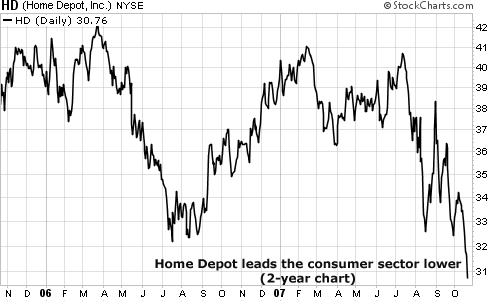
And perhaps the most troubling loser? We present the nation's largest home improvement chain, Home Depot. The Depot lives and dies by America's propensity to spend spare cash on roofing, room additions, and lawn work. Second-quarter sales declined 1.8%... and the stock is down 21% this year. No, the consumer isn't dead, but his free-spending days are behind him.


Click Here, or on the image, to see a larger, undistorted image.


Normxxx    
______________

The contents of any third-party letters/reports above do not necessarily reflect the opinions or viewpoint of normxxx. They are provided for informational/educational purposes only.

The content of any message or post by normxxx anywhere on this site is not to be construed as constituting market or investment advice. Such is intended for educational purposes only. Individuals should always consult with their own advisors for specific investment advice.

Crumbling Credit; Deadly Leverage

When Crumbling Credit Meets Deadly Leverage

By Richard Benson | 30 October 2007

    If our country's debt problems in the private sector were simply limited to the $1.5 trillion of subprime mortgages that needed to be repaid, restructured or foreclosed, the situation might be manageable. But they're not, and it isn't. It's widely understood now that this mess was caused by a Federal Reserve that pumped up home ownership (for everyone in America) and then proceeded to cut interest rates too low for too long, and by credit market participants who threw common sense and basic loan underwriting to the wind.

    In looking back at this era of easy lending, the orgy was effectively facilitated by Wall Street's ability to irresponsibly underwrite loans and then look the other way. Risky mortgage securities were packaged and sold in the secondary market to suckers who bought into the theory that the housing market would only go up
    [[and who foolishly believed the rating agencies: normxxx]].


As equity extraction becomes a thing of the past, a recession seems inevitable. I predict there will be continued credit surprises mostly on the downside as employment weakens, jobs are lost, and bills go unpaid. As a consumer-led recession unfolds, personal income and corporate revenues won't cover many debts, and the game of always being able to refinance has ended. So, for many borrowers the game is already over; they just don't know it yet.

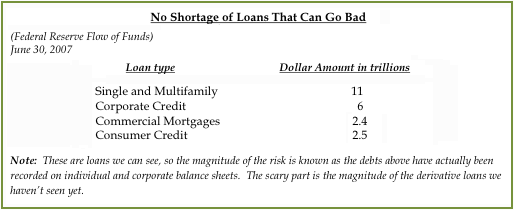
The credit cycle has clearly turned. Financial institutions, such as banks, have only begun to add to the massive loan loss reserves they'll need to shelter from the storm of at least $2 trillion of consumer, commercial real estate, corporate, and single family mortgage loans, that could easily roll over into default. And that's not all. Loan loss reserves are also being set aside as banks brace for the stress that has begun to appear in commercial mortgages and mortgage securities. See the chart below:


Click Here, or on the image, to see a larger, undistorted image.


In the world of easy money and the exponential increase of artificial liquidity and credit, there is also the "shadow world" of derivatives.

A derivative allows a market participant to make money or hedge a position as if they owned a financial instrument, yet they're not required to put the asset on-balance sheet (or post the capital the same way they would have to if the asset were on-balance sheet).

Why is this important? As Hank Paulson, Secretary of the Treasury, runs around trying to bail out the Structured Investment Vehicles ("SIVs"), it's become pretty obvious. These SIVs provided a way for huge banks, like Citibank, to hold another $400 billion of assets but conveniently keep them off-balance sheet. Up until a few weeks ago, the financial press hadn't even heard of a SIV. Now, suddenly, they're threatening the core of the financial system because the loans might have to go back on-balance sheet and tie up precious equity capital!

The big players love derivatives because they allow massive off-balance sheet leverage. However, the hedge funds and mortgage companies that have all blown up recently (along with some Wall Street firms and Bear Stearns) have learned a hard lesson: mixing massive credit losses with high leverage is a formula for quick and definitive financial death. While leverage may be positive to the bottom line on the upside, it can quickly kill on the downside.

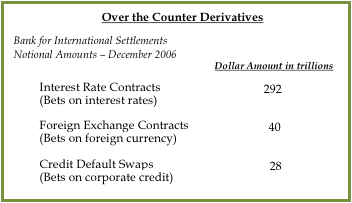
While SIVs are continuing to rock the system, they are a mere rounding error compared to Credit Default Swaps ("CDSs") and other major derivatives. (CDSs are the most widely traded credit product.) See the Table below:


$28 trillion of CDSs is a staggering number! It's more than double the U.S. GDP, and is more than four times the total of all outstanding corporate debt. The off-balance sheet "shadow world" of credit actually dwarfs the on-balance sheet visible world.

As the Music Man says, "There is a lot of gamboling going on here in River City"

In real speak this means the financial players reap all of the benefits on the upside, while the investors assume most of the risk on the downside. The "gamboling" going on is off-balance sheet and, therefore, hidden from the investor's view.

In July and August we all learned how cruel the markets can be. When the market value (gain to one party, and loss to the other) of mortgages and mortgage derivatives spiked in value very quickly, quite a number of firms, and funds, simply failed. It was very sudden. Derivatives are by design extraordinarily leveraged, so tiny changes in the financial markets can affect their value in a big way. A sizable wave in the financial markets can easily be magnified and turned into a tsunami of market losses. With the current level of credit derivatives all sitting off-balance sheet (and unnoticed like the SIV's recently were), unsuspecting investors could wake up to discover more alarming losses amounting to a few trillion dollars that were neither anticipated nor welcome.

Finally, the financial institutions that have exposure to on-balance sheet credit risk are the Who's Who of major hedge funds, major banks, and Wall Street investment banks. Guess who the major counterparties are in the derivatives market? Why, they're the same major players [[and, remember, for every winner on a derivatives trade THERE MUST BE A LOSER! : normxxx]]! So, while Bear Stearns has become the poster boy for all that's wrong with subprime mortgages, don't worry. Other firms like JP Morgan Chase, Morgan Stanley, Citibank, Merrill Lynch, and even Goldman Sachs, may have their pictures posted alongside Bear Stearns' in the "Hall of Shame" when corporate credits turn down. Crumbling credit combined with deadly leverage can prove fatal to portfolios invested in financial stocks.

Normxxx    
______________

The contents of any third-party letters/reports above do not necessarily reflect the opinions or viewpoint of normxxx. They are provided for informational/educational purposes only.

The content of any message or post by normxxx anywhere on this site is not to be construed as constituting market or investment advice. Such is intended for educational purposes only. Individuals should always consult with their own advisors for specific investment advice.

Monday, October 29, 2007

'Level 3' Decimation?

The Bear’s Lair: Level 3 Decimation? [¹]
Click here for a link to complete article:

By Martin Hutchinson | 29 October 2007

There’s a mystery on Wall Street. Merrill Lynch last week wrote off $8.4 billion in its subprime mortgage business, a figure revised up from $4.9 billion, yet Goldman Sachs reported an excellent quarter and didn’t feel the need for any write-offs. The real secret of the difference is likely to be in the details of their accounting, and in particular in the murky world, shortly to be revealed, of their "Level 3" asset portfolios.

Both Merrill and Goldman have Harvard chairmen— Merrill’s Stan O’Neal from Harvard Business School and Goldman’s Lloyd Blankfein from Harvard College and Harvard Law School. Thus it’s pretty unlikely their approaches to business are significantly different— or is a Harvard MBA really worth minus $8.4 billion compared with a law degree? (The special case of George W. Bush may be disregarded in answering that question!)

We may be about to find out. From November 15, we will have a new tool for figuring out how much toxic waste is in investment banks’ balance sheets. The new accounting rule SFAS157 requires banks to divide their tradable assets into three "levels" according to how easy it is to get a market price for them. Level 1 assets have quoted prices in active markets. At the other extreme Level 3 assets have only unobservable inputs to measure value and are thus valued by reference to the banks’ own models [[i.e., the banks' 'best guess': normxxx]].

Goldman Sachs has disclosed its Level 3 assets, two quarters before it would be compelled to do so in the period ending February 29, 2008. Their total was $72 billion, which at first sight looks reasonable because it is only 8% of total assets. However the problem becomes more serious when you realize that $72 billion is twice Goldman’s capital of $36 billion. In an extreme situation therefore, Goldman’s entire existence rests on the value of its Level 3 assets.

The same presumably applies to other major investment banks— since they employ traders and risk managers with similar educations, operating in a similar culture, they probably have Level 3 assets of around twice capital. The former commercial banks Citigroup, J.P. Morgan Chase and Bank of America may have less since their culture is different; before 1999 those institutions were pure commercial banks and a substantial part of their business still lies in retail commercial banking, an area in which the investment banks are not represented and Level 3 assets are scarce.

There has been no rush to disclose Level 3 assets in advance of the first quarter in which it becomes compulsory, probably that ending in February or March 2008. Figures that have been disclosed show Lehman with $22 billion in Level 3 assets, 100% of capital, Bear Stearns with $20 billion, 155% of capital and J.P. Morgan Chase with about $60 billion, 50% of capital. However those figures are almost certainly low; the border between Level 2 and Level 3 is a fuzzy one and it is unquestionably in the interest of banks to classify as many of their assets as possible as Level 2, where analysts won’t worry about them, rather than Level 3, where analyst concern is likely.

The reason analysts should worry is that not only are Level 3 assets subject to eccentric valuation by the institution holding them, but the ability to write up their value in good times and get paid bonuses based on their capital uplift brings a temptation that few on Wall Street appear capable of resisting. Both Goldman Sachs and Merrill Lynch are reported to have made profits of more than $1 billion on their holdings of Level 3 assets in the first half of 2007, for example, profits on which bonuses will no doubt be paid at the end of their fiscal years. Given that we have had five good years on Wall Street, years in which nobody has known the amount of Level 3 assets on banks’ balance sheets, and no significant media waves have been made questioning their valuation methodologies, it would not be surprising if many banks’ Level 3 assets had become seriously overstated, even without any downturn having occurred.

When Nomura Securities sold its mortgage portfolio and exited the US mortgage business in this quarter, it took a write-off of 28% of the portfolio’s value, slightly above the 27% of the portfolio that was represented by subprime mortgage assets. Were Goldman Sachs’s Level 3 assets similarly value-impaired, it would result in a $20 billion write-off, more than half Goldman’s capital, leaving the bank severely damaged albeit probably still in existence.

Defenders of Goldman Sachs and the rest of Wall Street will insist that less than 27% of their Level 3 assets are represented by subprime mortgages yet that is hardly the point. Subprime mortgages, estimated to cause losses of $400-500 billion to the market as a whole, though only a fraction of that to Wall Street, have been only the first of the Level 3 asset disasters to surface. There is huge potential for further losses among assets whose value has never been solidly based. These would include the following:

  • Mortgages other than subprime mortgages. With the decline in house prices accelerating, the assumptions on which even prime mortgages were made are being exposed as fallacious. As house prices decline, debt to equity ratios increase, and for mortgages with an original loan-to-value ratio of 90% or more quickly pass the 100% at which a mortgage becomes uncovered. If the value of conventional mortgages decline, many securities related to them, currently classed as Level 1 or 2 assets, will become un-marketable and descend into Level 3

  • Securitized credit card obligations. $915 billion of credit card debt is currently outstanding, the majority of it securitized, and its default rate is likely to soar as the full effects of the home mortgage market’s crack-up spread to the credit card area. The risks in Level 3 portfolios derived from this asset class arise particularly in the areas of complex derivatives and manufactured assets based on credit card debt pools.

  • Leveraged buyout bridge loans. After the hiccup in August, the market in these has reopened recently, although around $250 billion of them still remains on banks’ balance sheets. The value of a leveraged buyout bridge loan that has failed to find a pier to support the other end of the bridge is very dubious indeed, even though these loans are being carried in the books at or close to par. As the value of underlying assets declines and the cash flow fails to match debt payments, the deterioration in credit quality of these loans will accelerate.

  • Asset backed commercial paper. The amount of [other than mortgage] asset backed commercial paper outstanding has dropped from $1.2 trillion to $900 billion in the last three months. This financing structure was always unsound; it was basically a means of removing the assets backing the commercial paper from bank balance sheets, and always faced the problem of a severe mismatch between asset and liability duration. The $100 billion vehicle intended to rescue this market has found a mixed reception to say the least. It is likely that as credit conditions deteriorate, the assets underlying ABCP vehicles will increasingly find themselves on bank balance sheets, where they will prove to be almost completely unmarketable.

  • Complex derivatives contracts. Even simple interest rate swaps and currency swaps caused large losses in the last significant credit tightening in 1994, although most of those losses were suffered by Wall Street’s customers rather than Wall Street itself. The more complex transactions that have been devised during the last twelve giddy years are much more likely to prove impossible either to sell or to hedge. Goldman Sachs reported that in the third quarter of 2007 its profits on derivatives used for hedging more or less matched its losses on subprime mortgages. It is likely in reality that the bulk of those profits were incurred through model-based write-ups of value on contracts that were within the Level 3 category— after all, Goldman’s Level 3 assets increased by a third during the quarter. It’s not much good shorting to match a long position you don’t like if your hedging shorts prove to be impossible to close out.

  • Credit Default Swaps, the global outstanding value of which in June 2007 was $2.4 trillion, according to the Bank for International Settlements. These are a relatively new instrument, the efficacy of which has not been tested in a downturn. It appears likely that the value in banks’ books of their Level 3 credit derivatives contracts bears no relation whatever to reality. As discussed above, the incentives have been all in favor of inflating it.

The capital underlying Wall Street, at the top, is not all that large— a matter of a few hundred billion. Given the piling of risk upon risk that has been engaged in over the last few years, and the size of the losses in the mortgage market alone that seem probable— my own estimate last spring of $980 billion looks increasingly likely to be somewhat below the final figure— it appears almost inevitable that in a bear market in which liquidity dries up and investors become skeptical, Wall Street’s capital will be wiped out. Only the commercial banks like Wachovia and Bank of America whose investment banking ambitions have been largely thwarted and portfolios of Level 3 rubbish are correspondingly lower are less likely to disappear.

Given the size of the overall figures involved and the excessive earnings that Wall Street’s participants have enjoyed over the last decade, a taxpayer-funded bailout of Wall Street’s titans would seem politically impossible, however loud the lobbyists scream for it [[but don't bet on that— it's happened in the past "for the good of the country": normxxx]].

In the long run, that is probably a blessing for the US and world economies.

______________

The contents of any third-party letters/reports above do not necessarily reflect the opinions or viewpoint of normxxx. They are provided for informational/educational purposes only.

The content of any message or post by normxxx anywhere on this site is not to be construed as constituting market or investment advice. Such is intended for educational purposes only. Individuals should always consult with their own advisors for specific investment advice.

Twenty One Flavors of Mortgage Fraud

Twenty One Flavors of Mortgage Fraud [¹]

By Howard Lax for iTulip.com | 29 October 2007

    Mortgage fraud is now a part of our lexicon, but few people understand what this means and the harm it causes. Mortgage fraud is a catch all phrase that encompasses schemes allowing one or more parties to a real estate transaction to obtain money through illegal or unethical means. Mortgage fraud cost us, as a society, somewhere between $946 million and $4.2 billion in 2006, and the cost will increase.

    Residential mortgage transactions are particularly susceptible to fraud, since the mortgage lending industry relies on patterned transactions to simplify home sales and mortgage financing with as little cost and time as possible.

In a "normal" residential sale transaction, the buyer, seller, and real estate broker(s) negotiate a sale using a model purchase agreement. The buyer meets with a loan officer from a mortgage broker or lender, and chooses a standard loan product to finance the transaction. The lender obtains an appraisal of the property and a credit report for the borrower. An investor underwrites the loan with the assistance of an automated system, conditionally commits to purchase the loan after closing, and "locks" the loan terms. The mortgage broker or lender obtains a title insurance commitment and schedules the closing after the loan is approved. A closing agent (usually a title insurance agency) explains the closing documents, acknowledges the parties’ signatures, accounts for the parties’ funds, distributes the proceeds of the transaction, sends the deed and mortgage to the Register of Deeds for recording, and issues title insurance policies for the buyer and lender. The lender sells the loan to an investor, and the borrower makes monthly payments to the servicing agent selected by the investor. Because the documents are standard, and the roles of the parties are very uniform, nobody spends the time or money to perform much due diligence on the transaction. Hence, it is relatively easy for any of the players (except the investor) to use false documents or parties in the transaction.

Mortgage fraud schemes are extensive, ranging from simple to complex, and are far too common. It is possible to stop a mortgage fraud if one of the parties recognizes the fraudulent features of a transaction before the proceeds of the transaction are disbursed. Some of the more common schemes are:

    Inflated income or assets: Some of the most misrepresented facts on an application for credit are borrower income and assets. Recent audits by one lender found actual income was significantly overstated in two thirds of the applications submitted for credit on a "stated income" basis (i.e. the borrower’s income is not verifiable and the loan is approved based on the borrower’s credit score and statement of income).

    Assets are often misrepresented to make the lender believe that the buyer has funds to make a down payment and to pay closing costs. Sometimes the buyer borrows the down payment without revealing the obligation to repay the funds. A debt may be characterized on the settlement statement as an unrecorded lien, or an invoice for unidentified management services, to hide the fact that the down payment was borrowed.

    Making false representations in a loan application, or providing false documents to verify income or assets, is a crime. It is also a crime for a mortgage broker or lender to knowingly process a false loan application.

    False Social Security Numbers: Borrowers sometimes use the social security number of another person, or fake identification documents of a person with "good credit" to obtain a loan. More sophisticated thieves use a good social security number and a fake name ("synthetic ID theft") to make it harder to detect and identify the thief. The first five digits of a social security number indicate the area of the country where the card was issued and the year of issue. These values can be checked against the area of the country where the borrower was raised and the age of the borrower.

    Altered documents: W-2 forms, bank statements, title commitments, leases, and all manner of documents used to verify income and asset information can be altered or forged. Fake employment verification forms can be purchased over the Internet. Some borrowers forge discharges from their prior lender, or erase the loan from the schedule of exceptions on a title commitment, to avoid paying the balance of their prior loan. Accepting these documents or verification forms from the borrower saves time, but invites fraud. Asking the source of these documents for a separate copy is safer.

    Multiple loans: Lenders rely on the credit report and title commitment to locate the borrower’s obligations. There is always a "gap period" between the date that documents are submitted to the Register of Deeds for recording, and the date that these documents are available for inspection. There is also a gap between the date of a loan payment (or a missed payment) and the date that information is listed in a credit report. Some borrowers will close two or three refinance loans on a property with different lenders during a "gap period," knowing that the credit report and title commitment will not reveal recent loan transactions and missed payments. Mandatory electronic recording and universal reporting of consumer loan payments to credit bureaus may some day eliminate gap periods.

    Inflated Deposits and Soft Second Mortgages: Consumers who have an equity interest in their home are less likely to default on their mortgage payments. Hence, most loan programs require a minimum down payment. A buyer may give a false purchase agreement to the lender, showing an earnest money deposit twice as large as the real deposit and an inflated purchase price. A buyer and seller sometimes inflate the purchase price of a home, and offer seller financing in lieu of a down payment, so that the buyer may obtain a larger loan than would be permitted by the lender’s underwriting standards. The seller’s note and mortgage are torn up after the closing. Insisting that all loans be documented and that mortgages must be recorded will reduce fraudulent seller financing.

    Identity theft: The closing agent relies on the borrower’s driver license or other forms of identification to verify that persons who physically sign the deed, note, mortgage, and other documents have the authority to sell the home and borrow money. Buyers, sellers and closing agents must remember that a forged mortgage is void. Use a "black light" to locate the reflective seal on a valid driver license card. If a person’s identity is stolen, it is important that one of the parties files a police report. The police report also entitles the victim to obtain a copy of any fraudulent financial documents that used the victim’s identity.

    Straw buyer: A real estate investor may ask a friend or relative, or a stranger, to be a straw buyer (usually for compensation). The real estate investor promises to make monthly loan payments, and to pay off the loan within a year or two. In some cases, a land speculator purchases a home at a low price, and conspires with a straw buyer to sell a home for an excessive price. The net proceeds are used to make monthly payments on the loan and/or the parties split the net sale proceeds and disappear. Besides the criminal liabilities mentioned above for making a false loan application, the straw buyer’s credit rating is ruined when the real estate investor stops making loan payments.

    Inflated appraisal: The homeowner, seller, or mortgage broker may have an illegal arrangement with an appraiser to inflate the true value of the property, or provide improper comparable sales information to the appraiser so that a loan will be approved for an amount that exceeds the home’s market value. Excessive valuations may be justified using fake pictures of the subject property or property values from other fraudulent transactions. Appraisers should thoroughly inspect the subject property and use comparable property data that they independently verify. Federally chartered lenders must review the appraisal if it is provided by another mortgage lender or by a mortgage broker.

    Money laundering: It is very easy to prepare and record a forged deed. To launder money, a straw buyer uses illegally obtained funds to buy the home. The title agency unknowingly takes the illegally obtained funds, and issues its own check to the fake seller with good funds. The object of exchanging tainted funds for good funds is to hide the trail of money from its illegal source. The property may be subject to a forfeiture action if the source of the purchase money is discovered.

    Foreclosure rescue: Avoid offers to "help" a homeowner in a difficult financial situation. The purpose of "saving" a borrower that nobody else considers a fair credit risk is often to "strip" the homeowner’s equity. A homeowner who is facing loss of a home through foreclosure may deed the home to a rescuer, who promises to sell it back at a higher price in a year or two through a land contract or lease with an option to purchase. The rescuer or a straw party (described above) obtains a conventional loan to buy the home. The rescuer may even convince the homeowner to sign over the proceeds of the sale of the home with a promise to pay off other debts owed by the homeowner. The rescuer knows that the homeowner has no means of obtaining a new loan to buy the home back at its inflated price. The investor does not provide any disclosures required by law for these transactions. Courts have held that a deed given as security, and not as a true sale, must be treated as an equitable mortgage. The difference between the amount paid by the rescuer to buy the loan and the price demanded to repurchase the home is interest, subject to state usury laws. Furthermore, these transactions are subject to federal Truth-in-Lending Act disclosure requirements. The homeowner may be able to rescind the transaction and seek the return of the home.

    Servicing transfers: Federal law requires a lender to send a Notice of Transfer of Servicing to the borrower when mortgage payments must be sent to a different entity or address. Since the content of this Notice is proscribed by federal regulations, a thief can send a convincing Notice of Transfer of Servicing to a borrower, instructing the borrower to send mortgage payments to the thief.

    Flipping: Frequent sales of a property are not illegal. Higher sale prices may be justified when the property is rehabilitated. However, frequent sales at increasing prices between parties with a hidden relationship can make the property appear more valuable than it is. Sometimes the parties attempt to justify the price increase with cosmetic improvements that hide more serious problems. Flipping is often accomplished with the help of an improper appraisal, a false title commitment, or intentional misrepresentation of the condition of the property. The FBI website highlights the case of a collapsed Detroit home sold one day for $25,000, and the next day for ten times that amount.

    Occupancy fraud: Mortgage lenders require higher down payments for second homes and investment properties than for a loan secured by a principal residence. To obtain better loan terms, borrowers will state that a second home or investment property is or will become their principal residence after the closing.

    Inflated Credit History: Borrowers with poor credit payment histories may purchase the right to become a "co-borrower" on good credit accounts ("tradelines"). Good tradelines dilute the impact of the borrower’s poor tradelines, and raise the borrower’s credit score. This scheme is not illegal (yet). Companies that produce credit scoring software are trying to identify these borrowers, to eliminate the impact of the purchased tradelines.

    Misleading Disclosures: Federal rules require disclosure of a good faith estimate of closing costs within three days after the mortgage broker or lender receives an application for a residential mortgage loan. Borrowers also receive an estimate of the annual percentage rate and monthly payments within three days after providing a purchase money loan application to a lender. However, there is no requirement that this information must be redisclosed if the actual closing costs are different. Some brokers will arrange a subprime loan for the borrower, even though the borrower would qualify for a conventional conforming loan. This does not violate federal law, and the borrower has nobody to blame but himself if he accepts a loan that is not advantageous. However, engaging in fraud, deceit or material misrepresentation is illegal. Providing an estimate of costs to originate a "prime" loan, knowing that the borrower will only qualify for a "subprime" loan with higher origination fees misrepresents closing costs and the cost of credit. A lender or broker violates state law if disclosures are provided for low cost credit, or low cost credit is promised, when such credit is not available to the applicants.

    Required Use of Affiliates: A seller and his/her real estate broker cannot require the borrower to use a particular title agency for the lender’s title policy if the buyer pays the insurance premium. Hence, it is illegal for a real estate broker or for the seller to require a documentation fee solely if the buyer does not use the seller’s preferred title agency. It is also illegal to require a borrower to use the services of an affiliated settlement service provider if the borrower will pay for the services.

    Illegal Kickbacks: It is illegal to directly or indirectly pay or receive something of value under an agreement or understanding that the payment is for the referral of settlement service business. It is also illegal to split a fee for settlement services without doing any work to earn a portion of the fee. Some mortgage brokers, lenders and title agencies find it more expedient to pay kickbacks "under the table" to assure business referrals than to generate business based on the merit of their services. These kickbacks, in theory, increase the cost of credit.

    Failing to Disburse: Some lenders wait until after the loan has closed to finish underwriting a loan. If the borrower fails to meet underwriting requirements, or the loan cannot be sold at a profit, the lender refuses to fund the loan. State law requires that a lender satisfy its lending commitments.

    Selling Fake Loans: Some unscrupulous lenders create documents for loans that do not exist, and sell the loans to raise capital or hide losses. A lender may also sell a loan more than once to hide losses at the company, or to satisfy credit obligations. The proceeds of the sale may be used to make monthly payments on behalf of a non-existent borrower. Perpetrators of these schemes typically receive stiff prison sentences.

    Closing Agent Defalcation: Licensed title insurance agencies are required to keep transaction funds in a trust account. There is no requirement that a notary closing service (a "signing service") maintain trust accounts. Employees may steal these funds, resulting in the failure of the closing agent to pay transaction proceeds.

    Mortgage Elimination: Some borrowers send an "International Commercial Claim in Admiralty Administrative Remedy" to their lender, and file a frivolous lawsuit to discharge their mortgage. This scheme evolved from the repudiated "Bonded Bill of Exchange" given to payoff mortgage loans.

What to do? Mortgage fraud succeeds because consumers do not understand residential transactions. Consumer education will help prevent consumers from falling into these schemes:

  • We can strive to teach financial literacy to all consumers. Financial literacy training should be a mandatory part of the high school curriculum. Financial literacy course materials (the Money Smart program) and teacher reference guides are freely available from the FDIC.

  • The FBI and the Mortgage Bankers Association recommend that lenders post a sign to warn borrowers that mortgage fraud is illegal.

  • Lenders and homeowners should each assure themselves that they have identified a financially responsible party (e.g., the closing agent) who is willing to legally insure the reasonable accuracy of all documents and transactions, i.e, that no fraud has taken place anywhere in the chain.

  • Interthinx produced a video, Fraud Scheme Investigation, to help consumers and industry employees recognize mortgage fraud.

We can implement safeguards to prevent mortgage fraud, and to guard against repeat offenders:

  • The Mortgage Bankers Association is sponsoring a committee to draft uniform residential closing instructions. These instructions will require the closing agent to be a gatekeeper against mortgage fraud.

  • Data mining techniques are used by many lenders to evaluate loan application characteristics against a pool of previously closed loans. These computer programs look for similar transactions that might reveal repeat fraud attempts.

  • We should prosecute individuals who break the law. The Conference of State Bank Supervisors and the American Association of American Association of Residential Mortgage Regulators recently proposed a uniform mortgage company and mortgage company employee licensing program (pdf) to make licensing in multiple states easier and less costly, and to allow states to share information about bad actors within the mortgage industry. State oversight of the mortgaging process should be the law in all states, and the oversight process should be adequately funded (probably through a tax on the mortgaging process) and enforced.

Finally, we should draft consumer disclosures that are understandable and meaningful. The Federal Trade Commission released a Bureau of Economics report finding that mandatory mortgage disclosures fail to convey key mortgage costs and terms. Our legislatures must simplify disclosure laws. Disclosures should mandatorily highlight information that really matters to the average home buyer. Some legislatures are proposing to prohibit unsafe or unsound lending practices, and practices that mislead consumers. Better disclosures, and safer lending practices, may help consumers avoid inappropriate real estate and loan transactions.

Normxxx    
______________

The contents of any third-party letters/reports above do not necessarily reflect the opinions or viewpoint of normxxx. They are provided for informational/educational purposes only.

The content of any message or post by normxxx anywhere on this site is not to be construed as constituting market or investment advice. Such is intended for educational purposes only. Individuals should always consult with their own advisors for specific investment advice.

Sunday, October 28, 2007

Stock Market— Update

Stock Market— Update [¹]
Click here for a link to complete article:

By Frank Barbera, CMT | 27 October 2007

At the present time, the S&P 500 is somewhat mildly oversold near term, and could be near another short term low. The 9 day RSI for the S&P reached down to a low value, below +30 earlier this week with the S&P holding support near the 50 day moving average and the 20 day lower Bollinger Band (1503). That said, it is important to remember that in emerging Bear Markets, Rule #1 is that surprises come to the downside. Now, we know that there are those who would disagree with our assessment that the S&P is in a bear market. A bull could still point out that the 200 day moving average is still rising, and therefore, that the primary trend of the market is still higher. They would be right, as at the moment, the evidence within the stock market really points to a grand transition phase and the presence of an emerging stealth bear market. In our experience, these types of conditions are usually the hallmark of a stock market that is moving into a full on bear, but the proof of that still waits to be seen in the weeks and months ahead.

For now, all we can do is point out some of the more glaring bearish indications, and let readers judge for themselves the health of the stock market. In the chart below, we show our own version of the DJIA along with its Daily Advance-Decline Line. The daily A/D Line is a cumulative summation of the daily NET of advances less declines within the DJIA. In the top chart, we re-compute the DJIA using our own Unweighted Formula so that instead of a Divisor and arithmetic computation, which favors high priced stocks over low priced stocks, using a logarithmic calculation, all stocks are are weighted equally. The value of our DJIA is arbitrary, and could be set to trade at 500, or 5,000 or 50,000.


Click Here, or on the image, to see a larger, undistorted image.


So the scaling on the chart is not important. What is important, is that the Unweighted DJIA is not at decisive new all time highs to anything like the degree seen in the widely reported DJIA. Re-computing the DJIA, we find the DJIA to be right back to the vicinity of its former January 2000 highs, and running into a lot of price resistance in that zone. Next, let's compare the A/D Line with its 2000 highs, nowhere close is the answer on that one despite a good performance in the last few months. On the positive side, we can also point out that the strong bias toward large cap stocks has been producing a robust undertone within the DJIA, which has been reflected in a strong A/D Line moving to new higher highs in recent weeks. Next, let's look at the Dow Jones Transports. Notice that unlike the DJIA, neither the traditional Transportation Average, nor the GST Unweighted Transportation Average were anywhere close to confirming the new “all time” highs in the DJIA. On a Dow Theory basis, this is the kind of bearish divergence that often signals a major market peak.


Click Here, or on the image, to see a larger, undistorted image.


In his fine efforts at "Cycles News and Views", market analyst Tim Wood notes that going back to 1896, there have been 27 four year cycle tops, with the current cycle potentially marking the 28th four year cycle top. During the prior 27 four year cycles, a bearish divergence between the Dow Transports and the Dow Jones Industrials marked 81% of those prior tops. Over the course of the last two to three months, that type of action is exactly what is taking place, with the Advance-Decline Line for the Dow Jones Transportation Average presently very close to a major breakdown below support.


Click Here, or on the image, to see a larger, undistorted image.


Above: the Unweighted DJ-65 Composite, could be finishing off the "right shoulder" of a major peak.


Click Here, or on the image, to see a larger, undistorted image.


Above: the Unweighted DJ-65 (upper), the Unweight DJIA, then the Transports and Utilities (lower). Only the DJIA made new highs in Sept, with the other averages failing to confirm.


Click Here, or on the image, to see a larger, undistorted image.


In addition to the obvious bearish divergences between the averages, we can also point out that with even the Dow Jones Industrial Average, overall participation in the advance has been thinning. For example, when the Dow went to new all time highs in July, nearly 86% of the DJIA 30 stocks were above their own 200 day moving averages. Flash forward to September and the latest round of new highs on the DJIA, and only 73% of the stocks were above the 200 day average. Looking at the other two averages, the Transports and the Utilities through this lens, we see that with DJIA hitting new all time highs in September, LESS than 50% of the DJTA average stocks were even above the 200 day average. Ditto the 15 DJ Utility stocks where more then half the list was below the 200 day average. We don’t know if that degree of failure has ever been seen before, but it certainly suggests that the market notwithstanding the CNBC Bobble-head cheerleading is not in good shape technically.


Click Here, or on the image, to see a larger, undistorted image.


Above: the Transports with Percent of Stocks above the 200 day average, less then 50% at the recent all time high in the DJIA, and Below: same thing for the Utility Index. These later two indices often lead, and that cannot be a good message for the market.


Click Here, or on the image, to see a larger, undistorted image.


As a result, we continue to suspect that the stock market is not far away from serious trouble, as looking at the four Dow Averages, the DJ-65 Composite, the Industrials, the Transports and the Utilities, ONLY the DJIA made new all time highs in September, and now, with prices reversing sharply lower, the odds are growing that the September high may have been a final exhaustion peak for the major indices.

Elsewhere, we also want to point out that over the last two years, the US Railroad Industry has thrived as a result of US-China Trade. Over this time, railroads were seen as the extension of the ports, which they are, and moved to P/E multiples not seen in years. In many ways, the rise in China as measured by the surging Shanghai exchange has been paralleled by the recovery in US Railroad fortunes. If demand is dropping off in the US as a result of a consumer led recession, then perhaps the recent downturn in the Transports, and especially the Rails, is an ominous sign for the fortunes of the Chinese Stock market, as the US Consumer has been a key source of aggregate demand. In addition, the Shanghai Stock Exchange, which has unquestionably held up longer than we ever imagined, appears to have completed its five wave advancing pattern, but to be sure, we need to see another three to four percent decline. The momentum profile on Shanghai looks very bearish in our view, and a break in the Asian stock markets where we have seen a speculative mania would be a very big negative for other global markets, including the US.

As another foot note, we also note that European stock markets like the DAX, CAC and FTSE, really lagged the US, perhaps a strong Euro biting into market share, with European ministers pointing the anti-free trade finger at China over the last few days. Protectionism and negative sentiment is rising against China, with the US and Europe now joining in against low priced Chinese goods and an undervalued Yuan. If there ever was a case of "be careful what you ask for" pushing the Chinese to revalue the Yuan has to be it. Attention Wal-Mart shoppers, everything in the store is about to get a lot more expensive once the Yuan revalues…


Click Here, or on the image, to see a larger, undistorted image.


Above: Shanghai with US Railroads.


Click Here, or on the image, to see a larger, undistorted image.


Above: the Shanghai Composite with a very clear five wave pattern, the final high looks to be in place and with a few more percentage points on the downside, we can start to make a bear case for China.


Click Here, or on the image, to see a larger, undistorted image.


Above: A double failure pattern on the medium term RSI for Shanghai, this can’t be good. Momentum peaked back in late 2006, and then made a first failing high in April - May 2007, and now a second failing high in Sept - October 2007.

To date, Asian stock markets have held up longer than we expected, but the roll over in RSI in recent days smacks of something more serious afoot. While some of the Hong Kong ‘H’ Shares still appear as though they could hold up and make token new highs over the next two to three weeks, overall, the vertical nature of the move appears to be very late in the cycle. In our view, a break in the Asian stock markets— perhaps in November or early December would be very serious and could accelerate the outcome to the downside for the US Equity and other International markets leaving us with a mindful approach to investment risk at this late date in the cycle. That’s all for now.

  M O R E. . .

Normxxx    
______________

The contents of any third-party letters/reports above do not necessarily reflect the opinions or viewpoint of normxxx. They are provided for informational/educational purposes only.

The content of any message or post by normxxx anywhere on this site is not to be construed as constituting market or investment advice. Such is intended for educational purposes only. Individuals should always consult with their own advisors for specific investment advice.

It's Halloween: Financial Markets Are Jumpy.

More Trick Than Treat: Financial Markets Are Jumpy. With Good Reason... [¹]
Click here for a link to complete article:

By The Economist (print edition) | 28 October 2007

Halloween arrived early for investors this year. Gone is the euphoria of late September and early October, when stockmarkets surged to new records, shrugging off the credit crunch and the spectre of a slowing American economy. Today's mood is jittery, with investors easily spooked by credit-market phantoms and the shadows of weak corporate profits. October 19th, the 20th anniversary of the 1987 crash, was a particularly grim day, with the Dow Jones Industrial Average falling almost 370 points. This week markets shuddered again as Merrill Lynch, an investment bank, reported its first loss in six years thanks to a large write-down on assets related to low-quality subprime mortgages in America.

In fact, the surprise is less the markets' nervousness now than their earlier confidence. That optimism was based on two shaky-looking assumptions: first, that economic damage from the summer's turmoil was either limited or would be mitigated by further interest-rate cuts from the Fed; and, second, that weakness in America's economy would, in any case, be countered by strength in the rest of the world.

Ghost-Busters

The credit markets, particularly the most dysfunctional asset-backed parts of them, are still something of a battlefield (see article). The corpses from the summer's turmoil— the "conduits" and "structured investment vehicles" (SIVs) which gathered up mortgage-related assets— have yet to be disposed of. That grim process is beginning, and with it the discovery of what subprime-related assets are actually worth. But dismembering SIVs will take time. And, in a cruel irony, American policymakers' ham-handed efforts to ease the pain, by giving an official stamp of approval to the idea of a super-SIV, have only added to investors' worries. If America's Treasury is involved, the logic goes, the SIV mess must be worse than it looks. Not surprisingly, investors feel risk-averse again. The spread between high-yield bonds and safe Treasury bonds, for instance, is now close to its peak in early September.

    Even as investors are reminded that the credit crunch is not yet history, the news on America's economy is mixed. Thanks largely to booming exports, growth in the third quarter will turn out to have been quite robust. At the same time, the news from the housing market gets ever gloomier. Even though fewer houses are being built, the glut of unsold homes is growing. Tighter credit conditions are sapping already feeble demand. Existing home sales fell 8% in September, according to new figures. With the housing bust accelerating, the jobless rate inching up and oil prices close to record levels, the outlook for consumer spending is gloomy.

    And the gloom cannot be magicked away by America's central bankers, as euphoric investors seemed to think back in September.
    The next meeting of the Federal Reserve's rate-setting committee falls on Halloween, and judging by the price of Fed futures, financial markets expect a treat. As of October 24th, a cut in the federal funds rate was regarded as a certainty. But even if the markets are proved right and the central bankers do bring down the rate by another notch, the immediate economic impact will be modest. The effect of lower interest rates takes many months to work through an economy— especially when the housing market is in such a slump. And the risk of inflation could anyway stop the Fed from making aggressive interest-rate cuts.

Much depends on what happens outside America. For the past year or so, slower growth in America has been more than offset by strength elsewhere. Since America's biggest firms make around half their profits abroad, this strength has helped underpin share prices. But Japan and the euro zone— the most important players, measured at market exchange rates— are looking wobblier. The IMF, which just chopped its growth forecast for the American economy next year by nine-tenths of a percentage point to 1.9%, has also downgraded its figure for Japan (by three-tenths of a point) and the euro zone (by two-fifths of a point). Optimists put their faith in the booming emerging markets— China, India and the like. China, in particular, could counter American weakness by shifting more towards domestic consumption. But that outcome is not certain. Which is another reason why the markets' jitters will last long after the pumpkins have gone.

  M O R E. . .

Normxxx    
______________

The contents of any third-party letters/reports above do not necessarily reflect the opinions or viewpoint of normxxx. They are provided for informational/educational purposes only.

The content of any message or post by normxxx anywhere on this site is not to be construed as constituting market or investment advice. Such is intended for educational purposes only. Individuals should always consult with their own advisors for specific investment advice.

The Sky Has ALREADY Fallen

The Sky Has ALREADY Fallen [¹]

By Ambrose Evans-Pritchard, Telegraph.uk | 25 October 2007

If you are a bear, you must accept that you will always be wrong in polite society, and you will continue to be wrong all the way down to the bottom of recession. That is the cross that bears must bear.

Over the last three months we have seen a rolling collapse of speculative debt and real estate across half the global economy, yet friends still come over to my desk at the Telegraph, with that maddening look of commiseration on their faces, and jab: "so when is the sky going to fall then, eh"?

    Well, excuse me. The sky HAS fallen. The median price of US houses has crashed from a peak of $262,600 in March to $211,700 in September. This is an 18% drop nationwide. Yes, the year-on-year slide is still just 4.2%, but that will soon change as the base effect catches up.

    Merrill Lynch has just confessed to a
    $7.9bn write down on CDO subprime debt and assorted follies, nearly double what it suggested three weeks ago.

    This is what happens when a bank values its CDO debt at
    "mark-to-market" rather than "mark-to-myth", as some of Merrill’s rivals are still trying to do.

    Merrill’s Q3 loss of
    $3.5bn has cut the group’s equity capital by a fifth. This has consequences. The bank’s lending multiples will have to shrink.

    In Britain, we have had the first bank run since the City of Glasgow Bank collapsed in 1878. The Fed has cut the interest rates a half point and vastly increased the pool of eligible collateral for Discount operations. The European Central Bank has injected over €400bn of liquidity in the biggest intervention since the euro was created.

    Japan is in recession. Housing starts fell
    23.4% in July and 43.4% in August.

    The US dollar has fallen below parity with the Canadian Loonie for the first time since 1976, and to all-time lows on the global dollar index.

All it will take now for a full-fledged rout is a move by the Saudi and Gulf states to break their dollar pegs, which they may have to do to prevent imported US inflation causing havoc; or for the Asian banks to stop buying US Treasuries— as Vietnam, Singapore, Korea, and Taiwan, have gingerly begun to do.

And for good measure, the Bank of England has just warned in its Financial Stability Report that lenders are still in serious trouble, that there is a risk of commercial property crash, and that equities are "particularly vulnerable" to a downturn. It is said there may well be a repeat of the summer crisis, "potentially on an even larger scale."

What more do you want?

It is true that stock markets have once again decoupled from the realities of the debt markets. But they did this in the early summer, when the Bear Stearns debacle was already well under way. They caught up famously in August.

Nobody I talk to in the City credit trenches believes for one moment that the crunch is safely over. Indeed, they think that we are edging back to extreme stress levels, and the longer it goes on, the worse the damage.

Yes, Blue Chip companies can borrow money, but most of them don’t need to do so because they have bloated cash reserves.

Once you go down the chain, the picture changes fast. The iTraxx Crossover index measuring spreads on mid to low-grade corporate debt has jumped 100 basis points or so in the last week to around 360. It costs companies 1.8% more to borrow than it did in the halcyon days of the credit bubble in February, if they can borrow at all.

The ABX indexes measuring subprime debt— those infamous CDO packages of mortgages sliced and diced, and sold to German pension funds and Japanese insurers with a lot of lipstick— are still falling to record lows.


As Goldman Sachs strategist Peter Berezin put it: "It’s the summer that won’t end,"

"We continue to learn that it pays to respect the sell-offs in ABX and housing-related credit. This has elements of the February and August sell-offs, where credit markets signalled problems," he said.

From a par of 100, these indexes have fallen to (depending on the vintage):
AAA grade: 90
AA: 64
A 33
BBB 21

This means that the toxic BBB tier has lost almost four fifths of its value. Even the AA has lost a third.

Now, remember that the total stock of subprime and Alt-A (close kin) debt issued from early 2005 to early 2007 amounts to $2 trillion. Ben Bernanke’s estimate that losses would be $100bn looks wildly optimistic.

Not to labour the point, but three-month Euribor rates are still at 62 basis points over the ECB’s 4% rate. This amounts to a de facto half point rise since the crunch for all those in the euro-zone with floating mortgage rates— 98% of the total in Spain, the biggest property bubble of them all.

Asset-backed security (ABS) issuance peaked at €78bn in March, fell to €52bn in July, €9.8bn in August, €5.6bn in September, and €2.5bn in October. It has died. Banks no longer dare to hawk the stuff of fear of a humiliating rebuff.

As for asset-backed commercial paper in the US, it has contracted every week since August as the lenders refuse to roll over short-term loans. Roughly 25% of the market has been closed down, cutting off almost $300bn of funding for SIVs.

    These SIVs (structured investment vehicles) are `conduits’— in City argot— that allow banks to juice profits by speculating off books on high-risk debt. They borrow short (three to six months) to invest long (five years of so), making money on the interest arbitrage. Until the game blows up, of course.

    Some
    $370bn still needs to be rolled over, and there lies the rub. The strong suspicion is that Hank Paulson’s $75bn SIV rescue for the big four US banks is intended to cover up the problem by feeding out losses slowly, rather than allowing firesales to cause a cascade.

    As the Bank of England warned, the Super-SIV should not be used to prop up fictitious valuations.

"It stinks, as does the Treasury’s sponsorship of the scheme. It seems designed to prevent price discovery." says Bernard Connolly, global strategist for Banque AIG.

Connolly says it resembles the slippery practices at the start of the Bear Stearns debacle, when creditors quickly abandoned attempts to force CDO sales by the Bear Stearns hedge funds as soon as they realized that prices were collapsing— exposing the awful truth that hundreds of billions were falsely valued on everyone's books.

Nauseating though Paulson’s M-LEC— `Master Liquidity Enhancement Conduit’— may be, it probably has to be done.

Connolly says the Fed-led pack of central banks have made such a mess of capitalism by blowing credit bubbles (with low rates in the late 1990s and 2003-2006) that they now have no alternative other than to relaunch the "Ponzi Scheme", or risk depression.

    This will have political consequences, of course. "The looming threat on the horizon, or just over it, is that the socialization of risk will be accompanied, in many countries, by the socialization of wealth," he said.

    Indeed. The investors now baying for bail-outs had better be careful what they wish for. Democracy will have its way of making them pay. One recalls the
    98% tax rate on dividends in Britain in the late 1970s. Haircut now, or haircut later.

In any case, the Paulson Super-SIV has failed to calm the horses. "This rescue has back-fired. The central banks don’t want anything to do with it. There is a fear that the big four US banks are trying to hide their debts," said Hans Redeker, currency chief at BNP Paribas.

The DOW is down 500 points or so since peaking in early October, and it looks wobbly.

Even so, equities have not begun to reflect the reality that the 2006-2007 credit bubble has popped [[and with it the principal engine of the world economy: normxxx]] and cannot easily be reflated at a time of stubborn, lingering inflation. Spare me the mantra that the "fundamentals" are sound. Credit is the ultimate fundamental.

Woe betide Wall Street if the Fed fails to slash rates dramatically over the Winter, starting on October 31.

Woe betide the dollar if it does.

Normxxx    
______________

The contents of any third-party letters/reports above do not necessarily reflect the opinions or viewpoint of normxxx. They are provided for informational/educational purposes only.

The content of any message or post by normxxx anywhere on this site is not to be construed as constituting market or investment advice. Such is intended for educational purposes only. Individuals should always consult with their own advisors for specific investment advice.

Saturday, October 27, 2007

Black-matter SIVs

What really goes on with Black-matter SIVs. A Micro-case study.
My Experience with Prosper and how it is Similar to the Current Mortgage Debacle. [¹]

Click here for a link to complete article:

By Dr. Housing Bubble | 27 October 2007

As Dorothy and her entourage approach closer to unveilling the mortgage Wizard of Oz, everyone is doing their best impression of Baghdad Bob on the housing yellow brick road. "Please turn your heads, there is nothing to see here," state the embattled mortgage lenders. Of course they need to hold up this front for fear of further deteriorating market sentiment. This week, in what has become a monthly spectacle and a routine funnier than comedy Def Jams, the National Association of Realtors once again had to readjust their housing numbers toward the downside. If anything, you can take a look at what the market expects and subtract a few hundred thousand from these expectations since no one has any idea how bad the mortgage portfolios really are. I’m surprised no one in the mainstream media is calling these experts out by how off they are.

On the flip side, we think we have an idea of the toxic black lagoon sewage these companies are holding onto. Take a look at the Real Home of Genius [[at the link above: normxxx]]. These homes’ collateral via a mortgage is sitting in a hedge fund portfolio near you. Now we are hearing all these archaic names such as SIVs or M-LEC and glorious words such as mezzanines. I’m thinking many of these hedge fund managers and banks took an English 101 course where they were forced to read Orwell’s 1984 and realize that giving an entity an ironic name may actually keep folks at bay. We have the words 'secure' and 'security' thrown into mortgages that are quite the contrary, and Option ARMS where you really have only two options, really bad and awful. Think about other clever titles such as Operation Freedom and you’ll catch what I’m saying.

Another clever idea which seemed to have merit is Prosper.com. Prosper is an online marketplace where potential lenders are able to fund people that may not have any other option or are looking for more competitive rates. I decided last year to enter the game with a marginal amount of play money. As my eyes twinkled with 24 percent returns on D rated clients, I figured, "hey, I’m only putting $50 into this loan so what’s the big deal? I’ll balance it out with a 9 percent loan from an A rated customer." The reason I bring this up is the similarity of what is going on in the current mortgage markets. On Prosper each loan is amortized over 3 years.

At first, lenders may be drawn to the prospect of unbelievably high returns. The catch is that you need to find reliable risk and reward and continually make these bets each and every time. You are provided a snap shot of prospective borrowers including late payments, income, debt to income ratios, and also a brief profile personalizing the reason they are looking for a loan. In fact, you’ll sometimes see a suggestive picture on the loan and amazingly some people would find this sufficient to fund a horribly rated loan. Well, maybe I’m not surprised but that’s besides the point. You’ll also find folks trying to start a business, guys looking for a down payment on their fiancées engagement ring, others looking to consolidate debt, and of course those thinking they are the next Donald Trump. It is actually a great place to be a borrower, but as I have come to find out, not a really good place for lenders on the long-term.

As usual, there are people that are making fantastic returns on Prosper. But these folks are professionals and know what they are doing and are much more the exception than the rule. In fact, the folks that do the best are the lenders that have the ability to vet loans much deeper than your average armchair investor like myself. I am still positive for my investing career with Prosper but far from the glorious 24 percent returns I once envisioned.

So what occurred that stunted my returns? There’s a couple of things that go wrong even with running complex risk analysis models. In fact, some lenders on Prosper use complex formulas relying on the credit ratings the agency provides. What happens is first, your potential returns are front-loaded and look attractive from the start. That is, you are receiving the maximum on day one since all loans are current. As time goes on and you start experiencing defaults, your returns begin to diminish. You can only go down. Since the model is based on continually reinvesting your returns for comparable gains, you must keep the game going and finding solid borrowers. Therein lies the problem. Of course this amazing potential attracted a lot more lenders and the pool of borrowers grew but not at the same rate.

Well it did grow, it is only that prime borrowers grew at a much slower rate. In fact, a prime borrower is prime because he doesn’t need last ditch financing. So you have a slew of money chasing potentially high yields and a growing group of subprime borrowers. Sound familiar? With only a few defaults, your portfolio can go from fantastic, to mediocre, to barely breaking even.

If anything, this gave me an idea of what these mortgage lenders with their pie in the sky projections were thinking. They somehow felt that there would be an unlimited supply of [quality] borrowers and they could simply keep reinvesting over and over. Well as you are seeing with the early defaults in the current market, these lenders and purchasers of debt were spread so thin that a few defaults were enough to turn their A-rated portfolio into junk. It doesn’t matter if you own an entire piece of crap or only a tiny sliver, it is still crap.

There is Such a Thing as Spreading Risk too Thin

Therein lies the false perception of risk. With the asset backed markets and collateralized debt obligations, these companies felt that they would be able to slice the debt into exotic tranches and hungry investors and hedge funds would eat up this stew of debt for higher yields. And they did for several years. In fact, this is the perception with Prosper. You’ll see a borrower requesting $2,500 and multiple investors chipping in $50. So the risk is spread out over 50 individuals. But what if this one borrower loses their job or is unable to make the payment? Guess how many people are impacted by that one default? That is right, 50. But naive investors view the risk as minimal— so long as this individual pays in a timely manner.

But suppose this individual doesn’t pay and many parties are impacted. This is massive leverage on the downside— one individual impacting 50. Now you can understand why one home that is declining or in foreclosure is impacting multiple lenders and not just one. Also, you can understand the difficulty in distributing the money recovered in a foreclosure to large numbers of individuals. There are many more subtleties of course but please do not let the housing complex try to make you feel like a fool who simply cannot understand the current situation. Weren’t they the one’s that swore we wouldn’t be facing the issues we are currently facing?

Option ARMs are for High Quality Top Rated Customers

I hope you are starting to realize that an enormous amount of mortgage debt outstanding is simply radioactive toxic banana republic sewage. UBS data suggests 80 percent of Option ARM borrowers pay the minimum. Meaning, these folks are [already] hedging their bets that their home will rise in value so when it comes time to sell, they won’t have to face the music of their negative amortization. As we all know, housing isn’t going up but going down. Since these folks are paying the absolute rock bottom minimum, what other option do they have? Even refinancing into a simple low-rate 30 year mortgage will raise their monthly payment. Many of these Option ARMs will hit a major reset wave from 2010 to 2012. And we still have to deal with the major subprime rate reset wave in H1 of 2008. In another ironic play on words, Countrywide holds a large amount of "PayOption" ARMs in their portfolio. Since most people elected the do not pay option, they are simply sitting on a mortgage volcano hoping that it doesn’t erupt even though steam and lava are now starting to vent.

Dr. Strange Love and Learning to Love Mortgages

So all this seems rather dire. I’m sure many of you have realized the play on words for the title of this blog. What can we do? What are our options? This is where we have to lay out ground rules and stick to our philosophical leanings; and of course arguing philosophy is like trying to come to a reasoned decision about what is the greatest movie of all time. Everyone will give you a perspective based on their own experience or beliefs.

Many of these companies underestimated the risk involved with these mortgages; if we are to believe in true market capitalism we have to let the market work its way out. What this means is that a large number of these companies will go under and guess what, they already are doing so. People should be angry at management for not diversifying into other industries during the good times. Take a look at GE and Proctor and Gamble for example, they haven’t lasted this long by putting all their eggs into one basket. But of course these companies decided to chase these unsustainably high returns and, by definition (of unsustainable) that is something that cannot go on forever. In our nation, historically, returns on housing are on par with inflation. These last 10 years have been an enormous anomaly.

Most companies will need to face the music on their own dime [[all should, but then there are those "too big to fail" and the FOG— friends of George: normxxx]]. If our belief is that government should bailout people that made irresponsible investment decisions then we do not believe in capitalism. Government is there to protect and provide support in unforeseen circumstances such as the horrible fires we are having here in Southern California. No one saw it coming and there is a need for assistance. But to say that this mortgage debacle was "unforeseen" is a blatant lie. Take a look at the archives here and at other sites and you’ll realize many people were ringing the warning bells even when everything was supposedly going fine.

I’m completely fine with banks and lenders reworking their own mortgages and swallowing the cost of refinancing their own loans. No problem. I do have an issue when these lenders want government sponsored entities to subsidize their greed by pushing off bad investments into the public sector. What we then have is a type of cronyism and corporatism that was prevalent during the roaring '20s and subsequent Great Depression.

In fact, if we are going to open the government wallet, why shouldn’t you be reimbursed for that money you lost in Vegas last year? [[I think you have to have a net worth of around $10 billion to qualify for a 'handout!': normxxx]] Or what about that high rate you had on your first vehicle? Shouldn’t you be able to retroactively go back and reassess your loans and get current market rates refunded to you? What about people that already lost their homes? What if you bought your home before all this housing speculation and want to refinance your loan? Shouldn’t you have the same option to defer your payments? Too many of our 'leaders' are warning that many people will be out on the streets.

Actually, that is why renting is an option and the majority of Los Angeles County, a county of 10,000,000 people, are renters. But even if you dig deeper into the data, many of these homes that are going into foreclosure are sitting empty! We have would be Trump investors buying 2nd, 3rd, and 4th homes with ridiculous mortgages that are now coming home to roost. They gambled and lost. Do you want to bail these folks out? How do you distinguish between a flipper and a legitimate owner in trouble? Again, if these lenders and hedge funds want to rework the mortgages then more power to them. But this new talk of a conduit with an absurd acronym of M-LEC is simply a way of reshuffling the chairs on the Titanic [[to postpone the day of reckoning for a few big banks: normxxx]]. The fact that the US Treasury was involved on this causes me to pause and wonder what the hell is going on in Washington.

    We have a lot more information that will be hitting the market in the next few days. Note especially the 3rd quarter foreclosure results for the state of California. Make sure you read between the lines and learn how to prosper. McDonald’s didn’t get rich by giving people a free lunch.


  M O R E. . .

Normxxx    
______________

The contents of any third-party letters/reports above do not necessarily reflect the opinions or viewpoint of normxxx. They are provided for informational/educational purposes only.

The content of any message or post by normxxx anywhere on this site is not to be construed as constituting market or investment advice. Such is intended for educational purposes only. Individuals should always consult with their own advisors for specific investment advice.

Suggest Broader Mortgage Losses

Reports Suggest Broader Losses From Mortgages [¹]

By Vikas Bajaj and Edmund L. Andrews, NYT | 27 October 2007

Every time economists and Wall Street executives think they have acknowledged the full extent of the losses from the meltdown in real estate mortgages, more bad news turns up.

Merrill Lynch said late last week that it would take a charge for mortgage-related securities on its books that is $3 billion more than the $5 billion it expected just two weeks ago. And a report from the National Association of Realtors showed that sales of existing homes in September fell twice as much as economists had expected, to their lowest level in nearly 10 years.

    At this juncture, economists say the troubles in the mortgage market could, all told, cost financial firms and investors up to $400 billion.

    That is far more than the roughly
    $240 billion cost, adjusted for inflation, of the savings and loan crisis of the early 1990s, according to estimates of the combined financial toll of that crisis on both the federal government and private sector. The loss in total real estate wealth is expected to range from $2 trillion to $4 trillion, depending on how far home prices fall, according to several economists.

    That would be significantly less than the losses suffered by investors in the stock market collapse earlier this decade, which erased more than
    $7 trillion, or about 40 percent, of market value.

Experts caution, however, that these estimates are preliminary and the total costs could get bigger still. They also note that the loss of real estate wealth could prove more damaging for the general public than falling stock values because more American families own homes than own stock.

In recent years, the rise in real estate values has helped propel consumer spending, as homeowners refinanced mortgages and took out home equity loans.

"There weren’t a lot of people living off their capital gains from stocks," said Jane Caron, chief economic strategist at Dwight Asset Management. "There were a lot people using their home as a piggy bank."

Of course, many people who bought their houses several years ago are still ahead financially, because the sharp run-up in home values is still far greater than the expected decline. Those who bought close to the peak stand to lose the most if they have to sell in the near future.

    In a new report to be issued today, the Joint Economic Committee of Congress predicts about two million foreclosures by the end of next year on homes purchased with subprime mortgages. That estimate is far higher than the Bush administration’s prediction in September of 500,000 foreclosures, which in itself would be a tidal wave compared with recent years. Congressional aides provided details of the report yesterday to The New York Times.

    The Joint Economic Committee estimates that the lost of real estate wealth just from foreclosures on subprime loans will be about $71 billion. An additional $32 billion would be lost because foreclosed homes tend to drive down the prices of other houses in the neighborhood.

    Those figures would cause a decline of $917 million in lost property tax revenue to state and local governments, which will also have to spend more on policing neighborhoods with vacant homes. The states likely to be hardest hit fall into two categories: those where prices had been rising fastest, like California and Florida, and Midwest states with weak economies, like Michigan and Ohio, where people with low or moderate incomes made heavy use of subprime loans to become homeowners and consolidate debts.

"State by state, the economic costs from the subprime debacle are shockingly high," said Senator Charles E. Schumer, Democrat of New York and the chairman of the Joint Economic Committee. "From New York to California, we are headed for billions in lost wealth, property values and tax revenues."

    Still, subprime mortgages make up a relatively small share of the total housing market— about $1 trillion of the $10 trillion in outstanding mortgages.

    The much bigger losses will be in declining real estate prices. Household real estate currently totals about $21 trillion, according to the Federal Reserve.

    Global Insight, a research firm, predicts that the national average for housing prices will drop 5 percent over the next year and 10 percent before mid-2009, for a total of about $2 trillion. Economists at Goldman Sachs have predicted prices will drop by 15 percent, meaning an overall decline of more than $3 trillion; other forecasters have said the decline could be 20 percent or more.

    House prices decline slowly, because many potential sellers simply stay in their current homes when they think prices are too low. But that becomes more difficult as people have to move either because of job changes or, increasingly, because their monthly payments are rising sharply. In the next 18 months, interest rates on more than two million homes loans will reset to higher adjustable rates. Already, inventories of unsold existing homes rose last month to their highest level in almost 20 years.

    Economists continue to update their predictions on how the loss of housing wealth might affect the overall economy. Nigel Gault, chief domestic economist at Global Insight, said he assumes that consumers reduce their spending by about 6 cents for every dollar of lost wealth.

    If prices drop 5 percent next year, that would mean a decline of $60 billion in spending, all else being equal. That would be a noticeable slowdown, but not enough to cause a recession.

In the last several years, Americans have increased spending faster than their incomes by borrowing against the rising value of their homes. Economists estimate that such mortgage-equity withdrawals may have added one-quarter of a percentage point to consumer spending growth— a boost that could now disappear.

Thus far, spending has climbed more than 3 percent over the last year, and the most recent data on chain-store sales suggests sluggish growth but nothing near levels consistent with a recession.

    The housing bust has also led to job losses. From the start of 2003 to March 2006, housing-related businesses like mortgage companies, home builders and contractors added 1.3 million jobs, or about 23 percent of all new jobs created in that period, according to an analysis by Mark Zandi, chief economist at Moody’s Economy.com.

    Since then, the housing business has shed 383,000 jobs, while the rest of the economy has added nearly three million jobs.

    Jan Hatzius, chief United States economist at Goldman Sachs, said the small decline in housing employment thus far is surprising and suggests more layoffs are ahead.

"You still have a million jobs that aren’t really needed anymore due to the downturn in housing," he said.

D. Ritch Workman, president of the Florida Mortgage Brokers Association, believes he has an explanation. Many of the brokers and loan officers he knows are still working in the industry, even though they have taken on second jobs to make ends meet.

The home-loan company he owns with his brother in Melbourne, Fla., has seen revenue fall by half, to $500,000, and he has laid off two of its three salaried employees. But the firm has added several loan officers, who are paid on commission only, and it now has 18 people making loans.

"I am surprised they have hung in there," Mr. Workman said. "But it’s a scary thing when that’s all you know. If for 15 years you have been a relatively successful broker and you have lived through the highs and lows, what are you going to do? Most of them are holding on for dear life and hoping things get better."

    On Wall Street, which fueled the housing boom by lending to mortgage companies and packaging and selling home loans, banks are writing off billions of dollars in bad loans and are setting aside billions more for the expected surge in defaults. Late yesterday afternoon, Bank of America said it would lay off 3,000 people across the company and has replaced the head of its investment banking division.


Normxxx    
______________

The contents of any third-party letters/reports above do not necessarily reflect the opinions or viewpoint of normxxx. They are provided for informational/educational purposes only.

The content of any message or post by normxxx anywhere on this site is not to be construed as constituting market or investment advice. Such is intended for educational purposes only. Individuals should always consult with their own advisors for specific investment advice.

Doom & Gloom Report

Marc Faber Says Fed `Like a Bartender' Cutting Rates [¹]
Click here for a link to complete article:

By Pimm Fox and Eric Martin | 27 October 2007

Oct. 23 (Bloomberg)—
    The Federal Reserve acted "like a bartender" in lowering interest rates and its actions are contributing to a stock market bubble in the U.S., investor Marc Faber said.

"Each time you bail out, it becomes bigger and bigger, and the credit problems become much, much larger," said Faber, managing director of Marc Faber Ltd. and publisher of the Gloom, Boom & Doom Report. The Fed "feeds its customers with booze, and when they get totally drunk and are about to fall off their chairs, the bartender gives them more booze to keep them going. One day, it will lead to the ultimate breakdown."

The Standard & Poor's 500 Index has risen 2.9 percent since the Fed cut its benchmark rate by half a percentage point on Sept. 18 to keep credit market losses from spurring a recession. Faber said the action spared U.S. financial companies such as Citigroup Inc. from the consequences of bad lending decisions.

"If Citigroup made a mistake, let them be penalized, let the shareholders of Citigroup be penalized," Faber said in an interview in New York. "Then the shareholders will eventually put pressure on the board of directors not to do stupid things continuously."

The biggest U.S. bank dropped 12 percent last week after saying credit defaults will plague the financial industry for the rest of the year. Citigroup spokeswoman Shannon Bell declined to comment.

"The best for the system would be if a major player would go bust," Faber said. "Then there would be an example for investors and for the players, the Wall Street establishment, the banks, to be more prudent."

China, India

Faber said this year's rally in Chinese assets, including the 171 percent gain in the CSI 300 Index, will end by the August 2008 start of the Olympic Games in Beijing. He predicted India's gains will end by the same time. The Bombay Stock Exchange's Sensitive Index has climbed 34 percent this year.

"We still have the emerging markets going ballistic," Faber said. "The Chinese market could double here, but it doesn't change the fact we are already in bubble stage."

Faber said if bubbles in emerging markets deflate, the dollar may rebound from all-time lows against the euro as fund managers who have invested in emerging markets invest in the U.S.

The European Central Bank has raised its key interest rate eight times to 4 percent from 2 percent in November 2005, a "more responsible" policy than the Fed's, Faber said.

    Track Record

    Faber told investors to bail out of U.S. stocks a week before 1987's so-called Black Monday crash, according to his Web site. He correctly predicted in May 2005 that stocks would make little headway that year. The S&P 500 gained 3 percent. He also told investors to buy gold in 2001, before it more than doubled.

    On March 29, Faber said the emergence of home loan concerns meant the U.S. stock market was unlikely to benefit from the conditions that supported its rally since June 2006. The S&P 500 climbed 10 percent between then and July 19, when it reached a record, and again reached new highs on Oct. 5 and Oct. 9.

    In February 2004, he said stocks in Brazil and Argentina were expensive because investors were overestimating China's demand for commodities. Brazil's Bovespa index has since more than doubled while Argentina's Merval Index has gained about 90 percent.


Credit Crisis Worse Than Long-Term Capital Management Collapse in ’98

By Marc Faber on Sep 20th, 2007 | 20 September 2007

Unlike all the Wall Street strategists who compare the current credit crisis to the credit crisis of 1998 (Long Term Capital Management), I believe that the ongoing credit problems will be far worse and of a longer-term nature. This will make it difficult for the market to reach new highs in the near future [[The S&P 500 again reached new highs on Oct. 5 and Oct. 9: normxxx]]. Moreover, even if the 1998 comparison were to hold, we would still be looking at a much deeper stock market correction than the 22% sell-off we saw in 1998.

The stock market peaked out in July 1998, after having been in an uptrend since the 1991 lows. It then sold off on the Russian default and on the LTCM crisis by 22% to its intraday low on October 9, 1998. When it became obvious that the Fed would bail out LTCM, and it flooded the system with liquidity, the stock market took off. Between the October 9 intraday low and the year end, it rallied by 33%, to achieve a new all-time high, and then continued to rise— interrupted by a correction in 1999— into the final March 2000 top.

Pundits who are likening today’s market rout to that of 1998, and who expect the market to rally strongly towards the end of this year and to close at a new all-time high, are failing to consider the very different economic and financial circumstances of today, compared to those of 1998. In the years leading up to the 1998 crisis the US dollar was in a bull market, and interest rates— which had peaked in September 1981— were in the middle of a secular decline. At the same time, gold and other commodities were still deflating. Also, in the 1990s, the US stock market had significantly outperformed the emerging markets, most of which had peaked out between 1990 and 1994 and had crashed during the Asian crisis of 1997-98.

Therefore, in 1998, the emerging markets and commodity prices were very depressed (unlike today). Moreover, in 1998, house prices weren’t elevated, the subprime lending industry was in its infancy, Japan and Europe were largely stagnant, and Asia and Russia were in depression (i.e. there was no synchronised global growth). The process of securitisation existed, but was very modest when compared to the present.

    Today, the key difference is that the dollar looks extremely wobbly. In 1998, the US current account deficit was 2% of GDP; today, it’s hovering around 8%. This massive deficit puts continuous pressure on the dollar. Moreover, gold and other commodities are in an uptrend. There is another reason why conditions today are very different from those in 1998: in 1998, total credit market debt to GDP was 250%; today, it’s 330%. In addition, whereas debt growth averaged 4% per anum in the 1990s, it has averaged almost 10% per annum since 2002. In particular, household debt has surged from 65% of GDP in 1998 to almost 100% in 2007. Since debt growth has been so strong in the last few years, and because the system is now far more leveraged than in 1998 (not to mention the derivatives market), a tidal wave of liquidity would be needed to bail out the system, which would have to lead to even stronger debt growth; but, obviously, it would only lead to even larger dislocations and problems later.

Another difference: in 1998, the Fed had to deal with the bailout of just one institution— LTCM; today, who should it bail out: the subprime lending institutions (it’s too late), leveraged home owners, the US$2 trillion-plus collateralised debt obligation (CDO) market, or the financial institutions, which are now stuck with over US$200 - 300 billion of leveraged buyout (LBO) loan commitments which they cannot sell to investors? So, whereas it was relatively easy to bail out just one institution in 1998, today the task would be extremely complex and daunting. Of course, the Fed could try to bail out everybody by cutting the interest rate aggressively and taking "extraordinary measures", such as buying up the entire CDO market. [Editor’s note: Faber wrote the words above in late August, well before the Fed’s aggressive 50bp rate cuts.]

Aggressive Fed fund rate cuts may not help much for the following reason: from June 2004 to August 2006, the Fed increased its fund rate in 17 baby steps from 1% to 5-1/4%. During this period of "tightening", no actual tightening took place because credit growth accelerated as lending standards were eased and leverage increased. Moreover, as Bridgewater Associates recently pointed out, "globally, central banks have kept interest rate levels out of line with economic growth rates". So, even if the Fed were to cut rates massively now, it is unlikely that it would stimulate credit growth, which, as I have explained repeatedly in the past, must continuously expand at an accelerating rate in a credit- and asset-driven economy in order to keep the economic plane from losing altitude. Accelerating credit growth is most unlikely now, because I cannot see how financial intermediaries will ease lending standards any time soon after the losses they have recently endured and following their dismal stock performance.

In addition, being fairly familiar with the cowardly attitude of investors, it is most unlikely that investors will now wish to buy anything other than top-quality paper and solid companies’ shares [[hah!: normxxx]]. Therefore, I can see only one solution if the Fed really wanted to attempt to bail out the system, and that would be for it to drastically cut interest rates. Unfortunately, massive interest rate cuts at present may not help much and could potentially have very negative side-effects (an even weaker dollar, inflation, rising long-term interest rates, further widening of income and wealth inequity etc.)

    The crises that build up in international financial structures always ricochet from country to country…. Boom, distress and panic are transmitted through a variety of connections between national economies: psychological infection, rising and falling prices of commodities and securities, short-term capital movements, interest rates, the rise and fall of world commodity inventories.

    These connections, moreover, can take various forms, and may be interrelated in various ways…. Boom and panic in one country seem to induce boom and panic in others, often through purely psychological channels…. Just as one huge bubble breeds others in a country, so a host of bubbles in a financial market seems to inspire the production of others in other countries.

    For the last several years, investors have enjoyed a massive global boom. But they should not rule out a massive global panic.


Normxxx    
______________

The contents of any third-party letters/reports above do not necessarily reflect the opinions or viewpoint of normxxx. They are provided for informational/educational purposes only.

The content of any message or post by normxxx anywhere on this site is not to be construed as constituting market or investment advice. Such is intended for educational purposes only. Individuals should always consult with their own advisors for specific investment advice.

Deteriorating subprime market

Deteriorating subprime market pummels ABx, bond insurers [¹]

By Anusha Shrivastava | 27 October 2007

NEW YORK (MarketWatch)—
    Fresh evidence that the subprime mortgage problems are growing worse pummeled a leading derivative index Thursday, and caused investors to grow much more cautious about the prospects of bond insurers and financial institution American International Group Inc. (AIG:62.15, +0.36, +0.6%) .

Troubling data on subprime mortgage delinquencies and defaults released Thursday punished the riskiest, BBB-portion of the closely watched ABX index based on mortgages made in the second half of 2006 to record lows.

Investors have used the ABX index as a gauge of the subprime market since its fortunes have largely led the deterioration of mortgages extended to borrowers with shaky credit. The BBB-slice of the index traded at a record low of 18 cents.

Even the less risky tranches of the index are much weaker, with the A and AA tranches hit the most. The single A slice of the index based on loans from the second half of 2006 is quoted at 28.5 cents, down from a close of 32.42 cents.

Though analysts are still digesting the reams of data on loan performance released by the trusts that hold loans that ultimately influence the ABX index, the preliminary readings of these remittance reports are bad.

    "After seeing the remit reports, people are saying it's time to go back into bomb shelters because the war continues unabated," said Dan Nigro, ABS portfolio manager at Dynamic Credit Partners in New York, a hedge fund investing in ABS, CDOs and distressed structured finance, with $5.5 billion in assets under management. Nigro trades the index and has been buying protection, and therefore, benefiting from the declines in the index.

The data fed anxiety already heightened by Wednesday's staggering writedowns at Merrill Lynch & Co. due to exposure to subprime mortgages, with the bulk coming from collateralized debt obligations, complex securities that are difficult to trade.

The mortgage-related jitters, however, only provided modest and short-lived flight-to-safety buying.

Financial institutions and bond insurers were targeted by cautious investors. The cost of credit protection on insurer AIG and bond insurers such as Ambac Financial Group rose while their stock price tumbled as worries about their exposure to the subprime mortgage market mounted.

Credit default swaps on AIG gapped out 15 basis points to a bid/offer price of 55/60 basis points, according to Scott MacDonald at Aladdin Capital Holdings.

RBS analysts in London noted that AIG has acknowledged a super-senior portfolio of $465 billion at AIG Financial Products at the end of the second quarter, of which $64 billion is backed by subprime. "The scale of the exposure must surely raise eyebrows here," they wrote.

"The real issue is understanding exactly what the underlying assets are and the structure of the CDO (collateralized debt obligations)— gross exposure alone doesn't really tell us a lot although clearly anything with subprime looks more at risk in the near term," they wrote.

Other bond insurers that saw their credit default swaps widen included Ambac, which have gapped to 365/395 basis points from 345/375 basis points Wednesday, according to Sid Bakst at Robeco Weiss Peck & Greer. The insurer reported worrisome results Wednesday.

But protection on MBIA Inc., whose stock also declined after the insurer marked down the value of its structured portfolio, held steady at 200/220 basis points, compared with 210/230 basis points Wednesday.

Recently, MBIA's share price was down 20%, Ambac was down 18% and AIG's stock was 6.7% lower. Countrywide Financial Corp. was also under pressure ahead of its earnings report Friday— its shares were down 9.1%.

Normxxx    
______________

The contents of any third-party letters/reports above do not necessarily reflect the opinions or viewpoint of normxxx. They are provided for informational/educational purposes only.

The content of any message or post by normxxx anywhere on this site is not to be construed as constituting market or investment advice. Such is intended for educational purposes only. Individuals should always consult with their own advisors for specific investment advice.

UK financial system at risk

UK financial system at risk from new shocks, says Bank [¹]

By Gabriel Rozenberg and Christine Seib, Timesonline UK | 27 October 2007

    Britain’s financial system is vulnerable to new shocks in the wake of its most severe challenge for decades, and banks and authorities must learn the lessons of the crisis, the Bank of England says today.

    In its first detailed analysis of the squeeze that has engulfed credit markets since the summer, the Bank says that financial institutions have become more fragile and that the availability of credit may tighten. In turn, it sounds a warning that tighter lending conditions could spell serious fallout for the economy, with sub-prime borrowers and highly-leveraged companies particularly exposed.

The Bank’s unexpectedly gloomy report goes on to warn investors that share prices in Britain and the US could prove "vulnerable to any further revision in growth prospects". A further danger is that the dollar could fall sharply if adverse sentiment towards US securities persists, it says.

Sir John Gieve, the Bank Deputy Governor, admitted that although it had expected some of the problems, "the speed and ferocity" of the global disruptions "had not been anticipated by firms or authorities".

The Bank’s half-yearly Financial Stability Review, published today, says that the turmoil "has proved to be the most severe challenge to the UK financial system for several decades" and calls for the UK’s crisis management tools to be strengthened. It says that "serious fragilities" have been exposed within the so-called originate and distribute business model used by many financial firms to parcel up debt.

    British banks are especially vulnerable. They face a bill of almost £150 billion, hitting their profitability, if the credit crisis forces them to set aside capital against their exposure to structured investment vehicles (SIVs), leveraged loans and mortgage-backed securities, the Bank says.

    The banks have promised liquidity lines worth about £109 billion to their SIVs and other off-balance sheet vehicles. If these provisions have to be drawn down and become an on-balance sheet exposure, the full amount in risk capital could have to be put aside. This could come on top of £15.5 billion for leveraged loan risks that have been kept on the banks’ books, and £22.8 billion against exposure to mortgage-backed securities. The Bank points out that the £109 billion bill alone was equal to 35 per cent of the banks’ on-balance sheet loans to British nonfinancial companies.

If banks now fail to adapt their business models and carry on as before, confidence will return but at the risk of a repeat of the market turbulence "potentially on an even larger scale", the Bank says. It adds that there is evidence that some banks are already loosening their standards once again.

In a shot across the bows of the private equity industry, the report says firms subject to leveraged buyouts will be particularly sensitive to the rise in the cost of debt. The likelihood of a sharp rise in corporate distress in this area has risen, the Bank says.

The report singles out commercial property as "particularly prone to shocks and to rises in the cost of finance", noting the high levels of borrowing by the sector.

Normxxx    
______________

The contents of any third-party letters/reports above do not necessarily reflect the opinions or viewpoint of normxxx. They are provided for informational/educational purposes only.

The content of any message or post by normxxx anywhere on this site is not to be construed as constituting market or investment advice. Such is intended for educational purposes only. Individuals should always consult with their own advisors for specific investment advice.

For sale: 2 million empty homes

For sale: 2 million empty homes
Number of vacant homes on the market nationwide equivalent to all homes in Detroit; another sign of weak housing market. [¹]


By Chris Isidore, CNNMoney | 27 October 2007

NEW YORK (CNNMoney.com)— In another sign of the weak housing market, the number of vacant homes for sale rose in the third quarter, according to the latest government reading that casts new harsh light on the weakness of the housing market.

The Census Bureau report puts the number of vacant homes for sale at 2.07 million in the period, up about 2 percent from the second quarter, and 7 percent above year ago levels. But, the number is down 5 percent from the record high reading reached in the first quarter.

    For purposes of comparison for the current situation, imagine the Detroit metropolitan area, which the Census Bureau estimated had 2.08 million households in its 2000 Census. Now picture virtually every house or condo empty, with a for sale sign in the front yard of every home, from inner-city Detroit to its suburbs, all the way to nearby cities such as Flint and Ann Arbor.

    There are always
    some homes vacant and for sale, even in a booming real estate market.

    But the combination of overbuilding by home builders in the middle of the decade and problems in mortgage markets this year that made it more difficult for buyers to get the financing they needed to buy a home has swelled the inventory of vacant homes on the market.

Because the mortgage market meltdown has thinned the ranks of potential home buyers, some home owners have been forced to move out of homes before they can find a buyer. And those who bought homes or condos as investments during the real estate and building booms of a couple of years ago have found an exceptionally weak market for their property. That in turn has lifted the number of vacant homes for sale by 57 percent in just the last three years. And some see the situation only getting worse.

New home sales: Bad, and worse than they seem

    "It's really striking how high that is compared to historic levels," said Dean Baker, co-founder of the Center for Economic and Policy Research. "It's a lot of homes sitting there vacant. It's very hard to see how we're near a bottom, when you have that much excess supply."

Baker said that the owners trying to sell the vacant homes are going to be very motivated sellers, since it's difficult to carry the cost of a home that isn't having any use. That will drive down home prices and values for all homeowners. And he said that the problem is likely to get far worse as events in the mortgage markets could cause further housing problems if foreclosures increase as expected.

There are estimates that about 2.8 million homeowners could see the payments on their subprime mortgages reset higher in the next two years. If they can't afford the new payments or are unable to refinance due to the significantly tighter mortgage market, that could cause an additional flood of empty homes onto the market.

    "It's very hard to see how this doesn't get worse," Baker said. "It's certainly possible we could see 3 million, maybe 4 million (vacant homes on the market.)"

Existing home sales: Historic weakness

Friday's report is just the latest in a series of readings showing weakness in the nation's real estate market.

Wednesday the National Association of Realtors reported that the pace of sales of existing single family homes fell to the lowest level since 1998 in September. Its reading for the sales rate for all existing homes, including condos and other multi-family units, was the lowest since it started tracking those sales in 1999.

Thursday a separate Census Bureau report showed the pace of new home sales fell to an 11-year low in August, as it revised lower its earlier estimate for sales that month and for July. The September sales pace of new homes was a touch higher than August, but some experts questioned that estimate given the report of a jump in sales in the West [[and considering that the "increase" was only 4+% while the margin of error is well over 10% : normxxx]].

The rising delinquency and default rates that caused a meltdown in the mortgage market led Countrywide Financial, the nation's leading mortgage lender, to report a $1.2 billion net loss Friday that was far larger than forecasts. And the glut of new homes available for sale has hammered the results of the nation's leading builders.

On Wednesday, Pulte Homes reported a much bigger than expected loss in the most recent quarter. Ryland Homes also reported a loss, while rival Centex disclosed that it had cut prices on some homes by 15 to 20 percent in order to try to maintain sales, as well as cutting staff by more than 40 percent. The day before Centex had reported a large second quarter loss.

Home builders: Worst is yet to come

In addition, leading home builder D.R. Horton reported last week that its fiscal fourth-quarter orders fell 39 percent, while the value of those orders plunged 48 percent. Credit rating agency Moody's downgraded the debt of Pulte, Centex and Lennar, the nation's No. 1 builder in terms of revenue, into junk bond status earlier this month.

Normxxx    
______________

The contents of any third-party letters/reports above do not necessarily reflect the opinions or viewpoint of normxxx. They are provided for informational/educational purposes only.

The content of any message or post by normxxx anywhere on this site is not to be construed as constituting market or investment advice. Such is intended for educational purposes only. Individuals should always consult with their own advisors for specific investment advice.

Send in the Clowns

Send in the Clowns [¹]

By Peter Schiff | 27 October 2007

    Four leading members of the Bush administration's economic team, including Ed Lazear, Chairman of the Council of Economic Advisors, Commerce Secretary Carlos Gutierrez, Al Hubbard, director of the National Economic Council, and Jim Nussle, director of the Office of Management and Budget, convened on a CNBC panel earlier this week [week ending Fri Oct 26] and confidently forecast that the economy would avoid a recession. As they uttered their platitudes, we learned that housing sales plunged again, with national inventories of unsold homes hitting a new record high, and that Merrill Lynch disclosed nearly $8 billion in losses. Set against this backdrop of deteriorating economic news, it would have been more honest, and perhaps more effective, if the Administration team came on stage in clown makeup and oversize shoes.

The group's most entertaining routine could be described as the "falling dollar hot potato". It is a testament to the professionalism of CNBC host Dylan Ratigan that he was able to suppress howls of laughter while the economists scrambled to avoid any discussion of the dollar by claiming that only the President and the Secretary of the Treasury were allowed to comment. (Of course the only thing Bush or Paulson will utter on the subject is the all too familiar mantra "a strong dollar is in our national interest.") How can the leading economic policy makers in government refuse to discuss the value of our money, which is arguably the single most important part of the economy? Why is the subject taboo? Perhaps they feel that anything they say will only inspire less confidence in the dollar? In reality, the Administration is persuing a policy of "benign neglect".

In addition to the dollar dance, the wacky economists also provided some laughs on a variety of other subjects.

Regarding the California wildfires, the panel reassured us that the resilient U.S. economy would weather the storm, much as it did with hurricane Katrina. However, as state and federal officials promise unlimited funds to rebuild thousands of burned homes, they conveniently ignore the fact that we must put the tab on our national charge card. The ability to postpone pain by borrowing from abroad is not evidence of economic resilience but vulnerability. A truly resilient economy has ample domestic savings to cover these vicissitudes itself. America has yet to pay the costs associated with a string of natural disasters, the bills for which will likely come due much sooner than anyone seems to realize.

The Administration gang also told us that the American economy will benefit once China moves to an economy based on consumption rather than savings (in other words, more like our economy) as they will finally begin buying more of our products. Although it is true to expect that the Chinese will inevitably start spending more, it is ridiculous to assume that it will benefit the United States. When the Chinese begin spending they will simply snap up their own abundant production and send fewer goods to America [[at ever higher prices: normxxx]]. As the Chinese reduce their savings to begin enjoying the fruits of their labor, American borrowers will lose access to their largest source of credit. The two-pronged effect on the American economy will be substantial increases in both consumer prices and interest rates— hardly the benign outcome all the President's men expect.

None seemed too concerned about the cost of funding the war in Iraq (already more costly than either Korea or Vietnam in inflation adjusted terms), which on the day of this "summit" we learned is now projected to be almost two trillion dollars. Their lack of concern likely reflects their belief that Americans are not the ones picking up the tab. I'm sure there is a different reaction among our foreign creditors, as they contemplate the prospects of "lending" [[gifting?: normxxx]] us that much more money knowing that a declining dollar guarantees they will never be re-paid in full. Perhaps the thought of lending us endless sums to cope with natural disaster at home and man-made ones abroad will shock foreigners to their collective senses, prompting them to finally cut us off.

On housing we were once again told the problems would be contained. Such upbeat pronouncements should be wearing thin in the face of mounting evidence to the contrary. When will people begin to grasp that the trillions of dollars of mortgage loans financed by Wall Street will never be repaid in full and that the losses for lenders will be staggering?

    [ Normxxx Here:  Of course, you must realized that most of those lenders are you and I; the small amount of toxic MBSs still owned by the banks will be handled by passing the costs on to us through higher banking fees, etc. But the vast majority of this financial sludge was bought up by pension funds, mutual funds, state and local governments, brokers (better check to make sure your's is not likely to go bust), hedge funds, etc.— including lots of foreigners with long memories, truly innocent bystanders.  ]

Homeowners have lenders over a barrel, and soon all will know it. Once the government exempts forgiven mortgage debt from being treated as taxable income, defaults will become a national trend. Under normal circumstances, lenders have all the power, as 20% down payments and an ample supply of qualified buyers makes foreclosure a real threat [[quaint notions both: normxxx]]. However, under current circumstances, it's a completely empty threat. Lenders cannot foreclose as there are no buyers and no equity. If homeowners choose not to pay, lenders really have no choice but to renegotiate the loans. Once homeowners understand this, no one will make a mortgage payment until their loan is reduced to an amount more consistent with the actual value of their home.

While homeowners themselves will experience mere paper losses, those of the lenders will be all too real. However, even with less mortgage debt, homeowners will finally wake up to the fact that their home equity is gone. Without it, much like the Chinese today, Americans will consumer a whole lot less and hopefully save a whole lot more.


Crash Proof: How to Profit From the Coming Economic Collapse"
by Peter D. Schiff

For a more in depth analysis of the tenuous position of the Americana economy and U.S. dollar denominated investments, read my book.


Normxxx    
______________

The contents of any third-party letters/reports above do not necessarily reflect the opinions or viewpoint of normxxx. They are provided for informational/educational purposes only.

The content of any message or post by normxxx anywhere on this site is not to be construed as constituting market or investment advice. Such is intended for educational purposes only. Individuals should always consult with their own advisors for specific investment advice.

Friday, October 26, 2007

Targets? Anything Goes

Targets? Anything Goes [¹]
Click here for a link to complete article:

By Alan M. Newman, Ed., Stock Market Crosscurrents | 26 October 2007

These excerpts from the October 22nd issue have been posted to coincide with receipt by snail-mail subscribers.

    Webster's defines mania as an "excessive or unreasonable enthusiasm." If recent action in Google (GOOG) and Apple (AAPL) does not fit the definition, we suppose it must be a brave new world. In all candor, if the rules have changed to this extent, everything about this market is seriously flawed. We remember the halcyon days of late '99 and very early '00 as price targets were lifted on an almost daily basis for those such as Amazon, Cisco, EMC, Brocade and JDS Uniphase, just to name a few. If you bought Amazon at the top, you're still down 21% even though the shares doubled in the last six months. Cisco is still down 61% from the high, EMC is off 78% and Brocade a mere 93%. JDS Uniphase? Don't ask (99%+). Thus, with much apprehension we noted Google's ascension beyond $600 and the prompt and subsequent increases of analyst price targets to as high as $725. As well, Apple's break above $150 on September 25th was celebrated by increases of price targets, which are now as high as $190. At this juncture, fundamental valuations are meaningless. Since only trading and the short term count, any target is deemed reasonable. The average holding period for AAPL is down to 23 trading sessions. Our view is that the analyst community has far too much vested in the coverage of "hot" stocks. It is apparent that a cycle of higher and higher targets has emboldened traders and inspired analysts to further upgrade, again emboldening traders. It's not quite a replay of early 2000, but the similarities are nevertheless, quite disturbing.

---------------------------------------------

Be Afraid, Be Very Afraid

We read a very scary piece recently that we thought we should share with you here. The Bloomberg sponsored blog addresses the potential for problems when too many think alike. MIT academics Amir E. Khandani and Andrew W. Lo used financial models to simulate this summer’s bloodbath and "Their findings….suggest that hedge funds may have grown more dangerous since the demise of Long-Term Capital Management in 1998." The world is a much more dangerous place than it used to be. Another derivative disaster will occur. It’s not a matter of if, it’s only a matter of when.

The clues stick out like a very sore thumb.

    Consider the case of Victor Neiderhoffer, who blew out a $139 million portfolio in 1997 on a wrong bet and incredibly, was able to rebuild his business and reputation, only to lose big time once again. Neiderhoffer’s flagship Matador Fund lost more than seventy-five percent of its value and was recently shut down as the money manager admitted, "I was caught wrong-footed in the market turbulence." This time he was controlling $350 million in assets. Paul Tharp’s NY Post article speculates hubris as a cause for the disastrous encore and Neiderhoffer admits as much in John Cassidy’s must read New Yorker story).

Given the propensity for investors to place so much faith in hedge managers that they are willing to pay a 2% annual fee plus 20% of any profits, we’re not surprised. Many hedge managers appear to be revered for their acumen, yet the repetition of blowups this year point to a sober reality; if an investor gives away the first 22% that comes his way, he had better do 22% better than he could do otherwise. The odds against investors are simply staggering. Consider the case of the hedge fund that gains a remarkable 25% for four years running and is then cut in half in the fifth year. That equates to under a 5% return annualized and we have not even considered fees yet. With fees, a 30% annualized return for four years then cut by 30% gets an investor to roughly the same level as a bank CD. Success must not only be assured, it must be constant and endure.

Worse yet, take a gander here. Steve Johnson’s FT.com report focuses on the most compelling reason to suspect that a substantial price decline is still inevitable; to wit, the possibility of at least $500 billion in withdrawals from hedge funds, predicated on the belief that "….investors are increasingly dissatisfied with industry performance, and that computer-driven quantitative hedge funds now simply run too much money to make healthy returns."

The former is certainly borne out by the many collapses suffered this year. The latter is also in evidence as several market-neutral hedge funds were hit hard. Clearly, as we have suggested repeatedly, far too much money is chasing black box formulas that measure the merest relative price inefficiencies [[and then leverage the results as much as 20 times with borrowed money: normxxx]], without fairly considering the prospects of individual corporations. In fact, value considerations cannot be made or implemented, because they are too time consuming and too expensive to make [[moreover, value considerations are completely at odds with what Wall Street Quants do— and the quants have largely taken over the hedge funds, which need instantaneous results: normxxx]]. If values are not a major consideration for transactions, the transactions have little or no veracity! As well, since leveraged derivative portfolios can return enormous sums, they have become the best game in town. Trouble is, since we cannot trust price and leverage increases risk, we have an environment tailor made for disaster.

Supposedly, hedge funds now control $2 trillion in assets. If leverage has been employed only two-to-one on a large scale, $500 billion in withdrawals could cripple the markets in very short order. From the peak in 2000 to the secondary low in March 2003, stock mutual funds still experienced $205 billion in net INFLOWS. Now consider the possibility of $500 billion in OUTFLOWS, perhaps the scariest scenario we have ever encountered. Can it happen? Extensive leverage suggests the answer is yes.

And it doesn’t end with hedge funds. Institutional activity is at an all-time high and as a result, the competition for performance has catalyzed risk-taking assumptions on the greatest scale ever seen. Christine Harper’s Bloomberg article shows how Morgan Stanley’s "….quantitative strategy traders lost $390 million during a single day in August as their computer models failed to account for ’widespread' investor selling." This huge loss was suffered in only 13 days as "….Stocks that they anticipated would decline in price rose, and shares that they expected to rise instead fell." In our view, instances such as this represent only the tip of the iceberg. The stuff has really yet to hit the fan. We believe it will.

Bhattiprolu Murti’s article in the WSJ (see here) points to $72 billion in so-called "Level 3" assets controlled by Goldman Sachs that are valued solely on management assumptions. Level 3 assets are those that trade so infrequently that there is virtually no reliable market price for them [[and, lately, there has been NO market for them: normxxx]]. In its third-quarter financial report filed with the Securities and Exchange Commission Wednesday, the firm said level 3 assets for which it bears economic exposure amounted to about $50.9 billion. Eventually, the many "what if?" scenarios MUST come into play. What then? Goldman’s entire market cap is $100 billion [[but its working capital, which is what it would have to use to cover all losses, is only about a third of that at $36 billion! : normxxx]]. Perhaps our continued stance on risk exposure is too conservative. However, the fallout from the many "what if" scenarios says the opposite. Better safe than sorry. The risks to investors today are probably the highest they have ever been in the history of the U.S. stock market.

---------------------------------------------

Sentiment

Our own sentiment indicators are mostly negative but have not been consistently predictive for awhile, so for now, we elect to focus on other sentiment indicators. Below, the Investors Intelligence survey of newsletter writers is as lopsided as it has been in two years and implies we may yet face a substantial correction. In short, it is usually best to fade the majority. As of a week ago, the Rydex stats were startlingly imbalanced, with assets in bull and sector funds four times that of bear funds. The ratio has since fallen to 3.6, but still suggests much more to come on the downside.


Click Here, or on the image, to see a larger, undistorted image.


  M O R E. . .

Normxxx    
______________

The contents of any third-party letters/reports above do not necessarily reflect the opinions or viewpoint of normxxx. They are provided for informational/educational purposes only.

The content of any message or post by normxxx anywhere on this site is not to be construed as constituting market or investment advice. Such is intended for educational purposes only. Individuals should always consult with their own advisors for specific investment advice.

Thursday, October 25, 2007

What if LT goes over 8%?

What if Long Term rates go over 8%? [¹]

By Rick Bookstaber | 26 October 2007

What if Long Term rates go over 8%?

It might seem now that it was in a different world, but it was in this one, and in fact it was in the United States. Traders watched their bank of broker screens as the 30-year Treasury dropped below 8% for the first time in their youthful memory. That was in the 1980s. I was working at Morgan Stanley at the time, and someone on the Treasury desk made a trade for his own account just so he could frame the ticket from that momentous event. Yes, interest rates can go above 8%. In fact, at the time an 8% rate seemed quite reasonable.

I mention this because over the past decade or so we have constructed a financial landscape where an 8% interest rate not only is hard for us to envision, but where it would be disastrous. The reason is the huge stock of adjustable rate mortgages. Looking at the dislocations that are coming about from the subprime problems and the related credit crunch, it is hard to fathom the effect on the housing market and the overall economy if all those remaining homeowners with various flavors of adjustable rate mortgages saw rates shoot up hundreds of basis points. I don’t know how to quantify the effect, but I would hope that there are researchers at the Fed who do. And I would bet that the implications are pretty scary. Maybe so scary that the Fed would start buying LT bonds, to keep interest rates down, for fear of triggering a populist revolt otherwise.

    [ Normxxx Here:  In the '70s, when rates shot up, most mortgages were fixed-rate, so the institutions that bore the brunt of the rapidly increasing interest rate were the savings and loan banks, and we all know how that turned out!  ]

Of course, now all of the discussion is about possible Fed loosening. So I am worrying about something that is not even on the radar screen? [[But LT interest rates have not come down very much— and may not, if our foreign investors decide to leave us as they did in August.: normxxx]] And can anyone envision a scenario where a substantial increase in interest rates would make sense from an economic standpoint, but where the Fed finds its hands tied because the costs to homeowners would be just too great? [[For example, a precipitous drop in the value of the dollar?: normxxx]]

Normxxx    
______________

The contents of any third-party letters/reports above do not necessarily reflect the opinions or viewpoint of normxxx. They are provided for informational/educational purposes only.

The content of any message or post by normxxx anywhere on this site is not to be construed as constituting market or investment advice. Such is intended for educational purposes only. Individuals should always consult with their own advisors for specific investment advice.

Sub-Prime? So Over!

Sub-Prime? So Over!

By Adrian Ash | 25 October 2007

    "...Goldman Sachs bucked the trend this summer and made money— pots of money— selling subprime bonds short. Funnily enough, GS also issued what might prove the most toxic of all subprime bonds back in 2006... "

PHEW! That was close. For a moment there, it looked like the collapse of the subprime mortgage market was going to wipe billions off financial earnings for years to come.

The bad debts were stacked up like poisoned nuts gathered by a crazed squirrel during the housing bubble of 2003-2006. Going bad— fast— in summer '07, they threatened to wipe out consumers, investors and businesses everywhere in a slow-motion replay of Japan's "zombie" banking deflation.

At least, that's how the credit markets saw the subprime meltdown in August. Two subprime hedge funds at Bear Stearns had gone bust in June; Ben Bernanke, head of the Federal Reserve, said in July that total subprime losses could total $100 billion; private-sector economists put the total nearer to $150 billion. Now MacroMavens in New York thinks we're looking at $210 billion to $346 billion "and that's assuming the situation doesn't get worse."


These billions in bad debt would seep into the broader economy, investors feared, and kill the market in new lending dead.

But hey, panic over!

"They revealed all of it," as a friend of mine— now senior analyst at a leading mutual fund here in London— told me over a beer or three late last week.

    "Trust me, I've been through the disclosures. I was there for Deutsche Bank's results last week. They're writing down more than $3 billion... all the banks are clearly stating their subprime losses, too.

    "Sorry Ade, but there's nothing left to hide. Nothing to see here... "

This happy, if not quite sober view of "Subprime? So over!" is certainly what the banks announcing their Q3 numbers this month would like the world to believe. For all we know, they're sincere about it, too. And the write-downs sure look dramatic enough to mark the end of the crisis in subprime bad debt:

  • Citigroup, the biggest bank in the US, reported a 57% drop in third-quarter earnings from a year earlier, due in no small part to bad mortgages

  • Bank of America, the second-largest US bank, just reported a 32% drop in earnings, led by a loss of $527 million in revenues at its structured products division

  • J.P. Morgan, the third biggest bank in the US, has marked down $186 million in bad mortgages plus $339 million in debt-derivatives for June-Sept.

  • National City Corp. of Cleveland— the ninth-largest bank in the US according to Reuters— now projects mortgage-book losses of $160 million for Q3, "the high end of its previous forecast"

  • The leading US savings and loan, Wamu, says it expects a 75% drop in profits, with a new set-aside of almost $1 billion to cover bad debts and a hit of $410 million to its current lending portfolio

  • Sovereign, the No.2 savings and loan firm, has raised its bad-debt provision three times over to $155 million, adding another $35 million in mortgage-loan charges and writedowns

  • Some 170 investment bankers are losing their jobs at Credit Suisse after it warned of a 29% drop in operating profits

  • Nomura, Japan's largest brokerage firm, says it expects to lose $621 million by shutting its US mortgage division after heavy losses taken over the summer

  • Merrill Lynch wrote down $5.5 billion in subprime and leveraged-loan losses for June to Sept., with around $4.5bn lost to bad home-loans alone.

In short, a litany of woe all 'round!

Still, thanks to the wailing and gnashing of teeth by hair-shirted banking chiefs this earnings season, it's clear to see that their subprime mistakes have now been settled in full.

Yes, subprime was a mess, but it's been cleared up and tidied away like the trash of beer bottles and bucket bongs after an 18th birthday party. The investment bankers' hangover is already starting to clear. Right?

Equity investors seem to believe so. Banking stocks have risen by nearly 13% from the bottom hit in August. And as proved by my night out at the John Snow pub on Broadwick Street last week (their beer, by the way, is shockingly cheap for London... and rightly so) professional analysts are happy to take the banking world at its word.

"Deutsche Bank joins a conga line of banks coming clean," says FinancialWeek. "Swiss bank exposes holes in Q3 results," adds a French newswire, reporting that UBS, the world's biggest wealth manager, expects to lose $3.4 billion on its subprime mortgage book.

"Coming clean... exposing holes... " This is the language of honest men 'fessing up and moving on. "While we're disappointed with our anticipated third-quarter results, we look forward to an improved fourth quarter," says Kerry Killinger, chief of Wamu.

"While it is very early in the current quarter and despite continued challenges in structured finance, we are beginning to see signs of a return to more normal activity levels in a number of markets," says Stan O'Neal, head of Merrill.

In short, "we see substantial opportunities in investment banking after this period of correction," as Josef Ackermann, head of Deutsche Bank, put it.

Indeed, the world's highest-ranking bankers have enjoyed what looks like a moment of clarity. From here on, their mortgage-backed losses of third-quarter 2007 will always serve to remind them: Don't lend to people with no income.

Only Goldman Sachs escaped the carnage— and even then, it seems, only on paper. "Common sense tells me that a lot of their losses were real and a lot of their gains were paper," says Charles Peabody, head of research at Portales Partners in New York.

"The opaqueness of Goldman's balance sheet makes us immediately question how they made money in the [third] quarter."

Goldman's stock still shot higher on its "yah-boo" earnings report, however, gaining some 7% since the firm announced— in stark contrast to everyone else— a stellar quarter between June and Sept.

Trading revenues at GS rose 70% from the same period in 2006, a massive $8.2 billion all told, taking the group's net earnings to a new record for the year so far. Merrill Lynch and UBS, on the other hand, reported their first quarterly losses in more than four and a half years as the International Herald Tribune notes, adding that:

"Bear Stearns posted its biggest earnings drop in a decade."

So how did Goldman "increasingly perceived as the world's biggest hedge fund" according to the IHTsucceed where everyone else failed? The bank made no secret of its success in its Q3 report of Sept. 20th:

    "Net revenues in [trading] mortgages were... significantly higher, despite continued deterioration in the market environment. Significant losses on non-prime loans and securities were more than offset by gains on short mortgage positions."

Put another way, Goldman Sachs cleaned up during this summer's collapse in subprime mortgage bonds... by selling the subprime mortgage-backed market short. And why not?

It's not like Goldman is barred from shorting the investment markets that it helps bring into being. Nor did it have any special insight; all of the big investment banks were busy creating and selling subprime junk in 2005-2006.

None of the other big banks, however, had the chutzpah to short the very market in junk they'd given birth to— not yet, at least. And few banks seem to have created bonds quite as toxic as Goldman did.

Take last year's vintage, for example. In 2006, Goldman Sachs' mortgage-bond division— Alternative Mortgage Products (known as GSAMP for short)— issued 83 home-loan-backed bonds, valued at $44.5 billion. In the subprime sector, it grew its business by 59% from 2005, unloading some $12.9 billion on to unsuspecting, stupid and/or greedy investment fund managers who thought a bond under-pinned by home-buyers with no hope of repaying might be worth having.

According to Inside Mortgage Finance, that made GSAMP the 15th biggest issuer of subprime-backed bonds in 2006. And come the start of the third quarter this year, those securities were being downgraded by the credit ratings agencies faster than anyone else's.

Research from Citigroup, dated 22nd June, found that "portions of Goldman's GSAMP-issued bonds, which include subprime loans from a variety of lenders, have been downgraded a combined 69 times by Standard & Poor's and Moody's Investors Service in the year through June 15," as Reuters reported.

"Sixty of the GSAMP downgrades refer to classes from 2006 bonds," Citigroup added, and one of Goldman's 2006 crop— the GSAMP Trust 2006-S3— may actually be "the worst deal... floated by a top-tier firm," reckons Allan Sloane in the Washington Post.

In spring 2006, "Goldman assembled 8,274 second-mortgage loans originated by Fremont Investment & Loan, Long Beach Mortgage, and assorted other players," explains Sloane after studying the public record.

    "More than one-third of the loans were in California, then a hot market. It was a run-of-the-mill deal [face-value $494 million], one of the 916 residential-mortgage-backed issues totaling $592 billion that were sold last year.

    "The average equity [these] borrowers had in their homes was 0.71%... [meaning]
    the average loan-to-value of the issue's borrowers was 99.29%.

    "It gets even hinkier," Sloane goes on. "Some 58% of the loans were no-documentation or low-documentation. This means that though 98% of the borrowers said they were occupying the homes they were borrowing on— 'owner-occupied' loans are considered less risky than loans to speculators— no one knows if that was true. And no one knows whether borrowers' incomes or assets bore any serious relationship to what they told the mortgage lenders."

Whatever the truth, one in every six of the 8,274 mortgages bundled together in GSAMP Trust 2006-S3 was already in default 18 months later. Whoever bought the S3 bonds will have either taken a 100% loss, or they're now waiting— and hoping against hope— for some other schmuck to turn up and take this toxic waste off their hands at a very heavy discount.

Meantime at Goldman Sachs, the profits made by shorting the subprime market flipped Q3 '07 from "significant losses" to "significantly higher" net revenues. Goldman creamed it by selling 'em twice, in other words... first as an asset... and then as a tasty short.

You don't need to think this is more than ironic to wonder why anyone— most especially your pension or fund manager— would trust investment bankers to look out for your best interests.

Nor does it matter how Goldman went short of the subprime market. It may have sold derivatives against an asset-backed index such as the ABX (which now looks close to winding down, by the way, because "securitizations have fallen so low, there may not be enough bonds to fill the series" says Markit, the index's developer). Alternatively, Goldman might have borrowed a fistful of mortgage-backed bonds and derivatives from poor, benighted investors... and dumped them into the market as it plunged between June and Sept. [[Good thing they got rid of the "up-tick rule"— just in time, too— almost as if planned... nah.: normxxx]]

Goldman may even have borrowed the bonds that it shorted from its own 2006 customers, but I guess it's unlikely. Yes, the sales team at GSAMP must own a Rolodex packed full of investors now looking to hide, bury or burn the "toxic waste" they bought last year. But can you imagine the phonecall from GS?

    "Hey... remember those mortgage bonds we sold you last year? Betchya can't forget them! But we don't think they've sunk far enough yet. So we wanna borrow a bunch and sell 'em short. Whaddya say?"

Back in the US housing market, meantime— the source, remember, of all those defaults and delinquencies now hitting investment-bank profits— the trouble looks to have barely begun:

  • Construction of new homes plunged to its lowest level in 14 years last month, down more than 10% from August according to the Commerce Dept., swamping consensus forecasts of a 4.2% decline

  • US home foreclosures rose by 93% in the year to July said John Dugan, US Comptroller of the Currency, in recent testimony

  • Fitch— the ratings agency— has caught up with the junk it previously stamped as investment-grade, hiking its default forecast for one set of bonds by 50% this summer

  • More than $250 billion worth of US mortgages will reset to sharply higher interest rates in 2008 and 2009, and "another $700 billion will do so in 2010 and beyond," says a study from First American

  • Four months after issue, 6.3% of the home-loans bundled into mortgage-backed bonds during the first half of 2007 were 60 days late with repayments or more. "The rate was 4.2% after four months for bonds created last year," says research from Moody's

"I foresee several million [foreclosures]," warns Bill Wheaton of MIT's Center for Real Estate studies. "I think that we could easily see 2 to 3 million people lose their homes and go back to renting, basically."

But would that scale of wipe-out on Main Street matter to Wall Street?

    Well, if the investment banks were now home and dry, why would Citigroup, J.P. Morgan and Bank of America have agreed to back a $75 billion "off-balance sheet" fund that will actively seek to support the value of US home-loan securities?

    If the whole problem has been dealt with in one quarter, why would US Treasury Secretary Hank Paulson— a former chief of Goldman Sachs, no less!— want to bang heads on Wall Street and get this deal set up?

    And if the trouble in subprime were over,
    why didn't Goldman Sachs step up to join Paulson's bail-out baby? Does GS plan to short the mortgage-bond market— and keep shorting it— as 2007 turns into 2008... ?

"[The banks] may firmly believe this gets everything out of the way," says one analyst of the mass confession given in Manhattan, Frankfurt and London this month. "But I think there's going to be further reserve additions in future quarters."

"I'm pretty bearish on the whole banking sector," he adds. In our humble opinion, that sounds a fair call.

All told, the ongoing subprime crisis is just one more reason why we're sticking with gold, rather than paper promises.

Because there's more trouble to come in paper. Much more.

    "... If you can't spot the patsy then it might just be you— or your retirement-fund manager, money-market fund, local government trustees or mutual fund... "

On August 8th of this year, just one day before the sudden and savage "credit crunch" that Alan Greenspan— former head of the US Federal Reserve— now says was "an accident waiting to happen," the Investment Council of Oregon State voted to change the way it invests public retirement funds.

"Members of the council and staff from the state Treasury voted to gradually sell billions of dollars' worth of US stocks," reported The Oregonian the next morning just as the S&P index was beginning its 3% plunge for the day.

The plan? To "reinvest the proceeds in somewhat riskier real estate, private equity and international securities."

Fair enough. The State Treasury had said all along that it wanted to "broaden [the] investment universe" for its real estate and alternative plays in 2007.

But even after voting unanimously this summer to put $150 million into the Rockpoint Real Estate Fund... plus a $200 million commitment to Blackstone Real Estate... and another $125 million into the Fortress Fund V, which targets "a broad range of real estate and other asset-backed investments using 65% leverage"... the Oregon Investment Council was still very late to the mortgage-debt party.

By the start of June, the General Retirement System of Detroit held nearly $39 million in the highest-risk portions of three subprime-backed bonds, according to a Bloomberg report.

The Teachers Retirement System of Texas owned $62.8 million of subprime "equity" tranches— "equity" being the banking world's jargon for "highest risk, most likely to never pay up". The Missouri State Employees' Retirement System held another $25 million; the New Mexico State Investment Council owned more than $222 million of these high-risk products.

Indeed, the
New Mexico State Investment Council opted as recently as April '07 to buy another $300 million in subprime equity according to David Evans in his June 1st report for Bloomberg. That would have taken high-risk mortgage debt to nearly 3.5% of its total pot.

But US state pension funds weren't alone in piling up those mortgage-bonds most likely to go bust. Buying subprime exposure has been a crowded trade.

You may well be long some "toxic waste" as a result. Everyone else is, it seems, whether they chose to be or not!

1. Money Market Funds
By the start of Sept. this year, new cashflows into US money-market funds had outstripped 2006 inflows for the same period more than three times over according to data from the Investment Company Institute.

US equity funds, on the other hand, saw net inflows drop by one-quarter. Money-market funds only grew more attractive to safety-seeking investors as the threat of recession, inflation or some kind of financial meltdown— if not all three at once— became obvious to anyone reading the newspapers in early 2007.

But while fund buyers missed out on near-8% gains in the S&P, at least they could also hope to miss out risk, right? After all, money market funds are designed to offer "immediate liquidity, safety and a reasonable rate of return" according to Bruce Bent, founder of the Reserve Fund 35 years ago.

Subprime mortgage debt "doesn't have a place in money market funds," as he told Bloomberg recently, adding that "it's inappropriate."

But in a world of sub-5% yields, inappropriate doesn't mean you don't buy it.

"US money market funds have invested $11 billion in subprime debt," writes David Evans in the latest issue of Bloomberg Markets. Paper debt "laced with subprime home loan securitizations" accounted for more than 5% of Wells Fargo's Advantage Money Market Fund in June; Credit Suisse's Prime Portfolio had 8% of its assets exposed to subprime mortgages; two funds run by A.I.M. held $2.64 billion in collateralized debt, much of it based on subprime mortgages.

"I don't think the typical money market investor in his wildest dreams would assume he has exposure to the risk of subprime CDOs [collateralized debt obligations]," says Satyajit Das, ex-Citigroup banker and a leading authority— and former exponent— of today's most exotic high-finance offerings.

Take for example the PayPal money-market run on behalf of Ebay, the online auction phenomenon. "No. 2 among 248 first-tier retail funds over the past five years," according to Reuters, PayPal's money market fund invests all of its current $1 billion holdings into a "master fund" run by Barclays, the third-largest bank in London.

No prizes for guessing what Barclays "master fund" is exposed to, starting with the "special investment vehicles" (SIVs) that investment banks have used to fund and expand the subprime-mortgage bond market. The performance of PayPal's money market fund, says Reuters, has matched Barclays master fund tick-for-tick.

2. Mutual Funds
If you've got money in a bond fund— and financial advisors never tire of saying you should— it may well contain more subprime spice than you expected.

Sure, plenty of mortgage-bond meals state their exposure right there on the can: Pimco Total Return Mortgage... Huntington Mortgage Securities... Vanguard GNMA. And if you know what you're eating, at least you'll know who to blame if you feel sick in the morning (meaning you).

But the difference between cheese-flavor and real cheddar is starting to show up outside the pure mortgage brands, too. "The annual report filed for the Regions Morgan Keegan Select High Income Fund offers a rare window," says Diya Gullapalli for the Wall Street Journal, "into how mutual-fund firms are reporting and valuing their holdings in the wake of this summer's subprime-mortgage crisis."

Total assets at the High Income fund are down from $1 billion to around $420 million since the start of this year, according to Morningstar data. On a valuation basis, the fund has dropped by around one-third, says Gullapalli. But that still includes all the "mark-to-model" work put in by its bean-counters. Prices for some 60% of the High Income's assets had to be based on "fair value" rather than market prices.

Because, it seems, there simply ain't no market price to quote.

"The annual report also outlines some important steps taken by the funds' adviser and affiliates to help cope with recent losses," the Journal's sleuth goes on. "These include stepping in to buy about $55.2 million in shares of the High Income Fund and $30 million in [Regions Morgan Keegan's] Intermediate Bond Fund from the beginning of July to the end of August, to help provide liquidity."

Next time you fancy nibbling a bond fund, it might be worth checking the ingredients. Regions Morgan Keegan, meantime, restated the net-asset value of seven funds this Monday, revising them from what might be called last Friday's "guess-timate".

3. Private Pension & Insurance Funds
Investors don't sue if they don't lose any money. Hence the lawsuit now being brought by insurance giant Prudential (US) against State Street, one of the world's largest fund managers.

State Street Global Advisors is charged with failing to mention a change of policy that let it put subprime-based derivatives into two "low risk" funds. Prudential apparently took an $80 million hit in August as a result.

Poor State Street! The $2 trillion behemoth— is also being sued by Unisystems, a New York publishing group, in a class action. Unisystems says that 25 of its employees held $1.4 million in State Street's Intermediate Bond Fund, and three of the fund's top ten holdings are mortgage-backed securities, courtesy of Wells Fargo, TBW and Bank of America.

Between July and Sept. this year, the suit alleges, the Intermediate Bond Fund dropped by 25%, even as the index it's supposed to track "actually increased".

Indeed, State Street looks like the proverbial "barn door" right now for lawyers seeking new instructions. The US states of Idaho and Alaska may sue it too, with Alaska's Dept. of Revenue telling the Wall Street Journal that it's considering whether the funds it bought were "more risky than our board had been told about." The Public Employee Retirement System of Idaho, meantime, has got some $570 million in State Street's Intermediate fund.

"Prudential's legal action against State Street has a faint echo of Unilever's negligence action against Merrill Lynch Investment Managers, which led to a [$150m] settlement in 2001," says Renée Schultes at FinancialNews.com.

"In both actions, the plaintiffs said the managers took risks they should not have done with their money. Both managers had won huge sums of money to manage in previous years."

How much has been lost— and how much is yet to be lost— by other institutional investors claiming ignorance of what the funds they hired were up to? Just how much cash will now go to lawyers suing one fund on behalf of another, regardless of the original pension-savers' best interests?

4. Public Pension Funds
You might wonder, as several blogs do, quite what the State Investment Council of New Mexico was thinking when it piled up more than $220 million in high-risk real estate bonds? Hell's teeth— it funds educational services! Doesn't it know that minors shouldn't play with subprime derivatives?

But the fact is, the SIC was only doing the same as everyone else: chasing yield in a world gone mad with cheap money.


Picture this: You used to earn 10% per year for your fund just by holding US government bonds.

Now you go to work one day... fresh from eating breakfast at the granite-topped plinth in the 250-sq.ft kitchen you somehow managed to bag when you last re-mortgaged and moved home... to find that 10-year Treasuries are paying less than 4%.

Okay, you kinda knew in the back of your mind that lower rates equaled a bigger house for you and your family. But it also meant miserable returns for your employers— in this case, the would-be pensioners of Oregon State, the teachers of Texas, or the kids of New Mexico.

Investment-grade corporate bonds were also paying peanuts compared with a decade before; between the late '80s and 2003, the yield on mid-risk investment-grade bonds shrank by one-half. And even if you tried to make the jump when official Fed interest rates sank to their "emergency low" of just 1%, the extra income you'd earn over Treasury bonds was fast vanishing, too.

But rat-a-tat-tat! Help is at hand! That's an investment-bank salesman at the door, carrying a bundle of AAA-rated home-loans set to pay market-beating returns, secured against the non-stop boom in US real estate.

And not a moment too soon.

Who Can Blame the Buyers?

"We got very interested in [equity tranches] because a broker brought them to our attention," says Kay Chippeaux, head of the fixed-income portfolio in New Mexico.

On behalf of the state, her fund bought the highest-risk portions of mortgage-backed bonds from Bear Stearns, Citigroup, Merrill Lynch and Morgan Stanley. Wachovia also pitched to New Mexico, Chippeaux says. But remarkably, she seems to have turned them away!

"We manage risk through who we invest with," she goes on. "I don't have a lot of control over individual pieces of the subprime"— and nor should she, of course, for as long as New Mexico's subprime investments don't produce a subprime-sized loss.

But a quick glance at history might have advised against putting public money into subprime and complex mortgage-based bonds:


  • Charles County, Maryland, lost $8.3 billion after putting 98¢ of every Dollar into complex derivatives and collateralized mortgage obligations— the very same CMOs you're reading about in the financial pages 13 years later

  • Odessa Junior College in Texas lost one-third of its $22 million "investment" in CMOs. Just like the Wall Street bail-out fund now being put together by Bank of America, J.P.Morgan and Citigroup, it tried issuing new debt to cover the losses, but wound up having to slash classes and faculty staff in the aftermath

  • City Colleges of Chicago bought more than $250 million of mortgage-backed derivatives. The district court eventually awarded it $51 million in damages from Westpac, the salesman

  • The Shoshone Tribe of the Wind River reservation, Wyoming, lost $3.5 million in the CMO blow-up of 1994

  • The Lutheran Missouri Synod became a fund advisor in 1990, according to James Bodurtha at Georgetown University, growing its assets-under-management to $900 million by the mid-90s. Mortgage derivatives accounted for some 40% of the foundation's bond portfolio, but they dropped nearly two-thirds of their value by the start of 1999, and the fund closed out at a loss, facing lawsuits from 15 angry Lutherans.

All this made the headlines less than 15 years ago! Short memories sure help when you've got "innovative" financial products to sell.

As for the Federal Reserve, it's unlikely to face court as a result of its "emergency" rate cuts in 2003. But if it did, the case might go a little something like this.

The Bush administration, along with every major Western government of the last decade and more, said it wanted home-ownership rates to rise. Here in London, Prime Minister Brown has made a "home-owning democracy" one of his key targets— and the magic of mortgage-bond securitization, sparked by the collapse in government bond yields, proved to be just what Washington and Whitehall longed for.

US home ownership rates rose from 65% to 69% of the population in the 10 years to 2005, says the Atlanta Federal Reserve in a new research paper. The introduction of new mortgage products accounted for perhaps two-thirds of the increase. For the "younger cohort" of new home-buyers, roughly 80% of the 1995-2005 increase came thanks to new mortgage instruments.

The Atlanta Fed doesn't guess how much of Wall Street's bumper earnings over the last five years came from home-loan innovations as well. But now the US home-ownership rate is falling for the first time in 13 years.

The world's biggest banks meantime— and as if by pure chance— have just lost well over $20 billion among them on mortgage-backed investments, too. There's more trouble to come judging from Merrill Lynch's statement this week. It's extending its June-Sept. losses by another $2.4 billion, barely three weeks after confessing to a $5.5bn hit.

Merrill's continues, however, to hold almost $21 billion in subprime and collateralized loan obligations. UBS also holds around $20 billion in subprime securities according to Brad Hintz at Sanford C. Bernstein & Co.

And the rest? Who knows.

Until the next raft of write-downs show up— and the lawsuits are filed after "unapproved" risks lead to "unexpected" losses— few investors can say with certainty that they're 100% free of subprime.

That's before doubt and fear infect the wider markets again.

Normxxx    
______________

The contents of any third-party letters/reports above do not necessarily reflect the opinions or viewpoint of normxxx. They are provided for informational/educational purposes only.

The content of any message or post by normxxx anywhere on this site is not to be construed as constituting market or investment advice. Such is intended for educational purposes only. Individuals should always consult with their own advisors for specific investment advice.

The Two Mortgage Tsunamis

The Housing Wave of the Future: Two Main Mortgage Tsunamis. [¹]
Click here for a link to complete article:

By Dr. Housing Bubble | 25 October 2007

You really have to pause when you hear certain housing pundits state lucid thoughts such as, "we never saw this mortgage mess coming" or "all indications pointed to a stable market." Just like earthquakes sometimes give way to tsunamis out in the ocean, we’ve had a window of warning that this mortgage mess was going to happen. So what did people do in the housing industry with this information? They simply rolled out the beach blanket, opened up the picnic basket, and idly stared at the quite ocean expecting that the oncoming tsunami would somehow stop by serendipity. I’m sure all of you had seen and digested the chart below at some point in the past year— we have a near perfect picture of what was going to happen in the mortgage markets. But, rather than scale back, lenders stepped it up a notch and started funneling out even more absurd mortgages. In fact, Countrywide in May of this year was talking about 50 year mortgages, expanding their subprime unit, and even adding 2,000 jobs! Of course, instead, they will soon take the axe to about 10,000+ people. An amateur economist can see with this chart that even a mild pull back in housing prices was going to lead to what we are now living through:


Click Here, or on the image, to see a larger, undistorted image.


We are only in first stages of this mortgage mess. We are at point 10 on the horizontal axes. We’ve all been hearing about people refinancing and getting out of these risky mortgages trying to buy extra time. Well the IMF has come out with another reset chart and a fantastic paper that gives you an idea of the overall world credit markets. What does this new chart show us? Well take a look below:


First, you’ll notice that the subprime market will keep on having problems up until 2009. But an interesting new wave emerges with this new data. Now we are seeing a growth in Option Adjustable mortgages; that is, mortgages where you can pay even less and have your mortgage balance grow! So clearly if you can put 2 and 2 together, many people refinanced out of toxic subprime mortgages (if they could) into option mortgages and all those late comers to the housing party substituted option mortgages for subprime loans. Jumping from one frying pan to another! An option mortgage is just as bad as a subprime loan, possibly even worse. First, these loans give you various payment options. At the bare minimum, you have the ability to pay less than the interest on the loan. How can that be? Well, any interest shortfall is simply tacked onto your balance so when your mortgage fully amortizes, you will have a larger mortgage. Call it mortgage appreciation. It is another wonder of the financial engineering that we are now living through. As you can see from the chart above, this wave doesn’t fully expand until 2010 through 2012.

The two waves of the future. If we are already having trouble dealing with the ramifications of stage one of the subprime reset bomb, what do you think will happen in Q1 and Q2 of 2008 when we hit the peak subprime stages?


Normxxx    
______________

The contents of any third-party letters/reports above do not necessarily reflect the opinions or viewpoint of normxxx. They are provided for informational/educational purposes only.

The content of any message or post by normxxx anywhere on this site is not to be construed as constituting market or investment advice. Such is intended for educational purposes only. Individuals should always consult with their own advisors for specific investment advice.

Wednesday, October 24, 2007

Rogers: U.S. "undoubtedly in recession"

U.S. "undoubtedly in recession" [¹]

By Jim Rogers | 25 October 2007

LONDON (Reuters)—
    The United States has entered a recession, according to highly-regarded investor Jim Rogers, who told Britain's Daily Telegraph newspaper on Wednesday he was switching out of the dollar and into yen, the yuan and the Swiss franc.

The veteran investor, who predicted the 1999 commodities rally, also said he was still bullish about surging Chinese stock markets despite worries over a bubble.

Fears are growing over the health of the U.S. economy after the fallout from the subprime mortgage market crisis and the global credit crunch it triggered.

The U.S. Federal Reserve has already slashed borrowing costs by 50 basis points to 4.75 percent to try and shore up the world's biggest economy and is widely expected to lower interest rates again next week.


"The US economy is undoubtedly in recession," Rogers told the Telegraph in Hong Kong in an article published on its Website.

"Many parts of industry are actually in a state worse than recession. If it were not for (Federal Reserve Chairman Ben) Bernanke putting huge amounts of money into the market, the stock market would probably be down much more than it is."

Rogers, who co-founded the Quantum Fund with billionaire investor George Soros in the 1970s, said it made sense to desert the dollar.

"All other things being equal during the next six months, that's the way I will go," he said. "But if the Swiss franc goes through the roof, I probably won't put money into the Swiss franc."

And he dismissed worries for now that surging Chinese equities had formed a bubble.

The Shanghai Composite Index (.SSEC) settled 1.2 percent higher last Wednesday at 5,843 points. This time last year the index was trading around 1,800 points.

"It's not a bubble yet— if it goes past 9,000 in January I'll have to sell. Bubbles always end badly," he said. "I do not want to sell Chinese stocks. I want to own them forever and I want my (four year-old) daughter to own them."

Normxxx    
______________

The contents of any third-party letters/reports above do not necessarily reflect the opinions or viewpoint of normxxx. They are provided for informational/educational purposes only.

The content of any message or post by normxxx anywhere on this site is not to be construed as constituting market or investment advice. Such is intended for educational purposes only. Individuals should always consult with their own advisors for specific investment advice.

Grantham: Fed Up

Fed Up [¹]

By Jeremy Grantham | 24 October 2007

Of course I’m fed up. We had Risk on the ropes. His followers were panicking. They were calling for the ref to stop the fight: "He has absolutely no idea how badly our boy is hurting … he has no idea!" And what does the ref do? Ends the round early, extends the break, and allows a dangerous injection of adrenaline. Risk then leaps out of his corner, apparently rejuvenated, and wins the next couple of rounds. And here we are, wondering whether Risk has taken enough punishment to make him vulnerable to a knockout blow in a later round. Or has he completely recovered?

What a quarter for anyone interested in the workings of the Fed! They had been rather ostentatiously bullied by Congressional visitors over one provisional month’s weak employment data (surely a workable definition of statistical irrelevance), serving to remind us that politics is an occupational hazard for the Fed. But for the record, some Democrat had better get to Senator Dodd (D) soon and explain a basic truth: leaning on the Fed to stimulate the economy in Year 3 [of the Presidential Cycle] is an incumbent party strategy definitely to be avoided by the challengers!

Arthur Burns, for example, was continuously pushed around by Nixon before his 1972 election.1 This is Nixon exhorting him to be more forceful in pushing his colleagues toward interest rate reductions: "You can lead ’em. You always have. Just kick ’em in the [expletive deleted] rump a little." Nixon understood that the independent Fed needed a little forceful guidance from time to time. Greenspan also had his head metaphorically slapped by senators after his vision of "irrational exuberance" in 1996 as the S&P broke past the old 1929 record of 21 times earnings. The slapping was so effective that by 2000, at 35 times earnings, he had become a cheerleader for the new era. But of course we see only the tip of the iceberg through random Nixon tapes and public Senate meetings. The process must be continuous and hard to resist for any but the very strong of backbone.

The result that we can indeed measure is the very long record of the wonderful third year of the Presidential Cycle, when Presidents and administrations really want to be re-elected and really push for stimulus. Employment and GDP improve a little and the much more sensitive stock market a lot. Seventeen out of 19 Year 3s since 1932 have returned over 11% real versus 6.8% for the average year, and only two have been poor (one in 1946 as World War II ended and investors feared another postwar depression like 1919, and the other in 1979 during the oil embargo), a result that is statistically significant at the level of 1 in 10,000. The main cause of this (discussed in this quarter’s Letters to the Investment Committee) is almost certainly more the encouraging tone of the Fed than dramatic monetary action.

This year was heading for the third worst Year 3 in 19 tries, and was only 4.4% real on August 16, with just 6 weeks to go, when the onslaught of liquidity from the ECB and the Fed started. It was still the third worst on September 18 with only 7 business days to go to the end of the presidential year, when the 50 basis points arrived and kicked it up to a 14.1% year. We wuz robbed! Although 14.1% was still far below the remarkable 23.3% average return— a small but welcome mercy.

For a short while I had touching faith that the more "academic" Bernanke would take a tougher line than Greenspan, and he did sound fairly fierce early on, but as the heat turned up he overcame any qualms and threw in the towel quickly enough.

Mervyn King of the Bank of England talked a very much tougher game than Bernanke, positively disdainful of the U.S. and the ECB pandering to the imprudent, overextended financial community: "The provision of such liquidity support," he said on September 18 referring to the ECB and the Fed, "undermines the efficient pricing of Risk … that encourages excessive Risk-taking and sows the seeds of a [far more serious] future financial crisis." My kind of guy! But he too buckled under the combined weight of political and financial pressures and, additionally, he endured the public disgrace of the British enjoying an excuse to have a good old queue [[a real old-fashioned 'run' on the third largest bank in the UK: Northern Rock: normxxx]]. The Brits embarrassingly have always showed such solidarity with the U.S. that since 1932 they have a third year U.S. Presidential Cycle effect in their market almost as large as ours: 22% real versus our 23.3%. It is a telling commentary on who calls the shots in the U.K.: it is not their completely independent central bank, but our completely independent central bank.

And why should we care? Because we agree with the Mervyn King of early September 18 and not with the Mervyn King of late September 18. And because, as we’ve written about before, we are engaged in a dangerous experiment to see how far the elastic band will stretch. The experiment in moral hazard is leading to a series of asset price bubbles, any of which might float out of control. The last bailout produced or at least enabled a housing bubble, and the one before— after LTCM, Russia, and the Asian crisis— produced the real McCoy: the tech bubble of 2000. Each bailout seems to be received with a quicker rally, and negative news is increasingly easily dismissed. The other day it was announced that UBS, Credit Suisse, and the dance champions at Citibank all had to take billions of dollars of write-downs, far more than would have been admissible in polite conversation as little as even 6 weeks earlier. This was celebrated as good news— "it’s all behind us"— so the market rallied 2% for the day, back to its high! What will this new burst of liquid moral hazard bring? Emerging markets would certainly be my preferred choice, and they are indeed shaping up well, having rallied a remarkable 33% since August 15.

So What Happened in the Third Quarter?

There was indeed a genuine severe credit crisis. Either the Fed and others were told some pretty dire things about the state of some major institutions or they are even sillier than I think. The New York Times, The Economist, and others all gave their opinion that some serious financial failures (worse than Northern Rock) must have been feared by the authorities to justify such early and powerful intervention.

    [ Normxxx Here:  More than just the banks; with the CP market shut down, all commerce was slowly coming to a halt! see Why The Fed "Panicked" ...  ]

One can wonder how Countrywide and Northern Rock would have played out with no interference. Big chunks of the credit system had simply frozen. Risk premiums in fixed income widened very substantially in general, with a few exceptions. Liquidity premiums, not surprisingly, widened in particular. But, give or take a few down days, the equity market continued in denial.

Perhaps in the short term they had a brilliant understanding of the lack of strength in the Fed’s knees and in those of their European colleagues. Given the developments in the real world, the equity market’s ability to close up for the quarter is truly remarkable. In the quarter, the housing market was in ragged disarray; corporate profits were okay, but growing far less than in recent years [[clearly topping?: normxxx]]; the dollar was disturbingly weak; and the credit crisis had raged. So equities rally to a new high. Of course that is because it’s a discounting mechanism! Let’s consider what it is discounting: presumed continued dollar problems, almost certain housing weakness, slower economic growth in the U.S. and Europe, weaker estimated profit growth in the U.S., higher commodity prices (particularly agriculture), and more global pressures on inflation.

    [ Normxxx Here:  All, of course, leading to further (unlimited?) Fed easing!  ]

Yes, I get it! Where has the credit crisis left us other than with a carefree stock market? Banks are still not happy lending to other banks, and their rates for this, which surged in the crisis, are still not far from their highs. Mortgages are harder to get and will probably worsen. Leveraged corporate debt is still more costly, harder to get, and contains more careful provisions. On the other hand, credit default swaps, the indices of which doubled in a few days, have backed down 60%. The good news is that very probably the worst part of the crisis— the freezing of all lending— has passed. The bad news is that the reappraising of Risk and other economic effects of the credit crisis will play out slowly over the next year or so.

What Would You Have Done, Smarty Pants?

It’s a difficult question. You couldn’t allow the system to freeze, so even if you wanted to punish the wicked you had to let them off again. And 50 basis points— importantly with a unanimous vote and [prefaced] by massive liquidity injections from European colleagues— probably had enough positive effect on animal spirits to prevent what could have been a financial failure unprecedented since World War II. So the real question is: Why were central bankers forced into a corner where they had to reward reckless Risk taking once again? The bad behavior goes back a long way. (See my 3Q 2002 diatribe on Greenspan, "Feet of Clay".) It is embedded in how the recent Fed has seen its job description. Echoing earlier comments by Greenspan, Bernanke spelled out the problem in September 2004: "For the Fed to interfere with security speculation is neither desirable nor feasible," but "if a sudden correction in asset prices does occur, the Fed’s first responsibility is to protect … to provide ample liquidity until the crisis has passed."

As you can see, they have made no secret about it. To let bubbles form unimpeded and yet to move to cushion the subsequent decline is a simple and workable definition of moral hazard. The fact that they define it as not moving to prop up asset prices, but only to "cushion the economic effects of asset prices declining," is sophistry. It amounts to exactly the same thing. In contrast, The Bank of England, my former semi-heroes, have long maintained that it is appropriate for central bankers to be concerned with asset bubbles, knowing as we surely must by now how destabilizing they can be.

Recognizing bubbles is held to be hard: "To spot a bubble in advance," said Greenspan, "requires a judgment that hundreds of thousands of investors had it all wrong." Greenspan has since contradicted this ridiculous comment many times when describing investor herding and the "irrational behavior" of markets. And his great 2000 bubble, partly indeed his creation, peaked 65% higher than any previous market. Not only did it look like a Himalayan peak, but statistically it was a 3 standard deviation, 100-year event. Far from being hard to spot, it was impossible to miss.

The current housing bubble (Exhibit 1) was also easy to see. The seeing part is easy, but acting is not. It is particularly dangerous to the careers of anyone involved. No Fed Chairman, as Galbraith said, wants to be the one caught holding the pin as the bubble bursts. The pain caused by intervention will be very visible, and the pain avoided by intervention, perhaps much greater, will always be hypothetical. For any normal Fed Chairman (Volcker was clearly abnormal, happily for us), this will always be an easy choice. But if you don’t act to at least moderately restrain major asset bubbles— by all means ignore the medium ones; when in doubt stay out— then you will be backed into ever more corners and be forced to extend moral hazard until its ultimate Minsky moment where no intervention is enough.
Exhibit 1 [see left]
The Current Housing Bubble: U.S. House Prices
Will Decline


Housing: Where the Trouble Began

I suggested in 2005 after a trip to Australia ("The Canary in the Coal Mine", 1Q 2005) that the U.S. housing market that was still in bubble territory (Exhibit 1) should turn down in a year because it was lagging the U.K. and Australia, and because it is so reliably mean reverting. For once I got this more or less right, and about a year later we had a first down month in some of the data. Multiples of family income are a simple and powerful controlling factor on housing. Exhibit 1 shows that we in the U.S. in the recent decline (in the Shiller series) have come down about a quarter of the way to usual long-term affordability. Just for the record, how does my beloved Fed stand on this issue? Greenspan in 2005 said there was froth in some real estate markets, but basically it was fine, and also infamously exhorted home buyers to use variable rate mortgages rather than fixed at a time when rates were near their lows, definitely his weirdest piece of advice.

As for Bernanke, in October 2005 he claimed that advancing house prices merely "reflected strong economic fundamentals." Also in 2005 and slightly less cavalierly (but only slightly), he said on CNBC, according to The Economist, "We’ve never had a decline in housing prices on a nationwide basis. What I think is more likely is that house prices will slow, maybe stabilize." Look at Exhibit 1 for a second. The market was deep into a 40-year (2 standard deviation) bubble based simply on a long and relatively reliable price series and its volatility. What was he thinking? Do he and his assistants not look at long-term prices, or has the mean-reverting nature of house prices not yet revealed itself [to them]?

More recently, as yet another example of immoral hazard, his fellow board member Frederic Mishkin argued that since housing prices were likely in his opinion to come down and probably by a lot (20% real), and since he believed the resulting damage to economic growth to be predictable, the Fed should act preemptively— even before any sign of economic trouble. We wonder, when house prices were roaring, why the reverse was not argued and rates raised preemptively to cool housing so that excesses of consumption, extended consumer borrowing, and extended subprime nonsense would not have caused such problems.

Where Are We Now?

Compared with what we might have guessed a quarter ago, today’s outlook for the next year or two may be a little worse: the extent of the subprime problems in dollar terms, how broadly it spreads its pain, how uncertain the holders of the debt were (and are) as to values, and the shocking lack of responsibility in issuing, assembling, and rating this debt were all worse than most of us feared, and many of us feared a lot. GMO’s fear of economic slowdown at least a percent below consensus for 2008 has become more of a mainstream concern. Our general unease with the dollar has now increased and is very broadly shared. And for the first time in 20 years I am slightly worried about inflation.

I have never dwelt on this subject in a quarterly letter, but now long-term intractability with commodity prices may be joined by rapid wage increases in India and China. By the way, like many others I have an increasing distrust in the official inflation numbers. For example, we have rising commodity prices and a very large deficit combined with a very weak currency, yet we have a decreasing inflation rate and one that is lower than that of many European countries with strong currencies. Very odd indeed and a good research project for us.

For the next few months, in contrast to the longer term, the general economic outlook may have improved a little because the unanimity and extent of the authorities’ response to the credit crisis appears to have created some broadly based, if temporary, economic and financial faith that all issues are finely controllable by the Fed and others. This positive jump in animal spirits may actually help the real world as well as the markets, but probably not for more than a few months. (See Letters to the Investment Committee.)

Lurking beyond these current problems lies an interesting new inflationary problem with a very slow-burning fuse: the age profile of the developed world and China. There will be a steady shift in age cohorts with the cohorts of the new workers beginning to decline and those of older workers and retirees increasing. After the Black Death there were more agricultural and urban "plant and equipment," cleared fields to be planted, etc., than there were workers, and it ushered in by far the best 100 years for workers’ pay and income redistribution for hundreds of years on either side. From now on, slowly but surely and with less pain than the Black Death I hope, the generally favorable labor patterns of the post-war period will deteriorate.

Workers will carry more retirees, graduating classes will be smaller (Japan, leading this charge, is already running down well over 10% from its peak), and there will be steady upward pressure on wages, other things being approximately equal, which no doubt will be welcomed by new workers whose hourly pay has languished in the U.S. for decades. GMO will be looking at this situation and trying to assess its implications for markets, particularly housing and equities, over the next several years. Provisionally, it looks quite bad for inflation and for the supply-demand position of both real estate and equities.

Some Near Certainties in Uncertain Times

I wrote 800 words for Fortune magazine a few weeks ago, before the 50 basis points ("Danger: Steep Drop Ahead," 9/5/07. In it I argued that the three things that mattered most to me at the time horizon of 3 to 5 years (the period I’m most interested in) were near certainties and not dependent on whether the credit crisis was stopped in its tracks or was left more or less to run its course. First, U.S. house prices would continue down toward trend over the next 3 years or so, and accordingly mortgage defaults would rise, mortgage re-financings would fall, and all of this would cause a steady drag on consumption, profits, and GDP growth. Second, profit margins would decline globally with negative consequences for stock pricing.

Third, Risk would be repriced on a very broad basis so that some time in the future we would see, once again, a normal or above-normal premium for high quality stocks and bonds. If the crisis were not contained, these effects would occur quickly, and if it were contained they would occur slowly. Now, a few weeks later, I would argue that the workings of the credit crisis— it was more savage than I expected but also countered more aggressively than expected— have left us about in the middle ground: the occurrences of the third quarter have worked to moderately speed up the progress of these three nearly inevitable factors.

My view since March was that a crisis was certainly developing and was more clearly flagged than other important financial events I could remember. However, my "very slow motion train wreck" was not a very accurate description. "Train hits end of track at full speed" would have been more like it, perhaps with the sub-heading, "Several killed and hundreds hurt, but survivors showered with government aid."

Recommendations

No surprises here. For any but the very nimble players of musical chairs and the experts at Keynes’s beauty contest, of which there are clearly quite a few (lucky people), we recommend continued extreme caution. The best hedge against the career risk of being too conservative remains emerging market equity, overpriced but still attractive on a relative basis.

Forecast for the Next 12 Months

To keep it simple, we will use just two variables: the Presidential Cycle and value. Is the market in the expensive half or the cheap half? For the record, the presidential year just ended was an "expensive" Year 3. (As mentioned, since 1932 these have averaged a remarkable 23% real. The actual return was 14.1% real.) We are now in Year 4, famous for its super normalcy including its remarkable lack of outliers, heroes, or villains.

This is an "expensive" Year 4, and the average year since 1932 has been 3% real versus 12% for "cheap" Year 4s. I guess I would happily settle for 3% whilst waiting for the more interestingly bearish opportunities of 2009 and especially 2010. In the meantime I believe global equity markets will struggle to resist going down. Animal spirits have had years of reinforcement from great fundamentals and a friendly Fed, and will not readily abandon ship even though the tide of positive fundamentals has clearly turned and is slowly ebbing: global GDP and the U.S. GDP are both slowing, U.S. profit margins are forecast to decline, and inflation is threatening once more.

A modest up year, with a mixed return to Risk-taking but strong emerging market performance, would be my guess. And in the U.S., a small gain might easily be the result of a higher P/E on moderately lower earnings. Any major bearish behavior is likely to wait for another 12 or 18 months, but accidents do happen, and it should be remembered that the value of the U.S. market based on a normal P/E of normal profit margins is over one-third lower than today’s price.

P.S.: A Perma Contrarian Uncovers an Archive

Most regrettably we contrarians missed out on our real opportunity to be outrageous bulls in the 1930s, but I for one did at least catch all 13 years of continuous underpricing of equities in 1973 to 1986 after the fall of the Nifty Fifty. We at GMO did not get to say much in those early days, but I recently rediscovered the only quote in black and white from GMO’s entire first 10 years, and I must say it would warm the cockles of any contrarian’s heart. The June 28 issue of the Portfolio Letter in 1982, the year in which the market hit 8 times depressed earnings and the lowest price to replacement cost in 50 years, quoted me (deep in the issue) as saying, "…that the market was approaching ‘a major rally, perhaps the biggest in a decade,’ and that our firm’s cash position was ‘nil.’" And just to be mean, since I have the yellowing copy out on my desk, it also quoted Leon Cooperman, the predecessor to Abby Cohen as the Goldman Sachs strategist (of course on the front page), as saying, "…now is not the time to make any major commitments to stocks … for the foreseeable future." Sorry Lee, I’m sure you changed your position by August.

Stop the Presses: A Convenient Recognition

There were also some startlingly heavy scientific reports on how much faster northern ice was melting than the consensus of 2,000 scientists had indicated in the U.N. report. (Can you imagine what it takes to get 2,000 scientists to sign off on anything? The Earth is round, perhaps? So this conclusion that temperature increases were 90% likely to be caused by us actually reflected the 2,000th most conservative view; the median view was almost certainly 99%.)

I normally admire contrary thinking, but it is one thing in a herding marketplace. In science, particularly in our world that really doesn’t like bad news, contrarians can easily produce a smoking-doesn’t-cause-cancer and the-climate-future-can’t-possibly-be-that-bad perspective. But it now looks as if we will have to take climate change seriously. In this case, climate change and energy efficiency will be a giant investment area. And no doubt it will be full of interesting bubbles, of which, perhaps, boondoggle ethanol is the first of this new cycle.


Normxxx    
______________

The contents of any third-party letters/reports above do not necessarily reflect the opinions or viewpoint of normxxx. They are provided for informational/educational purposes only.

The content of any message or post by normxxx anywhere on this site is not to be construed as constituting market or investment advice. Such is intended for educational purposes only. Individuals should always consult with their own advisors for specific investment advice.

California falls into the sea

Housing flameout; California falls into the sea [¹]

By Mike Whitney | 24 October 2007

Is it really fair to blame one man for destroying the US economy?

Probably not. But Alan Greenspan is still tops on our list. After all, Greenspan "presided over the greatest expansion of speculative finance in history, including a trillion-dollar hedge fund industry, bloated Wall Street-firm balance sheets approaching $2 trillion, and a global derivatives market with notional values surpassing an unfathomable $220 trillion." (Henry Liu, "Why the Subprime Bust will Spread," Asia Times) Greenspan is also responsible for slashing the real Fed Funds Rate so that it was negative for 31 months from 2002 to 2005. That decision flooded the housing market with trillions of dollars in low interest credit, creating the largest equity bubble in history. Now that that bubble is crashing, Greenspan has hit the road. He now spends his time leap-frogging from city to city, hawking his revisionist memoirs of how he steered the ship of state through troubled waters while fending off protectionist liberals. Look for it in the Fiction section of your local bookstore.

Still, can we really blame "Maestro" for what appears to have been a spontaneous flurry of "free market" speculation in real estate?

To a large extent, yes. Apart from Greenspan's tacit endorsement of all the dubious loans (subprime, ARMs etc) which flourished during his reign, and despite his brusque rejection of the Fed's role as regulator, the Federal Reserve's own documents ("House Prices and Monetary Policy: A Cross-Country Study") indicate that housing was "specifically targeted," acknowledging that it would serve as "a key channel of monetary policy transmission." This is not even particularly controversial any more. In fact, we can see that this same scam has been used in England, Spain and Ireland— all now suffering the ill effects of massive real estate inflation. If no one else, bankers should fully understand the effects of cheap credit on the economy.

California housing falls off a cliff

We are now beginning to see signs that the so-far "benign" housing bubble deflation is becoming benign no longer. Last week's news from Southern California confirms that home sales have plummeted a whopping 48.5 percent from the previous year. This represents the biggest decline in home sales since the industry began keeping records more than 20 years ago. Sales are at a standstill and builders and homeowners have begun slashing prices in desperation. (See YouTube: "Central California Housing Crash")

The news is only slightly better in the Bay Area where DataQuick reports that "Bay Area home sales plummet amid mortgage woes":

    Bay Area home sales sank to their lowest level in more than two decades in September, the result of a continuing market slowdown and borrowers' increased difficulties in obtaining "jumbo" mortgages

    A total of 5,014 new and resale houses and condos were sold in the nine-county Bay Area in September. That was
    down 31.3 percent from 7,299 in August, and down 40.1 percent from 8,374 for September a year ago.

40.1 percent year over year. That is the definition of a market collapse.

"Foreclosure activity is at record levels."

September sales figures for the rest of the country are not yet available, but what is taking place in California, is what we anticipated after the subprime credit market "froze over" on August 16. Most people don't understand that markets nearly crashed on that day and that the tremors from that cataclysm changed the way the banks do business. Many of the loans which were available just months ago (subprime, piggyback, ARMs, "no doc," Alt-A, reverse amortization, etc.) are either much harder to get or have been discontinued altogether. Additionally, the banks are no longer able to bundle mortgage loans into securities and sell them to investors. In fact, the future of "securitization" of mortgage debt is very much in doubt now. An article in the Financial Times shows how this process has slowed to a trickle: "Only $9.9 billion of home equity loan securitizations have come to market since July 1— a 95 percent decline from the $200.9 billion in the first half of this year and a roughly 92 percent decrease from the same period last year."

Many potential buyers are now finding that they no longer meet the stricter standards the banks are using to determine credit worthiness. This is especially true for 'jumbo' loans, that is, any home loan that exceeds $417,000. The banks are getting increasing skeptical (some believe many are also hoarding capital to cover bad bets on mortgage-backed derivatives) in determining who is a qualified mortgage applicant. Understandably, this has thrown a wrench in sales figures and slashed the number of September closings in half.

In other words, the credit meltdown on Aug 16 changed the basic dynamics of home mortgage lending. Decreasing demand and mushrooming inventory are only part of a much larger problem; the financing mechanism has completely changed. The banks are increasingly reluctant to lend money. And, when banks don't lend money, bad things happen. The economy will die for lack of credit. Despite the valiant efforts of the Plunge Protection Team in engineering a late-day turnaround of the August rout, the damage is done. Much tighter lending will put additional downward pressure on a housing market that is already in distress, speeding us towards recession. The economic storm clouds are already visible on the horizon.

Treasury Secretary Henry Paulson has finally admitted that the slumping housing market is now the "most significant risk to the economy." Fed chairman Ben Bernanke agrees and adds that he believes that housing would be a "significant drag" on GDP. The troubles at the banks and the news from California have perhaps shaken the confidence of both men. But there's little they can do. Millions of people are "in over their heads" living in homes they clearly can't afford. They'll be forced to move in the next several years. Foreclosures will soar. That isn't likely to be avoided. Also, the industry has a 10-month [[and still growing?: normxxx]] backlog of existing homes that must be reduced before the housing market has any chance of rebounding. That takes time. Construction and construction-related industries will especially suffer substantial losses.

The problems facing the banks are much more serious than anyone cares to openly discuss. The large banks are overextended and undercapitalized. The CBersd have provided more than $400 billion in cash injections since the August meltdown, bu the troubles persist. The Treasury Dept. has joined with Citigroup, Bank of America and JP Morgan Chase in an attempt to 'repackage' bad debts and sell them to wary investors via a "super conduit" mega fund [[still, there doesn't seem to be enough lipstick to make this 'pig' saleable: normxxx]]. Desperation is palpable and this latest maneuver only adds to rising market jitters.

There's a still a strong belief that the Fed chief can wave a magic wand and make things better. But that is not the case. Bernanke's decision to cut the Fed's Fund Rate last month did not affect long-term rates and, therefore, did not make it cheaper to buy (or refinance) a home. The rate-cut was really just a gift to tide the banks over that are currently buried under about $400 billion in mortgage-backed debt and CDO sludge that they can't offload without taking a severe 'haircut'. The increase in liquidity hasn't made these toxic securities any more saleable or solvent. Nor has it increased the banks' willingness to provide new home financing to mortgage applicants. That process has slowed to a crawl. All the Fed has done is to buy more time for the banks while they try to wriggle out of their enormous but so far just 'potential' (i.e., off-books) losses.

The banks serve as the principal conduit for the transferal of credit to consumers. That conduit has turned into a chokepoint due to defaults in the mortgage industry and the banks own overhanging debt-load. The Fed cannot get money to the people who need it and who can keep the economy growing. This is a structural problem and it cannot be resolved simply by cutting rates.

We've already begun to see signs of a slowdown in consumer spending at Target, Lowe's and Wal-Mart. If that deceleration continues, the economy will slip quickly into recession.

American consumers have withdrawn over $9 trillion from their home equity in the last seven years. That spending-spree has kept the economy whirring along at a healthy clip. Now that housing prices have stopped going up and, in many cases, gone down, that easy money is no longer available— setting the stage for shrinking economic growth, slower home sales, and declining all-around demand. Deflation is the Fed's worst nightmare and will be fought with every weapon in their arsenal.

Regrettably, Bernanke does not have the tools to fix this problem and he is likely to destroy the currency if he keeps cutting rates— just about the only effective tool available to him. The recent cuts have already sent oil and gold to new highs while the dollar continues to nosedive. (The euro stands at $1.43 per dollar, up over 63 percent since Bush took office.) The weak dollar and the persistent credit problems in the markets, has sent foreign investors scampering for the exits. August was the biggest month on record for the withdrawal of foreign capital from US securities and Treasuries— $163 billion in capital flight. (Japan and China led the way.) Confidence in US markets, leadership and integrity have never been lower. Investors are voting with their feet. They've had enough.

At the present pace, the US will not be able to maintain its $800 billion current account deficit, which means that prices will rise, the dollar will fall still further, and consumer spending will dry up. No amount of financial tinkering at the Federal Reserve will make a bit of difference. Barring a dramatic change in economic policy— which seems unlikely— we appear to be quickly moving towards a system-wide, market-busting, breakdown [[say, about 2009?: normxxx]].

The mess that Greenspan made

The ruinous effects of Greenspan's housing bubble can't be fully appreciated unless one spends a bit of time studying some of the charts and graphs that are now available. These graphs are the best way to dispel any lingering suspicion that the housing bubble may be just another conspiracy theory. It's not, and these links should provide ample evidence to the contrary.


The first graph is the ARM (adjustable rate mortgages) reset schedule, totaling hundreds of billions of dollars in the next two years. The next two are the interest only and negative amortization share of total mortgage purchase originations for 2000 - 2006. Keep in mind, when studying the ARM reset graph, that a "study commissioned by the AFL-CIO shows that nearly half of homeowners with ARMs don't know how their loans will adjust, and three-quarters don't know how much their payments will increase if the loan does reset. 73 percent of homeowners with ARM's don't even know how much their monthly payment will increase the next time the rate goes up." (Calculated Risk)

The unwinding of the housing bubble is now beginning to show up in other areas of the economy. Credit card debt has skyrocketed to 17 percent annually now that homeowners are no longer able to tap into their vanishing home equity. Americans already owe over $500 billion on their credit cards. Now that debt is increasing faster than [discretionary?] retail sales, which suggests that many people are so overextended they are using their cards for basic necessities and medical expenses. Industry analysts now expect an unprecedented wave of credit card defaults in the next six to 12 months. Unfortunately, for the tapped-out consumer, the credit card represents his last access to any kind of additional funds.

We can also expect the downturn in housing to swell the unemployment lines. Oddly enough, while home sales have declined 40 percent from their peak in 2005, construction-related employment has only slipped 5 percent. That is really astonishing [[The loss of jobs in the construction and finance industries lag (also, illegal aliens do not show up in the stats); most of the people in the 'sales' and many in the 'finance' end ('brokers' and such) of the housing boom were 'independent contractors' and, as such, paid no unemployment insurance nor are entitled to receive it now, so do not show up in the 'unemployment' statistics: normxxx]]. It could be that the BLS is hiding the numbers using its Birth-Death model. But we know that construction has accounted for two out of every five new jobs in the US for the last six years, so we are sure to see a significant rise in unemployment as the bubble continues to deflate. The financial and mortgage industries have already experienced significant layoffs.

Similarly, we can expect to see substantial correction in home prices. Housing price declines typically lag six months after a sales peak as inventory rises. So far, prices have dropped a mere 3.5 percent, whereas inventory is at historic highs and sales have decreased 40 percent. It is impossible to know how low prices will go (some experts like Robert Schiller predict 50 percent cuts in the hotter markets), but the downward pressure on housing prices is bound to be enormous [[builders have already cut prices on some of their newest homes up to 35%, with the occasional 50% 'fire sale': normxxx]]. Growing unemployment, zero percent personal savings, a once more flattening salary growth, rising foreclosures, severely rising inflation of key items (medical expenses, education, food, energy), and the prevailing mood of gloominess suggest that the impending fall in home prices will be relentless. (A recent poll showed that a majority of Americans believe we are already in a recession)

Deflationary downward spiral

There is a debate raging on the econo-blogs about whether the country is headed towards a hyperinflationary or deflationary cycle. The argument for hyperinflation is compelling since the Fed has already shown that it is prepared to savage the dollar in order to keep the economy running. As a result, we've seen inflation heating up at a pace not seen in over a decade, despite the government's doctored figures. In September, gasoline costs rose 4 percent, heating oil soared 9 percent, food jumped 5 percent, and dairy products lurched ahead 7.5 percent. Everything is up except the greenback, which appears to be in its death throes.

As American consumers are increasingly forced to accept that they have maxed-out all of their readily available lines of credit, they will have to curtail their spending and live within their means. That means less growth or no growth, a continuing decline in housing, and (perhaps) a sharp fall in equities prices. These are all the harbingers of deflation.

Treasury Secretary Paulson's new "Master Liquidity Enhancement Conduit," (M-LEC)— which may allow the investment banks to postpone reporting their losses— is particularly ominous in this regard, since it was the Japanese banks' unwillingness to write-off their bad debts which extended their deflationary recession for 15 years. Can the same thing happen here?

Probably. An interesting exchange took place last month between the widely respected economic blogger, Mike Shedlock ("Mish's Global Economic Trend Analysis") and economist Paul L. Kasriel. [[LINK FIXED:normxxx]] The interview provides details of the Japanese crisis which offer some striking similarities to our present predicament. (A more recent note by Paul K. on his current thinking can be read here.) I have transcribed an extended portion of that discussion:

    Paul L. Kasriel: Japan experienced a deflation in recent years because the bursting of its asset-price bubble in the early 1990s created huge losses in its banking system. The Japanese banks had financed the asset-price bubble. When it burst, the debtors could not keep current on their loans to the banks and therefore were forced to turn back the collateral to the banks. The market value of the collateral, of course, was less than the amount of the loans outstanding, thereby inflicting huge losses of capital on the Japanese banks. With the decline in bank capital, the Japanese banks could not extend new credit to the private sector even though the Bank of Japan was offering credit to the banks at very low nominal rates of interest.

    Banks are an important transmission mechanism between the central bank and the private economy.
    If the banks are unable or unwilling to extend the cheap credit being offered to them by the central bank, then the economy grows very slowly, if at all. This happened in the U.S. during the early 1930s.

    U.S. banks currently hold record amounts of mortgage-related assets on their books. If the housing market were to go into a deep recession resulting in massive mortgage defaults, the U.S. banking system could sustain huge losses similar to what the Japanese banks experienced in the 1990s.
    If this were to occur, the Fed could cut interest rates to zero but it would have little positive effect on economic activity or inflation.

    Short of the Fed depositing newly-created money directly into private sector accounts, I suspect that a deflation would occur under these circumstances. Again, crippled banking systems tend to bring on deflations. And crippled banking systems seem to result from the bursting of asset bubbles because of the sharp decline in the value of the collateral backing bank loans.

    Mish: What if Bernanke cuts interest rates to 1 percent?

    Kasriel: In a sustained housing bust that causes banks to take a big hit to their capital it simply will not matter.
    This is essentially what happened recently in Japan and also in the US during the great depression.

    Mish: Can you elaborate?

    Kasriel: Most people are not aware of actions the Fed took during the Great Depression. Bernanke claims that the Fed did not act strongly enough during the Great Depression.
    This is simply not true. The Fed slashed interest rates and injected huge sums of base money but it did no good. More recently, Japan did the same thing. It also did no good. If default rates get high enough, banks will simply be unwilling to lend which will severely limit money and credit creation.

    Mish: How does inflation start and end?

    Kasriel: Inflation starts with expansion of money and credit. Inflation ends when the central bank is no longer able or willing to extend credit and/or when consumers and businesses are no longer willing to borrow because further expansion and /or speculation no longer makes any economic sense.

    Mish: So when does it all end?

    Kasriel:
    That is extremely difficult to project. If the current housing recession were to turn into a housing depression, leading to massive mortgage defaults, it could end. Alternatively, if there were a run on the dollar in the foreign exchange market, price inflation could spike up and the Fed would have no choice but to raise interest rates aggressively. Given the record leverage in the U.S. economy, the rise in interest rates would prompt large-scale bankruptcies. These are the two "checkmate" scenarios that come to mind.


Well put. Thank you, Mish.

Normxxx    
______________

The contents of any third-party letters/reports above do not necessarily reflect the opinions or viewpoint of normxxx. They are provided for informational/educational purposes only.

The content of any message or post by normxxx anywhere on this site is not to be construed as constituting market or investment advice. Such is intended for educational purposes only. Individuals should always consult with their own advisors for specific investment advice.

Tuesday, October 23, 2007

Risk Aversion Returns


Risk Aversion Returns

11:35:00, October 23, 2007

Another shakeout in risky assets appears to be underway following explosive gains in recent weeks.

Renewed concerns emanating from weakness in U.S. housing, further turmoil in the financial sector and credit markets have sparked a broad-based selling of financial assets. Over the past couple of days, implied volatilities have moved higher, carry trades have begun to unwind, stock indexes across the globe have taken a haircut and government bond markets have rallied. While further downside is probable in the near term, a bear market in risky assets is unlikely: the global economic backdrop remains decent despite a weak U.S. economy, and further monetary easing will be provided. Investors should continue to bet on reflation, but also to expect heightened volatility and a further narrowing in breadth of the advance to persist heading forward, particularly in the U.S.


Click Here, or on the image, to see a larger, undistorted image.


  M O R E. . .

Normxxx    
______________

The contents of any third-party letters/reports above do not necessarily reflect the opinions or viewpoint of normxxx. They are provided for informational/educational purposes only.

The content of any message or post by normxxx anywhere on this site is not to be construed as constituting market or investment advice. Such is intended for educational purposes only. Individuals should always consult with their own advisors for specific investment advice.
Roth Audio Music Cocoon

    The Music Cocoon has been designed for use with the lovely Apple iPod (hence the fairly obvious dock on the top of the amplifier), any portable audio device (that’s why there is a 3.5mm socket on the back of the amplifier), any device which outputs audio to a 3.5mm jack (e.g. a laptop), or a CD player (that’ll be why there is a pair of RCA sockets on the back as well).

    This means that regardless of the source unit, the MC4 can handle it, which immediately makes it more useful than a simple docking device for the iPod.

    For CD playback it simply is astonishing and the audio quality and depth generated from such a small amplifier is beyond froody*.

    In use, the MC4 is simple to operate and you can of course control the functionality of the iPod from the remote control. We made this nice and chunky so that you’re less likely to lose it.

    Main Features

    • Hi-Resolution pure tube sound

    • 2 pre-amp tube

    • Supports different musical sources: i-Pod, CD and MP3

    • Volume Control

    • iPod Charging

    • Overheating protection (85¢)

    • Speaker short circuit protection

    • Speaker protection when turning on

    • Fuse protection in the adapter

    * see Hitchhiker’s Guide To The Galaxy, Douglas Adams.


Front:

Click Here, or on the image, to see a larger image.


Click Here to see a specification sheet.


Back:

Click Here, or on the image, to see a larger image.

Empowering the fruitcakes

The Bear’s Lair: Empowering the fruitcakes [¹]
Click here for a link to complete article:

By Martin Hutchinson | 23 October 2007

    The long world boom, driven by cheap money and resulting in high commodity prices, has had one overwhelming disadvantage: it has empowered a series of economic fruitcakes— national leaders and private sector investors who operate on principles that make no economic sense. Without Schumpeteran “creative destruction” there is no force separating the sound from the unsound, the valuable from the insane. The long term destruction of wealth through this process will be far greater than the short term profits such people think they are creating.

For example the Center for Economic Policy and Research on Wednesday presented the Bolivian Minister of Hydrocarbons and Energy, Carlos Villegas. Evo Morales, the President of Bolivia, is a follower of Venezuela’s Hugo Chavez, but appears to be considerably less of a thug than Chavez. He also claims to be the first person of indigenous ancestry elected President of Bolivia, which if true indeed shows that the country has been run in the 180 years since independence largely in the interests of the Hispanic-ancestry governing class. If so, they’ve done a lousy job, as Bolivia is the poorest country in Latin America, in spite of having considerable natural resources, which of course is a large part of the problem. As British prime ministers from Sir Robert Walpole to Lord Liverpool could have told you, it’s perfectly possible for an oligarchy to rule in the interests of the country as a whole and enrich everybody including themselves by doing so.

The most politically important example of an economically counterproductive regime cemented in power by high oil prices is Vladimir Putin’s government in Russia. Putin in his early years was economically reformist, instituting a 13% flat tax that brought massive economic growth. However his seizure of oil assets and harassment of foreign investors since 2003 must by now have had a major negative effect, had it not been for the continually soaring oil price. With high oil and gas prices, Putin can keep Russian business under political control, and can use Gazprom’s supply capabilities to harass both his near abroad in the former Soviet Union and the more distant but more economically powerful countries of Western Europe.

Once oil prices drop, it will be very interesting to see what happens to the Putin regime. My guess is that it will descend into pure autocracy, as it will no longer be able to win elections or pursue an activist foreign policy through building up its military power. But as the old Soviet Union showed, economically sclerotic autocracies can last a remarkably long time.

The political consequences of low interest rates and high commodity prices have been seen within the US as well as overseas. The subsidies for producing ethanol from corn, an environmentally damaging and entropically futile effort, are encouraged by the high price and scarcity of petroleum. The house price boom of 2002-05 was entirely caused by low interest rates; it is now having its inevitable effect in producing calls for bailouts of foolish subprime homebuyers. Most damaging and subtle of all, the continual rise of asset prices has convinced middle-class Americans both that they don’t need to save and that the old paradigm of near-lifetime employment, good pensions and subsidized healthcare was in some way inefficient and can be replaced by workforce turnover and stock option grants.

In the private sector, bull markets always encourage speculators and this has happened with additional force in this cycle. In the late 1990s, analysts who didn’t analyze combined with accountants who didn’t audit and day traders who knew nothing about fundamentals to produce short term profits for some and long term costs for the economy. Since 2002, the mortgage banking industry has been built up on a series of intellectually untenable theories. [For example, it assumes that for mortgage banks and their ilk: ]

  • Risk in a mortgage transaction can be removed and cost lessened by selling it, slicing it up and re-selling it in 'tranches' to German and Chinese investors.

  • Financing long term assets through short term paper is financially sound, provided that the short term paper is issued by "conduits" so everyone can pretend it’s off their balance sheets.

  • In order to buy a house it is not necessary to have a steady income large enough to meet the mortgage payments; creative mortgage brokers [and creative mortgages] remove this requirement.

  • House prices will continue rising forever, with an eternally active buyer market, even if you go on building houses like madmen

  • If, as a local government you encourage massive amounts of house-building using illegal immigrant labor, you need not worry about the difficult future social problem of unemployed illegal immigrants, nor about future water shortages and overcrowded schools and roads, as your infrastructure fails to keep up with the overdevelopment.

A decade of loose money and rising asset prices has also made the financial services industry economically illiterate, at least at its margins. Hedge funds, in particular have engaged in a wide variety of short term games that must consume them in the long run. The "carry trade" borrowing in yen and lending in other currencies, for example, is not a viable long term business strategy.

The assumption that Value At Risk models manage risk adequately, and remain equally adequate however arcane the derivatives being managed is also a nonsense that would have been quickly quashed in a normal market. The private equity business, that has landed the banking sector with $200-$300 billion of "bridge financing" with no opposite pier to the bridge in sight, would also have been brought back to earth quickly with tighter money, as it was after the RJR Nabisco debacle in 1988. In the 1980s, Mike Milken’s creative usage of junk bonds to finance ever more speculative transactions lasted less than a decade before producing bankruptcy for his firm and imprisonment for him. Equivalent follies have lasted far longer this time around; it is not a good thing.

Bear markets and recessions are unpleasant. However a period of loose money lasting over a decade, with accompanying bull market, rising commodity prices and apparently easy roads to wealth lowers the world’s collective IQ by a substantial percentage.


  M O R E. . .

Normxxx    
______________

The contents of any third-party letters/reports above do not necessarily reflect the opinions or viewpoint of normxxx. They are provided for informational/educational purposes only.

The content of any message or post by normxxx anywhere on this site is not to be construed as constituting market or investment advice. Such is intended for educational purposes only. Individuals should always consult with their own advisors for specific investment advice.

Monday, October 22, 2007

The failure of central banking

The failure of central banking [¹]

By Stephen S. Roach, Chairman, Morgan Stanley Asia | 22 October 2007

    For the third time in seven years, the bursting of a major-asset bubble has inflicted great damage on world financial markets. In each case— the equity bubble in 2000, the housing bubble in 2005, and the credit bubble in 2007— central banks were asleep at the switch. The lack of monetary discipline has become a hallmark of unfettered globalization. Central banks have failed to provide a stable underpinning to world financial markets and to an increasingly asset-dependent global economy.

The current post-bubble shakeout is hardly an isolated development. Basking in the warm glow of a successful battle against inflation, central banks decided that easy money was the world's just reward. That set in motion a chain of events that has allowed one bubble to beget another— from equities to housing to credit.

When the bubble burst in early 2000, the optimists said not to worry. After all, Internet stocks accounted for only about 6% of total U.S. equity-market capitalization at the end of 1999. Unfortunately, the broad S&P 500 index tumbled some 49% over the ensuing 2 1/2 years, and an overextended corporate America led the U.S. and global economy into recession.

    [ Normxxx Here:  And, again, early on, the housing bust was predicted to be "short-lived."  ]

Similarly, today's optimists are preaching the same gospel: Why worry, they say, if subprime is only about 10% of total U.S. securitized mortgage debt? Yet the unwinding of the far broader credit cycle gives good reason for concern— especially for overextended American consumers and a U.S.-centric global economy. Central banks have now been forced into making [huge— over a half Trillion dollars] emergency liquidity injections, leaving little doubt of the mounting risks of another financial crisis. The jury is out on whether these efforts will succeed in stemming the rout in still overvalued credit markets. Is this any way to run a modern-day world economy? The answer is an unequivocal "no."

It is high time for monetary authorities to adopt new procedures— namely, taking the state of asset markets into explicit consideration when framing policy options. As the increasing prevalence of bubbles indicates, a failure to recognize the interplay between the state of asset markets and the real economy is an egregious policy error.

    [ Normxxx Here:  But here, Steve is calling for a far higher caliber of regulator than anything that has been evidenced.  ]

That doesn't mean central banks should target asset markets. It does mean, however, that they need to break their one-dimensional fixation on CPI-based inflation and also give careful consideration to the extremes of asset values. This is not that difficult a task. When housing markets go to excess, when subprime borrowers join the fray, or when corporate credit becomes freely available at ridiculously low "spreads" [[i.e., when the "wild men" of finance take over: normxxx]], central banks should run tighter monetary policies than a narrow inflation target would dictate [[but that takes a fair amount of political courage!: normxxx]].

The current financial crisis is a wake-up call for modern-day central banking. The world can't afford to lurch from one bubble to another. The cost of neglect is an ever-mounting systemic risk that could pose a grave threat to an increasingly integrated global economy. It could also spur the imprudent intervention of politicians, undermining the all-important political independence of central banks. The art and science of central banking is in desperate need of a major overhaul— before it's too late.

From bubble to bubble— it’s a painfully familiar saga. First equities, then housing, now credit. First denial [[of the painful dénoument: normxxx]], then grudging acceptance. It’s the pattern and its repetitive character that is so striking. For the third time in seven years, asset-dependent America has gone to excess. And once again, twin bubbles in a particular asset class and the real economy are in the process of bursting— most likely with greater-than-expected consequences for the US economy, a US-centric global economy, and world financial markets.

Sub-prime is today’s dot-com— the pin that pricks a much larger bubble. Seven years ago, the optimists argued that equities as a broad asset class were in reasonably good shape— that any excesses were concentrated in about 350 of the so-called Internet pure-plays that collectively accounted for only about 6% of the total capitalization of the US equity market at year-end 1999. That view turned out to be dead wrong. The dot-com bubble burst, and over the next two and a half years, the much broader S&P 500 index fell by 49% while the asset-dependent US economy slipped into a mild recession, pulling the rest of the world down with it. Fast-forward seven years, and the actors have changed but the plot is strikingly similar. This time, it’s the US housing bubble that has burst, and the immediate repercussions have been concentrated in a relatively small segment of that market— sub-prime mortgage debt, which makes up around 10% of total securitized home debt outstanding. As was the case seven years ago, I suspect that a powerful dynamic has now been set in motion by a small mispriced portion of a major asset class that will have surprisingly broad macro consequences for the US economy as a whole.

Too much attention is being focused on the narrow story— the extent of any damage to housing and mortgage finance markets. There’s a much bigger story. Yes, the US housing market is currently in a serious recession— even the optimists concede that point. To me, the real debate is about "spillovers"— whether the housing downturn and credit crunch will spread to the rest of the economy. In my view, the lessons of the dot-com shakeout are key in this instance. Seven years ago, the spillover effects played out with a vengeance in the corporate sector, where the dot-com mania had prompted an unsustainable binge in capital spending and hiring. The unwinding of that binge triggered the recession of 2000-01. Today, the spillover effects are likely to be concentrated in the much larger consumer sector. And the loss of that pillar of support is perfectly capable of triggering yet another post-bubble recession.

The spillover mechanism is hardly complex. Asset-dependent economies go to excess because they generate a burst of domestic demand that outstrips the underlying support of income generation. In the absence of rapid asset appreciation and the wealth effects they spawn, the demand overhang needs to be marked to market. The spillover is a principal characteristic of such a post-bubble shakeout. Interestingly enough, in the current situation, spillovers have first become evident in business capital spending, as underscored by outright declines in shipments of nondefense capital goods in many of the past months. The combination of the housing recession and a sharp slowdown in capex has pushed overall GDP growth below the 3.7% average gains over the previous three years [[though, so far, not markedly: normxxx]]. Yet the slowdown in capex has occurred in the face of ongoing resilience in consumer demand; real personal consumption growth is still averaging over 3.2%— only a modest downshift from the astonishing 3.7% growth trend of the past decade can be noted.

Therein lies the risk. To the extent the US economy is now flirting with "growth recession" territory— a sub-2% GDP trajectory— while consumer demand remains brisk, a pullback in personal consumption could well be the proverbial straw that breaks this camel’s back. The case for a consumer spillover is compelling, in my view. A chronic shortfall of labor income generation sets the stage— real private compensation remains over $400 billion below the trajectory of the typical business cycle expansion. At the same time, reflecting the asset-dependent mindset of the American consumer, debt and debt service obligations have surged to all-time highs whereas the income-based saving rate has dipped into negative territory for two years in a row— the first such occurrence since the early 1930s.

Equity extraction from rapidly rising residential property values has squared this circle— more than tripling as a share of disposable personal income from 2.5% in 2002 to 8.5% at its peak in 2005. The bursting of the housing bubble has all but eliminated that important prop to US consumer demand [[and the credit market collapse has marked it "paid": normxxx]]. The equity-extraction effect is now going the other way— having already unwound one-third of the run-up of the past four years. In my view, that puts the income-short, saving-short, overly-indebted American consumer now very much at risk— bringing into play the biggest spillover of them all for an asset-dependent US economy. Steadily weakening retail sales growth may well be a hint of what lies ahead.

It didn’t have to be this way. Were it not for a serious policy blunder by America’s central bank, I suspect the US economy could have been much more successful in avoiding the perils of a multi-bubble syndrome. Former Fed Chairman Alan Greenspan crossed the line, in my view, by encouraging reckless behavior in the midst of each of the last three asset bubbles. In early 2000, while NASDAQ was cresting toward 5000, he was unabashed in his enthusiastic endorsement of a once-in-a-generation increase in productivity growth that he argued justified seemingly lofty valuations of equity markets. This was tantamount to a green light for market speculators and legions of individual investors at just the point when the equity bubble was nearing its end. And then, only four years later, he did it again— this time directing his counsel at the players of the property bubble. In early 2004, he urged homeowners to shift from fixed to floating rate mortgages, and in early 2005, he extolled the virtues of sub-prime borrowing— the extension of credit to unworthy borrowers. [[and he was quick to reassure all that unfettered securitization had materially reduced the credit risk in the markets: normxxx]] Far from the heartless central banker that is supposed to "take the punchbowl away just when the party is getting good," Alan Greenspan turned into an unabashed cheerleader for the excesses of an increasingly asset-dependent US economy. I fear history will not judge the Maestro’s legacy kindly. And now he’s reinventing himself as a forecaster. Fancy that!

Greenspan or not, downside risks are building in the US economy. The sub-prime carnage is getting all the headlines these days, but in the end, I suspect it will be only a footnote in yet another post-bubble shakeout. America got into this mess by first succumbing to the siren song of an equity bubble. Fearful of a Japan-like outcome, the Federal Reserve was quick to ease aggressively in order to contain the downside. The excess liquidity that was then injected into the system after the bursting of the equity bubble set the markets up for a series of other bubbles— especially residential property, emerging markets, high-yield corporate credit, and mortgages. Meanwhile, the yen carry trade added high-octane fuel to the levered play in risky assets, and the income-based saving shortfall of America’s asset-dependent economy resulted in the mother of all current account deficits. No one in their right mind ever though this mess was sustainable— barring, of course, the fringe "new paradigmers" who always seem to show up at bubble time. It was just a question of when, and under what conditions, it would end.

Is the Great Unraveling finally at hand? It’s hard to tell. As bubble begets bubble, the asset-dependent character of the US economy has become more deeply entrenched. A similar self-reinforcing mechanism is at work in driving a still US-centric global economy. Lacking in autonomous support from private consumption, the rest of the world would be lost without the asset-dependent American consumer. All this takes us to a rather disturbing bi-modal endgame— the bursting of the proverbial Big Bubble that brings the whole house of cards down or the inflation of yet another bubble to buy more time.

The exit strategy is painfully simple: ultimately, it is up to Ben Bernanke— and whether he has both the wisdom and the courage to break the daisy chain of the "Greenspan put." If he doesn’t, I am convinced that this liquidity-driven era of excesses and imbalances will ultimately go down in history as the outgrowth of a huge failure for modern-day central banking. In the meantime, prepare for the downside— spillover risks are bound to intensify as yet another post-bubble shakeout unfolds.

    [ Normxxx Here:  For a theory of successive bubble blowing, see iTulip: "Ka-Poom! Theory"  ]

Investors move billions to EMs

Investors move billions to emerging markets in one week [¹]

By Phil Craig | 10 October 2007
    Emerging markets equity funds have taken in over $5bn for the second week running, meaning that over the past six weeks the funds have taken in a net $18.9bn while posting a collective portfolio gain of 19.7%.
According to fund research specialist EPFR Global, Asia ex-Japan equity funds took in the most new money with $2.87bn of net inflows over the first week of October alone, while global emerging markets vehicles took in $1.87bn.

Some of the assets came from developed markets funds, with Europe equity funds losing $1.2bn in net outflows, and Japan equity and global bond funds posting net outflows for the ninth straight week.

According to Christian Deseglise, global head of emerging markets business at HSBC Investments, the MSCI Emerging Markets index stood at a record high of 1218.05 on 1 October, more than 50 points above its previous high on 23 July.

"With rising GDP per capita, rapid urbanization and an expanding labor force, domestic consumption is becoming an increasingly important engine of growth for emerging countries. Growth is therefore becoming more sustainable. Overall macroeconomic conditions within emerging markets are also very supportive," he wrote in a report on the markets last week.

Cameron Brandt, EPFR Global analyst, said: "Despite the hints of higher risk aversion, this year’s story is clearly the accelerating shift by investors out of funds geared to the major developed markets and into those focusing on emerging markets. When you look at the numbers through the first three quarters of this year and 2006 the retreat from Japan and Europe equity funds is particularly striking."

Normxxx    
______________

The contents of any third-party letters/reports above do not necessarily reflect the opinions or viewpoint of normxxx. They are provided for informational/educational purposes only.

The content of any message or post by normxxx anywhere on this site is not to be construed as constituting market or investment advice. Such is intended for educational purposes only. Individuals should always consult with their own advisors for specific investment advice.

What will send the U.S. into recession?

What will send the U.S. into recession? [¹]
A growing cadre sees it happening, but economy gets better at dodging bullet

By Rex Nutting, MarketWatch | October 2007

WASHINGTON (MarketWatch)— Ben Bernanke faces his toughest challenge: Keeping the economy from slipping into recession, while at the same time allowing the markets to sort out the winners and losers of the housing and credit bubbles.

With job growth upended, the housing market still sinking fast, and credit problems mounting on Wall Street, a growing number of economists say the risks are growing that a recession will hit the U.S. economy in the next 12 months.

Even Federal Reserve officials are sounding the alarm.

"I think the probability of recession is higher than it used to be," said St. Louis Fed President William Poole in a conversation with reporters in London on Thursday.

The majority of economists, however, say the economy will weather this storm, as it almost always does. It's hard to put the resilient U.S. economy into a recession, they say. Over the past 17 years, the economy has been in recession for just eight months. That's less than 4% of the time.

The U.S. economy is extremely diverse. A slump in one sector or region can be offset by growth elsewhere. The economy is also less prone to recession than it used to be. As the economy has moved away from relying on cyclical industries, such as agriculture, mining and manufacturing, to more stable services, recessions have become less frequent and shallower.

'Sinking ship'

The way economists see it, there's only about a 35% chance of a recession in the next year, according to the median estimate of 25 economists surveyed by MarketWatch this past week prior to Friday's employment report. That's up from about a 23% chance estimated by economists surveyed by the Blue Chip Economic Indicators in early July, but it's still well below 50%.

It may be comforting to know that the odds are still tilted against a recession, until you remember that the economics profession as a whole has never predicted a recession. How to define a recession anyway?

    One reason economists assign such a low probability to a recession is that they expect the Fed to act forcefully to prevent it, by lowering the federal funds rate.

"A recession is still avoidable in my opinion, but the Fed will need to act promptly and with authority to right this sinking ship," said Scott Anderson, a senior economist for Wells Fargo.

The idea behind a Fed rate cut is that lower interest rates could prop up the housing market just enough to avoid a big increase in foreclosures and layoffs from construction companies. In the short run, lower rates could also boost liquidity and confidence in financial markets, which would also lead to more borrowing and spending.

But critics say the Fed's rate cuts can't produce a miracle.

The credit crunch on Wall Street reflects an unwillingness to lend because of a lack of trust, not a lack of funds. Until the markets get rid of the chaff, the price of credit isn't going to be that important.

Allergy

So far, the Panic of 2007 isn't like your grandfather's recession. Credit Suisse economist Neal Soss calls it "a new allergy to structured finance."

"You're not going to cure that with a cut in the federal funds rate," Soss said.

The most prominent exponent of the "recession is coming" view is Martin Feldstein, one of the grand old lions of macroeconomics, who spoke to all the Federal Reserve policy-makers at the last Jackson Hole retreat weekend.

When Feldstein told them was that the problems in housing "point to a potentially serious decline in aggregate demand and economic activity," you can bet they listened, even if they didn't fully agree.

Feldstein told the Fed officials that they should cut the federal funds target rate immediately by as much as a full percentage point, and even that wouldn't be guaranteed to work.

Economist Edward Leamer of UCLA told the same gathering that economic forecasters have systematically ignored the primary role of housing in the business cycle. Of the past 10 recessions, eight have been preceded by overinvestment and then a slump in housing, Leamer said. Housing isn't just some fringe part of the economy, but a major driver of the business cycle, Leamer argued.

Feldstein says that the housing sector is at the root of three major concerns, any one of which could significantly slow economic growth.

First, he said, the drop in home prices has devastated the home-building sector, costing thousands of jobs and slicing output. The decline in residential investment has shaved about 1 percentage point off growth in each of the past two years.

Second, the collapse of the subprime-mortgage industry has spiraled into a wider credit squeeze, hurting the ability for companies outside of mortgage and housing businesses to obtain the credits they need to operate.

The consumer

Third, consumer spending could be reduced significantly by the inability of homeowners to borrow against their home equity, closing off what has been a big source of disposable income for consumers.

There's not much disagreement about Feldstein's first point— that home building has been a big drag on the economy. It's his other two points that are debatable. So far, there's little evidence that the problems in the credit markets have had any impact on the ability of consumers or companies to get credit, outside of mortgages. But if the problems persist, the crunch could hurt the broader economy.

Bernanke agreed with Feldstein, up to a point.

In his speech at the Jackson Hole conference, the Fed chairman said that if the credit crunch didn't ease, then "the current weakness in housing could be deeper or more prolonged than previously expected, with possible adverse effects on consumer spending and the economy more generally."

There's a big disagreement among economists about the role of mortgage-equity withdrawal in consumer spending over the past five years. Contrary to Feldstein's position, some don't believe it's had any impact at all.

Investors will find out soon enough, because equity-takeout mortgages are now "officially dead," according to Alec Crawford, a market strategist in mortgage-backed securities for RBS Greenwich Capital. What makes this episode different is that the inventory overhang isn't just in physical assets, such as houses, cars and widgets. It's also in complex financial instruments, which are so novel that no one really knows how to liquidate them.

"Lenders have been flushing assets into the financial system's plumbing like there is no tomorrow," said Anderson, the Wells Fargo economist. "But now that plumbing system is backing up, and if lenders and the Fed aren't careful, they will be left with a hell of a mess to clean up."


Normxxx    
______________

The contents of any third-party letters/reports above do not necessarily reflect the opinions or viewpoint of normxxx. They are provided for informational/educational purposes only.

The content of any message or post by normxxx anywhere on this site is not to be construed as constituting market or investment advice. Such is intended for educational purposes only. Individuals should always consult with their own advisors for specific investment advice.

America vetoes G7

America vetoes G7's dollar alert [¹]

By Edmund Conway, Telegraph, UK | 22 October 2007

    European finance ministers this weekend failed in their bid to slap down the United States for allowing the dollar to plunge to record lows against the euro.

US Treasury Secretary Hank Paulson vetoed French, Italian and German proposals to use the final statement from the Group of Seven (G7) finance ministers meeting to warn of the problems that are facing Europe due to the falling dollar.

The US currency plunged to a record low against the euro of $1.4319 on Friday, amid market turmoil and falls in share prices around the world. In New York the Dow Jones dropped 370 points, while in London the FTSE 100 closed down 1.2 per cent over the week.

The dollar's weakness, fuelled by fears about a potential recession in America, is making life extremely tough for European exporters. European ministers had hoped to register the G7's official concern about this at the meetings in Washington this weekend, but were vetoed by the US and other members of the G7.
The ministers limited their currency comments to a warning to China to allow its currency to appreciate. They ordered the Asian giant to let the renminbi rise faster, amid concerns its peg against the dollar is one of the root causes of instability in global markets. Having sent only a skeleton team to the meetings, the Chinese government is not expected to respond. Paulson repeated the long-held US mantra [[since 1987, in fact: normxxx]] that "a strong dollar is in our nation's interests and currency values should be determined in a competitive marketplace."

French finance minister Christine Lagarde said: "I hope the market will hear him. That's not the case today. I hope it changes." Ministers also promised to do all they could to protect the global economy amid market turbulence but, in the wake of Friday's sudden lurch in stock markets, warned that "uneven conditions are likely to persist for some time and will require close monitoring."

The meeting, attended by Chancellor Alistair Darling, took place on the fringes of the International Monetary Fund and World Bank meetings. Several people were injured shortly after it finished when anti-globalisation protestors marched through the capital.

The G7 communiqué said: "Our response to recent financial turbulence must be based on full analysis of its causes." [[What? Not the usual gut-level response?: normxxx]]

Despite the rise in oil prices to a record high above $90 a barrel this week, the statement did not urge oil cartel Opec to raise its production levels.

Iran also came up. Paulson said: "We discussed ways to deal with Iran's pursuit of a nuclear capability and ballistic missiles, its vast financial support to lethal terrorist groups, and the deceptive financial tactics employed by Iran to evade sanctions and mask illicit transactions."


Normxxx    
______________

The contents of any third-party letters/reports above do not necessarily reflect the opinions or viewpoint of normxxx. They are provided for informational/educational purposes only.

The content of any message or post by normxxx anywhere on this site is not to be construed as constituting market or investment advice. Such is intended for educational purposes only. Individuals should always consult with their own advisors for specific investment advice.

Sandpapering the Vultures to Death

Sandpapering the Vultures to Death [¹]

By Tom Dyson | 22 October 2007

The vultures are circling Miami...

Matthew Martinez is the point man for a large private-equity fund from Connecticut. His mission: Fly to Miami with $200 million and buy cheap condos. "We're looking at purchases of $7 million and up, all-cash," he says.

Jack McCabe is the person you always see quoted in newspaper articles about the Miami condo meltdown. He has a vulture fund, too. It is eight figures in size. He calls it "the opportunity fund."

Peter Zalewski has found a profitable niche. He runs a real estate brokerage called "Condo Vultures." It's a registered trademark. He has a website and a blog. He's aiming to corner the market in Miami bottom feeding.

"Our group, for example, has been contacted by more than 40 different groups," says Zalewski. "Four are from abroad. As different as they are, all of the funds are ready, willing, and able to invest. All want to buy all-cash, and close quickly."

"[Last week] I was brought a 330-unit bulk deal out of a 750-unit project in West Palm Beach," said Zalewski. "I sent it out to 29 hedge funds and private-equity funds and, within 45 minutes, I had four responses."

My view? These condo vultures are going to lose all their money. Here's why...

Last year, Steve wrote about Bob Farrell's theory of the "guillotine and sandpaper."

When a bull market ends, first you get the guillotine. Prices plummet. It happens so fast, you don't know what hit you. The market blows right through stop losses. By the time you've come to your senses, you might be down 50% or 75%...

At this point, the bottom seekers pile into the market. We're getting close to this point in Miami.

The bounce is just as violent. Now the bottom feeders and the sellers are in a tug of war. They are debating... distributing... arguing... everyone wonders if the market has reached a final bottom or not. It generates volatility. You'll see lots of debate in the press, too. The market stays in the limelight, even though it has collapsed and is near bottom.

Both groups are wrong. They forgot about the sandpaper.

Between the guillotine stage and the start of the new bull market, you get the sandpaper.

In the sandpaper stage, the market forms a range. The excitement of the crash slowly drains away. People get bored. It wears everyone down as the market drifts slowly lower, but in tantalizing waves with quick up movements to suck in those waiting for the turn. Inflation, taxes, interest payments, and fees erode investments. Eventually, folks throw in the towel and find another market to gamble on.

This is the true contrarian buy point... when no one cares anymore.

Sandpaper can last a long time. Gold formed an incredible bubble in 1980. Then it burst, falling from $850 to $450 in just 10 weeks. That was the guillotine. Then, it traded between $300 and $500 for 20 years. That was the sandpaper. Yes... it took 20 years to wash all interest away. By 2000, gold was at $250 and most investors had forgotten gold ever existed. They were too busy gambling on tech stocks.

That's when the new bull market in gold started.

So how will we know when it's time to buy Miami condos again? Homeless people will have invaded downtown. The place will look seedy and run down. Mention your interest in buying a condo at a dinner party and everyone will laugh at you... or quietly change the subject.

We're probably still 10 years away. Real estate moves at a glacial pace.

In sum, bull markets do not start after the guillotine. They start after the sandpaper. The condo vultures in Miami may think they're acting smart by buying distressed properties. I bet they get sandpapered to death.

Normxxx    
______________

The contents of any third-party letters/reports above do not necessarily reflect the opinions or viewpoint of normxxx. They are provided for informational/educational purposes only.

The content of any message or post by normxxx anywhere on this site is not to be construed as constituting market or investment advice. Such is intended for educational purposes only. Individuals should always consult with their own advisors for specific investment advice.

Hard Assets

Up and Down Wall Street [¹]

By Alan Abelson | 21 October 2007

    Lee Quaintance and Paul Brodsky run money under the sobriquet of QB Partners (how they ever arrived at such an eloquent name is a mystery). What distinguishes them is they're literate and thoughtful, two qualities not rampant among the breed. Like all of us, they have a skeleton in their closet; as we recall, they admit to having done time in the bond business.

In their latest— shall we make them happy and call it an essay?— Lee and Paul voice their reservations about the market, not dissimilar to our own. They're concerned about runaway monetary inflation, the decline of the U.S. dollar and the fact that financial-asset markets are not set up to anticipate economic downturns (since Big Brother is always there to bail them out).

But they are professional investors and they probably, though we can't say for sure, like to eat. So where to invest when the financial markets seem unduly risky and the risk/reward ratio generally unfavorable?

The answer, they believe, is that hard assets will provide more profits and carry less risk than most financial assets. And that since most "hard-asset derivatives (equity) remain unpopular among financial-market investors," they provide intriguing investment potential.

To illustrate, even with oil at record high prices above $80 a barrel, "energy-related public equities continue to be valued on implied assumptions of long-term crude prices of no more than $45 a barrel." In like vein, they note that the equity-market valuations of certain global agricultural, precious and industrial metals, and mineral concerns are trading at a fraction of their future production/reserve values. Lee and Paul allow as there are valid reasons why such shares sell below their optimum value, but the discounting is typically much too severe.

Basically, their view is that "investors have not begun to allocate to these sectors en masse because we think they have yet to recognize the relationship linking money creation (and fiat currency declines) to the intrinsic value of natural resources."

They go on to explain that "most stocks that derive their value from natural resources are cheap because most investors that could sponsor such plays haven't done so in 30 years." But the pros will be forced to change that stance when economic fundamentals give them no choice. And, in due course, they'll be followed by the investment masses, who, as always, will be late to the party.


Click Here, or on the image, to see a larger, undistorted image.


Click Here, or on the image, to see a larger, undistorted image.


Normxxx    
______________

The contents of any third-party letters/reports above do not necessarily reflect the opinions or viewpoint of normxxx. They are provided for informational/educational purposes only.

The content of any message or post by normxxx anywhere on this site is not to be construed as constituting market or investment advice. Such is intended for educational purposes only. Individuals should always consult with their own advisors for specific investment advice.


Hard Assets
The best vs. the rest [¹]
Top letters did good job anticipating popping of Internet bubble

By Mark Hulbert, MarketWatch | 22 October 2007

ANNANDALE, Va. (MarketWatch)— The newsletters with the best long-term market timing records at the top of the market in March 2000 were not completely out of stocks. But, on balance, they were far less caught up than the typical adviser in the hype and hysteria that led to the Internet bubble. And, of particular relevance to today's market, their average recommended equity exposure then was markedly lower than it is today.

I was prompted to report these comparisons by a number of you who responded to my Oct. 5 column, in which I reported that there was not one bear among the newsletters whose market timing advice sported the best 10-year risk-adjusted performances. See Oct. 5 column

This is all well and good, many of you argued. But what would the conclusion have been of a similar analysis conducted at the March 2000 stock market high? We would be able to draw little comfort from the top timers' current bullishness if they were just as optimistic immediately prior to the Internet bubble bursting.

They weren't.

To find out, I determined which market timing newsletters would have emerged in March 2000 upon applying the same criteria used in my Oct. 5 column. In other words, I was looking for the 10 services whose market timing advice had the best risk-adjusted returns over the 10 years ending in March 2000. However, because only five of these 10 newsletters were actually ahead of a buy-and-hold strategy over the trailing 10 years, I confined my group to just these five.

(My decision to do so is not a case of Monday-morning quarterbacking, by the way. I advocated just such an approach in the March 2000 issue of my newsletter, since it makes little sense to base a consensus forecast on market timers who have failed to do as well as simply buying and holding. Today, in contrast, all 10 of the top market timing newsletters are well ahead of a buy-and-hold.)

Two of the five market-beating newsletters in March 2000 were outright bearish on the stock market, and a third was only moderately bullish; the remaining two were bullish. The average recommended equity exposure among the five was just 40% in March 2000. Not bad.

Not bad.

In contrast, the current average recommended exposure among the top market timing newsletters is more than twice as high, at 86%.

Another telling contrast comes from comparing the top market timers with all the other newsletters that the Hulbert Financial Digest monitors. In March 2000, the average recommended equity exposure among all monitored newsletters was 68%, 28 percentage points higher than the average among the top timers.

So the best were far less bullish than the rest.

Today, in contrast, the average recommended exposure among all monitored newsletters is 64%, or 22 percentage points less than the average among the very best timers. So the best are now far more bullish than the rest.

The bottom line? The top timers' current bullishness is something deserving of our serious consideration.

Normxxx    
______________

The contents of any third-party letters/reports above do not necessarily reflect the opinions or viewpoint of normxxx. They are provided for informational/educational purposes only.

The content of any message or post by normxxx anywhere on this site is not to be construed as constituting market or investment advice. Such is intended for educational purposes only. Individuals should always consult with their own advisors for specific investment advice.

Meltdown Time for the US Economy?

Is it Meltdown Time for the US Economy? [¹]

By Gerard Jackson | 22 October 2007

    On Friday the 19 October the Dow Jones industrial average plummeted by over 360 points. This immediately sent alarm bells ringing throughout the financial community— along with nightmares of October 1929 when the Dow Jones dropped from 400 to 145 in November. This dramatic fall in share prices was not confined to America. From March 1929 to June 1931 the prices of Dutch shares dived by 60 per cent; for Germany it was 61.7 per cent from April 1927 to June 1931, and French share prices dropped by 55.7 per cent from February to June 1931. (Wilhem Röpke, Crises & Cycles, William Hodge and Company Limited, 1936, p. 57 )

    Unfortunately the somewhat limited world of the share market is not noted for its historical perspective. To begin with, most observers missed the fact that America was definitely sliding into recession in July 1929, some months before the market crash. The terrible depression that followed was entirely due to political meddling combined with an atrocious degree of economic illiteracy by Hoover, which in turn was continued by the Roosevelt administration. (Naturally, our leftist media always makes sure that Hoover gets 100 per cent of the blame1).

Now some financial reporters were quick to point out that the market crash of 1987 on Black Monday October 19 witnessed a fall of 508 points without being followed by a depression. The reason is simple: there is no way a stock market crash can start a recession. The recession argument goes something like this: "irrational exuberance" starts an unsustainable market boom. When it is finally discovered that share prices are greatly inflated panic sets in, shares prices dive shrinking spending power in the process which in turn reduces consumption and hence triggers a recession. Balderdash.

Even if investors have extravagant expectations regarding future share prices their trading— no matter how enthusiastic— cannot bring about a boom. A stock market boom requires a continuous flow of bank credit. In other words, credit expansion. Fritz Machlup nailed this fiction with the statement that a

    ... continual rise of stock prices cannot be explained by improved conditions of production or by increased voluntary savings, but only by an inflationary credit supply. (Fritz Machlup The Stock Market, Credit and Capital Formation, William Hodge and Company Limited, 1940, p. 290).

For "irrational exuberance" read reckless monetary policy. Therefore we should look to 1987 for guidance, not for economic wisdom but for an economic fallacy. Immediately after the crash I advised people not to panic. There would be no recession because the central banks will flood their economies with money. Which is exactly what they did. However, I also warned that this could only delay the impending recession. Sooner or a later it would strike. For many people it was a lot sooner than they expected. My rather laboured point is that economic events need an economic explanation, something that is becoming increasingly rare in the media. So let us see what we can do.

In 1999 I repeatedly warned that conditions in American manufacturing pointed to a recession. I repeated these warnings throughout 2000, emphasizing that the then increase in the demand for labour was hiding the effects of job-shedding in manufacturing, and that this could not continue. And of course it didn't, resulting in a recession for which the mendacious media is still blaming President Bush. To be brief, the unfolding of the 2001 recession mirrored the nineteenth century classical description of a recession. It was always noted that the beginnings of a recession first manifested themselves in manufacturing (the higher stages of production) after which the economy contracted.

The Bush boom— just like the Clinton boom— has been driven by a loose monetary policy, with one significant difference and that is the Bush cuts in capital gains taxes. It should not— though it is— be doubted that these cuts added greatly to investment, which I think might still be playing an important role in keeping the economy afloat for the time being2. Therefore, using manufacturing as a leading indicator we find that from June to September capacity remained comparatively stable at around 80. For the same period total industrial production also remained stable at about 82.1, and also from primary and finished goods at approximately 82.

What is truly striking about these figures is that from January 2006 to September 2007 AMS3 (Austrian money supply) did not change. Ordinarily we would expect manufacturing to have felt the effects of this monetary tightening some months ago. But bear in mind that the Austrian approach never loses sight of the vital importance of savings in maintaining the production structure. This is what I think may have happened here. Moreover, "American exports are now coursing their way around the world at a record level". (Ron Scherer The Christian Science Monitor, Biggest export last year? Nuclear reactors. Sales of boats and harvesters surge, too,17 October 2007).

    [ Normxxx Here:  If this is true, 2008 could well be a last gasp good year.  ]

A falling dollar appears to have greatly increased the demand for US manufactures. One does not need a PhD in economics to figure out that lowering the prices of American products in terms of other currencies will help delay a recession. Lord King explained this process more than 200 years ago, saying that

    ... an exporting merchant ... will receive, besides the usual profit, the amount of the depreciation which will have taken place in the currency between the time of purchasing the goods and the arrival of the remittance in return. (A Selection of Speeches and Writings of the Late Lord King, Longman, Brown, Green, and Longmans, 1844, p. 85).

These additional receipts will be used to direct more production into exports. But this is no magic pudding and a time will come when painful adjustments will have to be made on a global scale. What we have been seeing is just one aspect of an unprecedented world-wide credit expansion that our economic commentariat have carelessly called "excess savings".

1 Geoff Elliot from The Australian make the patently absurd statement that "Roosevelt's New Deal, which helped lift the US out of depression in the 1930s" (Rising petrol prices fuel anti-Bush backlash, 11 July 2005). Elliot's historical and economic illiteracy is on par for our corrupt media.

2 How the Laffer curve really works

3 AMS is defined as currency plus demand deposits with commercial banks and thrift institutions plus saving deposits plus government deposits with banks and the central bank. This definition reveals very clearly that monetary expansion takes place as a result of central bank injections of cash and the commercial banks' practice of fractional reserve banking.

Normxxx    
______________

The contents of any third-party letters/reports above do not necessarily reflect the opinions or viewpoint of normxxx. They are provided for informational/educational purposes only.

The content of any message or post by normxxx anywhere on this site is not to be construed as constituting market or investment advice. Such is intended for educational purposes only. Individuals should always consult with their own advisors for specific investment advice.

Sunday, October 21, 2007

Homebuilder Bankruptcies

Q&A With Mike Morgan About Homebuilder Bankruptcies [¹]
Click here for a link to complete article:

By Mike Shedlock / Mish | 21 October 2007

I had a brief conversation with Mike Morgan on Saturday about what might happen should Levitt declare bankruptcy. Here is the background story...

Fort Lauderdale-based Levitt and Sons halts all work on houses.

    Levitt and Sons, the cash-strapped Fort Lauderdale company trying to survive the housing slump, said Thursday it has temporarily stopped building houses as it tries to restructure its debt.

    The action is an inconvenience for consumers who plan to move into Levitt homes and now are in limbo.

My Comment: Inconvenience[!?!] Putting down 10%-20% on a house and having the builder walk away in bankruptcy is merely "inconvenient"?

    "I'm up in the air," said Angelo Palermo, 69, who's renting an apartment in Pembroke Pines while waiting for his $380,000 house in Port St. Lucie to be finished. "This is a very bad situation."

    The builder's parent, Levitt Corp., said last Friday the subsidiary faces an uncertain future if it can't work out a deal with lenders.

My comment: "An uncertain future"? What's with these wimpy comments from Levitt? The future is very certain. If Levitt cannot work out a deal with lenders, the future is guaranteed. That future is called bankruptcy. Even IF lenders are willing to throw more money into this sinkhole, Levitt is still may go bankrupt. What new buyers would make a down payment on a house with Levitt with all this uncertainty over things?

    "We realize that there are a number of questions from customers," said Michael Freitag, a spokesman for Levitt Corp. "But until the matter of financing is resolved, we don't have answers to those questions." Levitt home buyers can call 877-538-4889 for information about the status of their homes.

My Comment: Levitt does not have any answers so if you call them that is all you will hear. But there's the number to call in case you want an actual voice to tell you just that. By the way, I called the number and talked to "Loretta" who was very pleasant but could not answer media questions. No one answered the media phone number she gave me.

    Bob Oblas of New York was scheduled to close on his two-bedroom house in Seasons at Tradition on Oct. 31, but said a company representative told him Thursday that it was not likely to happen. He wonders about a clubhouse and other amenities that have yet to be built. "I'm very concerned about the viability of the community," said Oblas, 66.

My comment: "Clubhouse"? Sheeesh That should be the least of your worries. People seem worried over the wrong things here. "Viability of the community" is certainly a more valid concern. There are a host of other pitfalls to be worried about as well which we will get to in a moment.

    Joel Dramis, assistant building official for the city of Port St. Lucie, said his office has received no complaints about Levitt and Sons. But he said a contractor has filed nine liens against the builder.

    Last month, Levitt Corp. said it was laying off as many as 200 of its 573 employees because of the housing downturn. Most of the cuts were planned at Levitt and Sons.

    The builder did not pay $2.6 million of interest payments due last week to its five primary lenders. Levitt Corp. said it has loaned $84 million to Levitt and Sons through Sept. 30 but is unwilling to loan more money unless the builder can negotiate better financial terms with the lenders.

    Levitt Corp. said it doesn't expect to recover the money it loaned to the builder.

Q&A With Mike Morgan

Mish: What happens in Florida if a builder goes bankrupt before the buyer closes?
Morgan: It depends. Most builder contracts request that deposits go into a general fund. You can opt out of the general fund, and your deposit will go into an escrow account, but this usually means you give up builder incentives. I’ve never had a single buyer opt out of the general fund for the escrow fund. It simply means giving up too much in incentives. So if the builder goes bankrupt, and your money is in the general fund, you are nothing more than an unsecured creditor. Even if your money goes into an escrow account, it depends how viable that escrow account actually is.

Mish: Who has first rights to the houses or partial houses?
Morgan: In each case I advise buyers to take their contracts to an attorney licensed in the state they purchased the home in as well as an attorney in the state they are in, if that is where they signed the contract and it is different than the state where the home is being built. Each state has different laws for contracts.

Mish: Should someone actually get to closing in these situations, what is the likelihood they will immediately be upside down on the loan.
Morgan: It's nearly guaranteed.

Mish: If someone decides to go ahead with a purchase shortly before or after a builder goes bankrupt are there any other potential pitfalls?
Morgan: Yes. It is quite possible that subcontractors who were not paid by the developer or only partially paid by the developer decide to slap mechanics liens on the house after closing. Another possibility is builder defects caused by rushed completions or builders cutting corners to save money. Both of these can be very expensive problems for the buyer sometime down the road.

Mish: Could a bankruptcy by Levitt be a blessing in disguise for those who have not yet closed on their homes?
Morgan: Absolutely. The smaller the original down payment, the bigger the potential blessing might be. This is true for any potential bankruptcy, not just Levitt. Depending on how contracts were written and whether any "outs" are present for the buyer, many potential headaches such as being upside down on a loan, amenities promised not being delivered, and the possibility of mechanics liens placed on homes for those who do manage to close, walking away can easily be the best option. Once again, I would advise talking to a real estate attorney over this matter. Contracts can vary for different buyers even with the same developer.

Contact information for Mike Morgan about this article or for Ground Zero Consulting Services to Wall Street and Retail Buyers Mike@MorganFlorida.com?subject=Ground%20Zero%20Consulting%20Ref=Mish

  M O R E. . .

Normxxx    
______________

The contents of any third-party letters/reports above do not necessarily reflect the opinions or viewpoint of normxxx. They are provided for informational/educational purposes only.

The content of any message or post by normxxx anywhere on this site is not to be construed as constituting market or investment advice. Such is intended for educational purposes only. Individuals should always consult with their own advisors for specific investment advice.

It Usually Begins in Greece

It Usually Begins in Greece [¹]

By Chris Weber | 21 October 2007

    I've been traveling a great deal and virtually everywhere I go the local stock market is looking very good. The investors in those places, however, are still rather unexcited about the fact that their markets are at or near record highs. They are usually still scared of the huge losses they suffered from 2000 to 2002. So they've been on the sidelines ever since.

The phenomenon (a Greek word) I've seen is perfectly encapsulated in Greece, a country I've been visiting for years. Let me show you what I mean by taking one of the major Greek stock indices, the Athex Bank Index of the Athens Stock Exchange. I like to look at banks because, after all, that's where the money is.

Back in 1996, this index hit a low of 798. But then began the huge run-up in stock prices all over the world. At the peak, on February 11, 2000, this index reached a high of 6,530. From the low of just four years before, the index had soared by 718%: Most of that increase came in the late 1990s.

Well, on a trip there a few months after that high seemingly everyone was in the market. Tour guides would check their stocks several times a day. All wanted to talk about how much they had made, how the market had fallen a bit from the highs, and how this was a good time to buy. In other words, much like other countries.

But the early 2000 highs would deteriorate rapidly over the next couple of years. At the lows of October 10, 2002, the index fell to a low of 1,672. That was a plunge of 74.4%, akin to the Nasdaq.

At the same time, the Dow and all the other major exchanges were putting in their lows. But in Greece during the fall of 2002, people cursed the stock market and swore never again to be in it. Lots of money was lost, as you can well imagine.

But that, of course, would have been the perfect time to buy. Ah, hindsight. From that low of five years ago, the index is now 7,446, and just a bit off of its recent record high of 7,511. So in the past five years, that index rose 349%. It broke out of its 2000 high some time ago, about the time the Dow broke out of its.

Now, 345% rises in the past five years still don't compare to the 700%-plus of the last years of the 1990s, when everyone piled in. Indeed, in percentage terms it is about half as much during these past five years.

But go to Greece today and it is hard to find an "average" person who has much in stocks. It is growing, but there are still many bad memories. Anyway, it is to me a microcosm (more Greek!).

But if that index doubles again, I predict Greeks will be piling in. Just as if the Dow doubles to 28,000, it'll be all any American wants to talk about. And that means the time will be near to sell any stocks we may own.

But if I'm right, all that is still in the future. In the meantime, establish a position that is comfortable for you in any index of your choice. Feel free to choose your own local index, either through an ETF or some other fund that enables you to buy that index. Just remember to have a trailing stop in case.

Which exchange can you buy? Pretty much any of them. Australia is on a tear: It has both the commodity companies as well as the usual companies that are performing very well. An ETF for this country is EWA on the NYSE. I've spoken of the Turkish ETF, the TKF. One month ago, it traded for $19.27. It's now 8% higher.

I've also been to several Eastern European countries recently. Most of them have new and soaring stock exchanges. Slovenia's is up 110% over the last year. Bulgaria's up 90.8%. I'm not rushing to buy these, however. They are too "emerging" for me.

One First World exchange I'm not in a hurry to buy is Ireland. The property boom is in the process of ending, which is putting a damper on the entire exchange. If euro interest rates rise, then Ireland will be hit hard. You could say that Ireland was artificially helped by the low euro a few years ago and would now be hurt by any rise. If Ireland still had its own currency, it would be able to slash interest rates. But being part of the euro, it cannot do this. We may be seeing somewhat of the same thing with Spain.

I myself am happy with my holdings of the five indices I've got ETFs in. We've made very good money in Singapore and India. Our India fund is up over 66% in just over a year, the Singapore up over 62% in that same time.

Also, I'm thankful about the holdings in precious metals and high-yield currency areas. For instance, we've owned the world's largest silver producer since April 2006. It too has soared: up a whopping 67% in just two months and 272% since recommended one and a half years ago. It's still a fine speculation on higher silver prices.

I say all this not to "crow." In fact, quite the opposite: When I see profits like this, my mind turns to trying to find the best way to protect those profits. Even though I am still very bullish on these stock markets, I always want to be able to protect my profits in case I am wrong. This is where trailing stops come handy.

It's all rather heady, considering I think we have much more room to go in both the metals area and the general market indices all over the globe. But I stress with caution... when faced with such excellent news, always keep possible exit strategies in mind.

    [ Normxxx Here:  Well, it may be just 1927 after all... And, we all know how well things went in 1928 and early 1929.  ]


Normxxx    
______________

The contents of any third-party letters/reports above do not necessarily reflect the opinions or viewpoint of normxxx. They are provided for informational/educational purposes only.

The content of any message or post by normxxx anywhere on this site is not to be construed as constituting market or investment advice. Such is intended for educational purposes only. Individuals should always consult with their own advisors for specific investment advice.

Saturday, October 20, 2007

Powers Vow to Limit Credit Crisis Damage

Powers Vow to Limit Credit Crisis Damage [¹]
World's Top Finance Officials Pledge to Limit Economic Fallout From Credit Crisis

By Jeannine Aversa, AP | 19 October 2007

    Finance officials from the world's top economic powers pledged Friday to do all they can to limit damage to the global economy from a jarring credit crisis as Wall Street took another plunge.

    "We remain committed to doing our part in sustaining strong global growth," the finance officials said in a joint statement. While saying the functioning of global financial markets was improving somewhat, they warned that "uneven conditions are likely to persist for some time and will require close monitoring."

    "Powers" vow to fix the economy? My but that sounds ominous, in a black and white movie reel from the 1930s kind of way.

We had been led to believe that the markets had all the power. Who are these powers who are going to fix the economy? Certainly not the same ones who broke it, we hope. Reminds us this tidbit from our 1999 research for Ka-Poom Theory.

    "Reflation"
    Apr. 25, 1932 (Time)

    Plans for a third enormous national credit pump lay last week before the House Banking & Currency Committee. In January this committee helped design Reconstruction Finance Corp. to pump
    $2,000,000,000 of Federal funds through the nation's banks into Industry. In February, with the Glass-Steagall bill, it went to the rescue of the banks themselves by giving them a bigger & better pipe line into the Federal Reserve System. It was now proposed to pump Federal Reserve credit into the commodity markets— wheat, corn, beef, cotton, coffee, sugar. The bill was introduced by Representative Thomas Alan Goldsborough, Maryland Democrat. It required the Federal Reserve "to take all available steps to raise the present deflated wholesale level of commodity prices as speedily as possible to the level existing before the present deflation, and afterward to use all available means to maintain such wholesale commodity level of prices." Just how the Federal Reserve was to accomplish this large order nobody was sure.

    George Leslie Harrison, governor of the Federal Reserve Bank of New York and Eugene Meyer, governor of the Federal Reserve Board, appeared before the Committee. Both opposed the Goldsborough bill. Their objections were similar: the Federal Reserve was now doing all it could to support the commodity markets;
    by itself it could not execute such a legislative mandate. Declared plump Governor Meyer: "I would not want to be peremptorily ordered to run 100 yards in ten seconds flat." The Federal Reserve, according to its chief, was now "holding the line" and "if you can hold the line, you can turn it eventually."

    To specify what the Government had already done Mr. Meyer revealed that R. F. C. has helped out of trouble
    1,319 banks of which 76% were in towns of 10,000 population or less.* Likewise since Feb. 1, $250,000,000 in currency had been returned to circulation by hoarders.

    But it remained for pipe-smoking Governor Harrison to lay the biggest piece of fiscal news down before the House Committee— namely, that the Federal Reserve was in the market for U. S. securities as never before. Its purchases were part of the Government's new determination to pump credit [directy] into the country— a process its friends call
    "reflation" instead of inflation— under the provisions of the Glass-Steagall bill. Not until its statement was issued later in the week was the full extent of the Federal Reserve's pumpings evident to the country.

    The Glass-Steagall bill permits Federal Reserve banks to use Treasury obligations for part of their currency coverage, thereby releasing gold above the 40% minimum requirement. Open market operations in the U. S. securities have always been part of the Federal Reserve's function. Last autumn the Federal Reserve began a credit-pressure move of the kind now undertaken. England's gold crisis halted that move, but since the Glass-Steagall bill's enactment (Feb. 27), the Reserve has been quietly purchasing in the open market Federal securities at the rate of $25,000,000 per week.
    Last week it was buying them at the rate of $100,000,000 per week. Total purchases: $245,000,000. The U. S. security market fairly boomed, imparting strength down the line to the rest of the bond market [[perhaps, but the stock market was still to suffer another severe fall in the summer of that year— the year I was born: normxxx]].

    The result of this new Government credit policy was to increase the funds at the disposal of Reserve member banks for commercial loans in the following manner: Bank A receives from a customer $500,000 in Government securities to sell. It turns them into the Federal Reserve bank which credits Bank A with $500,000. Bank A credits its customer with a $500,000 deposit on which it must pay interest. But it gets no interest on its own $500,000 Reserve deposit. Until it draws its Reserve deposit and puts it to profitable work at the service of commerce or industry, it is losing money.

    Last week, as a result of open-market purchases by the Reserve banks, the system's member bank balance increased $69,000,000 to $2,011,000,000. In effect the Federal Reserve was stacking this pile of $69,000,000 (worth approximately $690,000,000 in new credit) in its front window and inviting member banks to come and get it for
    "reflationary" purposes rather than to call loans to raise money.

    * Last week the Treasury gave R. F. C. the last $150,000,000 of its $500,000,000 allotment. Hereafter to raise money R. F. C. will have to sell its own securities.
    Last week, after subscriptions of $30,000,000 the Treasury ceased selling
    "baby bonds" to absorb hoarded funds.

In the 1930s they had no idea how bad things were going to get if they waited too long to react to the post-credit bubble debt deflation. Plus the Fed, by even a casual reading of the minutes, was clearly composed of a pack of perfect dimwits.

No such errors this time, but new ones. The key lesson the Fed learned: don't wait until the money supply has imploded and the banking system is crippled before acting. But no two circumstances are alike, and in the fullness of time the current FOMC will likely be seen as just as dimwitted but in a way unique to our times, such is the folly of trying to be a "power" over the markets.

Another lesson learned: a sure fire way to keep us all from "hoarding funds" is to take away the funds– in those days gold– as FDR did in 1933 by executive order, and raise the price by 30%. Presto, 30% monetary inflation. Oops, I meant "reflation," a more polite word invented at the time, and the one we chose to use in our Ka-Poom Theory of post-bubble disinflation/reflation cycles. Today, without gold backing, the Fed is free to simply print more fiat money to create inflation, I mean, reflation. The resulting mass behavior modification is to cause us all at once to think of hoarding old newspapers before government money. Better spend it while we can. So while the jobless claims numbers surprise four out of five economists on the upside by a factor of four, and living paycheck to paycheck is getting nearly impossible, the malls are [still] jammed with shoppers eager to spend their paychecks before they're sent to reflation heaven by the latest round of bonar depreciation.

Our crusty old 2001 recession forecast is looking more every day like it should have been made for the approaching recession. In it we said:
    "The fiscal 'surplus' of the past few years will turn out to be due primarily to capital gains tax receipts. As tax payers take capital gains losses against gains in 2001, tax receipts will fall by a greater extent than expected. Tax cuts, blessed by Greenspan last week and enacted to help the economy will create an enormous fiscal deficit for 2001."

Our 2001 recession forecast was about half right. The good news: the important half was correct: "The first stage of the depression is deflationary, the second inflationary."

Those of us who invested in gold and other inflation hedges in 2001 did better than those who listened to the deflationists, legion at the time, and made deflation bets. That holds true today.

Next week, we review our now year old forecast of a post housing bubble recession starting in Q4 2007. We've learned a thing or two since 2000 and expect this forecast to be better than half right. Evidence is that this will be, without a doubt, the most peculiar recession ever, with some sectors of the economy booming while others are crashing, some geographic areas of the US contracting while others are still growing. We figure the Alternative Energy and Infrastructure bubbles need to get cranked up and boosting demand in 18 to 24 months to keep the US from running into a Japan 1990s style debt deflation cycle.

Normxxx    
______________

The contents of any third-party letters/reports above do not necessarily reflect the opinions or viewpoint of normxxx. They are provided for informational/educational purposes only.

The content of any message or post by normxxx anywhere on this site is not to be construed as constituting market or investment advice. Such is intended for educational purposes only. Individuals should always consult with their own advisors for specific investment advice.

Buddy Capitalism— Ain't The Welfare State Great?

Buddy Capitalism— Ain't The Welfare State Great?

By Alan Abelson, Barron's | 20 October 2007

    In times of dire need, it's always there, ready, able and willing to bail you out.


We are not talking about giving handouts to undeserving wretches who are starving, out of a job and sleeping on the grates because they lack moral fiber.

No, we're talking about rallying to the aid of the best and brightest among us, the risk-takers, who in their zealously altruistic pursuit of profits find themselves (temporarily, of course) in need of financial succor— so they can continue to exercise their remarkable wealth-amassing skills that are so necessary if our free-enterprise system is to continue to flourish and Tiffany is to continue to prosper.

Happily, we have in the person of Henry Paulson a Treasury Secretary who has a keen grasp of how the financial world works, who understands how crucial bankers and brokers are to the comfort and well-being of this rich nation. He is able to make that judgment because so many of them are his bosom buddies, one of his treasured legacies from the many years he spent laboring in the vineyards of Wall Street.

Carpers and cynics who never met a payroll and, indeed, likely never did an honest day's work (you know the types as well as we do: politicians, journalists, that sort of lowlife) may snarl all they like about crony capitalism and worse. But decent, compassionate folk can only cheer the speed with which Mr. Paulson whistled up a $100 billion bail-out for a posse of banks that found themselves stuck on a sandbar when the sea of liquidity they have been so happily splashing about in suddenly went bone dry [[not to mention BB's alacratous interest rate cuts, just two days after opining that the subprime markets could take care of themselves— but that was before the Humongous Banks and Brokers' SIVs were found to be in need.: normxxx]].

After all, who better than Mr. Paulson [[and BB: normxxx]] could appreciate that the lenders were in distress only because of their noble exertions on behalf of the public weal, their selfless dedication to increase the return on the pittance earned by the sweat-built nest eggs of the pensioners and kindred worthies entrusted to their care? Why else would they have fiddled with such an insidious device, ingeniously cobbled together in the 1980s by a couple of Citigroup bankers (now with their very own hedge fund)?

Dubbed Structured Investment Vehicles, or SIVs for the polysyllabically challenged, these novel instruments were designed to raise short-term money, mostly by borrowing in the commercial paper market, to funnel into higher-yielding longer-term investments (including various asset-backed securities, not a few of which have properly come to be known as "toxic waste"). Last time anyone counted, between $350 billion and $400 billion of SIVs were outstanding— not bad for something that even many of the financial cognoscenti had never heard of.

Please, did we detect a voice back there muttering fe, fi, fo, fum? We don't know about the fi, fo and fum, but, sure, there were fees, but so what? Bankers have to eat, too, you know. But we guess it's typical of a society in which "disinterest" is commonly used to connote lack of interest— instead of its true meaning of impartial, or untainted by self-interestto mistake unstinting generosity for unseemly greed.

What attracted so many big banks and so many big bucks to Structured Investment Vehicles, we must stress again, was a driving impulse to do the right thing. It was very much akin to the inspiration that prompted lenders of every age, stripe, size and degree of solvency to avidly embrace subprime mortgages. You might call it an excess of fiduciary fidelity. Or, you might call it something else which we can't print in a family magazine.

What threw the monkey wrench into the SIVs was, as you might have guessed, the recent turmoil in the credit markets and especially the seizure felt 'round the world in commercial paper, which, it turned out, was not quite as soundly grounded as the rating agencies had led us all to believe[!?!]

Folks with dough in these curious contraptions became understandably jittery when the commercial-paper market hung out a "No Entry" sign aimed specifically at SIVs. That raised fears of a run on the bank-sponsored entities, in turn, raising the even scarier specter of a wholesale dumping of assets that might make the recent disturbances in the credit markets seem like a church picnic.

Enter Mr. Paulson, who put the arm on a number of major banks, even some that had no exposure to SIVs, to set up a fund with the real catchy name of M-LEC, or the Master Liquidity Enhancement Conduit for short, to help out the needy banks by buying securities from them, presumably at a discount. The obvious intention is to reassure the world that everything's hunky-dory and keep the banks, poor sensitive creatures, from having to show those squishy assets on their balance sheets.

Our considered view is that the supposed bail-out is a typical bit of Washington flash: all show and no substance. For a second, more tempered, opinion we turned to Punk Ziegel's savvy bank analyst, Richard Bove. He calls it "a horrible idea" that "would do nothing to solve any subprime-debt questions, mortgage issues, bad bank-loan problems etc... It would not bail out any bad loans from anyone, anywhere...It will not solve the liquidity problems where the SIVs need the most help and it will not reduce the debt problems facing the economy." (Otherwise, Mrs. Lincoln, how'd you enjoy the play?)

He also is adamant that the Treasury has zilch business sticking its nose in the SIV mess: "The Treasury's primary job is to fund the United States government. It should not be involved in working out debt problems in the private sector" [[except for the FOG, i.e., 'friends of George', or is that the FOW?: normxxx]]

Lest Mr. Paulson take umbrage at these mild demurs, let us reassure him that there's inevitably one in every crowd. Actually, make that two in every crowd, since we must confess we subscribe unreservedly to each and every one of Richard's complaints [[make that three: normxxx]].

Steve Roach, who now sports the somewhat weighty title of chairman, Morgan Stanley Asia, doesn't sound off on how the world's turning with anything like the frequency he did for so many years when he was that's firm's No. 1 commentator on markets, the economy and the like. Frankly, we miss his level-headed, original and contrarian take.

So it was with no little pleasure last week, with the market celebrating the 20th anniversary of the Crash of '87 with the appropriate swoon, oil prices topping $90 a barrel, and the bruised dollar under fresh siege, that we espied an e-mail from Steve bearing the title "A Subprime Outlook for the Global Economy."

As that suggests, he's less than sanguine about the economy, mostly because he sees real trouble ahead as asset-dependent U. S. consumers struggle to negotiate a post-bubble adjustment that's bound to stifle their insatiable yen to consume. And he doesn't buy the widely popular notion that the rest of the world will manage just fine no matter what happens here.

He notes that the bursting of the dot-com bubble seven years ago caused a mild recession but, more importantly, a collapse in business capital spending both in the U.S. and abroad. The subprime-mortgage fiasco, he warns, is only the tip of a much larger iceberg.

The consumer, who has indulged in the greatest spending binge in modern history, now accounts for 72% of our GDP. Steve reckons that's five times the share of capital spending seven years ago. Reason enough to suspect the impact of a sharp contraction in consumer spending could be considerably more pronounced than the damage wrought by the end of the capital-investment boom at the turn of the century.

Of the two forces that spark consumer demand, wealth and income, it's no contest which has provided the impetus for the mighty surge in Jane and John Q.'s spending. Since the mid-1990s, Steve points out, income has taken a back seat: In the past 69 months, Steve reports, private-sector compensation has edged up a mere 17%, after inflation, which "falls nearly $480 billion short of the 28% average increase of the past four business cycle expansions."

More than taking up the slack, however, has been the appreciation in housing assets [[most of which represents Asian savings: normxxx]] But with this source of wealth dramatically running dry with the bursting of the housing bubble, he sees no way that "saving-short, overly-indebted American consumers" can continue to spend with wild abandon. And for an economy like ours, so lopsidedly dependent on such spending, "consumer capitulation spells high and rising recession risk."

Even a moderate slump in growth could prove strictly bad news for "the earnings optimism still embedded in global equity markets," and obviously for the markets themselves. Recent action of our own juiced-up stock markets, we might interject, strongly hints that such optimism is beginning to wear a tad thin[[not to worry; just a momentary hiccup: normxxx]].

No mystery how we got into this bind. Following the end of the equity bubble, scared stiff of deflation, central bankers [[aka AG: normxxx]] opened the monetary floodgates and liquidity poured into the global asset markets.

As Steve relates,
    "Aided and abetted by the explosion of new financial instruments— especially what is now over $440 trillion of derivatives— the world embraced a new culture of debt and leverage. Yield-hungry investors, fixated on the retirement imperatives of aging households, acted as if they had nothing to fear. Risk was not a concern in an era of open-ended monetary accommodation..."

Steve plainly has doubts whether Fed chief Ben Bernanke's recent rate cuts can stem "the current rout in still-overvalued credit markets." He worries that the actions were strategically flawed in failing to address the "moral-hazard dilemma that continues to underpin asset-dependent economies."

And he asks, "Is this any way to run a modern-day world economy?" All those who think it is, please raise your hand, and then lie down and wait for the fever to pass.

The devil and Alan Greenspan

The devil and Alan Greenspan [¹]

By Spengler | 20 October 2007

    Does the devil exist? Former Federal Reserve chairman Alan Greenspan persuades me that he ought to. The much-discussed global credit crisis offers a singular sort of object lesson in the nature of evil. The world needs a devil of sorts to address such problems.

I refer to Greenspan's September 23 comment to the Frankfurter Algemeine Zeitung casting the first stone at the credit ratings agencies for causing the crisis in which the financial world finds itself. Greenspan reportedly said, "People believed [the credit rating agencies] knew what they were doing. And they don't." Greenspan was speaking about the agencies' claim that packages of risky securities such as subprime mortgages were effectively risk-free, when they weren't. The ratings agencies, as any casual reader of the financial pages knows by now, caused such damage only because Greenspan and his fellow regulators allowed them to.

Who is to blame? This may be the first systemic crisis of the world economy in which everyone is to blame. As US Senator Jim Bunning said last week, "Numerous groups contributed to the mess, though some contributed more than others. At the top of the list is the former Federal Reserve chief ... and now author, Alan Greenspan." The American Securities and Exchange Commission is investigating the big banks to determine whether they bribed the rating agencies, in effect, to bias their judgment in order to help the banks peddle a tainted product. As Pish-Tush said to Nanky-Poo1, "I am right and you are right and all is right as right can be."

Everyone blames everyone else, and with good reason. The ratings agencies pronounced riskless a trillion and a half dollars' worth of derivatives that turned out [quite] risky after all. The banks sold it, and the Federal Reserve and other regulators let the world apply vast amounts of leverage to it. That leaves the rest of us waiting to see whether the house of cards will come down.

The world slid to perdition down the path of least resistance. Until the subprime scandal blew up in June, no one thought that he had done anything wrong. No one had robbed the till, as in the case of WorldCom, or used corporate funds for personal indulgence, as in the case of Tyco, or cooked the books, as in the case of Enron.